





By James Brewer
Anyone can take a photo these days, thanks to the smart phone. But what of the quality and the relevance? It needs rare, sharp-eyed skill and lightning reflexes to capture the valued shots that stand the test of time. This was especially true before the high-tech era.
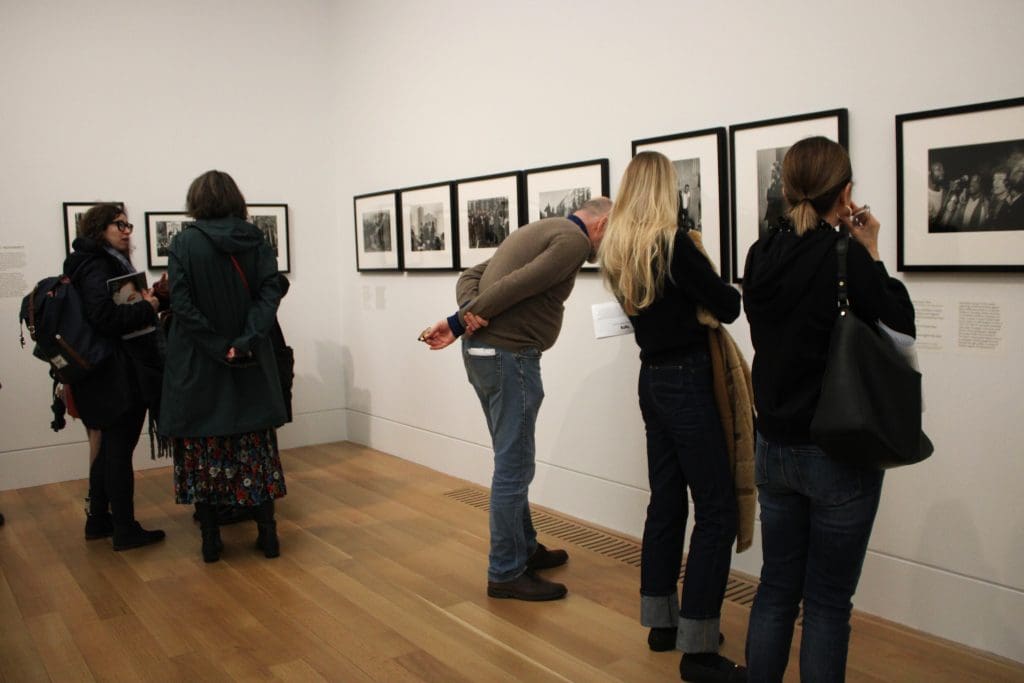
Tate Britain illustrates dramatically prime instances of that level of accomplishment, in The 80s: Photographing Britain, an extensive exhibition which pays tribute to the men and women who chronicled momentous events before and during the mentioned critical decade.
Individual photographers, collectives and dauntless publications were the indispensable sets of eyes that 35 to 45 years ago recorded street flashpoints and what were to be indelible shifts in culture. They used their lenses in quick-fire response to often startling outbursts of conflict and chaos and to the bubbling of sexual assertion and liberation.
Displaying more than 350 historic images, Tate Britain enshrines a compendium of protest and change. It documents anti-racist movements, big industrial disputes, the impact of a short-lived ban on councils “intentionally promoting homosexuality,” the effects of the AIDS pandemic, the class dynamics reflected in settings such as social security waiting rooms and of people living on the street while others led privileged lives.
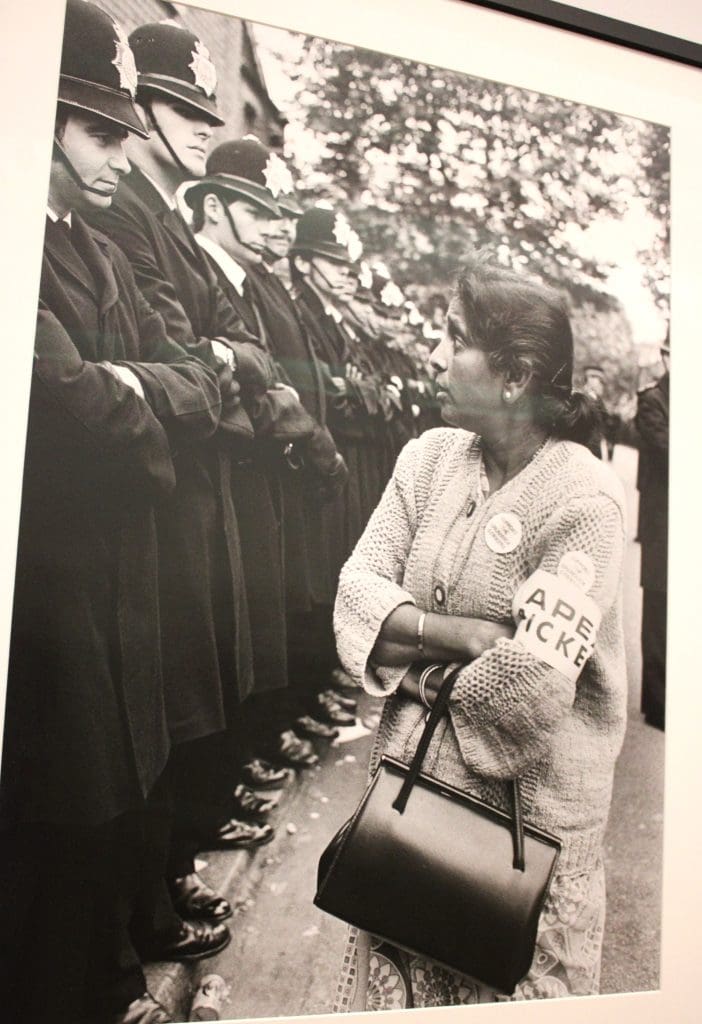
To understand the defining spirit of the 1980s, we are invited to dip back to the closing years of the previous decade. As we enter the exhibition, the tone is set. We are met by journalist David Mansell’s 1977 photograph of Jayaben Desai. Shewas one of the most courageous women of the time.The previousyear, she and fellow workers had walked out of a film processing laboratory in London, launching what was to become a draining two-year strike for the right to trade union representation. As she left her workstation, she declared: “What you are running here is not a factory, it is a zoo.” Predominantly women of South Asian origin, the workers’ identities permeated their cause, and their ardent fight for basic rights inspired solidarity marches of up to 20,000 people.
Mansell’s images, including one of Jayaben walking past a line of police, were used by left-wing media, aiming to counter coverage elsewhere which condescendingly referred to the women as “strikers in saris.” The dispute revealed the force that could be roused by collective protest, but pitted participants against resolute authorities, hardline policing and racist tropes.
A further curtain-raiser to the bitterness of the 1980s was the racially motivated stabbing to death in Whitechapel in 1978 of Altab Ali, a 24-year-old Bengali textile worker. The Bangladeshi and wider community took a stand against racial intolerance, and photographer Paul Trevor encapsulated their resistance in many images. He was there when 7,000 Bengalis marched from Brick Lane to Downing Street to deliver a petition calling for police protection and an end to racial violence. Other well-chosen examples of his art bring us to the gathering in St Mary’s Park (since renamed Altab Ali Park) preparing to march behind Altab Ali’s coffin; anti-racists blocking the route of a National Front demonstration, and a sit-down protest outside a police station.
The upsurge helped turn the tide against the far-right of the day and has long resonated in east London: where the Borough of Tower Hamlets in October 2015 decreed that henceforth every May 4th would be known as Altab Ali commemoration day. According to his website, having abandoned his job as an accountant, Paul Trevor “applied to picture-making the rapid hand-eye coordination he acquired as a teenage table tennis ace.” He has continued to work in the Brick Lane neighbourhood, where a multi-ethnic community survives hardship, racist tension and rapid social change.
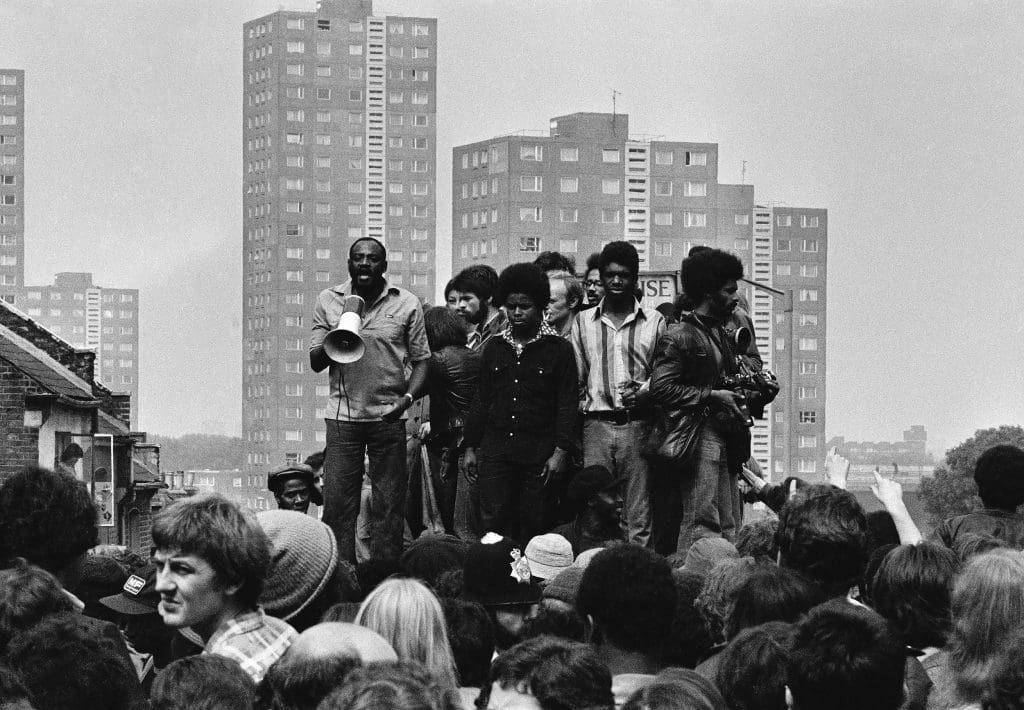
Another key photographer in this mode is Syd Shelton, whose picture captioned Darcus Howe addressing the anti-racist demonstrators, Lewisham, 13 August 1977 (Howe was a racial justice campaigner) was part of his series of the confrontation when 500 National Front members tried to march through an area with a large Black population in southeast London. They were forced to abandon the march by thousands of counterdemonstrators who defied a blockade by police equipped with batons and riot shields, in what became known as the Battle of Lewisham. Shelton’s photographs contrast the chaos of the streets with the resolve of the protesters. “Politics was one of the reasons that I became a photographer,” he is quoted as saying. “The idea of the objective photographer is nonsense.”
This kind of ferment continued as Conservative prime minister Margaret Thatcher sought to curb the unions and adopted policies of free markets, so-called traditional values and nationalism. Her agenda helped financial markets thrive but heightened class division and inequalities, which socially engaged photographers reacted against by uncovering dire conditions of everyday life that might otherwise have remained largely hidden.
The history of the miners’ strikes is brought to life through the photos of John Harris and others who challenged the government’s portrayal of those workers as aggressors and agitators.
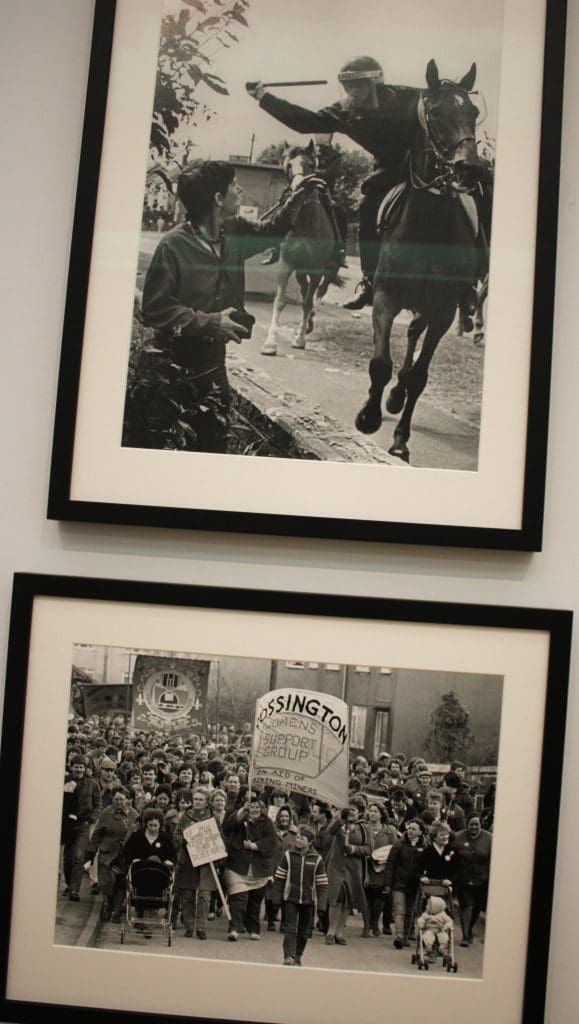
John Harris records the Battle of Orgreave which was the name given to clashes at a plant in Yorkshire which supplied the steel industry, and which was picketed by miners and others in 1984. In an iconic photograph, a mounted police officer appears poised with a baton to hit a woman over the head. In the photograph, the woman is holding a camera and cowering from the threat. Despite the photo’s supposed newsworthiness, it was published at the time in only one of 17 national newspapers surveyed, according to the Campaign for Press and Broadcasting Freedom. The woman in the photo said after the incident that she had been trying to attract the attention of police to call an ambulance for a man lying injured.
Another Harris photograph from the time is captioned Miners’ Wives Support group, Rossington pit village. This showed women volunteers who had a vital role in alleviating hardship. Harris (1939 –2023) was an American living in the UK who documented the year-long strike from the viewpoint of the workers and their communities.
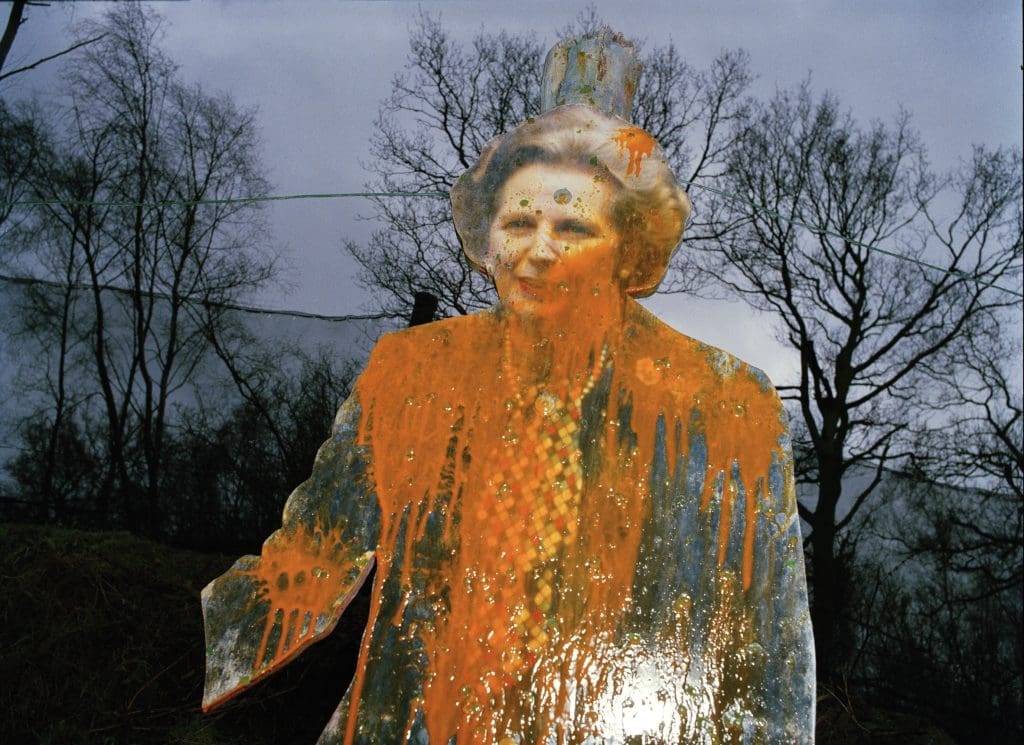
Photographer Anna Fox picked up on a different symbol to exemplify rage against Thatcherism. While working on her 1987-8 series Workstations, which looked at office culture in London, Anna came across the phenomenon of paintballing. This was a vogue for games encouraging team spirit among salespeople. Taken in the aftermath of the Falklands War, her image, Friendly Fire, target (Margaret Thatcher), is of a paint-drenched cardboard cutout of the prime minister which was used for target practice. It was a contrast between simulated conflict and the real experiences of forces personnel. Friendly Fire went on to be shown in exhibition at the Victoria & Albert Museum and elsewhere. Anna Fox is Professor of Photography at the University for the Creative Arts at Farnham and leads a research project called Fast Forward Women in Photography.
Unforgettable quotidian pictures of disappearing East End traditions come from the cameras of Markéta Luskačová and Don McCullin, while Chris Killip evidenced the lives of Northumberland ‘sea-coalers’ who made their living by collecting and selling coal washed up on beaches.
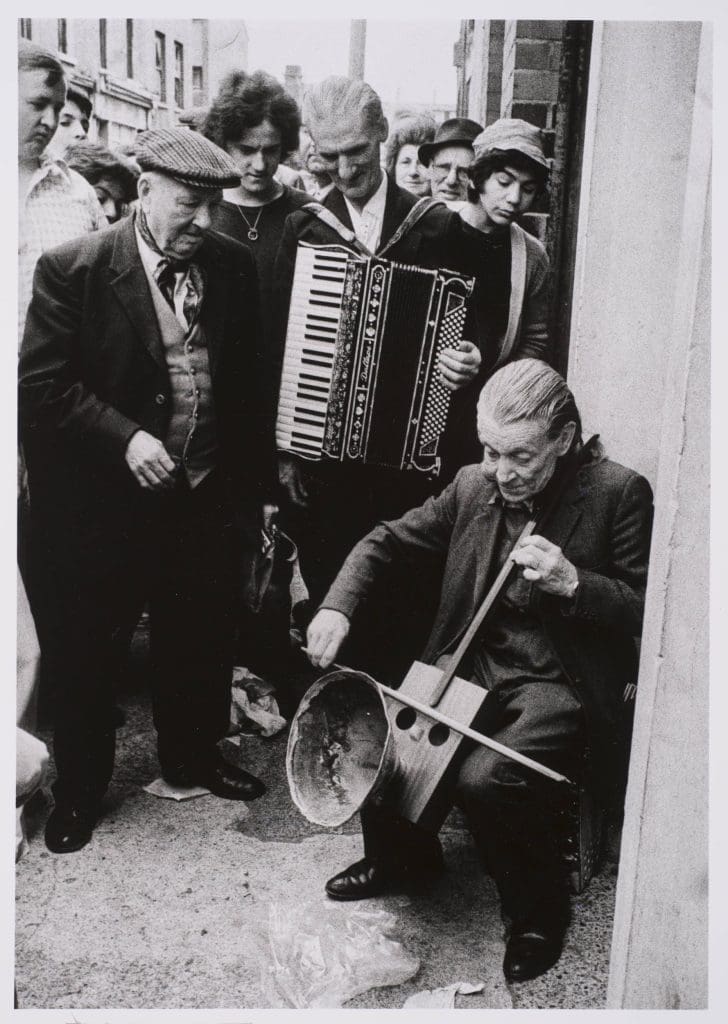
Marketa in 2016 self-published a collection of photographs of street musicians, under the title To Remember – London Street Musicians 1975-1990, with an introduction by the art critic and novelist John Berger. Prague-born Markéta started photographing the capital’s markets in 1974, noting the “Dickensian staging” of scenes In Portobello Road, Brixton and Spitalfields.
Best known as a war photographer, Don McCullin spent almost 20 years photographing marginalised people, many of them homeless, around Aldgate and Whitechapel, areas abutting the financial Square Mile district. Of his social documentary work, McCullin has said: “Many people send me letters in England saying: ‘I want to be a war photographer’, and I say, go out into the community you live in. There’s wars going on out there, you don’t have to go halfway around the world.’”
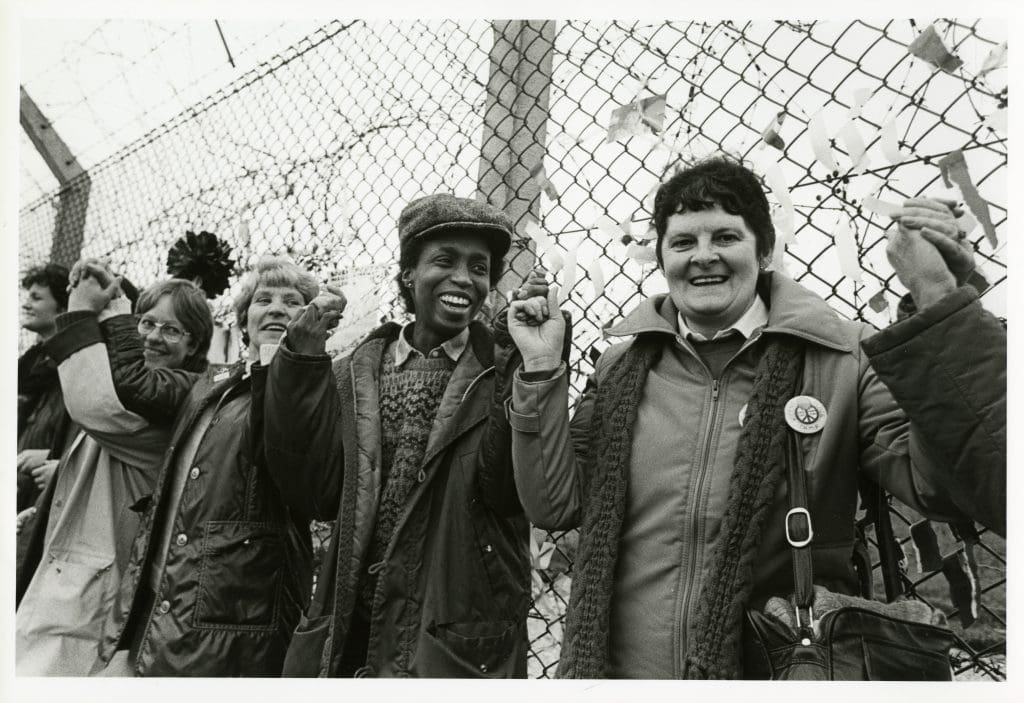
There are images by Format Photographers of Greenham Common Women’s Peace Camp, set up in 1981 in protest over the planned siting of nuclear missiles in the UK; and of projects responding to the conflict in Northern Ireland.
A wealth of photos depicts the Black arts movement, queer experience, and diasporas, thanks to innovative photography in journals such as Ten 8 and Cameraworks, and collectives such as Autograph ABP, Half Moon Photography Workshop, and Hackney Flashers. By the 1970s, most people expected to be photographed in colour, and this was a driving force for such ventures.
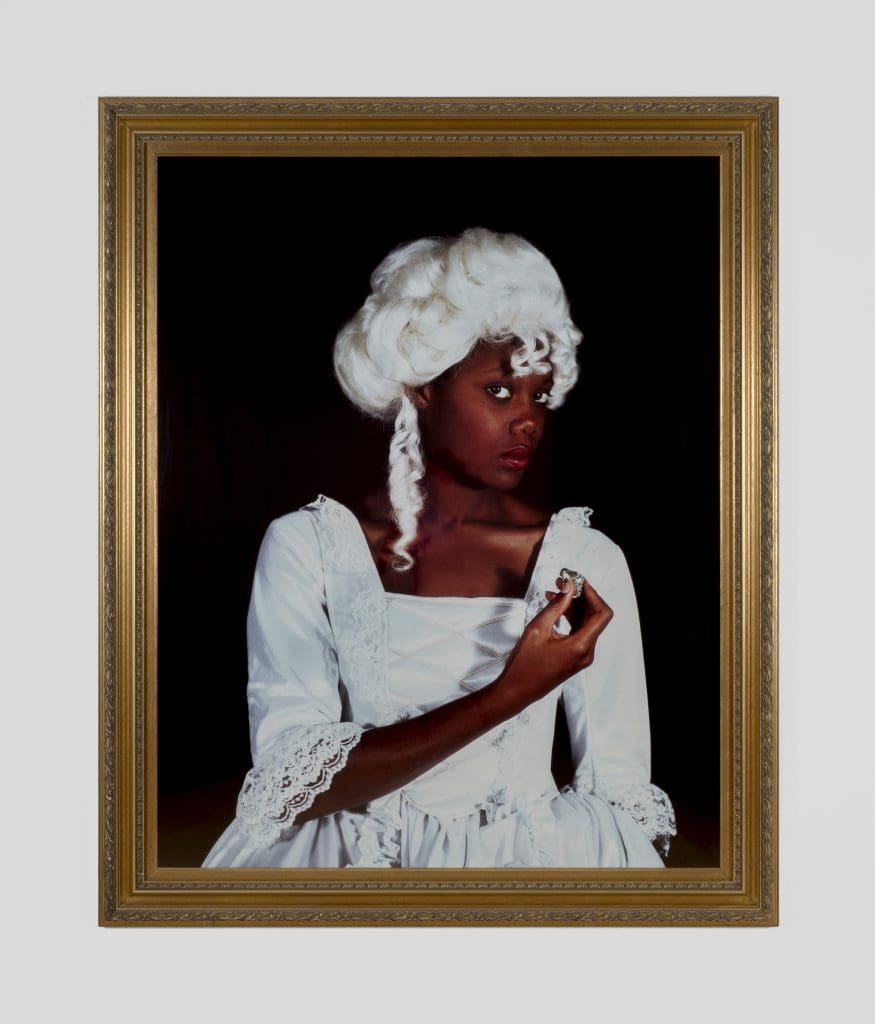
Several women employ portraiture of themselves and others to celebrate ideas of Black beauty and femininity. Maud Sulter (1960–2008) was one who sought to put Black women “back in the centre of the frame.” Of Scottish and Ghanaian heritage, the artist and poet curated exhibitions and published books and catalogues under her imprint, Urban Fox Press.
In her Zabat series, Maud reimagines the nine classical Greek muses as contemporary Black women. She invented the word Zabat which she said could mean “a sacred dance,” “an occasion of power” or “Black women’s rite of passage.” In one of the portraits, Terpsichore, Maud shows the visual and performance artist Delta Streete as the muse of dance. Delta’s costume was designed for her 1989 performance scrutinising portrayals of enslavement, wealth, Eurocentric beauty standards and the agency of women. Maud has Delta holding a piece of iron pyrite, also known as fool’s gold, to represent the transatlantic trade of enslaved Africans.
The 80s: Photographing Britain is curated by Yasufumi Nakamori, former senior curator of International Art (Photography) Tate Modern; Helen Little, curator of British Art at Tate Britain and Jasmine Chohan, assistant curator, Contemporary British Art at Tate Britain with additional curatorial support from Bilal Akkouche, assistant curator, International Art, Tate Modern; Sade Sarumi, curatorial assistant, Contemporary British Art at Tate Britain, and Bethany Husband, exhibitions assistant, Tate Britain.
Picture captions:
Friendly Fire, target (Margaret Thatcher), 1989. By Anna Fox. © Anna Fox.
Street musician, Cheshire St, London, 1977. By Marketa Luskačová. Collection of Eric and Louise Franck, London. © Markéta Luskačová.
Jayaben Desai,1977, printed 2024. By David Mansell. © David Mansell, reportdigital.co.uk. National Portrait Gallery, London.
The Battle of Orgreave coke works mass picket. Miners’ strike 1984, Sheffield South; and Miners’ Wives Support group, Rossington pit village. By John Harris. Report Digital.
Greenham Common, 14 December 1985. By Melanie Friend, Reprinted 2023. ©Melanie Friend, Format Photographers.
Darcus Howe addressing the anti-racist demonstrators, Lewisham, 13 August 1977. By Syd Shelton, printed 2020. Tate: presented by the artist 2021. © Syd Shelton.
Zabat, Terpsichore, 1989 from Zabat, 1989. By Maud Sulter. © Estate of Maud Sulter. All rights reserved, DACS/ Artimage 2023. Image courtesy of Street Level Photoworks, Glasgow.
The 80s: Photographing Britain is at Tate Britain until May 5, 2025.
