






By Natalia Lydia Papadantonaki
In 1774, the Treaty of Küçük Kaynarca allowed Greek ships to sail under the protection of the Russian flag. Within a generation, captains from a small volcanic island in the Aegean were carrying grain from the Black Sea to Western Europe, and returning home wealthy enough to change what their island looked like.
The mansions they built are still standing on Santorini. They are called kapetanospita, captain’s houses, and they are among the clearest architectural records of Greek shipping wealth anywhere in the Mediterranean.
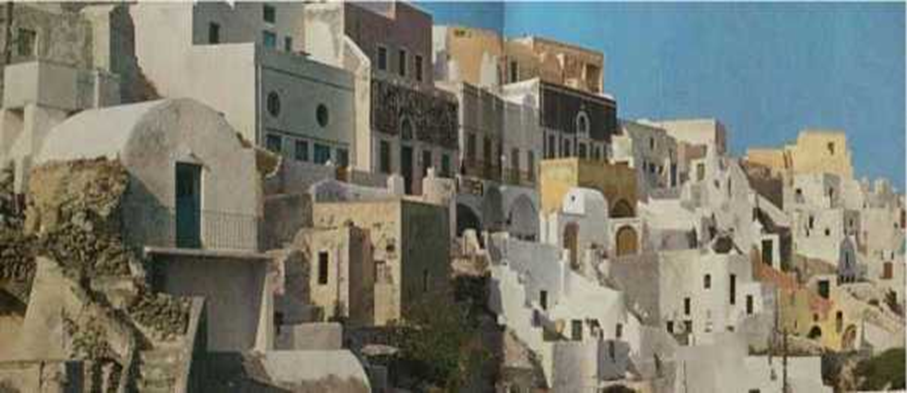
I first studied these houses years ago, as an engineering student in Thessaloniki, long before I had any interest in machine learning. They stayed with me. It was only while working on my MPhil at Cambridge, on systems that record how engineers actually make design decisions, that I understood what I had been looking at all along.
I went back to the material. The resulting paper was presented at the Classical Reception Seminar, University of Cambridge, and at the GBIA/AAE conference “Terroir: Ethical and Empathic Place for a Common Future”, held in the Robotics Laboratory of the Engineering & Innovation Centre, University of Lancashire. But what began as architectural history ended somewhere I did not expect: in the question of how engineering knowledge is stored, and why our industries keep losing it.
The island that exported its own ground
Before the captains, Santorini was poor. It has no springs, no rivers, and almost no trees. Its people did not build houses on the rock so much as dig them into it, because excavating soft volcanic pumice was cheaper than importing anything at all.
What the island had in abundance was volcanic ash. Mixed with lime, Theran earth produces a durable, waterproof hydraulic cement, and local builders used it for everything, above all the cisterns that made habitation possible.
The maritime industry noticed. Between 1847 and 1852, Santorini exported 30,400 tons of Theran earth to Austria alone, for harbour works at Trieste, Venice and Fiume. By 1875, annual production had reached some 28,000 tons. The material went into the Suez Canal (1859–69) and the Corinth Canal (1882–93), and extraction peaked at 80,169 tons in 1901 (Papastefanaki, 2018).
For half a century, the harbours of the industrialising Mediterranean were partly bound together by the ground of one small Greek island, shipped out by the same maritime economy that was building mansions back home.
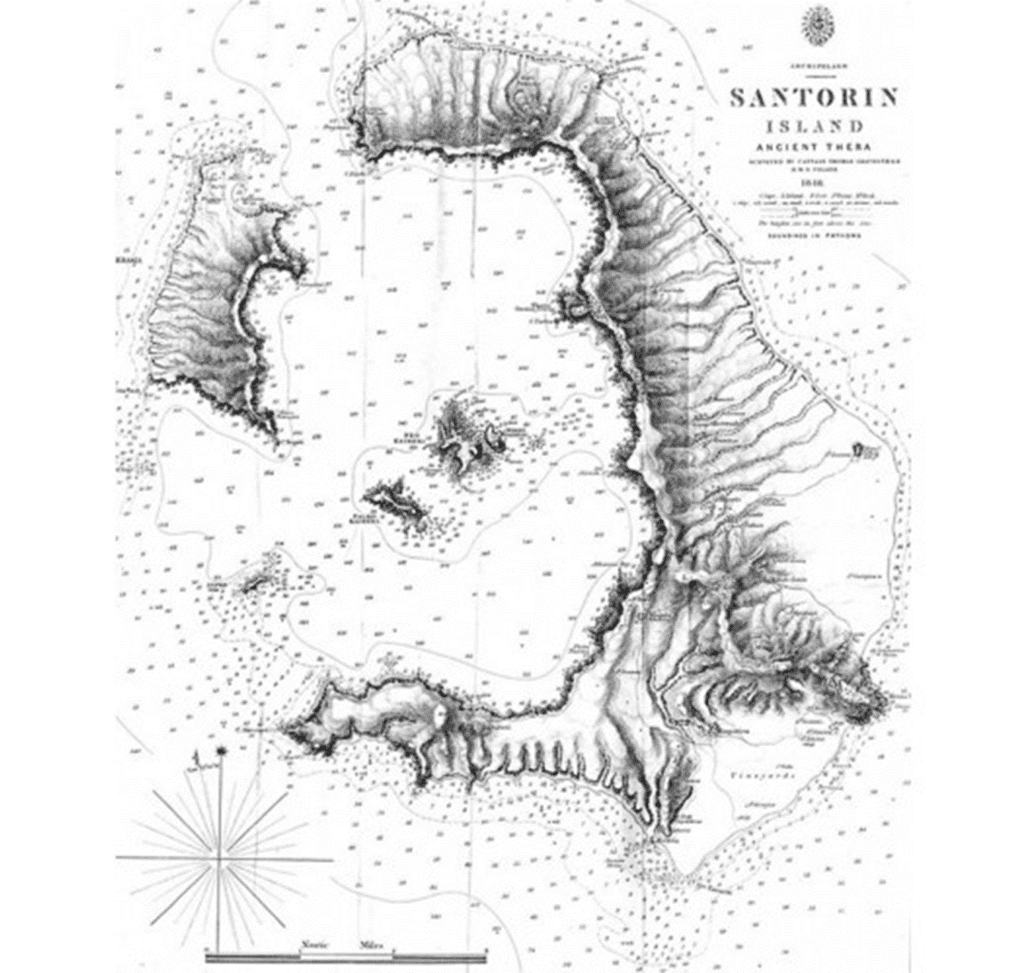
Fig. 2. Santorini surveyed by Captain Thomas Graves, HMS Volage, 1848: the same decade in which the island was shipping tens of thousands of tons of its own volcanic earth to Adriatic harbour works. Source: Graves (1850), Journal of the Royal Geographical Society, Vol. 20.
The knowledge nobody wrote down
Here is what drew me in. Those excavated houses hold a near-constant 22°C while the surface outside swings eleven degrees in a single summer day, from 21 at night to 32 at midday. That is not folklore: it was measured in 1983 (Fanchiotti et al., PLEA). It is also, remarkably, the same physics NASA measured in 2022 inside a lunar pit: about 17°C, constant, against roughly +127 to −173 on the surface (Horvath et al., 2022).
No drawings exist for these houses. No calculations, no specifications, because none were ever made. The builder read the slope by eye, knew the rock by hand, followed the sun by habit, and wasted nothing, out of poverty. Terrain, material, energy and waste: four constraints, solved simultaneously, at the moment of decision, with no tool beyond his hands.
And yet the knowledge was not lost. It was stored in the buildings themselves. Every house is a recorded decision. The typology is a database made of stone, filled over generations, each house correcting the one before it. Reading that reasoning back out of the stone took a researcher years of doctoral work.
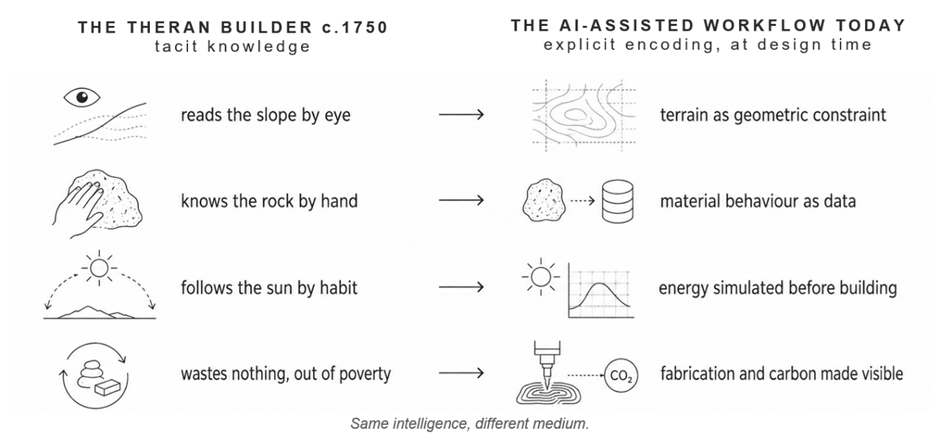
Fig. 3. The same four constraints, held in the body in 1750 and as data today. Source: author.
That is the shift the diagram above maps. On the left, tacit knowledge held in the body. On the right, the same four constraints as objects a machine can hold: terrain as geometric constraint, material behaviour as data, energy simulated before anything is built, fabrication and carbon made visible while the engineer is still choosing. Same intelligence. Different medium.
Shipping has the same problem
Which brings me to why this is not only a story about islands.
Every complex engineering industry now runs on the same pattern. Hundreds of design alternatives are generated and tested inside software. One gets built. And the reasoning behind that choice, why this option and not the other hundred, what was traded against what, which constraint gave way, disappears the moment the file closes.
The senior engineer who knows instinctively which option will be a nightmare in the yard carries knowledge that exists nowhere in the organisation’s systems. When they retire, it leaves with them. The company keeps the drawings, which record the answer, and loses the judgement, which was the question.
This is not a marginal loss. The decisions that determine a vessel’s cost and emissions across a thirty-year life are made in the earliest weeks of design, quickly, and largely without visible consequences: a geometry is chosen long before anyone can say precisely what it will cost to build, how long it will take, or what it will emit. Across construction more broadly, the sector accounts for roughly 37% of global CO₂ emissions and nearly half of all material extraction (UNEP and GlobalABC, 2026).
We now produce more engineering decisions than any generation in history, and we store almost none of them.
The Theran builder had an advantage we have lost. His errors were slow and expensive, so each house corrected the last, and the correction stayed visible in the settlement for the next builder to read. His storage medium was permanent. Ours is a file that closes.
Encoding it explicitly
That gap is where my current work sits. I am building software that predicts cost, build time, buildability and carbon impact inside the design workflow itself, rather than after a design has been finalised and exported to production. And it records not only which option an engineer selects, but which alternatives they reject.
Those rejections are the reasoning. Today they are discarded.
Captured systematically, they become structured records of how experienced engineers actually make trade-offs. The aim is not a black box that generates shapes. It is a system in which every recommendation stays connected to explicit human decisions, and the engineer remains in control: closer to an apprentice learning from a yard’s accumulated judgement than to an oracle.
The logic is alive
None of this is nostalgia. On Santorini itself, architects are building new excavated houses today, walled with stone taken from the excavation of their own plot. I worked on two such houses myself, under construction on Paros with the architect Anastasia Tzaka: dwellings embedded into the slope, planted roofs, walls in local stone, the section following the terrain rather than flattening it. At ETH Zurich, the Armadillo Vault stood as 399 unreinforced stones in pure compression, its geometry found from the forces themselves rather than imposed on the material: the craftsman’s vault, rewritten as computation. And when space agencies plan habitats for the Moon, the leading proposals are lava tubes and printing from local regolith, because importing material is impossible and radiation is lethal.
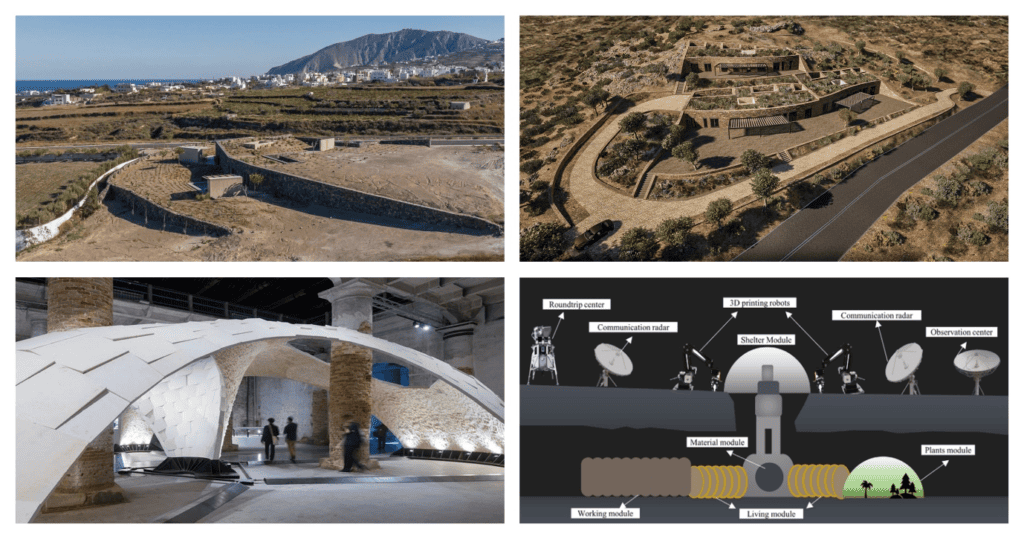
Fig. 4. Four scales of the same logic: new excavated housing on Santorini; two earth-sheltered residences under construction on Paros; the Armadillo Vault at ETH Zurich; a lunar lava-tube base concept. Sources: Kapsimalis Architects; design by Anastasia Tzaka, architect, render by the author; Block Research Group, ETH Zurich; Feng et al. (2024).
When constraints get hard enough, everyone converges on the same answer: work with what the place gives you.
There is a final irony. In Santorini’s cave hotels, insulation is now applied to excavated walls and air conditioning installed for visitors. The moment insulation sits between the room and the rock, the thermal mass stops working. The shape is kept. The intelligence is switched off.
The captains who built those houses made their fortunes by reading conditions nobody had written down: weather, cargo, credit, risk. Their successors face the same task with far more data and far less memory.
Which leaves the question I keep returning to: what could we build in ten years if we stopped discarding engineering judgement?
Sources and further reading: Papastefanaki, L. (2018), ‘From Santorini to Trieste and Suez’, Mediterranean Historical Review; Fanchiotti, A. et al. (1983), ‘The earth-sheltered dwellings of Santorini, Greece’, PLEA Conference; Horvath, T. et al. (2022), ‘Thermal and illumination environments of lunar pits and caves’, Geophysical Research Letters; Feng, Y. et al. (2024), ‘A comprehensive review of lunar lava tube base construction’, International Journal of Mining Science and Technology; UNEP and GlobalABC (2026), Global Status Report for Buildings and Construction 2025-2026.
——-
*Natalia Lydia Papadantonaki, MPhil Researcher and incoming PhD researcher, University of Cambridge | Computational Engineering, AI & Robotics
