


Dear Sir/Madam,
The French Border Police is conducting an investigation of the yachting industry, especially on foreign nationals entering into France with the view of taking training courses or seeking jobs on yachts.
They are also investigating crew placement agencies, especially those based in non-Schengen countries and having offices in France.
The PYA understands that the investigation was triggered by an apparent increased number of South African nationals entering France since April 2026, several of whom had declared to the immigration officers that they were coming to the South of France (SoF) to look for work on yachts.
As the CEO of the PYA, I met the investigators several times and the PYA was asked to remind the yachting community of the rules and regulations regarding the above*.
The article below consists of two parts:
A. Individual and visa matters for taking courses and looking for work on yachts in France and in Schengen countries (Italy, Spain, etc.)
B. Crew agencies operating in France.
A. VISA MATTERS
Yachting is an appealing industry and many individuals start their career in yachting in the SoF, Italy or Spain. However, understanding how the Schengen Borders Code applies to your passport is essential to avoid being detained, fined, or banned from Europe. For South African yachting professionals and other international crew members heading to the Mediterranean, the rules regarding Type C (Short-Stay) Visas are precise, especially concerning training and looking for work.
Here is a comprehensive breakdown of what you can and cannot legally do in France, Italy and in the wider Schengen Area, categorised by nationality status.
1: Schengen & EU/EEA Nationals
This category includes citizens of the 29 Schengen Member States, as well as European Union (EU) and European Economic Area (EEA) countries (e.g., France, Italy, Germany, Spain).
1.1. Training or Taking Courses
• What is allowed: Complete freedom. Schengen nationals can enrol in any maritime or yachting training courses (such as STCW and any modules) in France or in any Schengen country without any visa requirements, time restrictions (beyond standard course enrolment), or administrative hurdles.
1.2. Looking for Work (Dockwalking / Daywork)
• What is allowed: Unlimited access. They have the absolute right to look for work, participate in interviews, standard “dockwalking,” and accept daywork or permanent contracts on any flag vessel. They do not require a work permit.
2: Non-Schengen Nationals NOT Requiring a Short-Stay Visa
This group consists of “visa-exempt” third-country nationals. It includes passports from countries like the United Kingdom, Australia, New Zealand, the United States, Canada, and Brazil. These individuals can enter the Schengen Area for tourism or business for up to 90 days within any 180-day period without applying for a visa ahead of time.
2.1. Training or Taking Courses
• What is allowed: They can take short-term training courses during their 90-day visa-free stay. Under the Schengen rules, short-term study or professional training that fits entirely within the 90-day limit does not require a separate study visa.
2.2. Looking for Work (Dockwalking / Daywork)
• What is NOT allowed: They cannot legally look for work or engage in paid employment (including daywork) on the territory of France or in Schengen countries while on a visa exempt short stay.
• The Reality: While many visa-exempt crew members physically “dockwalk” under the guise of tourism, it is technically a violation of Schengen rules to seek local employment or perform paid labour on a standard visa-free entry.
To legally work, passport holders from the UK, AUS, NZ, USA, Canada, etc., must secure a formal job offer/employment contract before entering France or any Schengen country, allowing the yacht’s management to facilitate either an approved Seaman’s Book entry, a specific maritime contract, or a National Type D Long-Stay Visa from the French Consulate in their countries.
3: Non-Schengen Nationals Requiring a Visa (including South Africa)
This category includes citizens of countries that do not have a visa-waiver agreement with the EU. South Africa is strictly on this list. Other notable yachting nations on this list include Ukraine (non-biometric passports), Russia, Philippines, India, and Fiji.
To enter France for a short stay, these nationals must apply for a Type C Schengen Visa prior to departure.
3.1. Training or Taking Courses
• What is allowed: You can take short training courses on a Type C Schengen Visa, provided you specify this as the purpose of your travel during your application.
• Correction on “Study Visas”: There is a common misconception that you must request a Long-Stay Student Visa (Type D) for any training. Under French and Schengen law, if your maritime course lasts less than 90 days, you do not need a long-stay study visa. Instead, you apply for a standard Short-Stay Schengen Visa (Type C) for professional training purposes, backed by an official letter of acceptance/invitation from the maritime school (e.g., a training academy in Antibes).
3.2. Looking for Work (Dockwalking / Daywork)
• What is NOT allowed: It is strictly illegal to seek employment, dockwalk, or undertake daywork on a standard Type C Schengen Visa.
• The Law: A Type C visa is heavily monitored. Applying for a tourist or training visa with the hidden intent of looking for a job constitutes visa fraud. Furthermore, French authorities do not permit non-Schengen nationals to convert a Type C visa into a work permit while inside France.
• How South Africans legally join yachts: To legally work, a South African national must secure a formal job offer/employment contract before entering France or any Schengen country, allowing the yacht’s management to facilitate either an approved Seaman’s Book entry, a specific maritime contract, or a National Type D Long-Stay Visa from the French Consulate in South Africa.
Summary Matrix for Yacht Crew
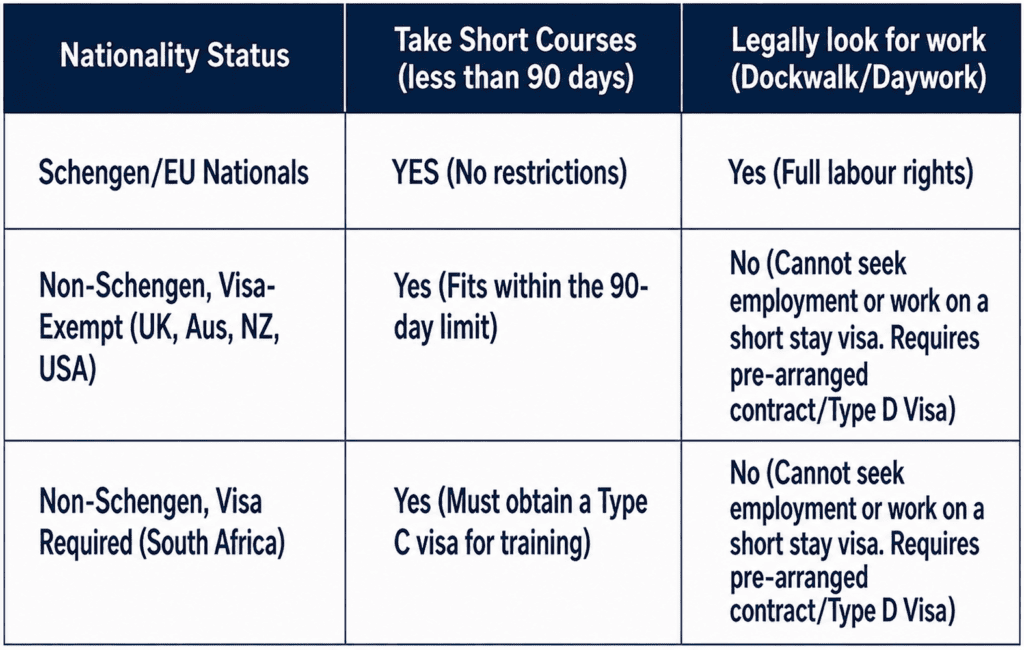
A Note for South African Crew: Always ensure your paperwork matches your exact intent. If you are entering France to complete your STCW or other training modules, apply for a Type C Visa for training purposes and ensure you have a return ticket booked. Engaging in dockwalking on this visa carries a high risk of deportation and a Schengen-wide travel ban.
B. CREW PLACEMENT AGENCIES
In France, yacht crew placement and recruitment agencies are strictly regulated to protect seafarers and ensure alignment with both French labour laws and international maritime conventions. In French legal terminology, these agencies are known as SPRPGM (Services Privés de Recrutement et de Placement des Gens de Mer — Private Seafarer Recruitment and Placement Services).
If an agency operates on French territory areas or places crew onto French-flagged vessels, they must be registered with the SPRPGM (link below) and adhere to a strict regulatory framework.
https://www.mer.gouv.fr/services-prives-de-recrutement-et-de-placement-de-gens de-mer
1. Compliance with the Maritime Labour Convention (MLC 2006)
France is a strict signatory to the MLC 2006. Under these international guidelines, any crew placement agency operating in France must ensure:
• No Fees to Crew: It is strictly illegal for a recruitment agency to charge seafarers any direct or indirect fees for finding them a job, managing their CV, or securing a placement. All fees must be billed exclusively to the shipowner or yacht management company.
• Blacklisting is Prohibited: Agencies cannot use mechanisms, blacklists, or under-the-table agreements to prevent qualified seafarers from gaining employment.
2. Mandatory Registration with the French State
Any recruitment agency established in France must be officially registered on a national register managed by the French maritime authorities (the RIF / Registre International Français registry office).
• Since 2022, registrations and renewals must be processed electronically through the government platform (démarches-simplifiées.fr).
• Yachts based in France: if a crew agency located outside of France or the EU is used, the shipowner is legally obligated to declare this to the French maritime registry and verify that the foreign agency strictly complies with MLC standards.
3. Financial Security & Liability Insurance
To protect the crew from financial exploitation or agency bankruptcy, French law requires all registered SPRPGMs to hold a specific Professional Civil Liability Insurance (assurance responsabilité civile professionnelle).
• This insurance covers potential financial losses suffered by a seafarer resulting from a failure of the agency to meet its obligations.
• The insurance must guarantee that if the agency acts as the employer (a “maritime labour company” that payrolls the crew), funds are secured for wages, employer social security contributions, and emergency repatriation costs.
4. Screening and Verification Obligations
A yacht crew agency in France cannot simply pass along a CV; they have strict legal “gatekeeper” responsibilities before placing a candidate on a vessel:
• Qualifications Check: The agency must verify that the crew member holds valid professional maritime qualifications (STCW certificates, MCA licences, CoCs, etc.) appropriate for the position.
• Medical Fitness: They must verify that the crew member has a valid, up-to-date maritime medical certificate (ENG1 or equivalent) certifying they are fit for duty.
• Contractual Review: The agency must ensure that the seafarer is given sufficient time to read, understand, and seek advice on their Seafarer Employment Agreement (SEA) before signing and embarking.
5. Strict Monitoring After Placement
Under the French Transport Code (Article R.5546-2-12), crew agencies have a mandatory follow-up rule:
• No later than 72 hours after a crew member arrives onboard the yacht, the agency must request formal confirmation from the seafarer that they have successfully embarked and that the actual position/working conditions on board correspond to what was promised in the contract.
6. The French Social Security Net (ENIM Integration)
If a crew agency acts as a “maritime labour provider” (employing the crew directly and leasing them to the yacht) and the crew members are considered French residents (spending more than 6 months/183 days a year in France or French territorial waters), the agency must ensure compliance with French social security rules.
• The crew must be affiliated either with ENIM (the French seafarers’ social security system) or a private insurance scheme formally vetted as providing “at least equivalent” coverage (covering health, accidents, disability, and retirement).
• Exception: Crew onboard foreign-flagged yachts undergoing extended refits or winter storage in French shipyards are generally exempt from this social security requirement for the duration of the ship’s immobilisation.
CONCLUSION
The Schengen Code is not easy to understand, and, as always, French regulations are complex and sometimes “strange”. In our conversations with the Police authorities, they told the PYA that the police feel that the irregularities (wrong visas, etc.) were largely due to individuals not knowing the regulations. This is the reason why they encouraged the PYA to disseminate the above information widely in our yachting community.
We understand that the French Ministry of Foreign Affairs will follow up on the police investigation and will scrutinise all visa applications. Other French administrations will also be taking an interest in activities related to yachting, including the activities of crew agencies.
As always, do not hesitate to reach out to the PYA should you have any questions regarding the above.
Christophe Bourillon
CEO, PYA
* The PYA is grateful to the officers of the Police aux Frontières’s office in Cannes (France) for their assistance in researching this article.