






The recently concluded intersessional meeting shows, as also evident at MEPC 84, that there is no significant support to diverge from adopting an NZF-based solution. However key details of exactly how such a solution will be finalised remain unresolved and could still weaken the NZF ‘as agreed in principle’ in 2025.
London 4th September 2026 – The IMO’s 22nd Intersessional Working Group on GHG emissions has concluded with significant majority of member states (two thirds of those who took the floor) supporting a centralised system for collecting revenues, operationalized through a GHG price (RU price), and disbursing it for rewards for early adopters and supporting a just and equitable transition. The group of member states focused on a technical-only solution and abandonment of GHG pricing, remained small and consistently composed of strongly fossil fuel aligned governments.
Just as at MEPC 84, the political dynamics observed at MEPC.ES2 did not occur in this meeting. The discussions were more representative of the ISWG-GHG 19 and MEPC 83 negotiating dynamics, but this does not rule out the potential for the dynamics that occurred at MEPC.ES2 returning in future meetings. That said, there was reassuring evidence from the week that reduces that risk, including in the contrast between strong public (press) positions taken against the IMO’s NZF, and the substance of how delegations negotiated in the meeting.
Dr Tristan Smith, Professor of Energy and Transport at UCL Shipping and Oceans Research Group said: “whilst there are many positives to take away – there is clear potential for a return to a strong policy solution and decision making this December, there remains high uncertainty in the extent that both industry’s transition and low-income countries’ transitions will be supported. There remains high risk that in the effort to find a creative way forwards, the equilibrium between these two aspects, that enabled the NZF in the first place, is lost to the detriment of the outcome overall.”
In addition to the discussion on centralised system for revenue collection and disbursement, the meeting discussed a number of other items as guided by the chair, discussed in detail with member state positions in the readout. Some of these included:
- GFI (Global Fuel Intensity) reduction pathway: GFI is likely to be softened initially (around 2030), but then steeper in the period to 2040.
- ZNZ rewards: ZNZ reward still broadly supported and a priority to many member states, but the broad support for a multiplier, despite it being taken off the table at the last meeting, could yet lead this to be incorporated to provide incentivisation.
- Compliance approaches:
- Most interventions confirmed support for the compliance mechanisms as setup in NZF ‘as is’. The strongest support was for the two least controversial options common to all proposals: reducing GHG intensity and pooling/transfer of SU.
- Direct contributions: Japan’s proposal to replace GHG pricing with shipowner-directed contributions was robustly rejected, particularly by the member states that would need to ‘swing’ to support it for this to start to build momentum.
- SU (Surplus Units) trading: Majority of member states opposed the inclusion of energy efficiency SU credits and the concept of printing SU’s to manage an SU price shock, citing various reasons, primarily a concern that this would destabilise the SU market and undermine investment predictability.
- Netting: China’s proposal to balance of RU and reward payments that could be netted to form a single transaction received broad support. However, the details of the concept will now need to be set out in guidelines and there remain a number of issues regarding this approach, as raised by several delegations.
Dr Annika Frosch, Research Fellow at UCL Shipping and Oceans Research Group said: “Despite the intense debate over its design, a clear majority of delegations still regard a Fund, Facility, or similar financial structure as essential to implementing the 2023 IMO Strategy. Their message is clear: without predictable financing, there can be no credible Just and Equitable Transition.”
Given all the above points, NZF ‘as is’ still remains the obvious answer (and most supported way forwards), but the process to realise that conclusion formally makes this a difficult political solution. The process from here could therefore be as much about producing what appears to be a new package, but one that broadly ends up with similar outcomes in relation to objectives.
But perhaps the most delicate part of a ‘deal’ and one that remains unclear, is the extent that a deal will support JET – at least as well as NZF ‘as is’. If support to JET does reduce, then many low-income countries currently willing to see clear mitigation stringency and obligation, could change position in support of weaker more ambiguous details, that then adds risk and cost to the transition’s investment. For now, those making investment decisions and strategy, the conclusions can be broadly stated as:
- Do not try to use this meeting as a signal you can finalise decisions around, several key aspects of the negotiation are wide-open and didn’t narrow this week, there could well be twists to come as different concepts are merged together to find common ground. The devil is still in the detail.
- Do still expect a clarification/agreement at MEPC 85 later this year – the spirit of cooperation was good, and the risk of a disruption equivalent to MEPC.ES2 looks lower. The chair summarised saying he was confident that the group would deliver a conclusion to its work at MEPC 85.
- The Revised Strategy, net-zero 2050 remain reiterated touchstones by all, perhaps with different levels of sincerity/disingenuity, but will set the frame – ultimately shipping will have to decarbonise to zero in a very short time-scale. The core question is just how soft the start to the transition is, and what regulatory tools/support businesses will have to manage the risks that the detail creates of being strongly incentivised to short-term dead-ends (like LNG) before the strong regulatory incentive to move to ZNZ occurs.
Alasdair Wishart, Institute of Marine Engineering, Science and Technology (IMarEST) Technical and Policy Director said: “The maritime energy transition will be shaped by the decisions the IMO Member States make over the coming months. As the professional body representing the technical voice of maritime professionals worldwide, the IMarEST is proud to support Member States in navigating these complex choices. UCL’s modelling, building on DNV’s comprehensive impact assessment, provides a valuable framework for comparing options and understanding their real-world implications. Evidence-led analysis is essential to developing an effective Net Zero Framework and supporting delivery of the IMO’s 2023 GHG Strategy through a just and equitable transition.”
The ISWG-GHG 22 meeting was not a meeting that progressed a draft MARPOL amendment text (often such meetings so close to a decision point would work through the detailed text and try and merge/streamline into a cleaner text). But it is clear such detailed drafting of a clean and consolidated/convergence text is needed to reach any agreement at MEPC 85. This is therefore going to evolve informally and will need to then be quickly resolved within the debates at ISWG-GHG 23 and MEPC 85, next meetings in November/December.
Link to readout: https://www.shippingandoceans.com/post/imo-makes-steady-progress-on-the-net-zero-framework-majority-back-ghg-pricing-centralised-fund
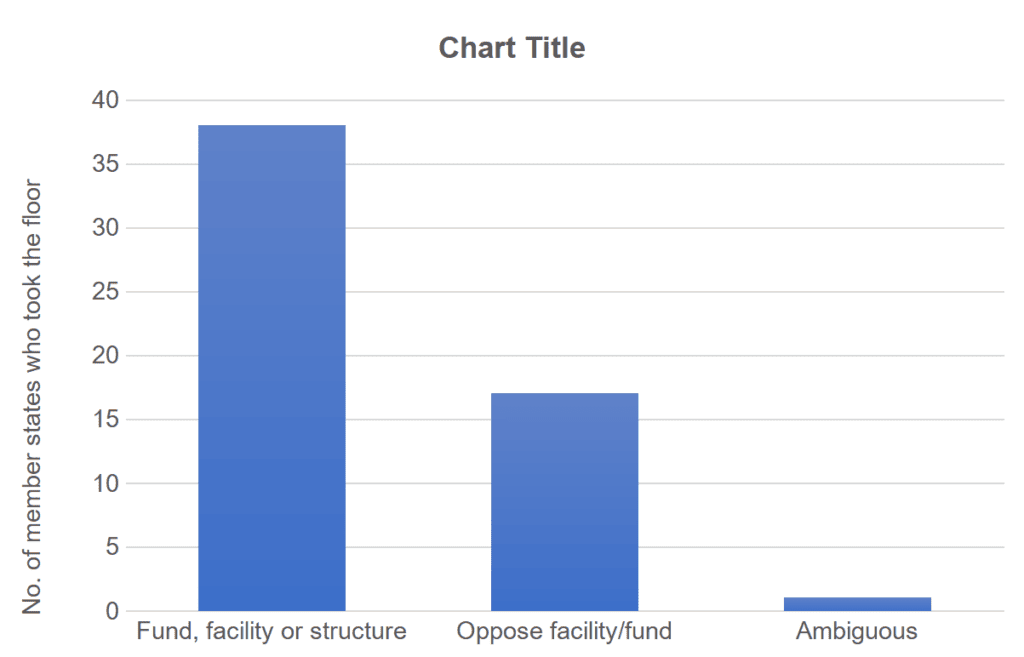
Positions taken on whether or not to include a fund/facility/structure for distribution of revenues
About UCL Shipping and Oceans Research Group
The UCL Energy Institute hosts a world leading research group which aims to accelerate the transition to an equitable and sustainable energy and trade system within the context of the ocean. The research group’s multi-disciplinary work on the shipping and ocean system leverages advanced data analytics, cutting-edge modelling, and rigorous research methods, providing crucial insights for decision-makers in both policy and industry. The group focuses on three core areas: analysing big data to understand drivers of historical emissions and wider environmental impacts, developing models and frameworks to explore energy and trade transition to a zero emissions future, and conducting social science research to examine the policy and commercial structures that enable the decarbonisation of the shipping sector. For more information visit www.shippingandoceans.com
