





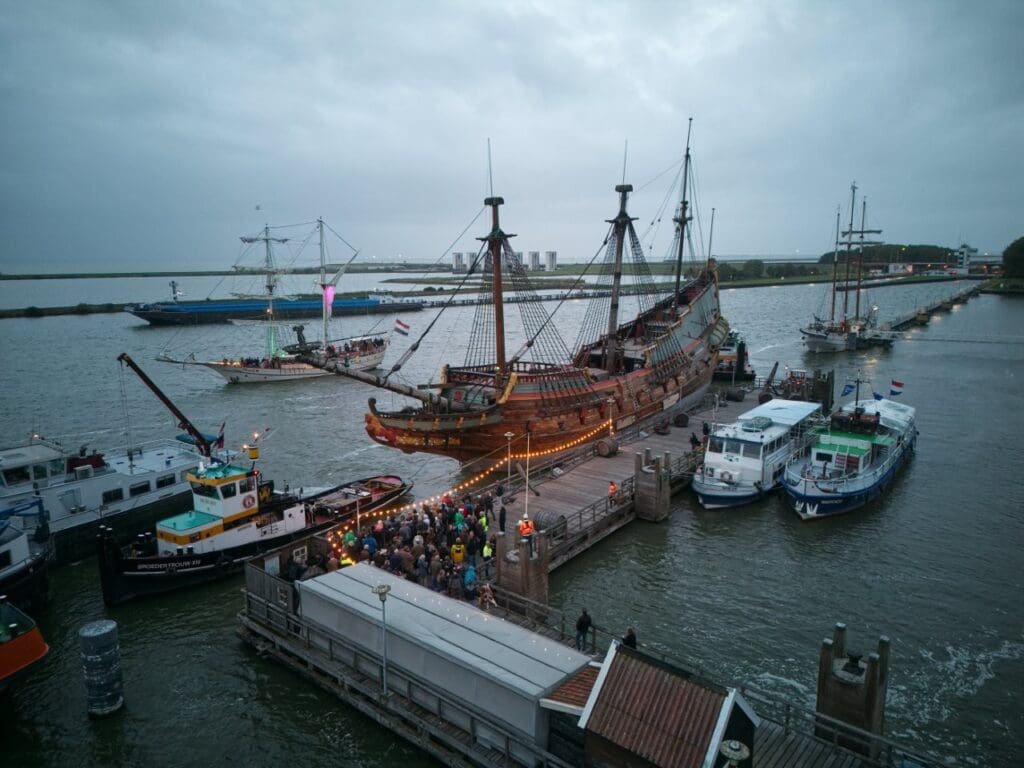
The wooden hull will be lowered into a purpose-built steel cradle in dry dock 4; the same dock she was launched from in 1995
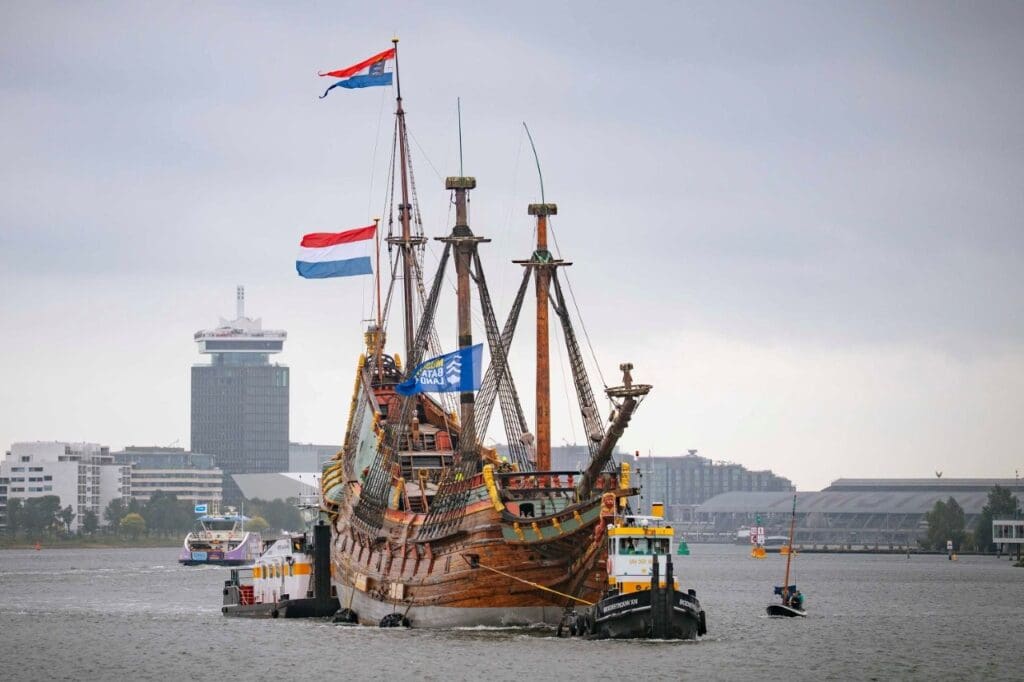
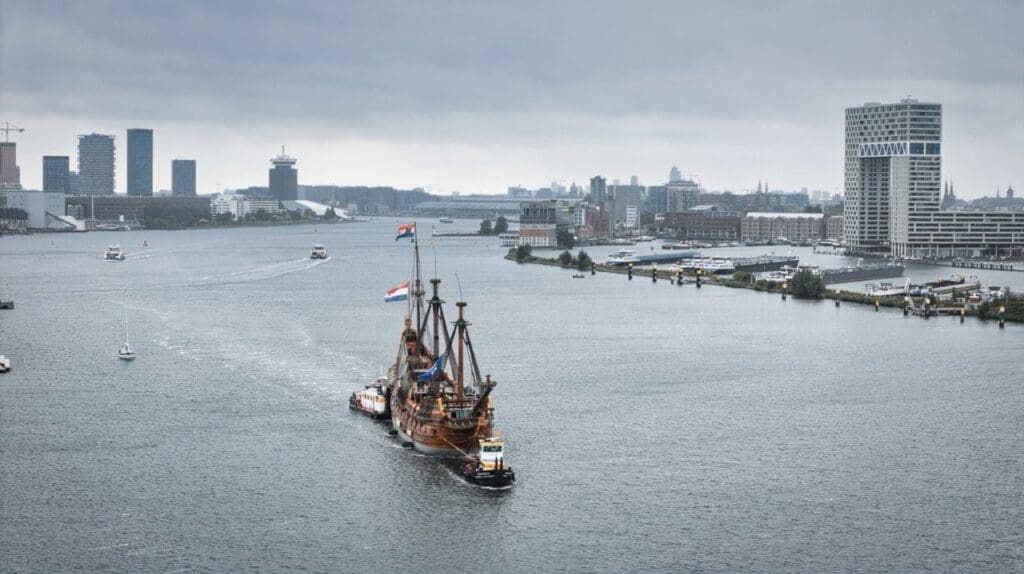
The Batavia, the full-scale reconstruction of the 1628 Dutch East India Company ‘retourschip’, arrived at Damen Shiprepair Amsterdam on Saturday 19 September after a six-hour tow. The 56.6-metre wooden ship made the passage afloat on her own hull, masts standing, under tow by two tugs of Koninklijke Van der Wees. At the Damen yard she will be lowered onto a 100+ tonne steel and wood cradle in dry dock 4, the first step in moving her permanently ashore at Museum Batavialand in nearby Lelystad.
A hull that cannot be replaced
The Batavia was towed rather than carried. Placing her on a pontoon for the passage would have introduced loads the hull is not built to carry, so she stayed in the water, with her full rig in place and a 30.5-metre air draught. The timber has been afloat for 31 years. In the 17th century these vessels could last between 15 to max. 25 years. Hence, the vessel must be handled with the utmost care. The hull is in fragile condition, which set strict weather limits on the operation: the ship could not be allowed to work or move excessively in a seaway. The guns and a large part of the ballast were removed in advance, and temporary steel shoring was fitted in the hold and on the decks to absorb the loads that arise once the supporting buoyancy of the water falls away.
Centimetre work in dry dock 4
The dry-docking follows a sequence engineered over the past 14 months. Crane mats are laid on a Van der Wees pontoon to distribute load, support pots are set on the mats, and the steel cradle – 39.7 metres long, 15.5 metres wide, 87.2 tonnes of steel and 14 tonnes of wood – is craned onto the pots from the quay. The pontoon is then ballasted down and submerged in dry dock 4, for which Damen Shiprepair designed a dedicated dock bed. Two small tugs manoeuvre the Batavia over the cradle, after which the dock is pumped down and the ship settles into her supports under controlled conditions.
Once dry, the remaining voids between hull and cradle are packed with timber, a task expected to take two days while the structure beds in. The pontoon is then deballasted, and the dockreflooded until it lifts the pontoon with the ship clear, and the Batavia is towed to the quay, where the remaining ballast is removed. She will leave Amsterdam at a hull weight of almost 650 tonnes.
Paul van de Craats, Commercial Manager at Damen Shiprepair Amsterdam: “I followed the construction of this ship during my own training years, under Mr Vos, and what struck me was that they built her authentically and taught young people the carpentry trade while doing it. We work the same way; we train our own people on the job to master ship repair. That is why this project means something here. Dutch maritime history came into dock 4 in 1995 and it is back now. In addition, the cradle carrying her, designed by Q3 Heavy Lift, was built by our sister company Niron Staal. We are incredibly proud to be part of this project coming full-circle.”
Where a wooden ship is strong
The load model behind the cradle took ten months to develop. FaraFlash established the ship’s dimensions and weight and produced the basic cradle design; Q3 Heavy Lift carried out the detailed engineering, including the support and jacking arrangement. Kuperus & Gardenier verified dimensions and weight and advised on the hull’s vulnerable areas – Jan Kuperus and Rienk Gardenier trained on the Batavia as apprentices under shipwright Willem Vos during her construction. Niron Staal fabricated the cradle. Trans Global Projects is responsible for project management, risk analysis, permitting and public safety.
Ard Suvaal, Project Manager at Trans Global Projects, says: “When we were contracted to arrange this project for Museum Batavialand, we wasted no time in bringing in the specialised subcontractors needed for this job. That is where our strength sits: making sure every link in the chain is present and delivered on time, including permits, the risk analysis, the interfaces between parties and more. We normally move transformers and offshore structures for a living. Nobody ever sees that work, except for the people who are inconvenienced by road closures and such. This project is different: it’s highly public and has enormous historical value. Both from a professional engineering point of view and from a personal perspective, it’s very special to suddenly manage the logistics of a reconstruction of a 17th-century East India vessel. And I am especially proud of the smooth collaboration between all partners; that is what brings success.”
The Batavia is scheduled to return to Lelystad on the pontoon on 1 October and to be moved ashore at Museum Batavialand on 2 October. The entire operation is part of Museum Batavialand’s large-scale redevelopment.
