





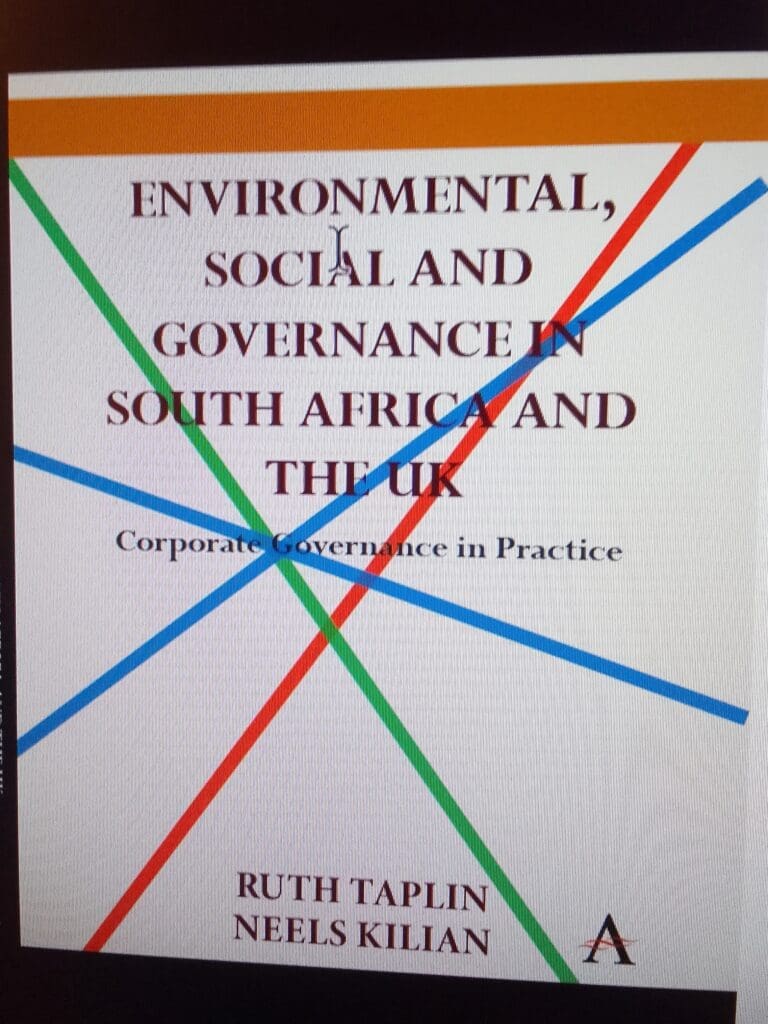
ESG in South Africa and the UK: Corporate Governance in Practice, by Ruth Taplin and Neels Kilian
By James Brewer
ESG: what is it, and what has it ever done for business and society?
The acronym stands for environmental, social and governance, supporting criteria for measuring the environmental and social impact of commercial organisations. The term, which brought together many long-standing and fundamental concepts, originated in 2004 from the United Nations Global Compact, since when its architecture – if not its prominence in the cultural imagination – has evolved considerably.
Environmental, Social and Governance in South Africa and the UK: Corporate Governance in Practice, just published by eminent academics in the speciality Ruth Taplin and Neels Kilian, runs the rule over the benefits, progress and problems of attempts to align corporate behaviour and investor choices with ever-evolving corporate reporting requirements.
There is no denying the importance of a subject which often does not get the attention it deserves. In this book, the story begins in Johannesburg and the City of London.

Despite its primary focus on South Africa and the UK, the 270-page survey allows for a close reading of valuable insights and lessons for those operating in many other jurisdictions in business, government, economics and the law.
The wealth of detailed analysis it presents might suggest that the pressures for businesses to improve are not so much regulatory as of fundamental necessity for enterprises to adopt plans and measures that embed sustainability – for their own sake and for that of wider society. It is argued that commitments to improve standards are inextricably linked to long-term profitability, not least because with demands for greater transparency, the conduct of businesses is, or should be, tipped into the public gaze.
In this domain, there is no ignoring potentially influential geopolitical swings. The book has appeared within days of electoral setbacks for the African National Congress in South Africa and for upsets on the US political scene, not to mention the summer Cabinet shake-up in the UK which has softened its attitude towards fossil fuels. The book is thus a highly informed guide as to what to watch out for in the ESG landscape in the coming year or two.
From the first page, the treatise in its dispassionate manner gets into the heart of ESG and good corporate governance in relation to the huge resources of pension funds in the City of London, and in South Africa.
This is seen alongside ESG’s wider career of adoption. Many companies are attracting pension investment based on the model’s principles and successfully integrating it into their ecosystems.
The need to become both responsible and accountable is becoming an essential aspect of consumer-facing business. Independent auditing consultants are being called upon to assist companies certify sustainable practices, offering an objective measure for the public to make informed decisions in this sphere.
The authors postulate: “What is clear is that support for good governance when allocating investment in pension funds should ensure that the right choices are made by pension fund managers and trustees to encourage the environmentally sustainable and socially beneficial use of the often huge sums raised by pensions savers.”
The importance in the financial system of the massive pension fund retirement pots cannot be underestimated. Reporting on available figures at the time of writing, the authors say that the United Nations has estimated that $90 trillion is needed in global investment to mitigate the effects of climate change by 2030, as outlined in the Paris Accords. ESG-branded assets constituted $30 trillion, nearly one-third of the global bond market. Unfortunately, the authors assert, it is not clear how much of this ESG investment supports environmentally sustainable infrastructure as recommended by the UN.

Rather than supporting sustainable debt to finance clear environmental goals such as those set by the Paris Accords, ESG bonds have been used to refinance or repackage bad debt.
Based on the foregoing figures, this means that in real terms sustainable debt related to the UN goals for climate change mitigation amounts to only $2.2 trillion, of which $1 trillion constitutes green bonds.
Given its head start in ESG endeavour, London is ahead of South Africa in its development of the function as a tool for good corporate governance and understanding of intangible assets and valuation.
Albeit still in a relatively early stage, South Africa is said to have made remarkable ESG progress since 2021 in terms of transparency in relationships between employer, pension fund and managers of assets and investments.
The Republic is among countries where new methods of assessment are being agreed. For instance, working closely with MSCI, a New York headquartered consultancy that offers data, analytics and indexes for global investors, fund managers at Old Mutual, one of South Africa’s leading businesses, have developed what is said to be a unique method for calculating the ESG sustainability of limited companies. This divides ESG into a rating scale of AAA for companies said to be very sustainable in the future, and CCC for those said to be unsustainable in the future.
Such a formula is seen as allowing an understanding of whether pension fund contributions made to listed companies on the Johannesburg Stock exchange are JSE-compliant, the rationale being that a company that is compliant will in the long run be more profitable than a company currently lucrative but lacking sustainability prospects.
Another fund manager, Prescient Investment Management, has metrics like those used by MSCI but discloses its sustainability report to the public.
Old Mutual rates funds that include fossil fuel companies, where corruption or poor corporate governance practice might make some state-owned companies unsustainable, underlining the importance of the Pretoria government playing a more active role to eliminate graft.
The authors note that among ESG considerations are concerns over gender balance in South Africa, as there are everywhere else in the world.
Prof Taplin is director of the City-based Centre for Japanese and East Asian Studies, a visiting professor in many countries and author/editor of 28 books. Her specialities include intellectual property, sustainability and artificial intelligence. She is the founder and editor of the Interdisciplinary Journal of Economics and Business Law.
Prof Kilian is head of the School for Mercantile Law at South Africa’s North-West University and has served as a research fellow at several institutions, including the Centre for Comparative Corporate Governance, Deakin University. He is vice-chairman of the Gauteng Society of Advocates and an admitted member of the Legal Practice Council of South Africa.
The study goes into extensive detail and analysis of the integration of ESG policies to align with international law, and of ratings for portfolios of companies. They raise the question of software programs to enable an auditor to draft sustainability reports.
ESG continues to have vociferous supporters as well as loud detractors. Like it or loathe it, industries of all sizes and stripes will, it seems, must prime themselves for developments. In the City of London, European Union and US, government regulators are demanding that pension funds meet, for example, the environmental targets of ESG. It is contended that countries such as South Africa will be stranded economically if they do not step up to such developments.
London has played a key part in encouraging progress in South Africa. The Institute of Directors in 1992 commissioned Professor Mervyn King (a former Judge of the Supreme Court of South Africa) to compile the country’s first report on corporate governance. Subsequent versions of the King report were issued – King IV remains the benchmark for measuring good corporate governance in the Republic.
The book is rare in terms of offering a broad assessment of where the maritime sector stands in relation to the ESG territory. The shipping sector has lagged in adherence to ESG policies, Taplin and Kilian contend, “but as the oldest industry in the world, the maritime industry is an example of a sector embracing the strengths and weaknesses of ESG.
“Norway, one of the world’s major shipping nations, has increasingly felt under acute pressure to reform its maritime industry in keeping with the challenges presented by issues of an ESG nature,” say the authors. The business daily Finansavisen quoted shipowner Tor Olav Trøim as saying he was a ‘jydrocarbonist’ and blamed ESG policy for at least being partly responsible for the global energy crisis. That said, Mr Trøim’s firm has published detailed ESG reports.
The trend among many companies is to be proactive and move quickly towards ESG implementation and integration; and the maritime industry is often in the forefront of such voluntary shifts.
Ocean Technologies group chief creative officer Raal Harris was quoted as saying that ESG is not only a sustainable approach but allows his company to retain highly skilled employees because the principles focus on company culture. According to Mr Harris, data indicates that employees are increasingly choosing companies where they can empathise with the organisation’s values , which leads to better decision-making and investment in people. ESG should not be seen as another regulatory headache but as a model for shipping companies to shape their organisations so that employees can thrive.
Even more demanding for companies are the pressures to ensure that supply chains are practising sustainable ESG. An example from the shipping industry would be where businesses demand that operators use reusable, collapsible containers and ask clients who receive the goods to reuse them.
A sustainability chief at an investment management firm was quoted as declaring at a conference in New York: “I think it’s time for RIP ESG.” She later qualified this surprising statement, reasoning that in relation to carbon emissions the war in Ukraine, energy security and poverty reduction have become just as important as box-ticking. The executive called for a re-evaluation of the definition of ESG and a more human-centred approach “which is not RIP but a call for clarifying what we mean by ESG and how to move forward in adopting and integrating ESG principles,” comment the book’s authors.
Companies in northern Europe including Britain are more likely to be given tax incentives and have cultural motivations to adopt ESG practice. Businesses in emerging markets may be less willing to adopt sustainable practices, but this is changing, as the book argues in relation to South Africa.
Tackling from the ESG perspective a range of operations and factors including supply chain vulnerabilities and considering climate risks will help clear a pathway to sustainability, the book indicates.
Meanwhile, net inflows into sustainable funds reached $6.5bn in the third quarter of 2026, driven by continued momentum in Europe but offset by net outflows in the US, according to Morningstar Sustainalytics, an independent ESG and corporate governance research, ratings and analytics firm. Its analysis found that sustainability performance is not always keeping pace with growth. Rising greenhouse gas emissions, increasing dependence on energy- and water-intensive data centres, and uneven management of key social and governance issues suggest that ESG risks are becoming more material as AI investment accelerates.
Will greater engagement with AI elevate the ESG profile in the business and wider world? The book cautions that machine learning can speed data analysis which could assist companies in producing the sustainability reports required by regulators, but the use of AI could be a problem as human bias that generates the data input may lead to greenwashing – that is, misleading observers by false claims.
If companies do try to engage in greenwashing, a certifying audit body should conduct an independent investigation and make the evidence public. Consumers will be likely to sever relations with errant companies.
ESG in South Africa and the UK: Corporate Governance in Practice. By Ruth Taplin and Neels Kilian. Anthem Press. ISBN: 9781801360166.
