





Yoshida: Three Generations of Japanese Printmaking. Glorious bloom of new exhibition at Dulwich Picture Gallery By James Brewer
So much more than cherry blossom. The first UK exhibition of the adventurous Yoshida printmaking dynasty is the summer and autumn treat at Dulwich Picture Gallery, and it brims with delights culminating in its final room with a mural representation involving 10,000 individual petals. Along the way is an efflorescence of forms and landscapes restyled by members of one of Japan’s most imaginative families.
In a lustrous display that tempts the viewer to linger throughout, the spotlight is on three generations of woodblock print artists and their towering role in the evolution of Japanese printmaking across the last 100 years.
The force sourced for the slow-burning visual experience is the tireless and painstaking Yoshida line whose achievements started with the patriarch Hiroshi, born 1876, and his wife Fujio; then descendants Tōshi, Hodaka, Chizuko; and in the current generation, granddaughter Ayomi. They are renowned in Japan, but much less familiar elsewhere, and this is the first time they have been thus honoured anywhere in Europe.
Their medium is a key component of an aesthetic tradition as dynamic yet delicate today as it was in the 7th century when woodblock prints in Japan began to disseminate Buddhist texts. The technique had been developed in China, and later proceeded in Japan to peaks of artistic expression by way of the colourful mass-produced Ukiyo-e (= floating world) prints of everyday urban life during the Edo period (1615-1868).
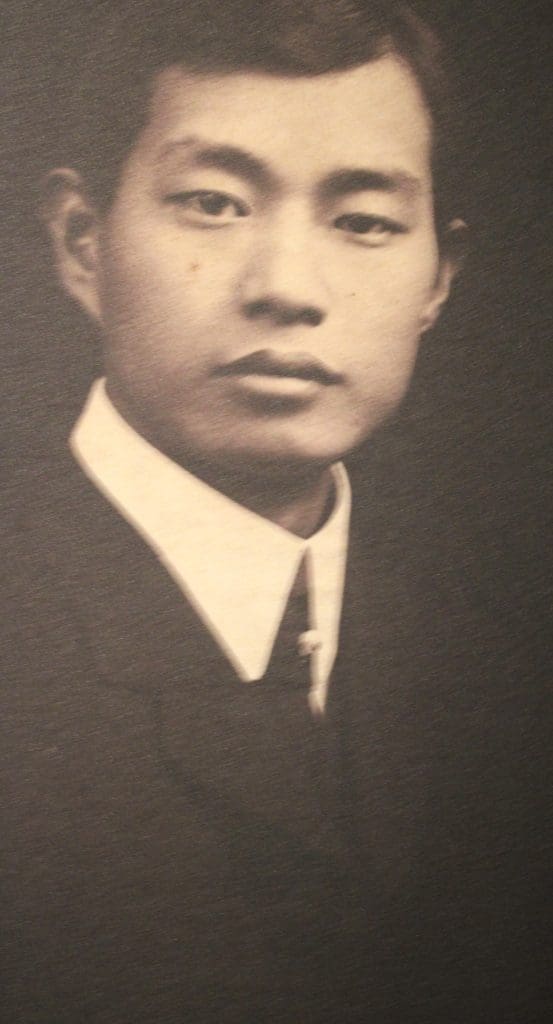
Then came shin hanga (new print) landscapes as an updated version of the older prints. The format was seized on by Hiroshi Yoshida, one of the most talented Western-style painters in Japan and who in the US exhibited his oils and watercolours to help fund his travels. He was no doubt buoyed by the vogue for Japanese prints, such as those of Hiroshige and Hokusai, which were impacting European modernism.
The couple were well into their careers before turning to produce their woodblock masterpieces. Their sons enriched the canon by venturing into modernism and abstraction, repurposing their parents’ feats. Granddaughter Ayomi, born in 1958, has flourished by ‘deconstructing’ the woodblock process for room-sized installations.
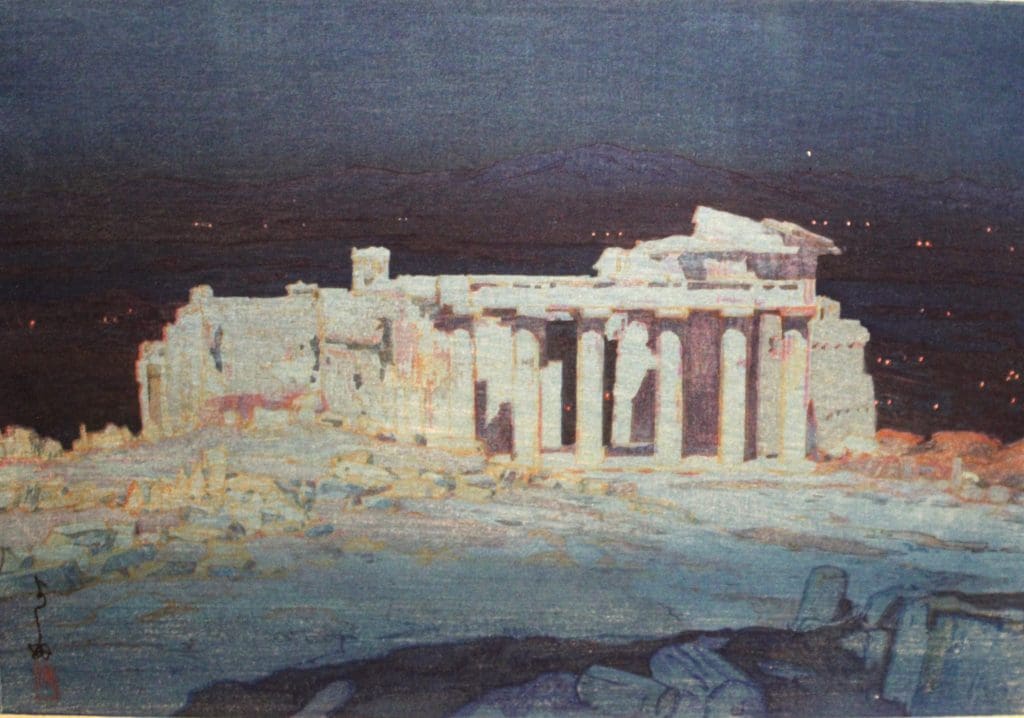
Dulwich’s potent exposition of the succession story opens radiantly with Hiroshi gaining an international reputation for his bold woodblock prints of American and European landscapes. There are 20 of his nonpareils of the grandeur of locales ranging from the Matterhorn, the Taj Mahal, and the Sphinx of Egypt to a canal in Venice. So impressed was he In Athens by the sight of the Acropolis that he made both a morning and an evening study of the revered sanctuary. While he rendered the daytime vista of what Unesco calls “the most striking and complete ancient Greek monumental complex still existing in our times” in soft beige, salmon, darker purples and pinks, the night impression is cast in a dark-to-light blue palette.
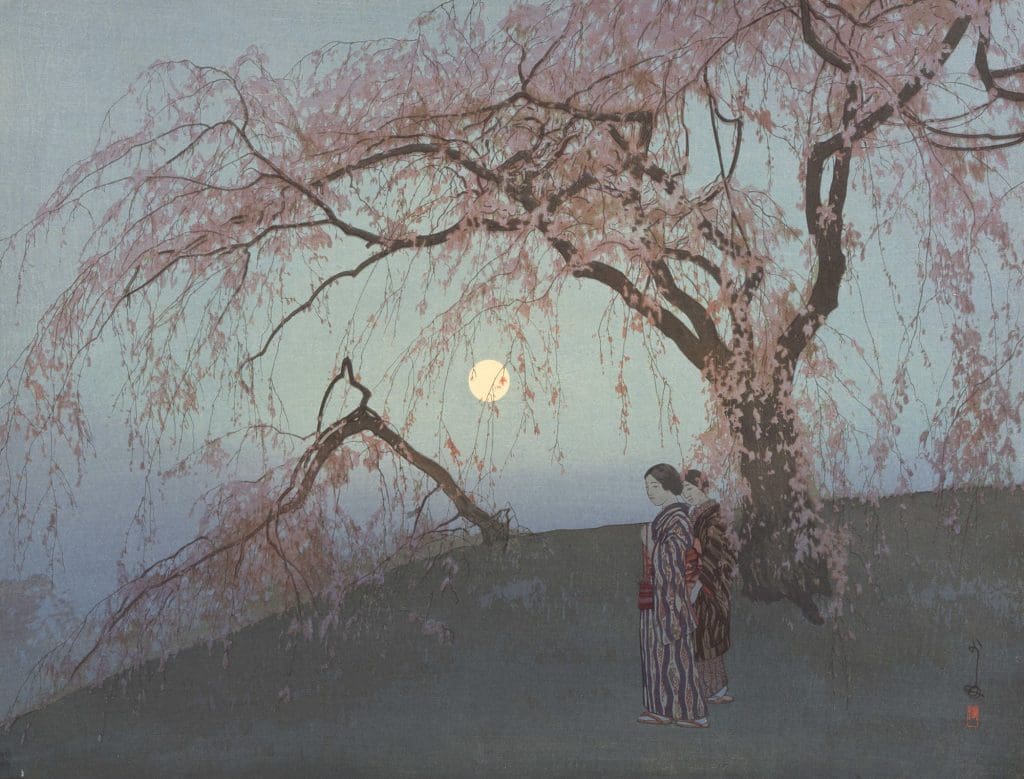
For many, the most affecting piece will be Kumoi Cherry Trees (1926) a woodblock print with ink and colour on paper, which Hiroshi based on his large watercolour painting of 1899, Memories of Japan. The painting showed five figures, but for the woodblock Hiroshi simplified that to two, achieving a more spacious and ethereal impact. The painting had been exhibited at the Detroit Institute of Arts soon after he completed it and bought by that museum through public subscription. It shows the daughters of the artist Kawai Shinzo (1867-1936) enjoying the blossoming cherry trees of Mount Yoshino, near Osaka. The site has been fabled for centuries for its spring display of blossom and been celebrated in poetry and paintings. Measuring 58.5 cm by 74 cm, Kumoi Cherry Trees is in the largest format Hiroshi designed woodblock prints.
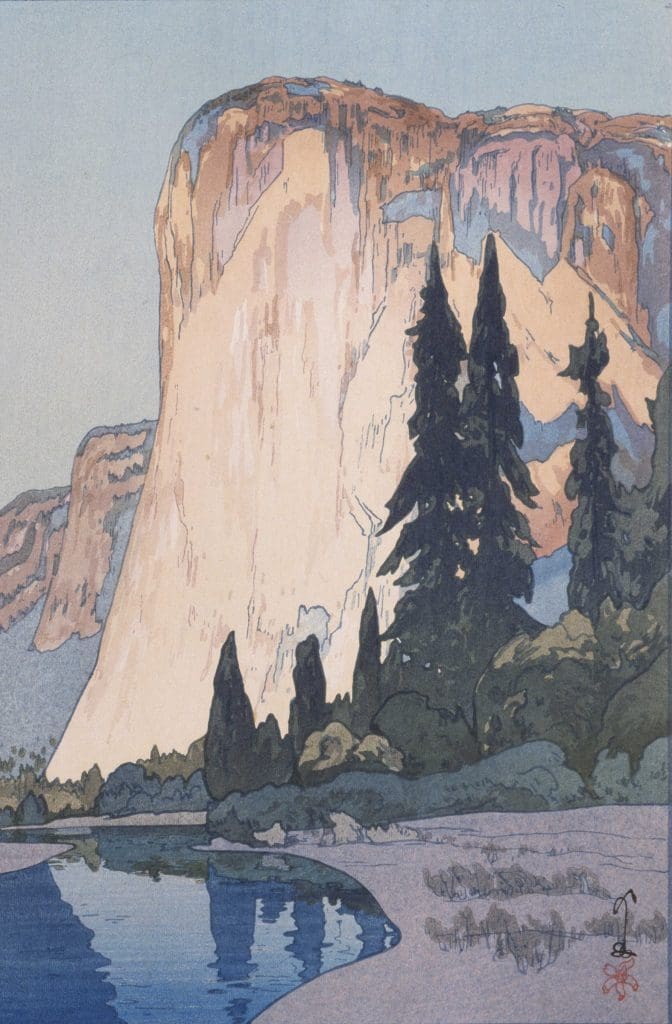
After the Great Kanto earthquake of 1923, which destroyed Hiroshi’s woodblocks at his publisher, he took a trip with Fujio to America. In the Yosemite National Park, he sketched El Capitan, which at 914 m is the world’s largest granite mountain. From the sketch, he plotted a print for his series The United States, the first output from his printmaking studio in Tokyo established in autumn 1925.
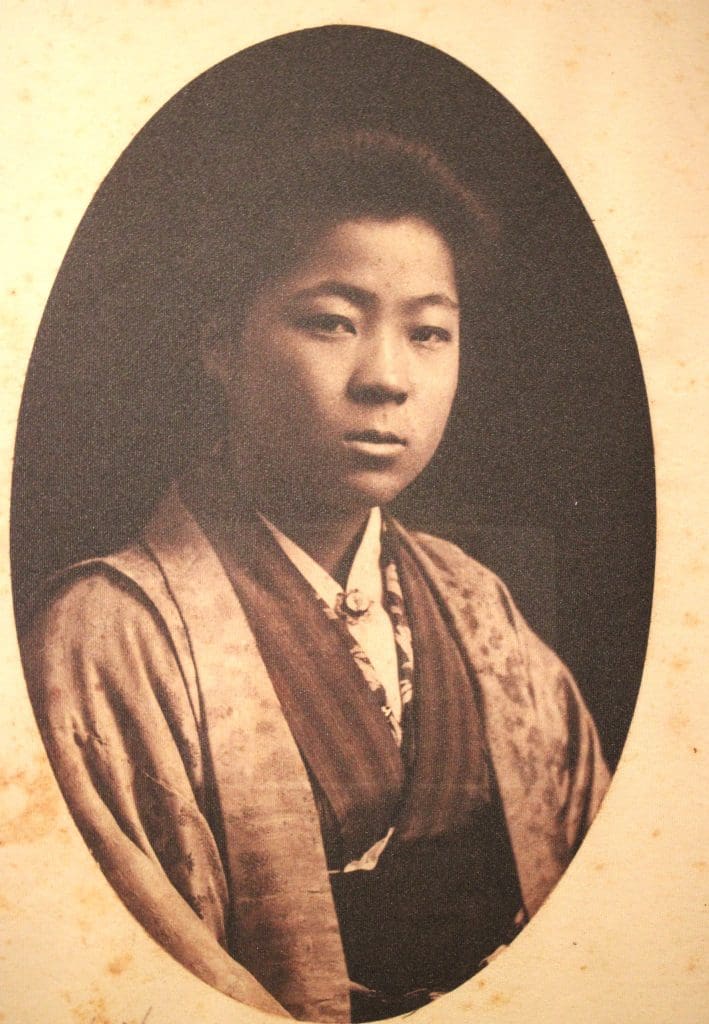
Fujio (1887–1987) was in her own right a renowned watercolourist and printmaker of landscapes and floral motifs. She co-founded in 1918 the first association of female Japanese artists and was one of the first to study Western-style painting. She travelled with Hiroshi across the US and Europe, exhibiting her delicate watercolours, and became known for her beautiful, enlarged flower prints: she would place the blooms in a fishbowl or behind it to amplify their image.
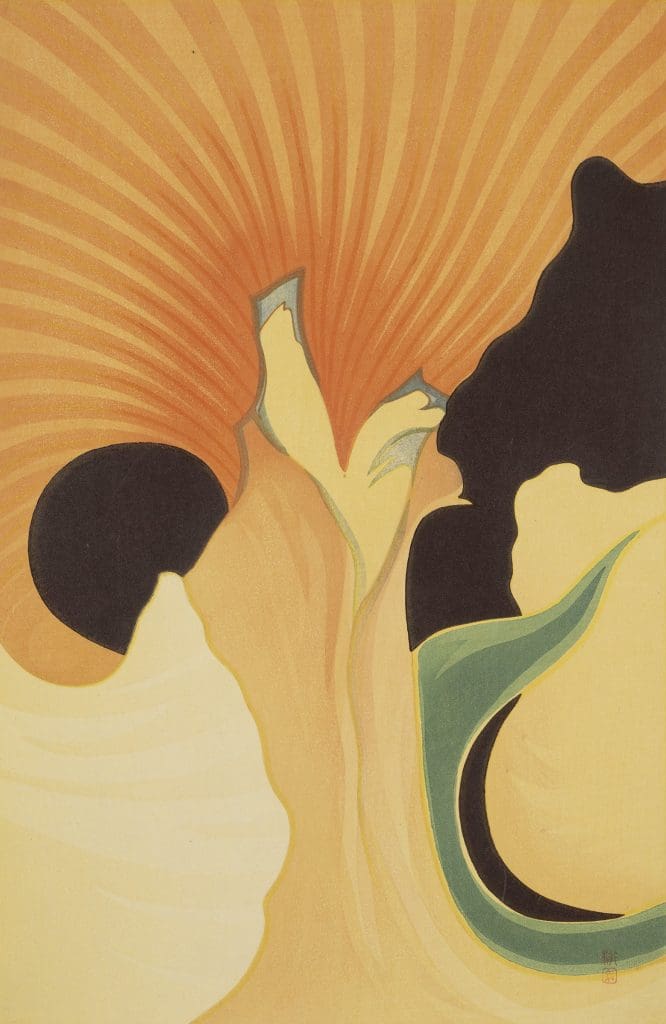
Fujio played a vital role in managing the family print-making business and after the death in 1950 of her husband occupied herself with bright, abstract depictions of flowers. A series of woodblock prints (such as Yellow Iris, 1954) marked her return to engraving after a near 30-year break. She died a few days short of her hundredth birthday at her home in Tokyo,
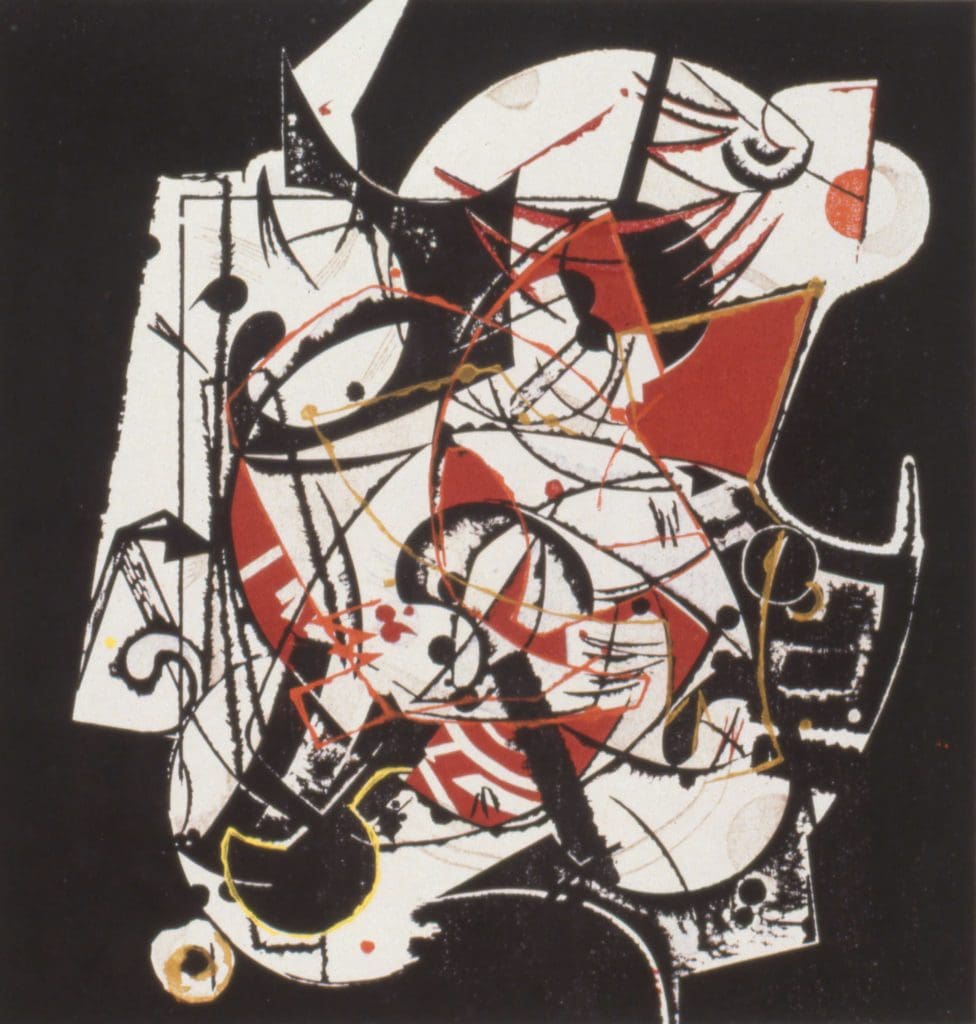
The exhibition moves on to showcase prints by Tōshi and Hodaka, sons of Hiroshi and Fujio. Tōshi (1911–1995) and Hodaka (1926–1995), both brought post-war abstraction to the process. Early in his career, Tōshi was spurred to venture in his father’s footsteps by depicting landscapes and cityscapes, but after World War II experimented with abstract prints. The exhibition includes some of his most accomplished works, including Night Tokyo: Supper Waggon (1938) and Camouflage (1985). In a change from his family’s established style, Hodaka incorporated collage and photoetching. Foreign travel influenced his choice of motifs, as did Pop Art, Surrealism and Abstraction. Works such as Profile of an Ancient Warrior (1958) demonstrate his distinctive style: the print derives inspiration from Mayan culture which he encountered on a trip to Mexico in 1955, and from the figure of a samurai, with topknot and katana sword. Such a cultural combination is typical of Hodaka’s production from this period The warrior emerges from a dense assemblage of white, black, red and yellow blocks. Another such gem is called Nonsense Mythology (1969).
Yoshida Chizuko (1924–2017), who was married to Hodaka, co-founded the first group of female printmakers in Japan, the Women’s Print Association. Her scenes of landscapes, nature, and traditional Japanese scenes connected Abstract Expressionism and traditional Japanese printmaking. Highlights include A View at the Western Suburb of the Metropolis/ Rainy Season (1995) and Jazz (1954) – she was a trained violinist and dancer. After her plane flew over the Great Barrier Reef on her way to Australia, she was moved to produce a series inspired by the sea.
The exhibition reaches a crescendo with the equivalent of a starburst – an immense new installation of cherry blossom by Ayomi (born 1958), the daughter of Hodaka and Chizuko. The youngest member of the printmaking family, Ayomi brings modern characteristics within the aura of seasonality to traditional printmaking, often using organic materials. Her whole-room installations extend the boundaries of printmaking while celebrating themes of nature, the environment, and human connection to the natural world.
Created especially for Dulwich Picture Gallery, Ayomi’s immersive installation is an homage to the early-flowering cherry trees seen in streets of Dulwich Village, and which originally came from the Yoshino district of Nara prefecture, famed for its white and pink cherry blossom. The almond-scented flowers, white suffused with pale pink, were unknown in the UK until brought to Kew in 1910 from Germany.
Despite its scale, Ayomi’s composition – which will exist only for the duration of the exhibition – conveys a feeling of intimacy. It includes 10,000 petals individually hand-cut and printed. To apply the petals high on three walls, members of the gallery team climbed on scaffolding they brought in.
Those who relish domestic sagas will be fascinated to learn that Hiroshi came as a painter to London in 1900 (it was only at the age of 44, in the 1920s, that he became a printmaker) and was keen to visit Dulwich Picture Gallery. He asked a policeman in south London the way to the gallery, but the officer admitted he had never heard of the place. Hiroshi eventually located the gallery and signed the visitors’ book, which, opened at the relevant page, is proudly on show at present, as are his diaries.
Ayomi said: “When I found my grandfather’s signature in the Dulwich Picture Gallery guest book, my heart skipped a beat. What an exciting and intriguing journey it must have been for Hiroshi, then an unknown painter and only 23, travelling from a country so far away. How proud he would be of this family exhibit of six [of its members], welcomed 120 years later at this wonderful museum.”
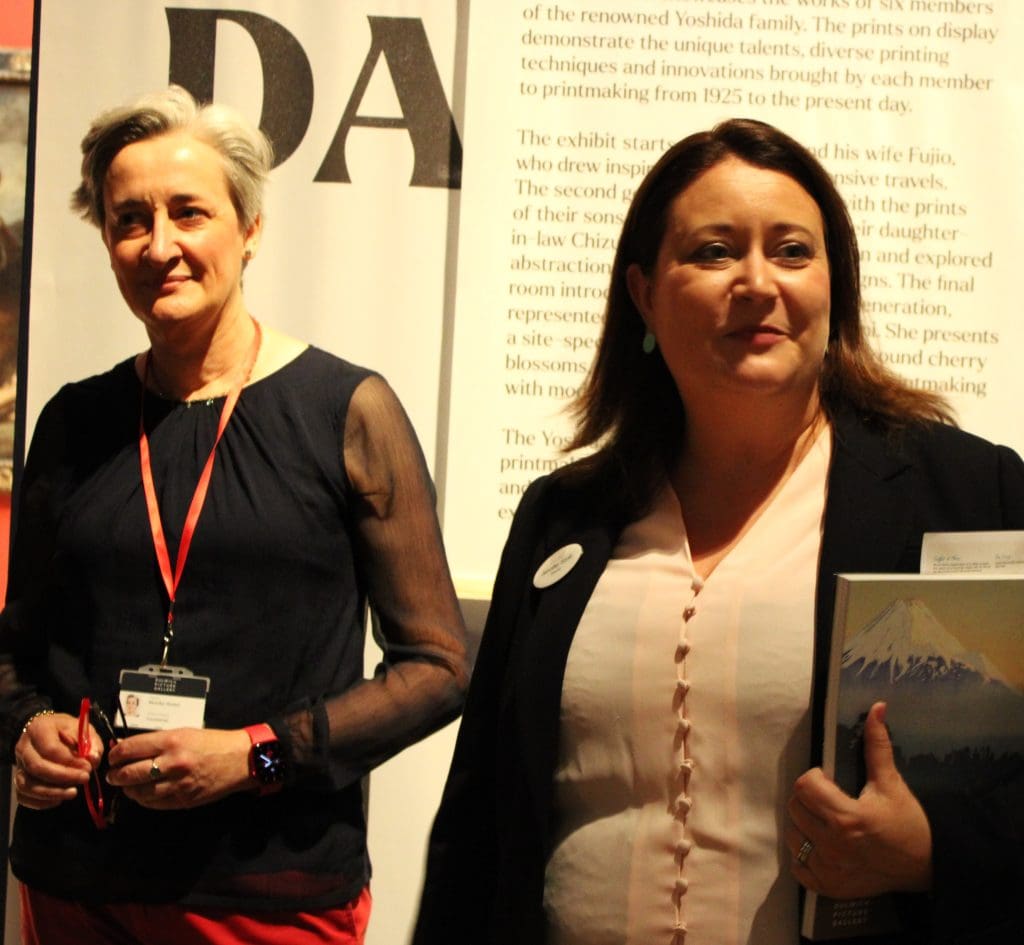
The exhibition is lovingly and meticulously curated by Dr Monika Hinkel, a specialist in Japanese woodblock prints at SOAS University of London, with support from Helen Hillyard, curator at Dulwich Picture Gallery. They accentuate assuredly the versatility of styles and techniques of the six artists.
Dr Hinkel has contributed new research to a full colour publication. “It is exciting to be able to exhibit so many iconic works of the renowned Yoshida family of printmakers to showcase the fascinating creative development of such outstanding artists over three generations,” she said.
Jennifer Scott, director of Dulwich Picture Gallery, said that while revered in Japan, the Yoshida dynasty which represented a dialogue between Japanese and European traditions had never been celebrated in the UK. “I get goosebumps thinking about Yoshida Hiroshi’s visit to Dulwich Picture Gallery in 1900. We (metaphorically) welcome him back with this landmark exhibition which introduces UK audiences to his exquisite work and to his legacy – an exceptional family of printmakers.”
Yoshida: Three Generations of Japanese Printmakers is at Dulwich Picture Gallery until November 3, 2024
