





By James Brewer
A self-described “poor householder” who was a carpenter and millwright in a Dutch village patented an invention in 1593 which changed the dynamics of international shipping. His genius resonated throughout centuries as the battle was waged for supremacy at sea and dominion over colonies.
The story of Cornelis Corneliszoon’s masterstroke is little known, but with its revolutionary ramifications is unfurled in an enthralling new book Forgotten: How One Man Unlocked the Modern World by Jaime Dávila. He is an amateur historian with a gift for painting both grand geopolitical pictures and meaningful vignettes.
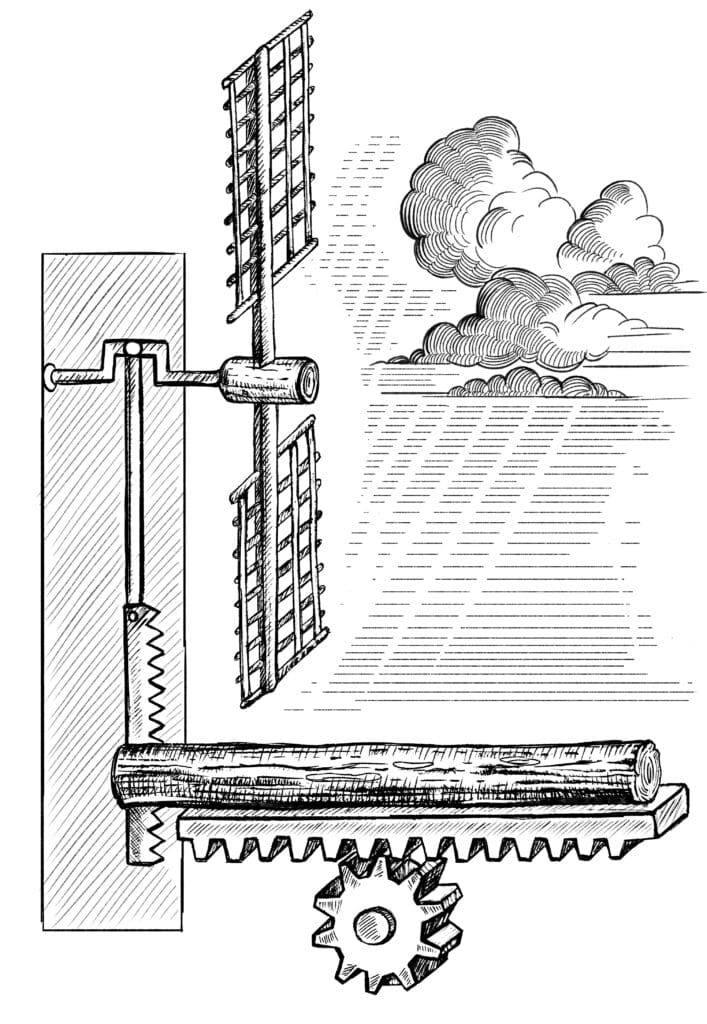
Born around 1550, Corneliszoon was known in his North Holland village of Uitgeest as a problem-solver with a gift for mechanical tinkering. His crowning achievement was to work out how to repurpose the characteristic windmills of his surroundings to cut wood – proficiently and cleanly. The aim was that an operator would simply feed logs into a mill, so that timber would come out of the other end: timber ideal for ship construction.
Why was this important? Because until then, timber had to be laboriously sawn by hand in sawpits, with one man working above and another below, a dangerous and exhausting slog that Corneliszoon’s wind-powered sawmill rendered obsolete. Getting suitable pieces of wood for even a modest merchant ship had needed as many as ten sawyers working for three months. Wind-powered sawmills would produce the same quantity of processed timber in less than a week.
This enabled the Dutch to leapfrog the productivity of competitors including England, Spain and Venice. Quickly, the whole maritime ecosystem felt the impact.
The mechanised sawmill fed through to economics on a grand scale. It “enabled Dutch maritime expansion which necessitated financial innovation, which facilitated distinctive governance arrangements, which influenced English development, which created conditions for industrialization, which broke the population constraints that had governed human existence throughout history,” contends Dávila in conclusions gained from wide reading and research.

He writes: “These advantages – speed, cost and quality – created a virtuous circle for Dutch maritime development. More affordable ships enabled greater trade volume, which then generated more capital for fleet expansion, which increased demand for ships, which stimulated further innovation in production.”
Dávila pulls the narrative along as smoothly as the revolutionary sawing process disbursed the prized, sturdy marine planks.
Cornelis Corneliszoon’s sawmill was the intelligent assembly of simple mechanisms arranged to work in perfect sequence with minimal human effort, delivering clean, straight and uniform cuts in a way that manual efforts could never achieve. Dutch shipwrights could reimagine the entire shipbuilding process, designing vessels based on optimal performance rather than timber constraints, and experiment with new construction techniques, dramatically increasing production volume.
Corneliszoon built his first sawmill based on his patent in 1594 and called it ‘Het Juffertje’ which means ‘The Little Miss’ and he patented an improved version in 1597.
Dávila recounts how the shallow coastal waters of the Low Countries had shaped vessel design up to that point. Dutch shipwrights wanted vessels that could be built quickly and operated by minimal crew. This contrasted with other European shipbuilding powers. Spain created massive galleons that were in effect floating fortresses, prioritising durability and firepower over sailing efficiency or cargo capacity. Dutch shipbuilding philosophy was: “A ship above all must be practical. The Spanish build monuments to their empire. The Venetians build floating palaces. We Dutch build tools for commerce.” The master engine of progress was the new breed of ship the fluyt, first built in the 1590s at the port of Hoorn, a cargoship designed purely for trade.
The chapter ‘The Ships that Conquered the Oceans’ is of particular interest to readers of AllAboutShipping. In prose that flows, the author navigates through the influence of Corneliszoon’s invention on the Dutch shipping industry, leading to the creation of the Dutch East India Company (VOC) which would provide a template for its rival British enterprise. The Dutch model was at first the more ‘democratic’ as it invited investment from people across the social spectrum.
A fascinating following chapter salutes the VOC’s enlightenment of the spread of capitalism and the expansion of subsidiary services to the maritime project. Alongside banking innovations, maritime insurance developed into a sophisticated financial service, insurance brokers emerging as specialised intermediaries, introducing standardised practices and developing secondary markets. By 1620, Amsterdam featured dozens of brokers assessing voyage risks, calculating premiums and distributing large risks across many underwriters to prevent catastrophic losses falling on individual investors.
Amsterdam developed a financial structure that anticipated features of modern capital markets: transferable shares, continuous price discovery, stable banking, risk management through insurance and information services supporting investment decisions. Thousands of ordinary citizens owned shares in the VOC.
Although English and Dutch ships battled physically at sea, English travellers, merchants and officials kept a close eye on the reasons for Dutch commercial success. Samuel Pepys, the great diarist who was secretary of the Admiralty, visited Dutch shipyards in the 1660s – seven decades after the adoption of Corneliszoon’s invention – observing production methods and the superior speed of shipbuilding. The VOC shipyard in Amsterdam was built in 1665, one of the world’s first great industrial complexes where massive timberyards and assembly slips produced fleets of ocean-going vessels. The intellectual influence deepened when William of Orange assumed the English throne in the 1680s.

In his winning style, the author relates how a 38-year-old maidservant, Neeltje Cornelis, in the household of the founding director of the VOC, offered her modest savings to become one of a new generation of shareholders alongside wealthy merchants. She did not need to understand trading practices or maritime navigation. She sold her share within a year of purchase; but another housemaid who received a fully-paid share as a gift held on through four volatile decades – she was fortunate to have insider information from her employer, the VOC’s Amsterdam bookkeeper. The new financial order was reaching beyond traditional economic boundaries.
The author has reconstructed some scenes and conversations, but says that the dates, technical details of the sawmill and the economic consequences are factual. He goes into impressive description of the factors that made for the new mill’s irrevocable transformation. Each mechanical element was modest on its own, but Corneliszoon’s genius was to combine them, so they acted in a perfectly controlled sequence. This coordinated system produced what Dávila calls mankind’s first true industrial machine.

What drew Dávila to write the book? The ever-inquisitive Mexican-born entrepreneur, whose interest in engineering and technology is the basso continuo of his life, a few years ago came across a brief mention of Corneliszoon’s keynote invention. Later the history enthusiast read what he called the magnificent book Longitude by Dava Sobel, a woman “who made horology sexy” as the New Scientist put it. Published in 1995 it told the story of John Harrison, a self-taught English clockmaker who in the mid-18th century introduced his revolutionary marine chronometer to measure longitude at sea. The effect on the safety and efficiency of sea voyages was dramatic, greatly facilitating commerce.
Dávila could not resist travelling from his home in Mexico City to London to see Harrison’s original instruments close-up at the Royal Naval Observatory at Greenwich. This set him on the trail of what he calls “the first machine in history that performed complex manufacturing operations without continuous human guidance.” Disappointingly, he recounts, Harrison was never fully rewarded for his insight – nor was the Dutch sawmill inventor. Cornelius Corneliszoon patented his sawmill but never made any money from it.

In all, this is a superbly written and researched book, a great contribution to the literature of maritime and global history.
Forgotten: How One Man Unlocked the Modern World. By Jaime Dávila. Hardback, 240 pages, £19.99; eBook £4.99. Whitefox Publishing. ISBN: 9798998953705 – ISBN (eBook) 9798998953712.
