





March 2026
Greek Controlled Shipping: An information paper based on data provided to the GSCC
by S&P Global Market Intelligence
For the 39th consecutive year the GSCC presents statistical data, in the form of 11 tables on Greek-controlled ships over 1,000 GT, registered under the Greek and other flags. The data has been provided by S&P Global Market Intelligence. The following is a short analysis of the data provided, prepared by the GSCC Secretariat.
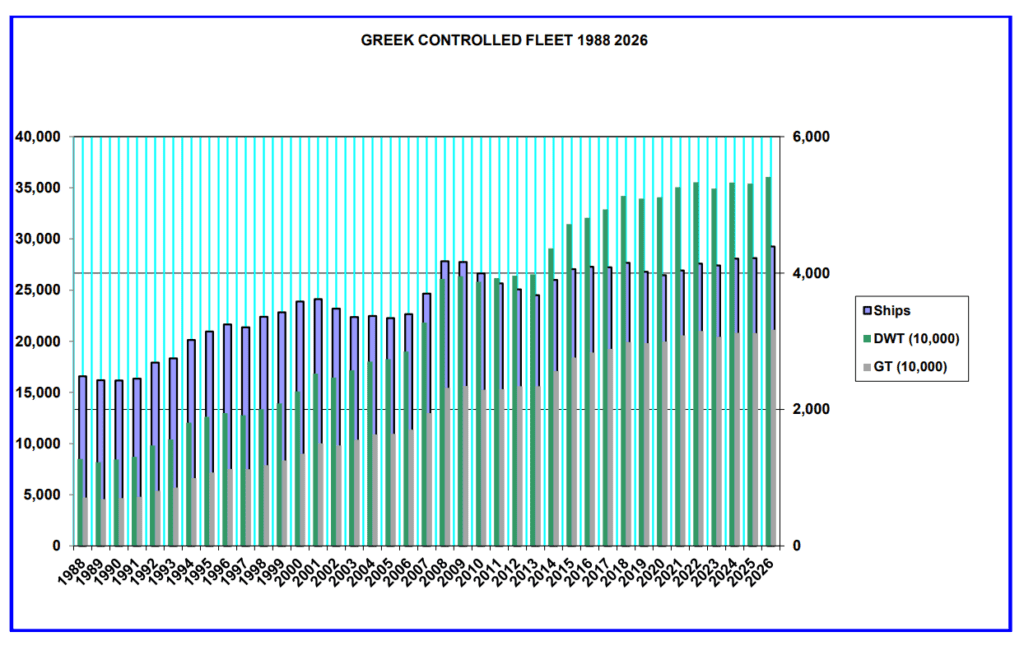
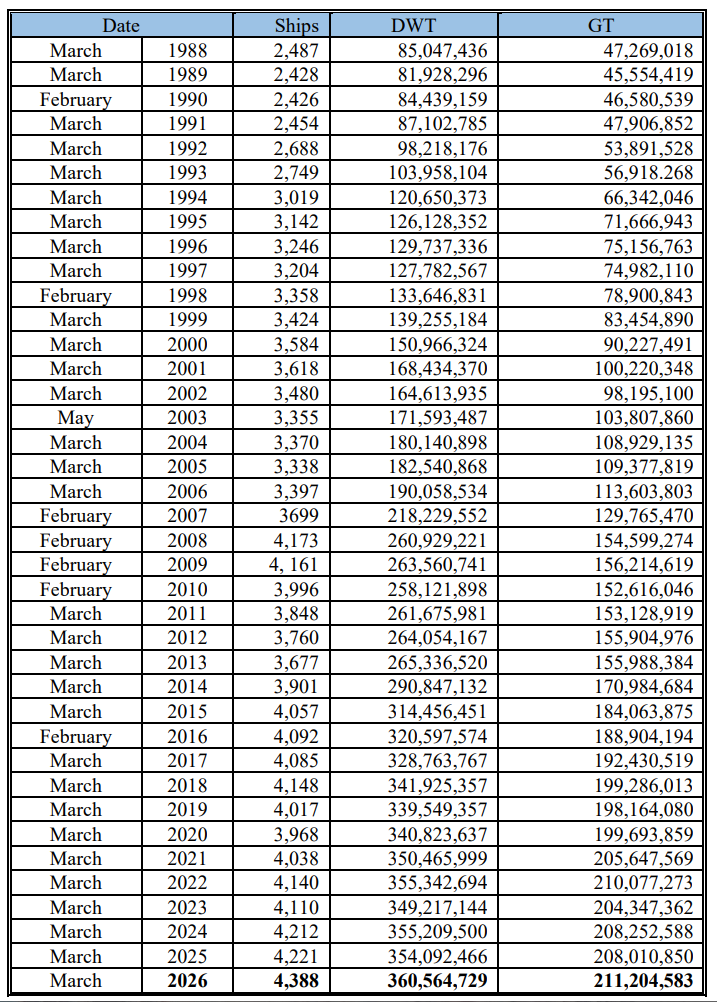
Information from Table 1, compared with corresponding data from the previous year, shows that, during the year to March 2026, the Greek-controlled fleet has increased in terms of number of vessels, DWT and GT. According to the data, as of 3 rd March 2026, Greek interests controlled a record 4,388 vessels of various categories, totaling 360,564,729 DWT and 211,204,583 GT.
Compared with the previous year’s data, this represents an increase of 167 vessels, 6,472,263 DWT and 3,193,733 GT. The figures do not include 422 vessels of various categories on order from shipyards, a total of 40,212,290 DWT and 25,258,008 GT
The fleet registered under the Greek flag has slightly decreased in terms of ship numbers,
comprising of 463 ships. This reflects the need for the Greek flag to be less bureaucratic
and more flexible. Also, a slight decrease in terms of DWT and GT has been noted, with
the figures now standing at 27,445,524 GT and 44,944,717 DWT, as opposed to the
previous year’s figures of 29,551,538 GT and 48,717,807 DWT.
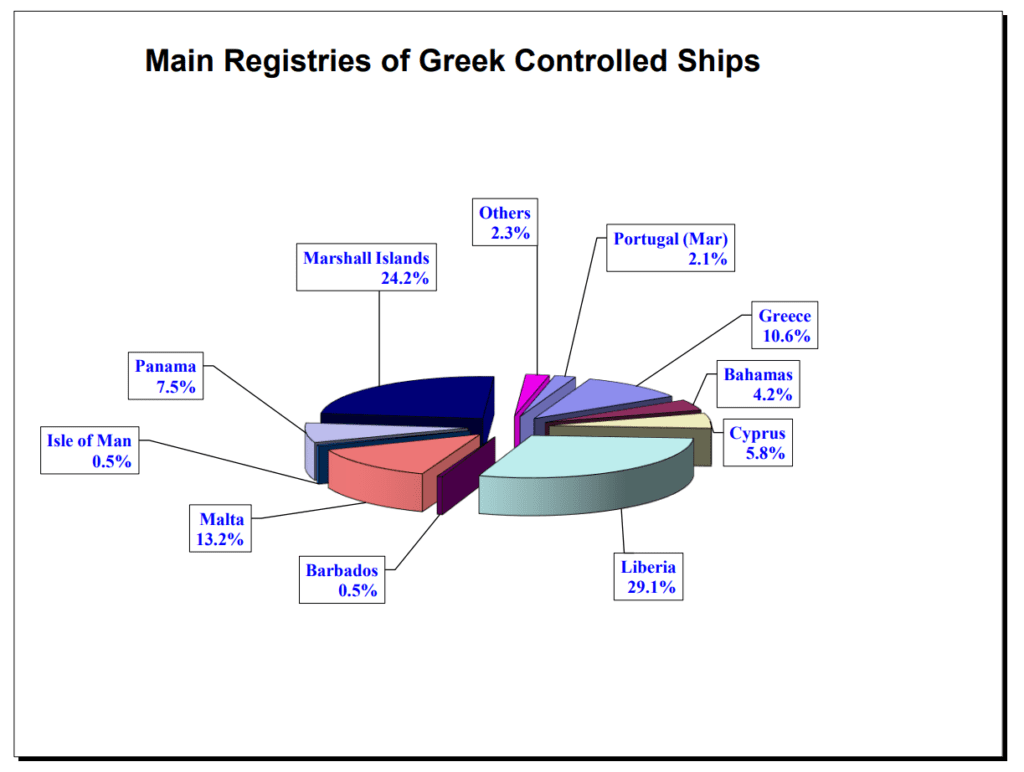
TABLE 1: Flag Analysis of Ships owned by Greek Parent Companies
The Greek-controlled fleet is registered under some 31 flags.
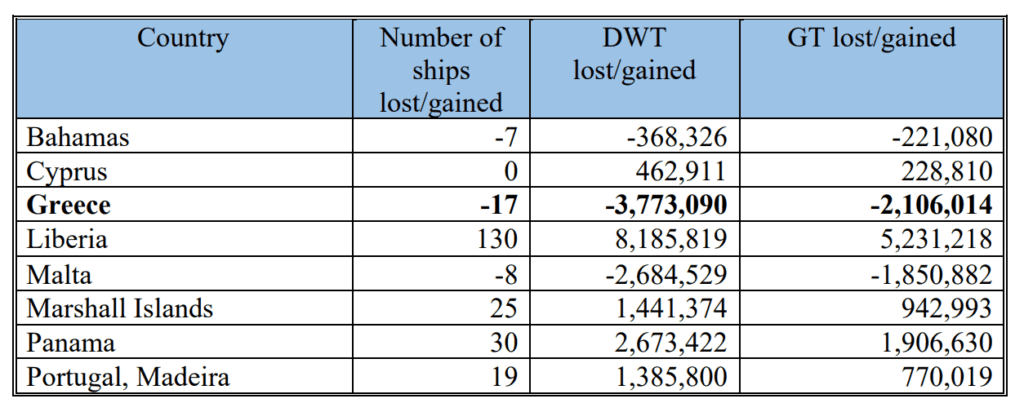
Flag analysis of ships owned by Greek parent companies, which gives the total number of ships, total DWT and total GT, registered under each of the main registries used by Greek owners, compared with the corresponding table of last year, shows that Liberia gained a record number of 130 vessels, Panama gained 30 ships, Marshall Islands gained 25 and Portugal (Madeira) 19. The Cyprus and Barbados registry remained unvaried in terms of number of vessels.
On the other hand, Malta and the Bahamas noted a slight decrease in the number of registered vessels, as well as in terms of DWT and GT.
As mentioned before, the number of vessels registered under the Greek flag decreased slightly this year by 17 vessels. In terms of DWT and GT there was a decrease of 3,773,090 and 2,106,014 respectively.
The table below shows the gains and losses in number of ships, GT and DWT for the
main registries of Greek-controlled ships.
Overall, the Liberia and Marshall Island flags are at the forefront of the Greek-owned fleet with 1,279 and 1,061 Greek-owned ships, respectively, on their registers. In terms of DWT, Liberia accounts for 111,307,219, representing 30.1%, Marshall Islands accounts for 83,286,472, representing 23.1 % and Malta with 579 ships of 50,891,381 DWT, representing 14,1% of the total DWT of the Greek-owned fleet.
The Greek flag stands with 463 ships of 44,944,717 DWT. It should be noted that the Greek flag remains in the fourth place globally in terms of DWT, as it represents 12.5% of the total DWT of the Greek-owned fleet.
In terms of DWT, Panama follows with 330 ships of 22,728,332 DWT, Cyprus with 253 ships of 19,024,790 DWT and Bahamas with 183 ships of 15,536,597 DWT.
Furthermore, it should be noted that the total number of vessels registered under EU flags stands at 1,388, which accounts for 31,6% of the Greek fleet. This figure has decreased, when compared to the previous year’s figure of 1,414 vessels, which represented 33,5% of the Greek fleet.
TABLE 2: Ship Type, DWT and Order Book – Greek Parent Companies
Comparing Table 2 with the corresponding table of the previous year, the following
increases/decreases in number of ships and DWT are noted
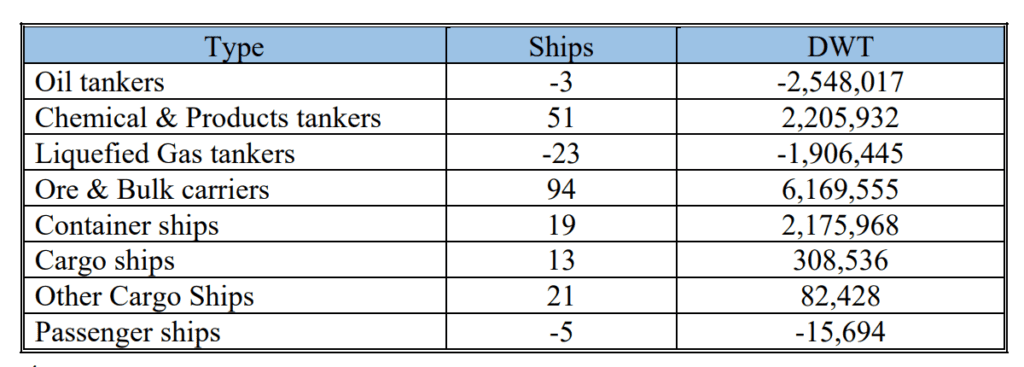
With regard to the order book as to ship type, currently there are 140 oil tankers on order for account of Greek owners, 61 chemical & products tankers, 43 liquefied gas tankers, 77 ore & bulk carriers, 74 container ships, and 6 cargo vessels.
TABLES 2 & 3: Comparison between the world fleet and Greek owned fleet per ship type
The following table presents the Greek-controlled fleet in number of ships, in comparison with the world fleet, providing the figures as to ship type.
What is notable is that Greek parent companies represent 22% of the world tanker fleet, 16% of the world ore & bulk fleet and 8% of the liquified gas fleet.
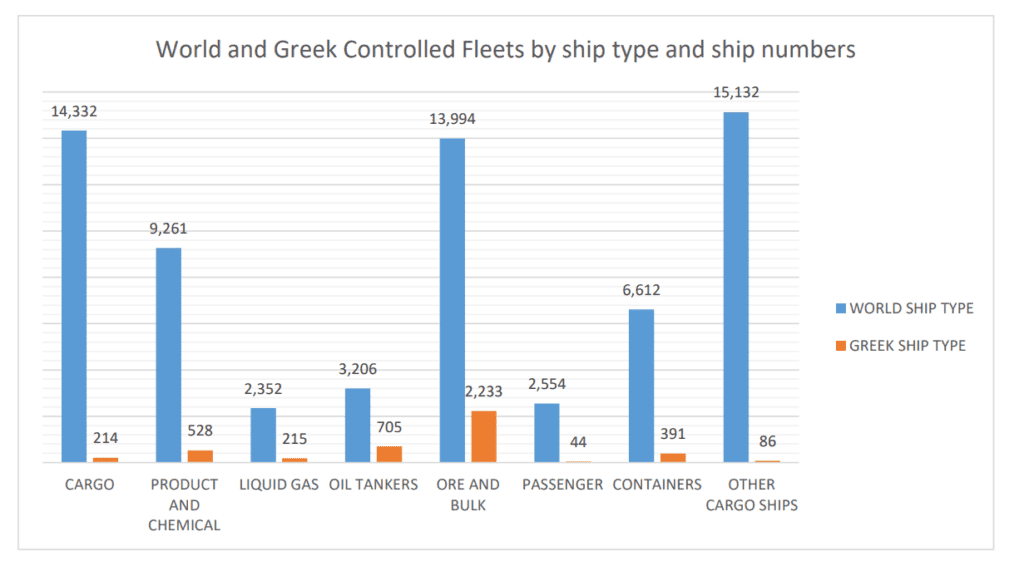
Overall, as shown in Table 4 of the attached data, the Greek-owned fleet stands at 6.5% of the world fleet in terms of ship numbers, 12% in terms of GT and 14.2% in terms of DWT.
The Greek-registered fleet as a percentage of the world fleet, in terms of number of ships, GT, and DWT is 0.7, 1.6 and 1.8 respectively, according to Table 9. It should be noted, however, that for oil tankers the percentages are 4.8, 5.1 and 5.1 respectively.
TABLES 3 & 4: Ship Type of the World Fleet and the Greek Fleet
Due to the forthcoming regulatory requirements, slight increases and decreases were noted in most of the categories of the Greek-owned fleet.
In particular, the Greek fleet as a percentage of the world fleet recorded an increase in the categories of cargo ships, chemical and products tankers, ore & bulk carriers, container ships and other cargo ships, in relation to the corresponding world fleet type for the year 2025.
On the other hand, a slight decrease was recorded in the categories of liquefied gas carriers, oil tankers and passenger ships.
Compared to the previous year, the percentages are as follows:
Oil Tankers
Percentage in terms of number of ships 2025: 22.7
Percentage in terms of number of ships 2026: 22.0
Percentage in terms of total DWT 2025: 21.9
Percentage in terms of total DWT 2026: 20.9
Chemical & Products Tankers
Percentage in terms of number of ships 2025: 5.3
Percentage in terms of number of ships 2026: 5.7
Percentage in terms of total DWT 2025: 10.3
Percentage in terms of total DWT 2026: 11.1
Liquefied Gas Carriers
Percentage in terms of number of ships 2025: 9.4
Percentage in terms of number of ships 2026: 8.0
Percentage in terms of total DWT 2025: 12.5
Percentage in terms of total DWT 2026: 9.8
Ore & Bulk Carriers
Percentage in terms of number of ships 2025: 15.8
Percentage in terms of number of ships 2026: 16.0
Percentage in terms of total DWT 2025: 18.2
Percentage in terms of total DWT 2026: 18.2
Container Ships
Percentage in terms of number of ships 2025: 5.8
Percentage in terms of number of ships 2026: 5.9
Percentage in terms of total DWT 2025: 5.5
Percentage in terms of total DWT 2026: 5.7
Cargo Ships
Percentage in terms of number of ships 2025: 1.4
Percentage in terms of number of ships 2026: 1.5
Percentage in terms of total DWT 2025: 2.6
Percentage in terms of total DWT 2026: 2.7
Other Cargo Ships
Percentage in terms of number of ships 2025: 0.4
Percentage in terms of number of ships 2026: 0.6
Percentage in terms of total DWT 2025: 0.9
Percentage in terms of total DWT 2026: 1.0
Passenger Ships
Percentage in terms of number of ships 2025: 2.0
Percentage in terms of number of ships 2026: 1.7
Percentage in terms of total DWT 2025: 2.5
Percentage in terms of total DWT 2026: 2.2
TABLES 5, 6 & 10: Average Age Analysis of Existing Ships owned by Greek Parent Companies, Greek Registered Ships and the World Fleet
The average age of the Greek-controlled fleet in terms of ships increased slightly compared to the previous year, but, nevertheless, continues to be 4.5 years below the average age of the world fleet.
The average age of the Greek controlled fleet in terms of ships now stands at 14.3 years, in comparison to 18.8 years for the world fleet. In terms of GT and DWT, it is 12.8 and 12.7 years respectively, as against 13.8 and 13.7 of the world fleet
The average age of the existing Greek flag fleet recorded a slight increase in terms of ship numbers, now standing at 16.6 years, in comparison to 16.3 years in 2025. A slight increase has also been noted in terms of GT and DWT, with values of 11 and 10.6 years respectively, as against 10.7 and 10.3 years in 2025.
TABLE 7: Class Analysis of Greek Parent Companies
The following six major international classification societies have the majority of the Greek-controlled fleet, in terms of ship numbers, on their books:
- ClassNK: 891 ships (849 ships in 2025),
- Lloyd’s Register: 804 ships (742 ships in 2025),
- ABS: 757 ships (730 ships in 2025),
- BV: 739 ships (734 ships in 2025),
- DNV: 607 ships (601 ships in 2025) and
- RINA: 352 ships (318 ships in 2025).
TABLE 11: Class Analysis of Greek Registered Fleet
The following seven major classification societies have the majority of the Greek registered fleet, in terms of ship numbers, on their books:
- ABS: 144 ships (146 ships in 2025),
- Lloyd’s Register: 78 ships (89 ships in 2025),
- DNV: 76 ships (76 ships in 2025),
- BV: 59 ships (58 ships in 2025),
- RINA: 49 ships (48 ships in 2025),
- ClassNK: 14 ships (15 ships in 2025) and
- CCS: 4 ships (5 ships in 2025).
