





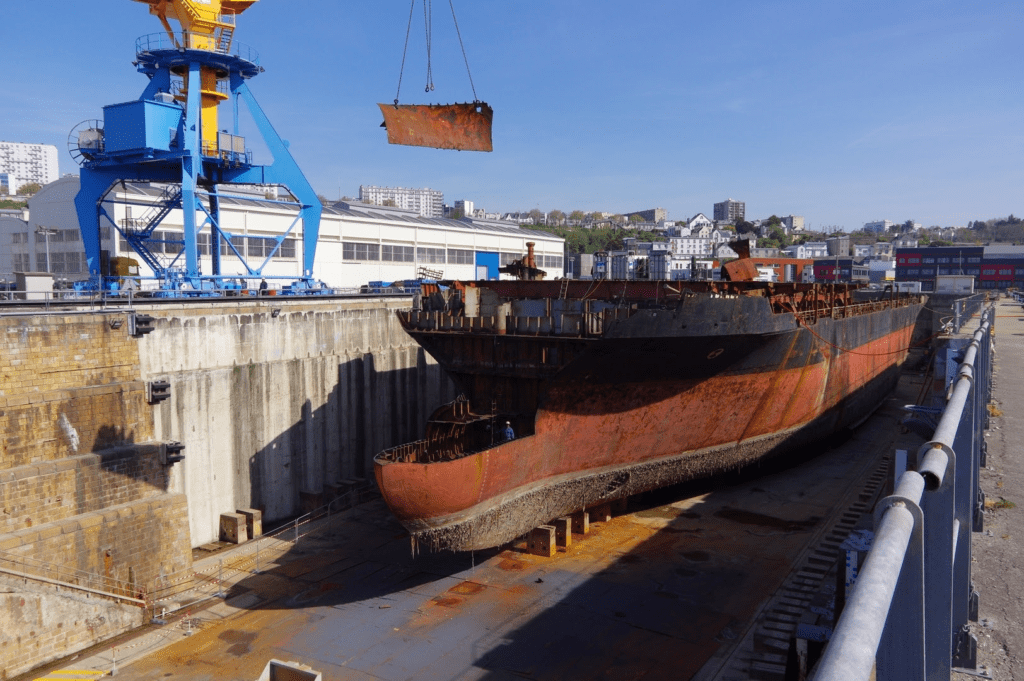
On Thursday 30/04, the final stakeholder workshop on the European Commission’s impact assessment for the Circular Economy Act (CEA) on the Circular Economy Act assessment was held. NGO Shipbreaking Platform is concerned that the current proposal risks squandering one of Europe’s most significant untapped material banks, end-of-life ships, and with it, a concrete opportunity for steel decarbonisation and material resilience.
The CEA is expected to build a Single Market for secondary raw materials and stimulate demand for high-quality recycled content. Yet, without unlocking new material streams such as ship recycling, it will fall short its objectives.
Why does ship recycling matter?
- Scale of the opportunity: the Platform’s research shows that EU/EFTA-owned ships could supply up to 12 million tonnes of high-quality steel scrap per year to the European economy over the next decade;
- Material recovery: up to 95% of a ship’s weight can be recovered as high-quality scrap, representing a major secondary raw material stream for the EU steel industry, and leading to the sector’s decarbonisation;
- The EU stake: companies based in the EU and EFTA own about one-third of the world’s fleet, placing Europe in a pivotal position to lead the transition.
The workshop revealed a critical blind spot of the proposed Act. The impact assessment focused almost exclusively on waste management measures: extensions to the WEEE Directive, construction and demolition waste, and harmonisation of End-of-Waste and EPR schemes. Higher levels of the circularity hierarchy, prevention, reuse, repair and refurbishment, were largely absent.
Primary focus on waste narrows down the Circular Economy Act simply to the waste management legislation, neglecting the very need of addressing material use throughout their lifecycle before they become a waste.
NGO Shipbreaking Platform finds the measures in the proposed Act too narrow, and urges the European Commission to address material overuse, overconsumption, and material reuse beyond the proposed prioritised recycling framework.
Together with Recycling Europe and EUROFER, the NGO Shipbreaking Platform recently published a joint statement calling on the EU to recognise the strategic importance of the European ship recycling sector and to adopt concrete measures to keep valuable scrap steel within Europe.
The Platform calls on the European Commission to use the Circular Economy Act to:
- Work across key waste legislative files to close the re-flagging loophole in the EU Ship Recycling Regulation, extending its scope to the real beneficial owners of vessels and recognising flag-swapping as a practice intended to circumvent EU rules;
- Recognise ship-derived steel as a strategic source of secondary raw material and ship recycling as a key circular sector for steel decarbonisation;
- Accelerate the development of a Ship Material Passport, building on the Digital Product Passport under the ESPR, to track materials from design to dismantling and enable cross-sector reuse;
- Establish appropriate financial incentives for ship-derived materials to remain in the EU, including a ship recycling return scheme as provided for under Article 29 of the EU Ship Recycling Regulation;
- Align shipping sector subsidies, including the tonnage tax regime, with clear circularity obligations, including end-of-life recycling at EU-approved facilities;
- Ensure dedicated investment under LIFE, the Innovation Fund and Horizon Europe to scale EU ship recycling capacity.
By keeping valuable steel within the EU, these actions will:
- Accelerate decarbonisation – each tonne of recycled ship steel avoids up to 1.5 tonnes of CO₂ compared with primary production, while using 72% less energy and reducing air pollution by 86%;
- Strengthen strategic material autonomy – reducing reliance on imported iron ore and coal in line with Europe’s Critical Raw Materials Act objectives;
- Create green jobs – modern ship recycling yards and green steel production generate skilled employment in engineering, environmental management and advanced manufacturing;
- Uphold Europe’s global leadership – reinforcing the EU as a front-runner in environmental stewardship, worker safety and circular economy policy.
“Bringing ship recycling back to Europe is also a matter of environmental justice. End-of-life ships contain asbestos, PCBs, heavy metals and toxic paints. Too many EU-owned vessels are still exported for dismantling on South Asian beaches, despite severe risks to workers, coastal communities and ecosystems, and despite international prohibitions on such exports. The EU must take responsibility for its own waste,” says Benedetta Mantoan, Policy Manager at NGO Shipbreaking Platform.
The NGO Shipbreaking Platform will continue to follow the Commission’s proposals closely and calls on EU decision-makers to deliver a Circular Economy Act that is ambitious, enforceable and fit for the realities of global ship recycling.
For the NGO Shipbreaking Platform’s position on the Circular Economy Act, click here.
