





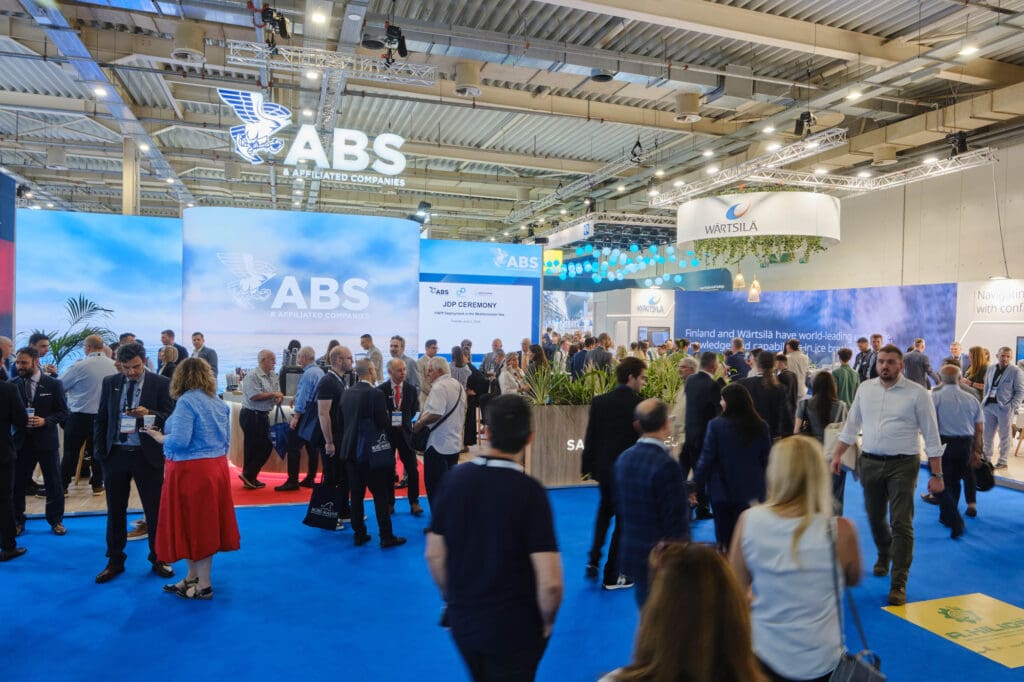
Posidonia 2026 is proving to be the industry’s most technologically charged edition to date — with artificial intelligence, energy efficiency technology, and cloud-native maritime software all converging on the floors of the Athens Metropolitan Expo.
A survey conducted by Posidonia Exhibitions ahead of the show found that more than 40 exhibitors had integrated AI into their business operations in some capacity — a figure that would have been unthinkable at Posidonia 2024, when AI-driven tech for maritime operations was tested in labs and pilot projects. From classification societies to software developers, from equipment manufacturers to logistics platforms, the technology is permeating every corridor of the industry.
The practical dimension of that transformation was on full display during a dedicated technology showcase hosted by the UK Department for Business and Trade in partnership with the Society of Maritime Industries (SMI). The session brought together a complementary portfolio of British maritime technology companies, each addressing a distinct operational pressure facing Greek shipowners and fleet operators in an environment shaped by tightening regulation, fuel cost volatility, and accelerating digital transformation.
The showcase highlighted five technology clusters of particular relevance to the Greek shipping community: wind-assisted propulsion and energy-saving devices; digital asset management and operational control; propeller optimisation and systems integration; and physical vessel security — together offering what organisers described as a “full-stack” approach to fleet readiness.
Noel Tomlinson,Business Development – Commercial Shipping & Ports at BMT, said: “Decision clarity is the key challenge for operators. The real question is which technology is right for the specific vessel or fleet and when to adopt it. Operators drown in a sea of data so having confidence in the decisions they are making depends largely on the quality and structure of that data.”
Dr. Milad Armin, Executive Director at Enki Marine focused on the benefits AI have brought to marine propulsion technologies. “We have launched Deep Impact, a breakthrough AI solution sitting at the intersection of decarbonisation and digitalisation. It’s a platform for the digital era designed to help propulsion systems maintain peak performance at all times.” According to Armin, this technology helps shipowners achieve significant annual fuel consumption efficiencies ranging from $200K – $500K depending on vessel type.
If the UK session offered concrete technology solutions, the “Navigating the Future: AI in Global Shipping” panel – held as part of the 5th Trading in US Waters Conference – provided the strategic and regulatory coordinates within which those solutions must operate. Three speakers brought distinct but complementary vantage points: classification, entrepreneurship, and academia.
Joshua Divin, Senior Vice President for Marine Business Development at the American Bureau of Shipping (ABS), addressed AI’s implications for classification and safety assurance — the regulatory infrastructure upon which the entire industry depends. He said: “We started looking at the value of data for shipping back in 2017. Now we have many projects driven by AI including our AI centre of excellence to help us build a foundation of data that is relevant and useful to operators. We are also offering AI consulting services and products such as Plato, a powerful AI tool designed to accelerate maritime compliance. It acts as a digital conversational assistant that helps professionals quickly navigate class rules and regulatory requirements. AI is here to stay and every company needs to think of how they can implement it.”
Representing the AI tech SME community, Maria Kolitsida, Founder and CEO of Signal Fusion, brought the human element of AI adoption to the surface. She said: “Ships are safer than ever but risk has been transferred to the human aspect of operation and this is how AI can help us systematically measure the human element. AI helps turn fragmented insight into a consistent operational signal. AI systems can now help us better understand and predict how crews perform under pressure, in context, and over time – in short, operational behavioural intelligence analytics is now possible for shipping crews.”
George Kokosalakis, Executive Director of the Centre of Excellence in Shipping, Logistics & Energy and Associate Professor at the American College of Greece spoke about AI-powered decision support designed to improve carbon footprint of fleets. “The most powerful tool today to help us with decarbonisation is AI. We have identified a few gaps inhibiting full implementation of AI systems, the trust gap, the automation paradox (as AI improves operators use manual skills less degrading judgment for the moment that matters most), cybersecurity and organisational readiness, however AI-enabled Decision Support Systems are not a distant aspiration because solutions are commercially available today.”
Also at Posidonia Today, German company HHX.blue, an independent financial services and advisory firm, demonstrated SeaCheck, a digital tool that goes beyond simple data collection, focusing on risk assessment, decision timing and the creation of sustainable financial structures in the era of AI.
Greek company, Fleetwork, is offering the first fully cloud maritime ERP platform developed entirely in Greece and designed specifically for the needs of modern shipping companies. Giannis Sarris, Founder and CEO of Fleetwork, stated: “At Posidonia 2026, we are presenting the next generation of our platform, with a strong focus on our new AI-driven tool, smarter workflows, and cloud-based capabilities that enhance real-time collaboration between vessel and shore operations. Our goal is to help shipping companies achieve greater flexibility, better utilisation of operational data, and more efficient day-to-day processes through a modern cloud maritime ERP environment, that is always looking toward the future.”

Posidonia 2026 is organised under the auspices of the Ministry of Maritime Affairs and Insular Policy, the Hellenic Chamber of Shipping and the Union of Greek Shipowners, with the support of the Municipality of Piraeus and the Greek Shipping Co-operation Committee.
