





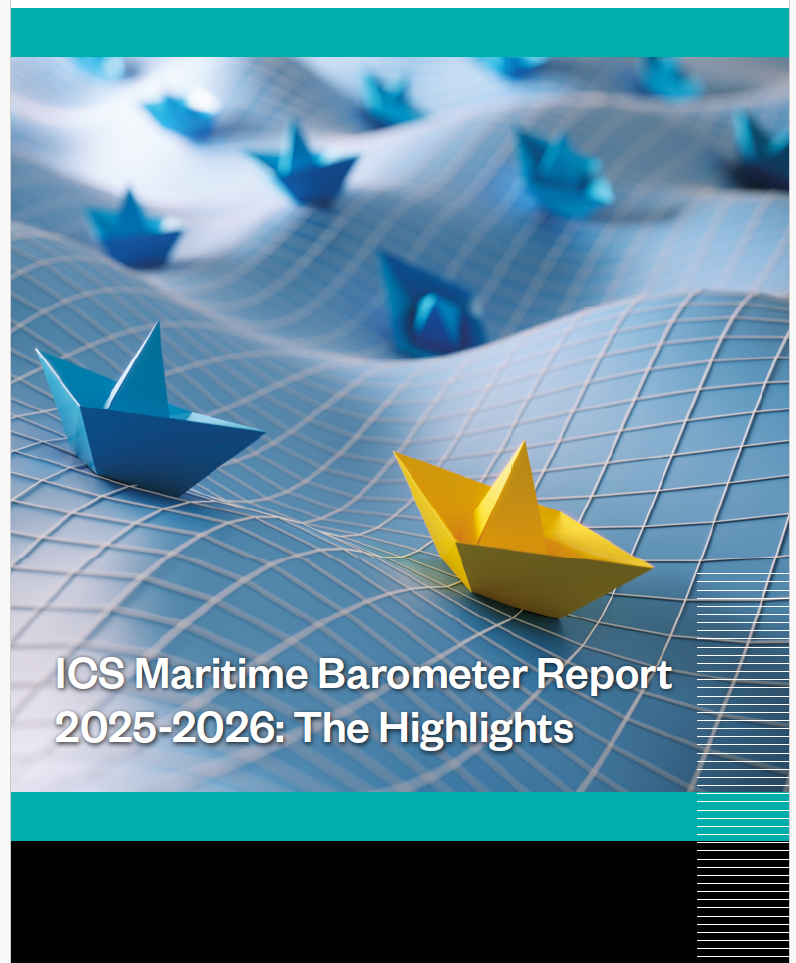
New ICS Maritime Barometer Report reveals geopolitical instability as defining force shaping global shipping
•Geopolitical instability identified as the industry’s leading risk and a key impact on wider operational challenges
•Cybersecurity and regulatory fragmentation rank among the sector’s most significant concerns
•Industry leaders are focusing on pragmatic solutions to reducing emissions amid continued uncertainty over availability of future fuels and regulation.
23 June 2026, Rome – The ICS Maritime Barometer Report 2025–2026, launches today by the International Chamber of Shipping (ICS) at the organisation’s Shaping the Future of Shipping Summit in Rome, reveals an industry adapting to an increasingly complex operating environment shaped by geopolitical instability, regulatory uncertainty, and economic volatility.
The ICS Maritime Barometer surveys C-suite level leaders, shipowners, and operators worldwide to identify the key risk areas shaping shipping. This 2025-2026 Barometer saw a record number of responses from shipping leaders worldwide, with the report identifying geopolitical instability as the sector’s most significant concern. The report suggests this instability acts as a risk multiplier across a range of challenges including cybersecurity, regulatory fragmentation, administrative burden, and changing global trade patterns.
The findings highlight a more fragmented and less predictable environment for international shipping, while also underscoring the sector’s continued resilience and ability to adapt. The report emphasises shipping leaders’ call for greater coordination, regulatory clarity, and financial support to ensure shipping can continue to facilitate global trade while progressing its energy transition.
Commenting on the Maritime Barometer Report, ICS Secretary General Thomas Kazakos said:
“Global shipping is entering a period where uncertainty is no longer an interruption to business, it is the backdrop against which decisions are made. The findings of this year’s Barometer are clear: geopolitical instability has become a defining risk multiplier, influencing everything from market conditions and operational planning to investment decisions and the pace of the energy transition. In response, industry leaders are taking an increasingly pragmatic approach, prioritising resilience, adaptability and proven solutions.”
The Barometer’s dedicated fuels section highlights how regulatory and market uncertainty is shaping the industry’s approach to decarbonisation. Respondents identified LNG (Liquified Natural Gas) and biofuels as the most viable fuel options for the next decade, followed closely by HFO (Heavy Fuel Oil) combined with abatement technologies. This reflects a potential preference for solutions supported by established supply chains and infrastructure. While alternative pathways continue to be explored across the industry, challenges related to cost and availability remain significant. The findings suggest that without regulatory certainty, the industry’s transition is likely to follow a more measured trajectory.
Reflecting on the industry’s practical approach, Thomas A. Kazakos said: “Maintaining progress will require regulatory clarity, global alignment, and continued cooperation between industry and governments. The Report reinforces the importance of stable international frameworks that support investment and provide confidence for long-term decision making. At a time of increasing fragmentation, maintaining a consistent global approach is essential for shipping, supply chains, and the wider world economy.”
