





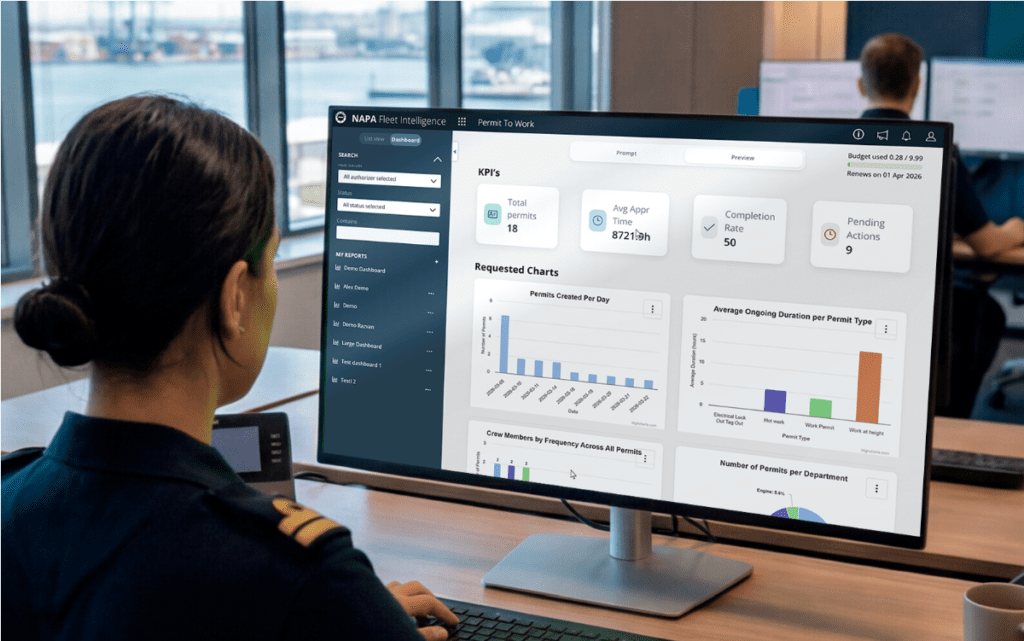
First natural language interface in maritime safety software gives shoreside fleet managers and safety officers a new way to monitor and analyze permit activity across their fleet
Helsinki, Finland, 24 June 2026: NAPA, the global provider of maritime software and data services, has launched an AI-powered Permit to Work (PtW) Dashboard within NAPA Fleet Intelligence, its cloud solution. The functionality, which is live now and adopted by Virgin Voyages and Ritz Carlton Yacht Collection fleets, gives shoreside fleet managers and safety officers a natural language interface – one of the first in maritime software – for permit analytics. This allows them to describe the data views they need in plain English and receive interactive, reusable and customizable dashboards instantly across multiple vessels, time periods and dimensions.
The launch of NAPA’s AI-powered PtW coincides with the International Maritime Organization’s Day of the Seafarer. This is an active investment in addressing shipping’s growing safety gap, as new technologies and regulations are introduced. Growing regulatory and administrative pressures introduce processes that are safety-critical, audit-sensitive, and heavily dependent on accurate record-keeping across multiple vessels simultaneously.
Research by the International Seafarers’ Welfare and Assistance Network (ISWAN) found that 54% of seafarers report increased workload and 44% report higher stress levels. Manual administrative tasks, including permit management and safety reporting, can account for up to 20% of crew time. NAPA’s own benchmarking with customers indicates that digitizing record-keeping with NAPA Logbook can recover up to 2,000 administrative hours per ship per year.
The new AI functionality is part of NAPA’s broader, multi-product and multi-year AI roadmap to strengthen maritime safety. The plan is focused on a principle-based approach to implement AI where it adds operational value to crew and shore teams. In May 2026, for example, NAPA released its AI-assisted cargo loading functionality within NAPA Stability, developed in collaboration with Stena Line for RoRo and ferry operations, which reduces cargo planning time from 1-1.5 hours to 10 to 15 minutes per departure.
The roadmap includes active development across NAPA Fleet Intelligence, focusing first on shoreside support to include anomaly detection in NAPA Logbook and Voyage Reporting, then extending to NAPA Logbook, PtW and Voyage Reporting functionalities onboard.
Sami Koponen, Product Owner, Cloud, NAPA Safety Solutions, commented: “The sequencing of this roadmap is deliberate: cloud-first, because that is where we can iterate fastest and at lowest cost, then onboard as each use case matures. What ties the program together is a single question we ask before committing to any AI capability: does this genuinely improve efficiency and accuracy? If the answer is not a clear ‘yes’, we do not build it. Launching the AI functionality for PtW on Day of the Seafarer felt like the right moment to say clearly that this work is already underway, and that it is built for the people that keep our industry safe.”
NAPA’s new cloud-based AI-powered PtW transforms the way fleet managers and safety officers interact with data and oversee permit activity across their vessels. Real-time insights using intuitive, smart technology help strengthen the ship-to-shore connection and turn operational data into actionable fleet intelligence at a speed that can keep up with the demands of shipping’s growing regulatory stack today. The result is less time on administrative tasks, faster and better data-informed decision making across teams, and stronger safety oversight across the fleet.
Tommi Vihavainen, Product Owner, NAPA Permit to Work, Safety Solutions, NAPA, added: “The AI-powered PtW Dashboard addresses a problem every fleet manager, particularly across cruise and ferry operations, recognizes too well: the data exists, but getting the right view of it across the whole fleet, in real time, has always required manual effort or technical support. Applying AI to tackle this challenge was both a natural evolution and a well-thought-out solution. Rather than applying AI for the sake of it, we carefully evaluated the problem and built a solution that could embed itself seamlessly into existing operational workflows. Our goal is always to make the lives of our end user easier.”
NAPA’s approach to AI and the underpinning privacy architecture distinguish it from many AI tools entering the maritime sector. The model is trained in the structure of permit data, not on operational data itself. When a user submits a query, the system generates chart logic, which is then applied client-side to live fleet data. Raw operational data does not pass through the AI layer.
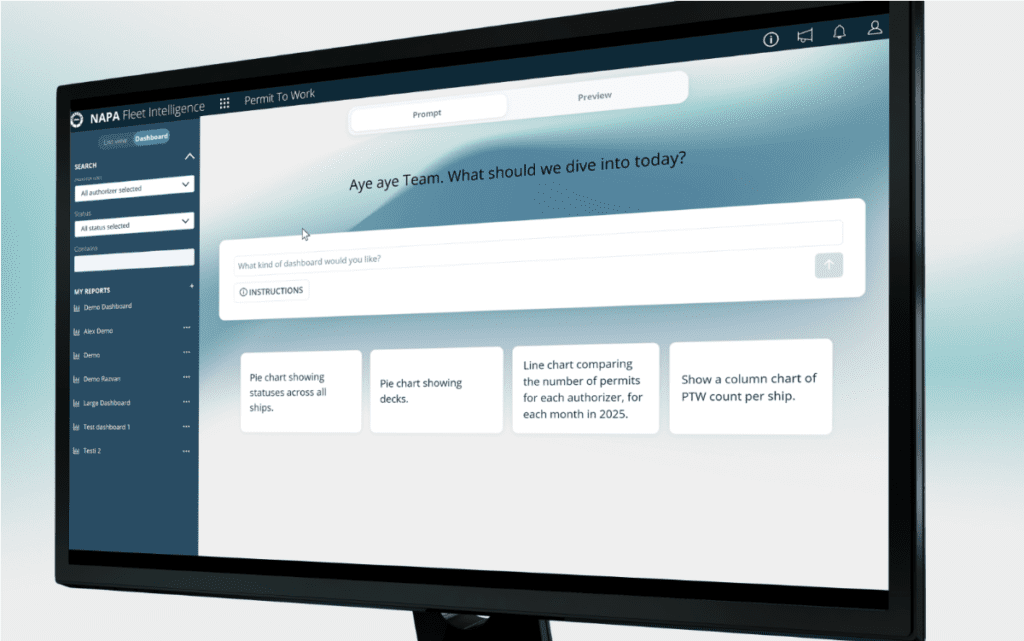
its cloud solution
Marco Carsjens, Fleet Captain, Virgin Voyages, said: “Managing permit activity across a fleet used to mean waiting for reports or trawling through data manually. NAPA’s new AI dashboard removes that inefficiency and provides us with a data secure, clear picture of what’s happening across the fleet just by asking for it. We can build and save our own, customized dashboards without any technical support, which means it is a tool we can actually use every day. It’s this element of usability that NAPA understands intimately and has made them indispensable to our teams.”
