





By James Brewer
For Seville, the 17th century was boom-time as galleons laden with gold and silver from the Americas sailed through the River Guadalquivir. Prosperity was secured too for the city’s lauded artist Francisco de Zurbarán (1598–1664) who made numerous artworks for religious institutions at home and overseas and for wealthy patrons.
With its legal monopoly on trade with the Americas, Seville was one of the richest cities in Europe, pivotal to much global commerce, allowing Zurbarán free rein and reign for his resplendent, captivating canvases.
The first major exhibition in the UK devoted to that prolific artist is enjoying a sterling run at the National Gallery in London (to August 23, 2026).
Although working at the same time as Diego Velázquez and Bartolomé Esteban Murillo, Zurbarán’s name is less familiar today to many, but for a long time he was the leading painter of Seville.
Zurbarán and his contemporaries reinforced the belief that paintings embraced tenets of faith uniting heaven and earth. He brought celestial visions onto huge canvases and altarpieces that were met with awe, in a style influenced by the then- radically new realism let loose by Italy’s Caravaggio and his followers, who often used live models from the populace.
To intensify the mysteries of faith, Zurbarán projected stark lighting onto the individual figures.
He modified a four-decade abundance of largely unforgiving representations of crucifixions, torture and saintly martyrdom by bestowing individuality (and sometimes elegant accessories) on several of his subjects. Such was Zurbarán’s forte and clearly yielded inexhaustible demand from his clients. Thankfully, the metaphorical and sometimes physical gloom of a constellation of suffering is offset by originality of treatment such as sympathetic renderings of the holy family, and of gorgeous fabrics and still life arrays.
Flawless images of the Virgin Mary, Joseph and Jesus, and of hallowed monks, saints and martyrs, make reverence and worship tangible. Iridescent fabrics, still life with the “breath” of fresh fruit and flowers – make for tone poems of the epoch. From the grandeur of soaring altarpieces to tender small canvases of piety, they haunt the imagination.
Zurbarán was born in Fuente de Cantos, near Badajoz, in the depressed region of Extremadura. In 1617, after training in Seville in painting, carving and gilding he returned to his native province. By 1629 he was back in Seville, where he ran a studio and began to win commissions from religious orders.
Zurbarán’s ability to make complex religious episodes immediate offer an insight into the Spanish psyche of the time. So true to life are the sacred figures, he seems to have the power to call up the dead.
The painting that set him aged 29 on the path to success was The Crucifixion (1627), here on loan from the Art Institute of Chicago. Part of a commission for the Dominican Order of San Pablo el Real in Seville, in its original setting it looked so dramatic that many of those who saw it thought it was a sculpture.
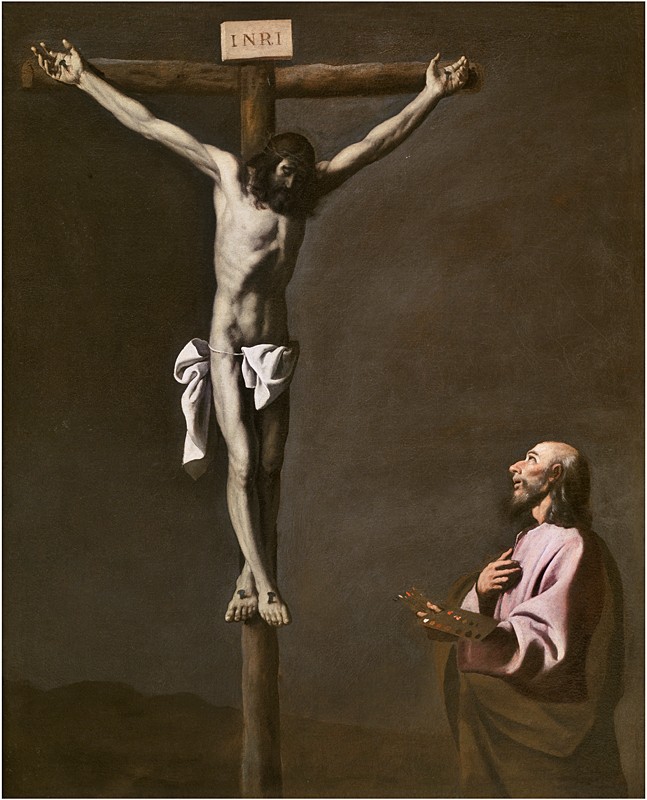
In The Crucified Christ with a Painter from Museo Nacional del Prado, Madrid, the figure with brushes and palette standing in awe of Christ has been identified as St Luke, patron saint of artists… although the curators speculate that it might be Zurbarán himself.
He represents saints as figures from the real world. Tellingly, and highlighted in a section of the exhibition entitled The Fabric of Saints, they wear variously wool, embroideries, leather and decorative cord. His cloth craftsman’s eye and fancy for stylish materials were derived from growing up with his merchant father, a respected haberdasher.
The tricks of the trade are apparent in the heft of the brocades that swathe male saints, in the elegant gowns of female saints and in the rustic apparel of friars.
For instance Saint Serapion is cloaked in a flowing garment of white wool. That martyr was tortured to death while attempting on behalf of the Mercedarian order to ransom Christians; the representation is relatively tranquil given the saint’s gruesome fate.
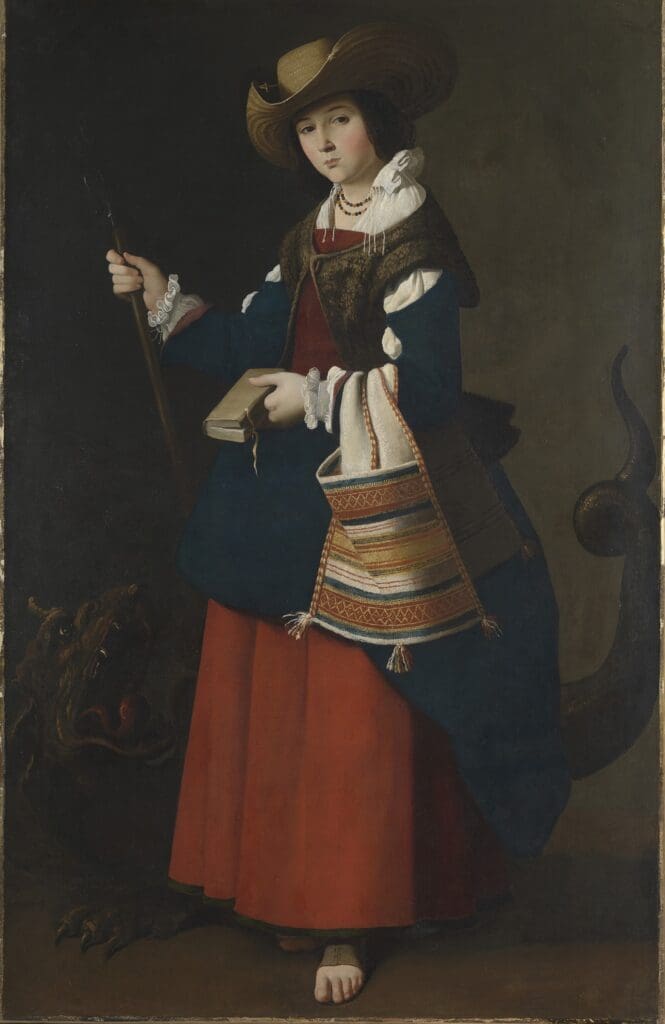
Through the detail he included in his paintings, Zurbarán made female saints beautiful and endowed them with personality. Saint Margaret of Antioch is a lavishly robed shepherdess, carrying a stylish woven tote bag that would to this day arouse envy, and stands coolly supreme over a Satanic dragon from which she had escaped by wielding a crucifix after being swallowed whole.
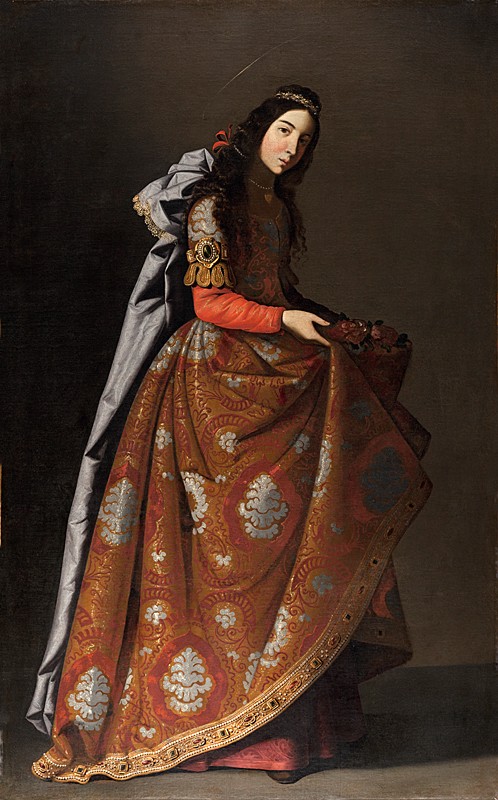
Marvel at the luxuriance of the garment of Saint Casilda of Toledo (Saint Casilda, Museo Nacional Thyssen-Bornemisza), the textures of her gold embroidery, and her jewellery.
Casilda was supposedly a Muslim princess who converted to Christianity and humanely nourished Christian prisoners with bread. When she was caught by her father, the pieces of bread miraculously turned into roses, although that did not prevent her from being martyred in 1087. A similar legend attached to Elizabeth, the daughter of Peter III of Aragon, and to Saint Elizabeth of Hungary. Said to be the great-niece of her Hungarian namesake, Saint Elizabeth of Portugal is envisioned by Zurbarán in splendid robes in the picture usually in the Prado.. Late in life Zurbarán himself was involved in the materials trade, selling silk thread of Seville to a buyer in Madrid.
Whether intentionally or not, his models of refined, self-assured saints and his perception of the Virgin Mary made women powerful participants in his repertoire.
With seemingly inexhaustible inner reserves, Zurbarán continuously strove for new ways to evoke intense feelings through paint.
Religious denominations across much of Spain strove to sport the most lavishly decorated buildings, as with the huge altarpiece for the Charterhouse of the Carthusian monastery of Nuestra Señora de la Defensión, at Jerez de la Frontera, about 96 km south of Seville. For the first time in a century or more, the National Gallery is reuniting works from the 15-metre-high altarpiece. They are three paintings from 1638-9: The Circumcision, The Adoration of the Magi and The Virgin of the Rosary with the Carthusians which is more than three metres tall.
Many missionaries left for the Americas from Seville, and Zurbarán exported more than 100 canvases over the Atlantic to Lima, Buenos Aires and elsewhere.
For a time, he worked prodigiously at the Madrid royal court to help decorate the Buen Retiro, Philip IV’s extravagant new palace.
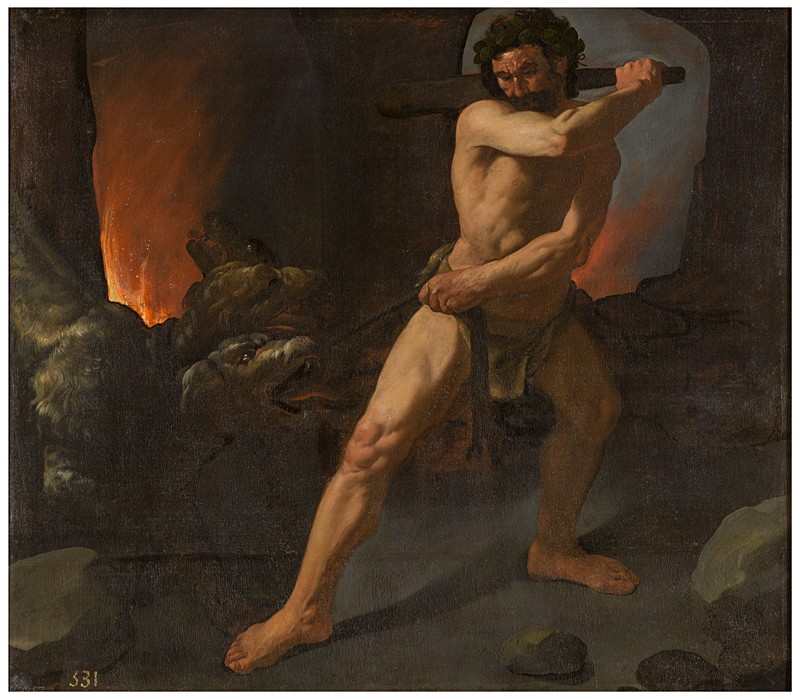
In 1634 Zurbarán received his most prestigious commission, to help decorate Philip IV’s grandiose, new palace, the Buen Retiro. He was to contribute 12 paintings to the Hall of Realms, including ten on the labours of a muscular Hercules, two of which are in the London exhibition (Hercules and Cerberus and Hercules and the Cretan Bull), both loaned by the Prado. He provided historic scenes including The Defence of Cádiz against the English (1634), illustrating the failed 1625 attack by an Anglo-Dutch fleet led by Sir Edward Cecil, Viscount Wimbledon.
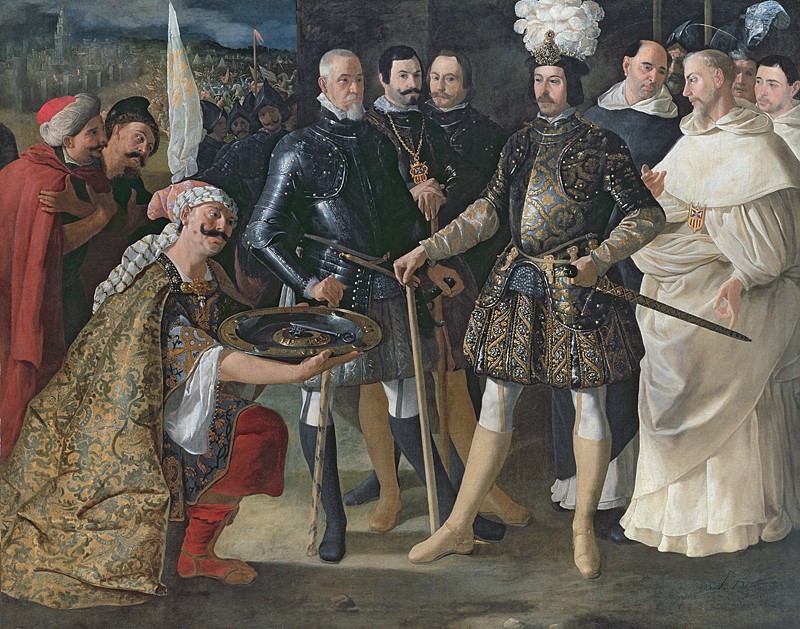
The Mercedarians commissioned The Surrender of Seville which is based on the end of a long Muslim domination in 1248. It shows the governor Achacaf ceding the region to Ferdinand III of Castille and Leon and was another perfect opportunity for Zurbarán to show his familiarity with stand-out fabrics.
Dating from 1629, The Apparition of Saint Peter to Saint Peter Nolasco from the Prado has the white-robed Nolasco – founder of the Mercedarian order – with a vision of his namesake who wanted to be crucified upside down to be distinguished from the treatment of the Saviour.
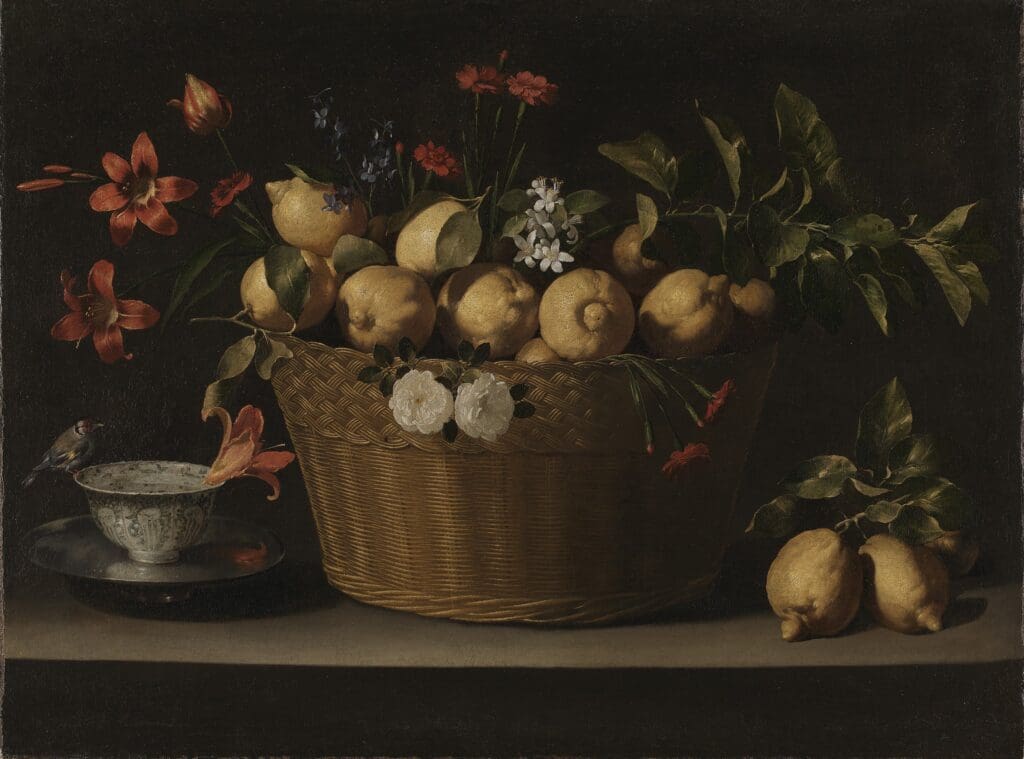
In sharp contrast to all the aforementioned, one room of the exhibition acclaims the genre of still life (bodegones) including four marvellous examples from Zurbarán’s son Juan. Tragically, the epidemic that wiped out half the population of Seville and wrought economic havoc felled Juan at the age of just 29 . Although Juan is recorded as having like his father painted religious works none of them have survived. In all, fewer than 20 paintings by Juan are known to exist.
Juan’s Still life with Lemons in a Wicker Basket (about 1643-9) and Flowers and Fruit in a Bowl (about 1645) on loan from the Art Institute of Chicago show that he had a more flexible approach than his father to still life composition.
The full glorious title of the bountiful wicker basket assemblage is Still Life of Lemons, Day Lilies, Carnations, Roses and a Lemon Blossom in a Wicker Basket, together with a Goldfinch perched on a Porcelain Bowl of Water, on top of a Silver Tray, all arranged upon a Stone Ledge.
In Juan’s first known painting, signed when he was 18 or 19, he arranged lush grapes so artfully on a copper dish, that it was said to have echoes of the story of the 4th century BCE Greek artist Zeuxis of Heraclea who painted grapes that were so realistic that birds swooped down to try to eat them.
Francisco de Zurbarán produced only10 or so essays in the still life category, in which unlike the more crowded compositions of his son, each object commands its own space. Still Life with Lemons, Oranges and a Rose, 1833, was the earliest signed and dated, and is on loan from the Norton Simon Foundation in California. It is shown for the first time alongside the National Gallery’s A Cup of Water and a Rose.
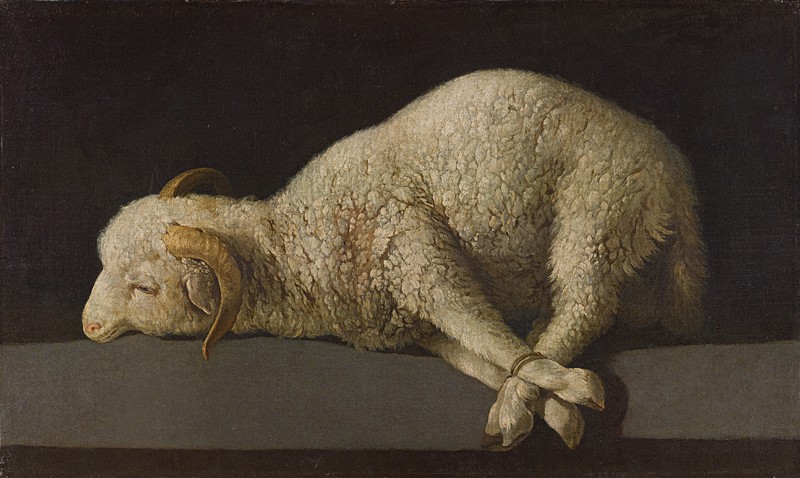
The final sections of the exhibition highlight examples of what Zurbarán made for individual devotion and contemplation, such as the disarming The Family of the Virgin from the Abelló Collection. In Zurbarán’s very moving Agnus Dei a lamb lies bound up for the slaughter, or perhaps the creature is already slain. Its soft fleece and drooping eye arouse compassion.
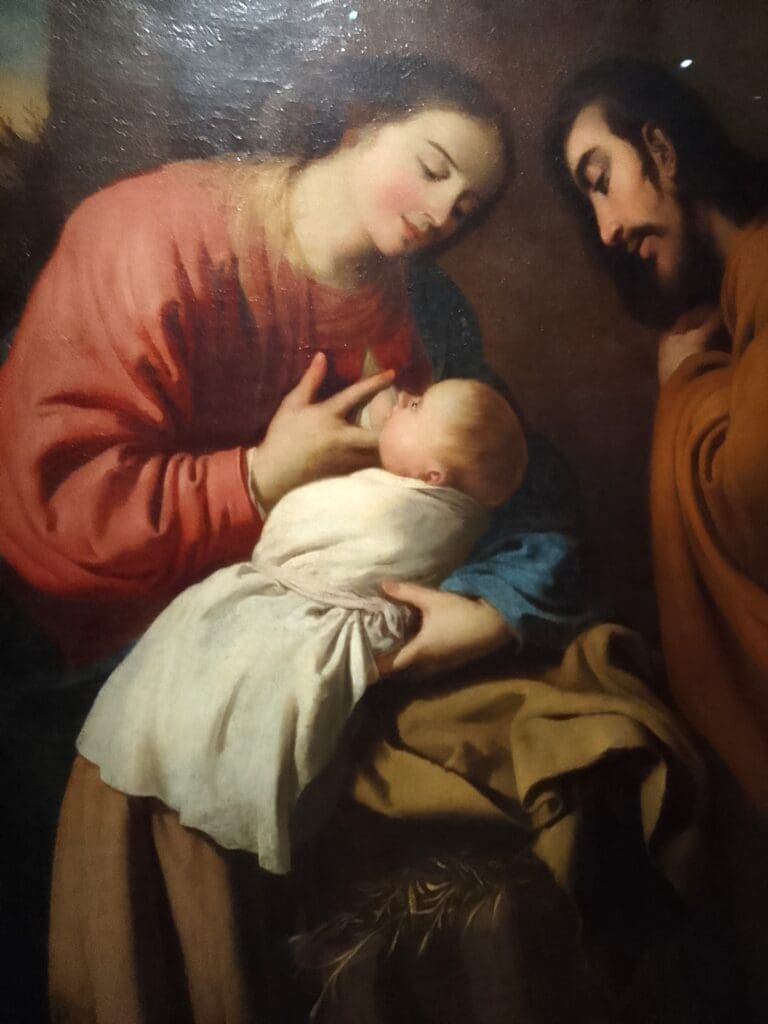
Allusion to much sorrow drains away towards the close of Zurbarán’s career in favour of a gentle intimacy and milder strokes of the brushes; for instance, Holy family of 1659 from the Museum of Fine Arts, Budapest, presents Mary and Joseph as parents caring lovingly for their child. Joseph is no longer interpreted as customary as an old man, and Mary is akin to a Nursing Madonna, unusual for the 17th century.
The exhibition is the first dedicated presentation of Zurbarán’s paintings at the National Gallery since 1994.
Daniel Sobrino Ralston, the National Gallery’s Centro de Estudios Europa Hispánica associate curator of Spanish Paintings, said: “We are excited to present the most comprehensive survey of Zurbarán’s work ever seen in Britain, bringing together exceptional loans from across the UK, Europe and the United States. This exhibition offers new insights on one of the great artists of the Baroque era, whose visionary paintings have shaped our understanding of 17th-century Spain.’”
The exhibition is organised by the National Gallery of London, the Musée du Louvre, Paris, and the Art Institute of Chicago.
It is curated in London by Francesca Whitlum-Cooper and Daniel Sobrino Ralston with Imogen Tedbury, in collaboration with Charlotte Chastel-Rousseau (Musée du Louvre) and Rebecca Long (Art Institute of Chicago). Ms Whitlum-Cooper, National Gallery curator of Later Italian, Spanish and French Paintings, described Zurbarán as a powerful storyteller. She said: “It is thrilling to present the UK’s first major monographic exhibition on Zurbarán, which is long overdue. I hope visitors in London – and at our partner venues in Paris and Chicago – will be both amazed and moved by this encounter with Zurbarán’s work.”
Ignacio Galán, chairman of sponsor Iberdrola and ScottishPower, said: “In our 125th year we are honoured to help showcase in the UK one of the most celebrated painters of the 17th century.”
Image captions in detail:
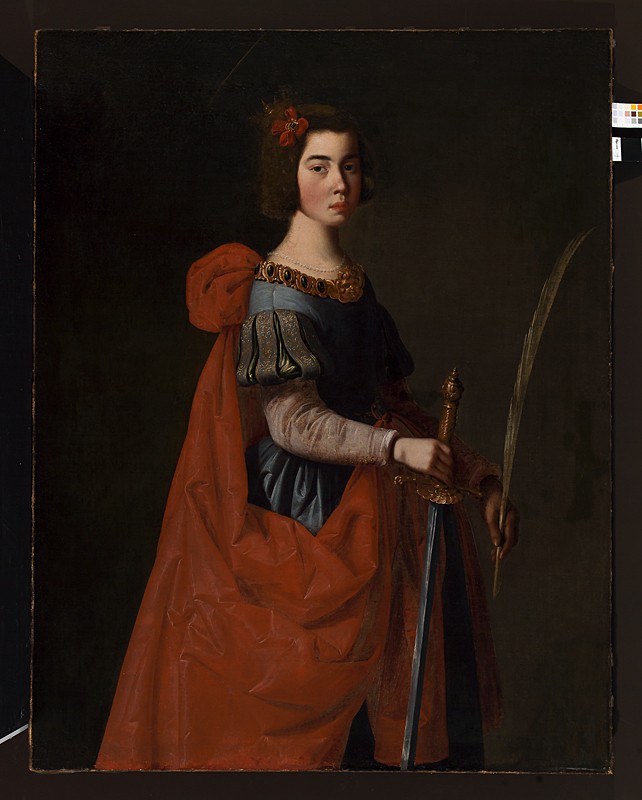
Saint Margaret of Antioch, 1630-34. By Francisco de Zurbarán. Oil on canvas. © The National Gallery, London.
Agnus Dei, 1635-1640. By Francisco de Zurbarán. Oil on canvas. © Photographic Archive Museo Nacional del Prado, Madrid.
The Crucified Christ with a Painter, about 1650. By Francisco de Zurbarán. Oil on canvas. © Photographic Archive Museo Nacional del Prado, Madrid.
Hercules and Cerberus , 1634. By Francisco de Zurbarán. Oil on canvas. © Photographic Archive Museo Nacional del Prado, Madrid.
Still Life with Lemons in a Wicker Basket. about 1643-9. By Juan de Zurbarán. Oil on canvas. © The National Gallery, London.
The Surrender of Seville, 1629. By Francisco de Zurbarán. Oil on canvas. © Private Collection/ Bridgeman Images.
Saint Catherine of Alexandria, about 1640. By Francisco de Zurbarán. Oil on canvas. © Arte Ederren Bilboko Museoa – Museo de Bellas Artes de Bilbao. Contributed by the Provincial Council of Biscay in 1919.
Saint Casilda, about 1635. Francisco de Zurbarán. Oil on canvas. © Museo Nacional Thyssen-Bornemisza, Madrid.
The Holy family (detail), 1659. By Francisco de Zurbarán. Oil on canvas. Museum of Fine Arts, Budapest.
The exhibition is at the Sainsbury Wing pf the National Gallery until August 23, 2026. The Louvre exhibition of Zurbarán’s works will run from October 7, 2026, to January 25, 2027, and the exhibition will be at the Art Institute of Chicago from February 28 until June 20, 2027.
