





Article Highlights
– Pharmaceutical residues are not always effectively removed by conventional wastewater treatment.
– Nano-bio/chemosensors enable highly sensitive detection of pharmaceuticals in water.
– Multifunctional nanoplatforms can combine pollutant detection with removal through adsorption, photocatalysis and advanced oxidation.
– Laboratory studies report removal efficiencies exceeding 80–99% for selected pharmaceutical contaminants.
– Further validation in real wastewater is required to ensure scalability, stability, cost-effectiveness and environmental safety.
by




and

1 School of Chemistry, Aristotle University of Thessaloniki, 54124 Thessaloniki, Greece
2 Immunology of Infection Group, Department of Microbiology, Hellenic Pasteur Institute, 11521 Athens, Greece
3Laboratory of Cell Technology, Department of Biotechnology, Agricultural University of Athens, 11855 Athens, Greece
4Hephaestus Laboratory, School of Chemistry, Faculty of Sciences, Democritus University of Thrace, 65404 Kavala, Greece
*Author to whom correspondence should be addressed.
Appl. Sci. 2026, 16(16), 8260; https://doi.org/10.3390/app16168260
Submission received: 17 July 2026 / Revised: 7 August 2026 / Accepted: 18 August 2026 / Published: 19 August 2026
(This article belongs to the Special Issue Feature Review Papers in Environmental Chemistry and Sustainability)
Abstract
The increasing accumulation of pharmaceutical residues in water environments poses serious threats concerning environmental safety and public health, mainly due to their tenacity, continuous bio-activity, and resistance to traditional wastewater treatment processing. Although many nano-bio/chemosensor systems have been reported for the monitoring and removal of pharmaceutical residues, the literature remains fragmented regarding their ability to integrate detection and remediation into a single platform. In this context, this review critically examines recent developments in nano-bio/chemosensor platforms for simultaneous detection and elimination of pharmaceutical effluents in wastewaters. Particular emphasis is placed on their functional integration, detection mechanisms, analytical performance, and removal pathways. This review covers the major pharmaceutical categories, including pharmaceutical drugs, antibiotics, hormones, perfluorinated compounds, and drugs of abuse and discusses nanostructured platforms based on metal organic frameworks (MOFs), nanochannel-based immunosensors, noble metal nanoparticles, layered double hydroxides, and hybrid composites. Detection approaches based on fluorescence modulation, electrochemical impedance, ionic current rectification, surface-enhanced Raman scattering (SERS), and colorimetric nanoenzyme activity could lead to extremely low detection limits. In addition, removal mechanisms such as adsorption, photocatalysis, advanced Fenton-induced oxidation processes, and nanoenzymes allow for high degradation efficiencies (>80–99%). Significant advantages for real-time monitoring and sustainable wastewater treatment can be achieved by multifunctional nanoplatforms that integrate detection and remediation capabilities. Finally, this review identifies current limitations and research gaps regarding practical application, matrix effects, regeneration, stability, scalability, and integration into real wastewater treatment systems and outlines future research directions towards more efficient and environmentally relevant multifunctional platforms.
Keywords:
chemosensors; biosensors; nanoparticles; pharmaceuticals; antibiotics; detection; removal; MOF; treatment; wastewaters
1. Introduction
The extensive consumption of human and veterinary pharmaceuticals and the continuous growth of the global pharmaceutical industry have dramatically increased the persistent release of pharmaceutical residues into water [1]. Antibiotics [2], analgesics [3], anti-inflammatory drugs [4], and hormones [5] are regularly found in surface water, groundwater, and even drinking water [6], as a result of incomplete human or animal metabolism, as well as inadequate removal by typical wastewater treatment plants [7]. An example of such contaminants are tetracyclines, an important category of antibiotics, which raise concerns for contamination due to their high stability, solubility, and resistance to biodegradation [8,9]. Their presence in water can result in increased antimicrobial resistance [10], ecological toxicity [11], and subsequent bioaccumulation [12], posing severe threats to human public and environmental health.
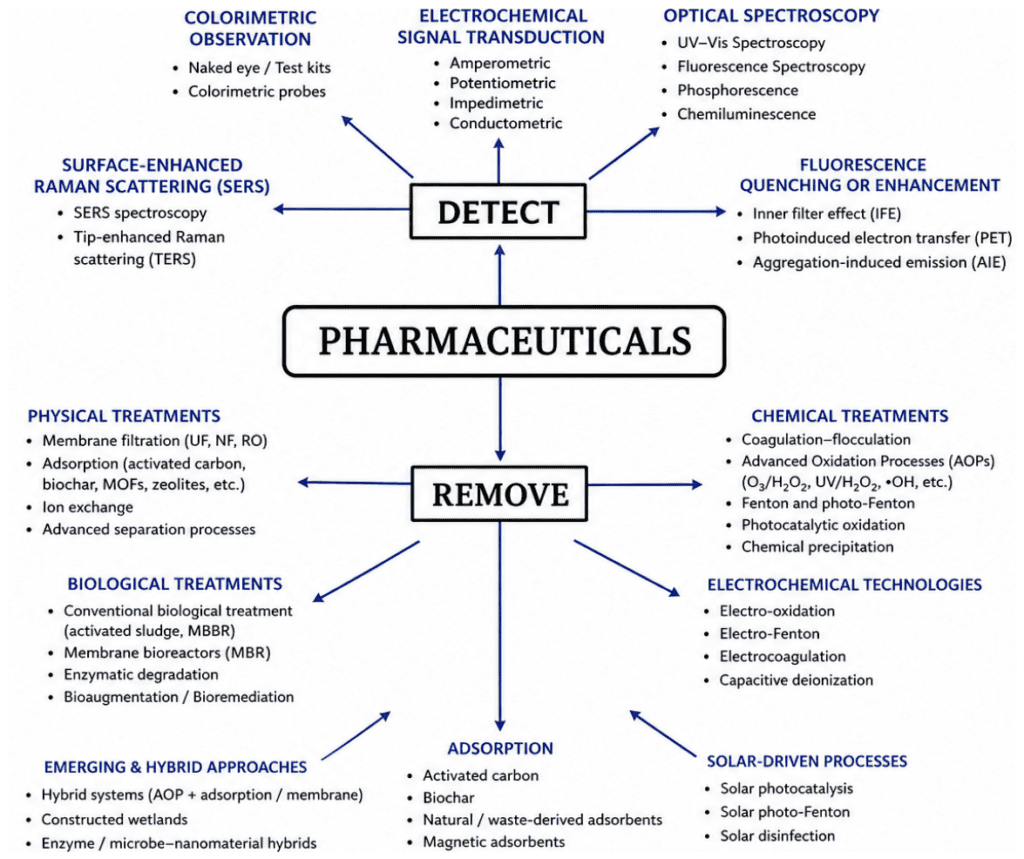
Conventional and advanced wastewater treatment technologies can be broadly classified into physical, chemical, biological, and electrochemical processes, while the development of new functional materials has provided additional opportunities for the effective treatment of pharmaceutical pollutants. Physical treatments, including membrane filtration [13] and adsorption [14], can facilitate the separation of pharmaceuticals from aqueous matrices; however, membrane fouling, limited selectivity, and the generation of concentrated waste streams may restrict their practical application [15]. Chemical treatments, such as coagulation/flocculation [16] and advanced oxidation processes (AOPs) [17], have also been widely investigated. Although coagulation and flocculation are relatively simple and established processes, their effectiveness can be limited for persistent and highly soluble pharmaceutical compounds and may result in secondary sludge production [15]. AOPs, which promote the formation of highly reactive species such as hydroxyl radicals (•OH), can enhance the degradation of recalcitrant pharmaceuticals; nevertheless, their application may involve high energy or chemical requirements, complex operating conditions, and, in some cases, the formation of potentially toxic transformation products [18]. Biological processes, including conventional activated sludge and other biodegradation systems, are generally cost-effective and environmentally friendly, but many pharmaceuticals, particularly persistent antibiotics, exhibit limited biodegradability and may therefore remain in the treated wastewater [19].
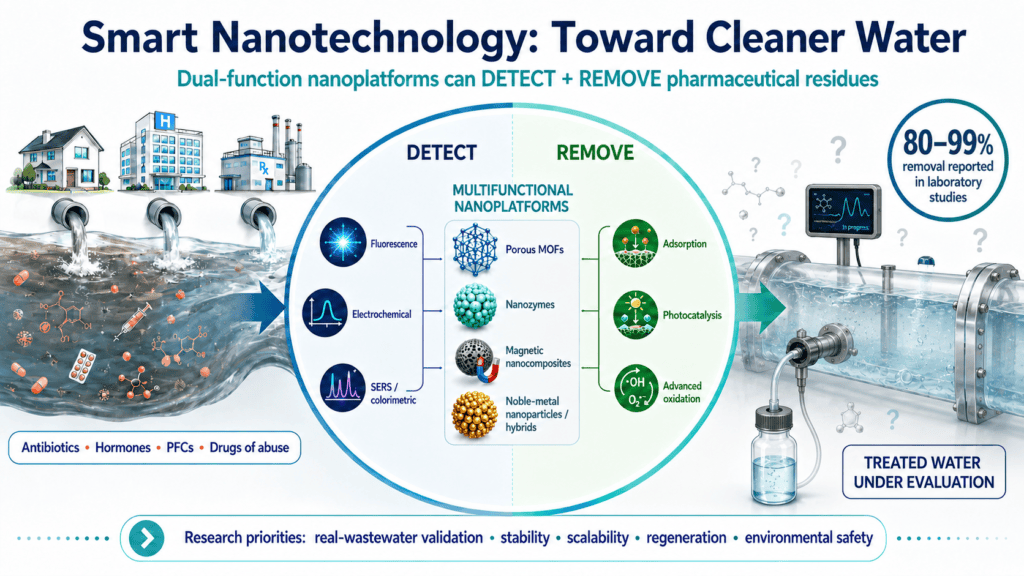
The most recent research efforts are focused on multifunctional nanomaterials—including metal organic frameworks (MOFs), noble metal nanoparticles, metal oxides, and nanozymes. An increasing trend towards effective integration of both detection and removal capabilities into a single nanoplatform is flourishing, in an attempt to move away from earlier approaches that addressed sensing and remediation separately. This trend emphasizes hybrid systems combining sensitive detection mechanisms (SERS, fluorescence, electrochemical, and colorimetric methods) with synergistic removal pathways (adsorption, Fenton-like catalysis, and photocatalysis) to enable real-time monitoring and in situ treatment of pharmaceutical contaminants such as antibiotics, hormones, PFCs, and drugs of abuse in wastewater.
More specifically, engineered nanomaterials, developed for nano-bio/chemosensors and other analytical applications, can be ideal for the simultaneous detection and removal of pharmaceutical residues from wastewaters, having improved physicochemical properties, such as high surface-to-volume ratio, adjustable electronic structure, abundant active sites, and high catalytic activity [20,21,22]. These features allow ultrasensitive biomolecule/pollutant detection, rapid response times, and high selectivity, such as a recovery rate reaching 100% [23]. In parallel, nanostructured materials, such as metal organic frameworks (MOFs) [24], noble metal nanoparticles [25], metal oxides [26], and nanozymes [27], have been evaluated and exhibited extraordinary performance in terms of adsorption, photocatalysis, and catalytic degradation. Integrating detection and remediation into a single nanoplatform constitutes an effective strategy for real-time monitoring and pharmaceutical pollutant treatment/removal [28].
Nano-bio/chemosensor detection principles are based on various mechanisms, including surface-enhanced Raman scattering (SERS) [20], fluorescence quenching or enhancement [29], electrochemical signal transduction [30], and colorimetric observation derived from enzyme mimic activity (nanozymes) [31]. At the same time, mechanisms that remove pharmaceutical residues include physical adsorption via hydrogen bonding, π-π interactions [32], Fenton or Fenton-like reactions that activate hydrogen peroxide (H2O2) to generate reactive oxygen species (for instance •OH and superoxide radicals (•O2−)) [4], and photocatalytic oxidation under light irradiation [33]. Therefore, the proper design of multifunctional nanomaterials enables synergistic interactions amid components, improving electron transfer, catalytic efficiency, structural stability, and recyclability [34,35], as shown in Figure 1.
While substantial progress has been made, various challenges remain, such as reaching lower detection limits, improving long-term stability under non-laboratory conditions, minimizing secondary activated sludge, and increasing removal efficiency [36]. For these reasons, it is essential to address the limitations of existed solutions for treatment systems, such as conventional biological treatment, adsorption, membrane filtration, and advanced oxidation processes [37], and to provide new eco-friendly solutions suitable for pharmaceutical pollution [38].
In general, pharmaceutical effluents comprise a broad and diverse class of emitted contaminants that are progressively detected in water systems due to their massive production, consumption, and incomplete removal by existing wastewater treatment systems [4]. These pollutants originate from domestic usage, hospitals, and pharmaceutical manufacturing effluents, as well as inappropriate disposal techniques. Many pharmaceutical compounds are designed to be biologically active and chemically stable; therefore, they have the ability to persist in water bodies at trace concentrations and have long-term ecological and toxicological effects [9,28,39].
The present work focuses on four major categories of pharmaceutical-related pollutants: perfluorinated compounds [2], hormones [40], drugs of abuse [20], and antibiotics [31]. Perfluorinated compounds (PFCs) are anthropogenic organofluorine substances that are extensively used and are considered environmentally significant due to their resistance to degradation and their accumulation in living organisms [41]. Hormonal compounds, notably endocrine-disrupting chemicals, for example natural and synthetic estrogens, can affect the hormonal balance of aquatic organisms even at low concentrations, causing reproductive and developmental abnormalities [40]. Drugs of abuse, such as illicit substances and their metabolites, are now accepted as environmental effluents and are used frequently as an index of community-level consumer standards [11,20]. One of the most worrying groups is antibiotics, because of their tenacity, common use in human and veterinary medicine, and role in enhancing antimicrobial resistance in environments containing microbes [42,43].
The appearance of such pharmaceutical effluents in wastewater and surface water makes implementation of sensitive detection methods using nano-bio/chemosensors and efficient removal technologies pressing priorities [44]. The pharmaceutical residues’ chemical structures, physicochemical properties, and biological activities require advanced treatment technologies capable of addressing both trace-level monitoring and effective remediation [45].
This review presents multifunctional nanomaterials capable of detecting pharmaceutical residues and further focuses on nano-bio/chemosensors used for both the detection and removal of pharmaceutical pollutants from wastewater. Unlike previous studies that refer to detection and treatment separately, in this work, detection mechanisms are mapped to the associated degradation and clearance pathways within incorporated nanoplatforms. Furthermore, particular attention is given to new hybrid systems, like MOF-based composites, nanoenzyme-enabled catalysts, and nanochannel immunosensors, highlighting their dual use for real-time monitoring and in situ repair.
This review summarizes nano-bio/chemosensors for pharmaceutical residue detection and the experimental processes used to test them. Thereafter, it mentions nano-bio/chemosensors that detect and remove pharmaceuticals from wastewater and comparatively evaluates them.
2. Nano-Bio/Chemosensor for Pharmaceutical Residue Detection
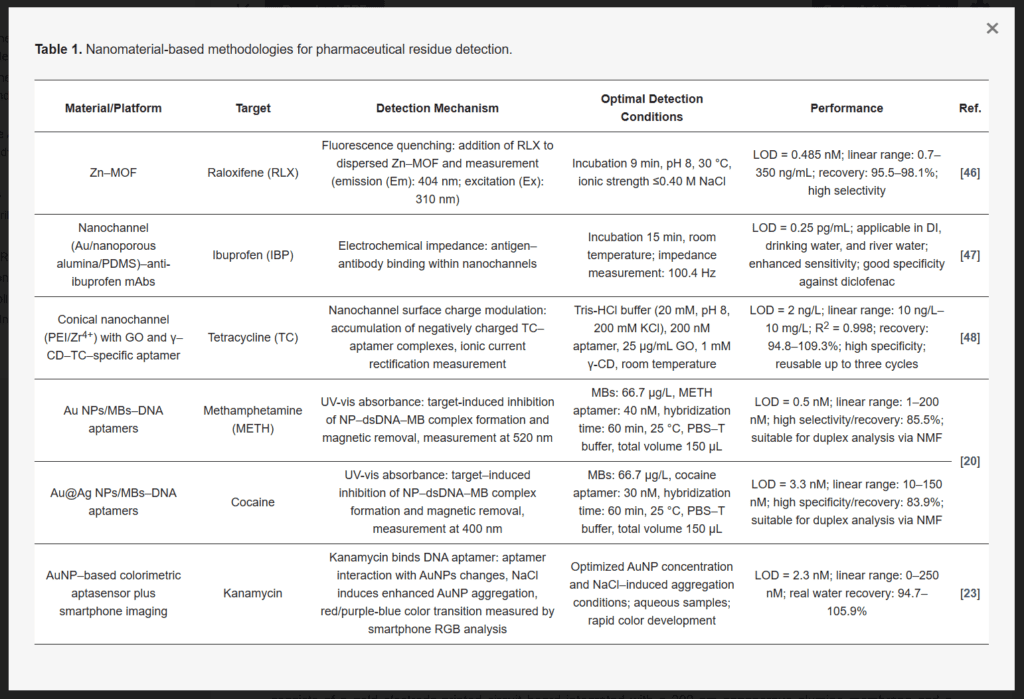
Pharmaceutical residue detection in wastewater has been facilitated by the implementation of nanomaterial-based methodologies. Several types of nanoparticles/nanostructures have been applied for the detection of various target substances, including gold nanoparticles (Au NPs), nanostructures containing Ag, Zn metal organic framework (Zn-MOF) nanosensors, and nanochannels based on nanoporous alumina or polyethyleneimine (PEI)/Zr4+ (Table 1).
Table 1. Nanomaterial-based methodologies for pharmaceutical residue detection.
2.1. Zn-MOF Nanosensor for Raloxifene Detection
Metal organic framework nanostructures were used to detect raloxifene (RLX), a member of the class of 1-benzothiophenes which is used to prevent and treat osteoporosis. More specifically, a fluorescent Zn-MOF nanosensor [46] was composed by a solvothermal method using Zn(NO3)2·6H2O and H3BDC in dimethylformamide (DMF), followed by autoclave treatment, washing, methanol activation, and drying. The original material was found to have symmetric fluorescence emission at 404 nm under 310 nm excitation, but the presence of RLX induced fluorescence quenching through the internal filter effect (IFE), enabling its detection within a linear range of 0.7–350 ng/mL and with a low detection limit of 0.485 nM. Optimal sensing conditions at pH 8 and 30 °C resulted in a 9 min response time, with negligible interference up to 0.40 M NaCl. The method showed high selectivity and good applicability in real urine and seawater samples, achieving recoveries between 95.5% and 98.1%, confirming its sensitivity and reliability for RLX monitoring application in the field. The mechanism of fluorescence quenching is based on the internal filter effect (IFE). Zn-MOF demonstrates strong fluorescence emission at 404 nm when excited at 310 nm. In the presence of RLX, the fluorescence intensity decreases because RLX absorbs the excitation energy of Zn-MOF due to the notable spectral overlap between the Zn-MOF excitation spectrum and the RLX absorption spectrum. This absorption reduces the energy available for fluorescence emission. The increase in the fluorescence quenching ratio (F0/F) with increasing RLX concentration confirms the IFE-based detection mechanism [46].
2.2. Nanochannel-Based Electrochemical Immunosensor for Ibuprofen Detection
A nanochannel-based electrochemical immunosensor was developed for the ultra-sensitive detection of ibuprofen, a nonsteroidal anti-inflammatory drug (NSAID), in environmental water samples [47]. The sensor platform consists of a gold electrode-printed circuit board integrated with a 200 nm nanoporous alumina membrane and a polydimethylsiloxane (PDMS) microfluidic manifold, forming a high-density nanochannel array at the electrode interface. Surface functionalization was achieved using a thiol-based linker, dithiobis(succinimidyl propionate) (DSP), followed by covalent immobilization of anti-ibuprofen monoclonal antibodies and blocking of nonspecific binding sites. The detection mechanism is based on measuring changes in electrical impedance resulting from the specific binding of ibuprofen molecules to the immobilized antibodies within the confined nanochannels. It was found that the nanoconfinement effect enhances analyte diffusion and amplifies capacitive changes at the electrical double layer, significantly improving sensitivity compared to non-nanochannel platforms (from 1 fg/mL 1 to 10 ng/mL). Under optimized conditions, including 15 min incubation at room temperature and impedance measurement at 100.4 Hz, the sensor achieved an exceptionally low detection limit of 0.25 pg/mL. In different types of water, such as deionized water, drinking water, and river water, the platform showed reliable performance, with good specificity against structurally similar compounds [47].
2.3. Nanofluidic Mechanical Aptasensor for Tetracycline Detection
A highly sensitive and selective nanofluidic mechanical aptasensor was developed for the detection of tetracycline (TC), a broad spectrum polyketide antibiotic. The nanosensor is composed as a conic nanochannel platform functionalized with polyethyleneimine (PEI) and Zr4+ ions, combined with graphene oxide (GO) and γ-cyclodextrin (γ-CD) [48]. The detection strategy is based on surface charge modulation of the nanochannel involved in the specified formation of TC-aptamer complexes. When TC is absent, GO adsorbs free aptamers due to π-π stacking interactions, causing minor signal variation. When TC is present, the aptamer selectively binds to TC, forming negatively charged TC–aptamer complexes that desorb from GO and accumulate on the positively charged PEI/Zr4+-modified nanochannel surface. This accumulation neutralizes the surface charge, leading to a detectable change in the correction of the ionic current. To minimize interference from free TC, γ-CD was used to form inclusion complexes (TC@γ-CD), thus preventing nonspecific adsorption on the nanochannel surface and improving detection accuracy. The conical nanochannels were produced by etching polyethylene terephthalate (PET) films. To achieve surface modification, electrostatic adsorption of PEI followed by coordination with zirconium acetate was performed to introduce Zr4+ binding sites. The detection procedure required incubation of TC with its aptamer, removal of excess aptamer using GO, shielding of residual TC with γ-CD, and subsequent ionic current measurement using a picoammeter with a voltage scan from −1 V to +1 V. Under optimal conditions (pH of 8, 200 nM of aptamer, 25 μg/mL of GO, and 1 mM of γ-CD), the device measurements resulted in a linear detection range of 10 ng/L–10 mg/L and a very low detection limit of 2 ng/L (S/N = 3). The calibration equation indicated excellent linearity (R2 = 0.998). The device illustrated satisfactory recoveries (94.8–109.3%) from river water, tap water, and wastewater samples and could be reused for up to three regeneration cycles following mild NaOH treatment [48].
2.4. Colorimetric Biosensor for Methamphetamine and Cocaine Simultaneous Detection
In a recent study [20], a simple and rapid duplex colorimetric biosensor capable of simultaneous detection of methamphetamine (METH) and cocaine (both drugs of abuse) in a single assay was developed. The sensing platform relies on the combination of magnetic beads (MBs), DNA aptamers, and noble metal nanoparticles, i.e., Au NPs for METH and Au@Ag NPs for cocaine, both functionalized with DNA reporter probes (RPs). The MBs were conjugated with specific capture probes (CPs) complementary to each target aptamer. In the absence of target drugs, the aptamer hybridizes with the CP and RP to form a sandwich structure (NP-dsDNA-MB), which can be removed using an external magnetic field. Upon introduction of METH or cocaine, the aptamer preferentially binds to the target, preventing sandwich formation and resulting in a supernatant color change proportional to the drug concentration. The AuNPs and Au@Ag NPs were synthesized and characterized via UV-vis spectroscopy, SEM, and HR-TEM, exhibiting uniform particle sizes of ~40 nm. Au@Ag nanoparticles exhibited a thinner silver shell around the gold core, with a 400 nm UV-vis absorption peak, while Au nanoparticles exhibited a peak at 520 nm. The Au@Ag nanoparticles exhibited a reduced absorption signal when hybridized with the aptamer and the CP, which corresponds to their removal by the MBs via magnetic separation in the absence of cocaine. When cocaine was present, uptake of Au@Ag nanoparticles increased because of the formation of cocaine-aptamer complexes, which stopped the sandwich-like assembly and subsequent removal. Likewise, the Au NP signal responded to the presence of METH. The optimization of experimental conditions shown that the MB concentration, the aptamer concentration, and the hybridization time were critical parameters for assay sensitivity. The ideal MB concentration was 66.7 μg/L for both analytes, the optimal aptamer concentration was 40 nM for METH and 30 nM for cocaine, and 60 min was the optimal time for hybridization. Under the optimal conditions, the biosensor showed linear detection ranges of 1–200 nM for METH and 10–150 nM for cocaine, with detection limit of 0.5 nM and 3.3 nM, respectively. For their simultaneous detection, UV-vis spectroscopy of the AuNPs and Au@Ag NPs was applied, and they were examined using non-negative matrix factorization (NMF) to decondense overlapping spectral signals and allow quantification of both drugs. Furthermore, the biosensor demonstrated perfect specificity against seven other illicit drugs and metabolites, such as cathinone, methcathinone, ketamine, and morphine, with insignificant interference. The method was applied to real wastewater samples, resulting in 85.5% recovery of METH and 83.9% recovery of cocaine, showing that the proposed approach is suitable for assessing illicit drug consumption at the community level through wastewater-based epidemiology (WBE) [20]. However, the source and characteristics of the wastewater samples were not determined in the original study, which limits the assessment of how the wastewater matrix and potential sources of contamination may have affected analytical performance.
2.5. AuNP-Based Colorimetric Aptasensor for Kanamycin Detection
A colorimetric biosensor based on gold nanoparticles (AuNPs) was developed for the detection of kanamycin in wastewater. The Au nanoparticles were synthesized by citrate reduction of HAuCl4, producing nanoparticles with a characteristic absorption peak at 520 nm. Detection was performed in 10 mM Tris-HCl buffer (pH 7.0) using optimized amounts of AuNPs, NaCl, and kanamycin, with a reaction time of only 3 min before measurement. Under optimized conditions, which included a kanamycin concentration of 200 nM and a concentration of interfering substances 2 μM, the UV–vis-based method showed a linear detection range of 5–250 nM and a limit of detection (LOD) of 4.4 nM, while smartphone-based RGB analysis detected from 0–250 nM with an improved 2.3 nM LOD. The biosensor exhibited high selectivity toward kanamycin compared with other antibiotics and was successfully applied to spiked environmental water samples, achieving recoveries of 94.7–105.9% with relative standard deviations below 7.3%. The detection mechanism depends on the synergistic aggregation of nanoparticles through two processes: charge neutralization and shielding. Kanamycin contains multiple positively charged amino groups that interact with the negative charges surface of AuNPs and are neutralized, which prompts nanoparticle aggregation. Additionally, NaCl improves aggregation by shielding the electrostatic repulsion between AuNPs. The synergistic effect leads to a visible color change from a wine-red solution (dispersed AuNPs) to a dark blue solution (aggregated AuNPs), which can be quantified by UV-Vis spectroscopy or smartphone-based RGB analysis [23].
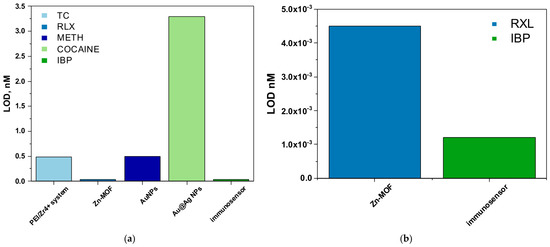
As summarized in Table 1 and Figure 2, the described nano-bio/chemosensor platforms demonstrate highly sensitive and selective detection of diverse pharmaceuticals and illicit drugs. The Zn-MOF fluorescent nanosensor enables raloxifene detection via an internal filter effect mechanism with a low LOD of 0.485 nM and reliable recoveries (95.5–98.1%) in real samples under mild conditions (pH 8, 30 °C) [46]. The nanochannel-based electrochemical immunosensor exhibits an exceptionally low detection limit of 0.25 pg/mL for ibuprofen, benefiting from nanoconfinement-enhanced impedance changes and demonstrating strong selectivity in environmental waters [47]. The nanofluidic aptasensor for tetracycline achieves an ultralow LOD of 2 ng/L across a remarkably wide linear range (10 ng/L–10 mg/L), based on surface charge modulation and ionic current rectification, with excellent recoveries (94.8–109.3%) in reported wastewater matrices [45]. Finally, the duplexed colorimetric biosensor enables simultaneous detection of methamphetamine and cocaine with nanomolar sensitivity (LODs of 0.5 nM and 3.3 nM, respectively), using magnetic bead-assisted separation and noble metal nanoparticle signal transduction, and shows satisfactory recoveries from wastewater samples [20].
3. Nano-Bio/Chemosensor for Simultaneous Detection and Removal of Pharmaceutical Residues
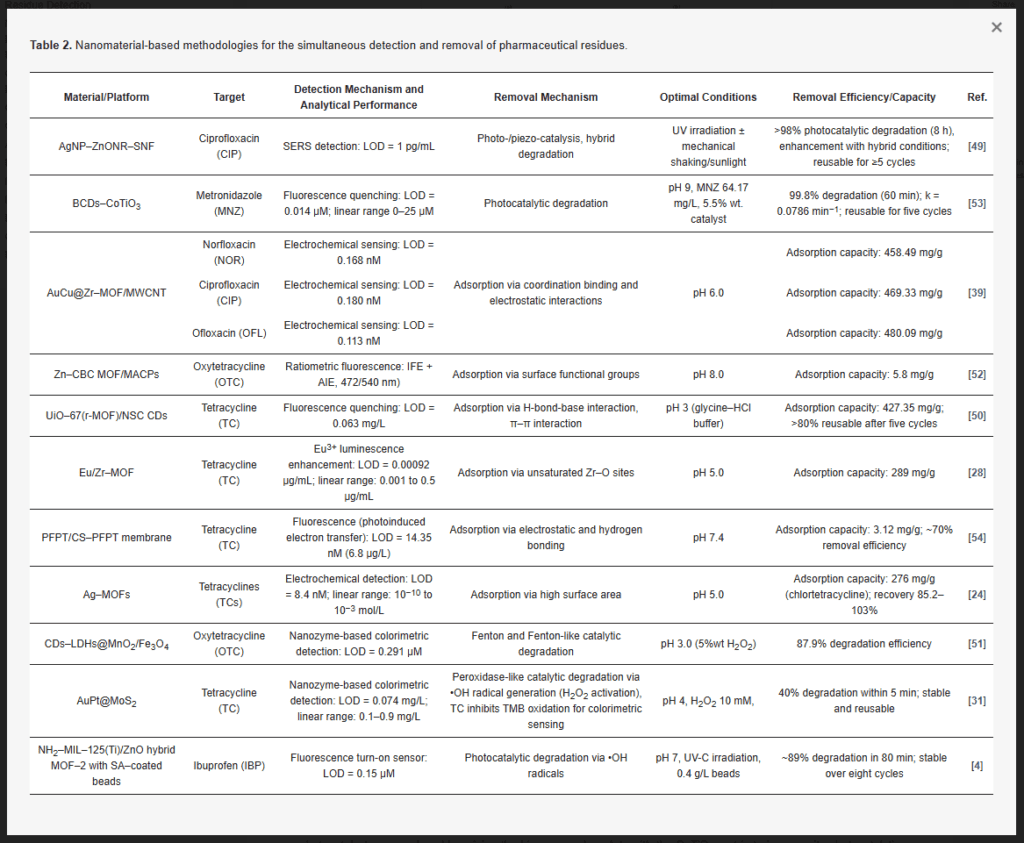
Recent advances in multifunctional nanomaterials have enabled the development of integrated platforms for the simultaneous detection and removal of antibiotics from aqueous environments. Representative nano-based platforms include AgNP-ZnONR-SNF [49], UiO-67/NSC [50], CDs-MgAl-LDHs@MnO2/Fe3O4 micromotors [51], AuPt@MoS2 nanozymes [31], Eu/Zr-MOF [28], Ag-MOFs [24], AuCu@Zr-MOF/MWCNT [39], Zn-CBC MOF/MACPs beads [52], and NH2-MIL-125(Ti)/ZnO [4] hybrid metal-organic frameworks, as shown in Table 2.
Table 2. Nanomaterial-based methodologies for the simultaneous detection and removal of pharmaceutical residues.
3.1. Ag NP-Decorated ZnO Nanorods on Silica Nanofibers for Simultaneous Ciprofloxacin Detection and Degradation
In detail, Ag NP-decorated ZnO nanorods on silica nanofibers (AgNP-ZnONR-SNF) were tested for detection and degradation of ciprofloxacin (CIP), a fluoroquinolone antibiotic [49]. In order to detect CIP, surface-enhanced Raman spectroscopy (SERS) was employed, and the signal was analyzed with a machine learning-assisted approach, achieving a detection limit of 1 pg mL and a classification accuracy of 92.3%. The machine learning-assisted approach (ML approach) was applied for Raman spectral data analysis and contaminant recognition. The collected Raman spectra were treated using a Laplacian operation and analyzed by a deep neural network for both qualitative classification and quantitative concentration prediction of multiple contaminants. In addition, a K-Nearest Neighbor (KNN) clustering method was incorporated to improve the identification of unseen chemical classes. Thus, ML served as a data analysis tool to enhance spectral recognition and analytical accuracy rather than contributing directly to the sensing mechanism. To achieve CIP removal, photocatalytic and piezo-catalytic degradation experiments were performed under UV irradiation with mechanical shaking. Photocatalytic treatment resulted in more than 98% degradation of organic pollutants after 8 h, while the combination of photo- and piezo-catalysis further enhanced degradation rates. The material also showed good reusability over multiple cycles [49].
3.2. Biomass-Derived Carbon Dots with CoTiO3 for Simultaneous Metronidazole Detection and Degradation
Another approach involved biomass-derived carbon dots (BCDs), which were synthesized using pine bark as a renewable precursor through microwave-assisted pyrolysis [53]. Pine bark was chopped, sieved, and placed in a quartz container, then irradiated in a microwave oven with a continuous nitrogen atmosphere to ensure inactive conditions, with periodic cooling. The charred material was placed in an ultrasonic bath with ultrapure water to achieve fluorescent carbon dot extraction. To remove large particles, the suspension was centrifuged, and the supernatant was filtered and freeze-dried to obtained the purified BCDs. In parallel, cobalt titanate (CoTiO3) was synthesized using a modified Pechini method by dissolving citric acid and cobalt (II) nitrate hexahydrate in ethanol, followed by slow addition of titanium (IV) isopropoxide with continuous stirring. The homogeneous mixture was stirred until homogenized, heated at 80 °C for 2 days to form a gel, and then calcined at 600 °C for 4 h to obtain crystalline CoTiO3, which was cooled and ground into a fine powder. Finally, the BCD–CoTiO3 (BCD–CTO) composite photocatalyst was produced by mixing the biomass carbon dots with the CoTiO3 matrix to increase its photocatalytic activity. The BCDs were used as fluorescent probes for detection of the nitroimidazole antibiotic metronidazole (MNZ), resulting in fluorescence emission signals at 430 nm under 330 nm excitation, with MNZ concentration-dependent fluorescence erasing. A linear detection range of 0–25 μM was achieved, with a detection limit of 0.014 μM, demonstrating high sensitivity. Under optimal conditions (pH 9, MNZ concentration 64.17 mg/L, and 5.5%wt catalyst loading), the BCD–CTO composite achieved 99.8% degradation of MNZ within 60 min. It was found that the degradation rate constant of the optimized composite was 0.0786 min−1, much higher than that of CoTiO3 (0.0192 min−1) and BCDs (0.0131 min−1), confirming that the carbon dots interact cooperatively with the semiconductor matrix. Reuse studies over five successive cycles showed high stability and sustained catalytic performance, highlighting the dual functionality of the material for sensitive detection and efficient removal of metronidazole from water environments. The reaction mechanism of the BCD–CTO catalyst is based on the generation of reactive oxygen species under visible light irradiation. When light is absorbed by CTO, electrons are activated from the valence band (VB) to the conduction band (CB), leaving positive holes (h+) in the VB. The stimulated electrons are transferred to the BCDs, where they react with oxygen (O2) to produce superoxide radicals (•O2−). Concurrently, the holes (h+) react with water molecules to produce hydroxyl radicals (•OH). These highly reactive species (•O2− and •OH) attack and degrade the MNZ pollutant molecules into smaller, less toxic compounds. The incorporation of BCDs improves electron transfer and reduces electron–hole recombination, resulting in enhanced photocatalytic degradation efficiency [53].
3.3. Multifunctional Au-Cu Bimetal-Loaded Zirconium Metal-Organic Framework for Simultaneous Antibiotic Detection and Degradation
A multifunctional Au-Cu bimetal-loaded zirconium metal organic framework (AuCu@Zr-MOF) was established to achieve simultaneous antibiotic adsorption and electrochemical sensing [39]. Combining the high catalytic activity and conductivity of the Au-Cu bimetallic nanoparticles with the large surface area and abundant active sites of the Zr-MOF, the nanomaterial allowed efficient capture and ultrasensitive detection of three fluoroquinolone antibiotics: norfloxacin (NOR), ciprofloxacin (CIP), and ofloxacin (OFL). The Zr-MOF was synthesized hydrothermally from zirconium tetrachloride and tetrakis(4-carboxyphenyl) porphyrin in a DMF/H2O mixture at 120 °C for 6 h, followed by purification and solvent washing. The AuCu@Zr-MOF nanocomposite was prepared by introducing CuCl2 and HAuCl4 precursors into a Zr-MOF dispersion and reducing them with NaBH4 in an ice bath, followed by centrifugation and vacuum drying. The AuCu@Zr-MOF shown strong interaction with these antibiotics through coordination interactions and electrostatic binding, reaching maximum adsorption capacities of 458.49 mg/g for NOR, 469.33 mg/g for CIP, and 480.09 mg/g for OFL. The adsorption process was dependent on pH, with an optimal pH of 6. Next, the nanocomposite was integrated with multi-walled carbon nanotubes (MWCNTs) on a glassy carbon electrode, fabricated by sequentially drop-casting the MWCNT dispersion and the AuCu@Zr-MOF suspension onto a glassy carbon electrode. The modified sensor exhibited excellent electrocatalytic performance with low detection limits for NOR at 0.168 nM, for CIP at 0.180 nM, and for OFL at 0.113 nM. Regeneration studies indicated that, after five cycles, the adsorption capacities decreased from 371.84 (NOR), 407.04 (CIP), and 410.43 mg/g (OFL) to 266.97 (NOR), 284.23 (CIP), and 289.52 mg/g (OFL) and stabilized at 69.8–71.8% of the initial capacity after the first cycle. It was found that the metal leaching rates were low, with 1.4% Au and 1.8% Cu detected after regeneration, confirming that the material has good structural stability. However, while these results demonstrated satisfactory regeneration performance and resistance to metal leaching, long-term stability during prolonged storage and repeated operation should also be considered for practical application. In addition, the scalability of the sensor composition and fabrication, as well as the batch-to-batch reproducibility of the material and the analytical response, should be further evaluated before large-scale application. The practical application was demonstrated using ultrapure water, tap water, and river water samples, from which recoveries of 96.0–103.7% were achieved [39].
3.4. Zinc-Based Metal Organic Framework for Simultaneous Oxytetracycline Detection and Removal
A novel zinc-based metal organic framework, Zn-CBC, constructed from 2-(4-carboxyphenyl)-1H-benzo[d]imidazole-5-carboxylic acid (CBC) ligand, was developed as a dual function platform for the simultaneous detection and removal of the antibiotic oxytetracycline (OTC) from water [52]. The hydrothermally synthesized Zn-CBC exhibited a large surface area, porous structure, and strong blue fluorescence emission centered at 472 nm. In Tris-HCl buffer (10 mM, pH 8), Zn-CBC showed an initial fluorescence intensity of 384.3 at 472 nm, while OTC exhibited weak fluorescence at 540 nm. Upon interaction with OTC (0–15 μM), the fluorescence intensity at 472 nm decreased from 384.3 to 282.4, corresponding to a 26.5% decrease, due to the internal filtering effect (IFE), whereas a new emission wavelength appeared at 540 nm and increased because of the aggregation-induced emission (AIE) of OTC within the MOF pores. The fluorescence intensity at 472 nm decreased from 384.3 to 282.4, while that at 540 nm increased from 166.9 to 348.8, forming a blue-to-yellow-green radiometric fluorescence system.
A high linear relationship between the fluorescence ratio and the OTC concentration was observed, with 26.9 nM detection limit, indicating high sensitivity. Good performance against interference was confirmed with selectivity tests against various other antibiotics such as ceftriaxone, clarithromycin, chloramphenicol, secnidazole, ampicillin, and streptomycin, as well as metal cations and anions at 75 μM. To improve practical suitability, Zn-CBC was integrated into alginate Ca2+ polyacrylic acid polymer beads (MACPs). They were prepared by dissipating Zn-CBC in sodium alginate solution and continuing reticulation in a CaCl2/polyacrylic acid coagulation solution to form stable composite beads. The Zn-CBC MACPs showed adsorption capability toward OTC in aqueous solutions at a pH of 8, with 5.8 mg/g adsorption capacity. The Freundlich model better described the process, indicating that heterogeneous surface adsorption took place. In real water applications, MACPs allowed optical detection via fluorescence color change from blue to yellow-green under 365 nm UV irradiation. In recycling adsorption experiments using real water samples with up to 10 mg/L OTC, the material achieved simultaneous detection and removal of OTC after 4 h of recycling. The mechanism of fluorescence sensing of the Zn-CBC MOF is based on the synergetic contribution of the internal filter effect (IFE) and aggregation-induced emission (AIE). Upon interaction with oxytetracycline (OTC), the fluorescence of Zn-CBC at 472 nm is gradually quenched, while the fluorescence of OTC at 550 nm is significantly increased, producing a characteristic fluorescence ratio. Specifically, the partial overlap between the absorption spectrum of OTC and the excitation spectrum of Zn-CBC indicates occurrence of the IFE, where OTC absorbs part of the excitation light and reduces the fluorescence of the MOF. In addition, OTC molecules are encapsulated within the pores of the Zn-CBC framework and interact with Zn2+ sites through collaboration and hydrogen bonding, encouraging OTC aggregation inside the MOF. This aggregation prompts AIE, leading to enhanced fluorescence emission from OTC and allowing sensitive ratiometric detection [52].
3.5. UiO-67(r-MOF)/NSC CDs for Simultaneous Tetracycline Detection and Removal
A hierarchical three-dimensional Zr-based metalorganic framework composite, UiO-67/NSC, was successfully produced by introducing N,S co-doped carbon (NSC) dots as heterogeneous nucleation centers during solvothermal synthesis, allowing the growth of UiO-67 into vertically oriented 2D nanosheets that assembled into a nanoflower structure [50]. This structure resulted in reduced diffusion barriers and improved mass transfer, allowing high-level sensing and adsorption of the antibiotic tetracycline (TC). The fluorescence signal at 410 nm declined with rising TC concentration, showing a strong linear relationship between ln(F0/F) and TC concentration in the range of 0.08–20.0 mg/L (R2 = 0.991) and a low detection limit of 0.063 mg/L under optimal detection conditions (λex = 315 nm, glycine-HCl buffer at a pH of 3). The nanoplatform showed good selectivity against ions and other antibiotics and was applied to real samples such as water, sheep muscle, and fish muscle, where recoveries (87.1–107.5%) with relative standard deviations below 6% were achieved, validating its reliability and accuracy. In adsorption studies, the nanomaterial showed a maximum TC uptake at a pH of 3 due to strong interactions with the TC protons, while the performance was reduced under neutral and alkaline conditions due to changes in TC speciation and electrostatic interactions. Adsorption equilibrium was achieved within 120 min and was satisfied by pseudo-second-order model (R2 = 0.995) kinetic analysis, indicating a chemisorption-dominated mechanism. The modification improved the adsorption capacity of UiO-67 to 427.35 mg/g, while the experimental kinetic calculations demonstrated capacities of about 319.22 mg/g under proper conditions. The improved performance was assigned to multiple interaction mechanisms, such as hydrogen bonding, π-π stacking, and Lewis acid–base interactions between TC molecules and the active sites of UiO-67/NSC. Regeneration experiments demonstrated good reusability: after five adsorption–desorption cycles (using distilled water and 0.1 M NaOH for desorption), the adsorption capacity decreased to 257.45 mg/g but maintained over 80% removal efficiency compared with the first cycle, indicating cost-effective recyclability for water purification applications. Cytotoxicity assays using HepG2 and Caco-2 cells confirmed negligible toxicity, highlighting the environmental safety of the composite. The detection and adsorption of tetracycline (TC) by UiO-67/NSC are driven by several synergistic interactions. Firstly, the Zr-O clusters of the MOF act as Lewis acid sites and complex with the amino groups of TC, while hydrogen bonding occurs between the hydroxyl, amino, and carboxyl groups of TC and the functional groups of UiO-67/NSC. In addition, π–π interactions between the aromatic rings of TC and the organic ligands of the MOF, together with electrostatic force of attraction under optimal pH conditions, further encourage TC adsorption. The fluorescence signal is suppressed through the combined action of the inner filter effect (IFE), where TC absorbs part of the excitation light, and fluorescence resonance energy transfer (FRET), where energy is transferred from UiO-67/NSC to TC [50].
3.6. Eu/Zr-MOF for Simultaneous Tetracycline Detection and Removal
Eu/Zr-MOF was synthesized via a traditional hydrothermal method. In details Eu/Zr-MOF, Eu(NO3)3, and ZrCl4 in Zr4+:Eu3+ at a molar ratio of 3:0.5 were dissolved in DMF containing terephthalic acid methylammonium salt and added to 1 mL of deionized water [28]. The blend was mixed for 30 min to homogenize it, then transferred to a Teflon-lined hydrothermal autoclave and heated for 18 h. After cooling to room temperature, it was centrifuged, washed with DMF and methanol to eliminate unreacted precursors, and vacuum-dried to obtain the product. The Zr-MOF was produced under the same conditions without adding Eu(NO3)3. The optimal detection conditions were 398 nm for excitation and at 615 nm for emission monitoring, ensuring minimal interference and stronger Eu3+ emission. Detection indicated a linear response in a concentration range of 0.001 to 0.5 µg/mL, with a 0.00092 µg/mL detection limit. The adsorption studies were performed by adding 10 mg Eu/Zr-MOF to 50 mL TC solutions with varying initial concentrations. The effects of pH values from 2 to 12, contact time from 10 to 230 min, and the elementary TC concentration were evaluated. At pH 5, the optimal adsorption efficiency was achieved. Adsorption was rapid during the first 10 min and gradually approached equilibrium at approximately 150 min. The maximum TC adsorption capacity reached 289 mg/g under optimized conditions. Regeneration experiments were conducted by washing the used adsorbent with distilled water and NaOH solution, followed by centrifugation and reuse for subsequent cycles. The mechanism of tetracycline (TC) detection by the Eu/Zr-MOF system is based on both adsorption interactions and fluorescence enhancement through the antenna effect. In the absence of TC, the Eu/Zr-MOF absorbs excitation light at 245 nm, where the MOF ligand acts as an antenna to transfer energy to Eu3+ through a ligand-to-metal charge transfer (LMCT) process, resulting in a characteristic red emission. After TC introduction, TC molecules complex with Eu3+ ions and act as additional antenna ligands, improving the energy transfer process and increasing the characteristic Eu3+ emission (615 nm). TC adsorption is promoted by many interactions, including hydrogen bonding between the functional groups of TC and Eu/Zr-MOF, as well as weak coordination between the Lewis acidic Zr-O clusters and the amino groups of TC. The TC molecules first diffuse onto the external surface of the MOF and then enter the internal pores, where they are preserved through these interactions. Therefore, the combination of TC adsorption and the enhanced antenna effect of Eu3+ allows sensitive and selective fluorescence detection of TC [28].
3.7. Poly [5,5′-(((2-Phenyl-9H-fluorene-9,9-diyl)bis(hexane-6,1-diyl))bis(oxy))diisophthalate] Sodium (PFPT) for Simultaneous Tetracycline Detection and Removal
Another study reported the synthesis and application of a new anionic water-soluble conjugated polyelectrolyte, poly [5,5′-(((2-phenyl-9H-fluorene-9,9-diyl)bis(hexane-6,1-diyl))bis(oxy))diisophthalate] sodium (PFPT), for the detection and removal of the antibiotic tetracycline (TC) from water [54]. PFPT was synthesized via a multistep procedure starting from the monomer 2,7-dibromo-9,9-bis(6-bromohexyl)-9H-fluorene, followed by palladium-catalyzed Suzuki cross-coupling polymerization with benzene-1,4-bisboronic acid in the presence of Pd(PPh3)4 and K2CO3 in THF with argon reflux for 24 h to obtain the intermediate polymer (PF). This was further reacted with dimethyl-5-hydroxyisophthalate in anhydrous DMF using K2CO3 at 80 °C to yield PFPTE, which was finally converted into the sodium polyelectrolyte PFPT through alkali-induced saponification using NaOH in THF/water at 50 °C, followed by dialysis (MW cutoff 3.5 kDa) and freeze-drying. Structurally, PFPT contains a conjugated fluorene backbone functionalized with phenyl groups and pendant carboxylate moieties in the sodium salt form, providing water solubility and negative charge for electrostatic interaction. For water treatment, PFPT was mixed with chitosan (CS) to form CS–PFPT composite membranes. Chitosan serves as a biopolymer based on its film-forming ability and the presence of amine and hydroxyl functional groups, while PFPT provides negatively charged carboxylate functionalities. Uniform fluorescent films with a thickness of approximately 0.02 mm were created by electrostatic interactions between the positively charged chitosan and the negatively charged PFPT. The composite containing 15% PFPT showed the best adsorption performance. For the adsorption experiment, the membranes were immersed in aqueous TC solutions for specific time intervals. Adsorption reached a plateau after 3 h. The CS-15% PFPT membrane exhibited an adsorption capacity of 3.12 mg/g and achieved 70% removal of tetracycline from water, compared to 0.68 mg/g and 15% removal for the blank chitosan film. The enhanced performance was attributed to strong electrostatic and hydrogen-bonding interactions between the carboxylate groups of PFPT and the functional groups of tetracycline (-OH, -CONH2, N(CH3)2), demonstrating its applicability for antibiotic-contaminated wastewater treatment [54].
3.8. Ag-MOFs for Simultaneous Tetracycline Detection and Removal
In a study by Cui et al., the development of a dual function platform based on silver-based metal organic frameworks (Ag-MOFs) for the detection and removal of tetracycline antibiotics (TCs) from water is described [24]. The Ag-MOFs were synthesized via a hydrothermal method using 4,4′-bipyridine (2 mmol) and 1,3,5-benzenetricarboxylic acid (1 mmol) as organic linkers, reacted with AgNO3 (2 mmol in 70 mL solution). The mixture was transferred to a Teflon-lined stainless steel autoclave and heated at 160 °C for 70 h, then cooled to room temperature, washed, and dried under vacuum to obtain the final Ag-MOF material. Structurally, the framework consists of Ag+ metal nodes coordinated with nitrogen-containing bipyridine and carboxylate groups from benzenetricarboxylic acid, forming a porous structure with ahigh surface area suitable for adsorption and electrochemical applications. For aqueous-phase adsorption experiments, Ag-MOFs were evaluated for their ability to remove tetracycline (TC) and chlortetracycline (CTC). In batch adsorption tests, 5 mg of Ag-MOFs were stirred with antibiotic solutions at room temperature for 40 min, identified as the optimal adsorption time. UV-vis spectroscopy was used to monitor the concentration changes. The adsorption kinetics followed the pseudo-first order model and showed the best correlation (R2 = 0.976), indicating that physisorption took place. The maximum adsorption capacities calculated from the Langmuir model were 112 mg/g for TC and 261 mg/g for CTC. Ag-MOFs were used to modify a glassy carbon electrode (GCE) via immersion in in water. Before modification, the GCE, which was 3 mm in diameter, was polished sequentially with 1 μm, 0.3 μm, and 0.05 μm alumina powders, rinsed, ultrasonically cleaned in ethanol/water (1:1), and dried. Then, 5 mg of Ag-MOFs was dissolved in 5 mL deionized water and sonicated for 30 min to form a homogeneous suspension. Afterwards, 0.6 μL of the suspension was spray-dried onto the GCE surface to generate the Ag-MOFs/GCE electrode. Electrochemical measurements were performed using a three-electrode system with Ag-MOFs/GCE as the working electrode, a saturated calomel electrode as the reference, and a platinum sheet as the counter electrode. The supporting electrolyte consisted of 0.1 mol/L KCl containing 5 mmol/L [Fe(CN)6]3−/4−, and cyclic voltammetry was measured between −0.2 and 0.6 V at a scan rate of 100 mV/s. The optimal Ag-MOF amount for loading on the electrode was 8 μg, harmonizing acceptable active sites and avoiding crowding effects. At pH 5, the highest oxidation peak current was observed at 142 μA, due to tetracycline speciation and electron acceptor properties. The sensor exhibited a wide linear detection range from 1∙10−10 to 1∙10−3 mol/L and a low limit of detection (LOD) of 8.4 nmol/L. The electrochemical behavior was surface-controlled, as indicated by the linear relationship between peak current and scan rate. For real water application, surface water and tap water samples were filtered through a 0.45 μm membrane and stored at 4 °C before analysis. Spiked recovery experiments (50, 100, and 500 nmol/L) showed recoveries between 85.2% and 103%, with relative standard deviations of 1.46–6.69%, confirming acceptable accuracy and precision [24].
3.9. (CDs)-MgAl-LDHs@MnO2/Fe3O4 Magnetic Micromotors for Simultaneous Oxytetracycline Detection and Removal
In another approach for the removal of oxytetracycline (OTC), 50 mg of carbon dot (CD)–MgAl-LDHs@MnO2/Fe3O4 magnetic micromotors were added to 50 mL of a 50 mg/L OTC aqueous solution and kept in the dark for 30 min to reach adsorption equilibrium [51]. Subsequently, 5 mL of 30%wt H2O2 was introduced to initiate the catalytic degradation process. At fixed time intervals, 5 mL of the solution was withdrawn and centrifuged, and the absorbance of the supernatant at 652 nm was measured. The residual OTC concentration was calculated based on the colorimetric detection method. The removal results indicated that H2O2 alone removed 6.89% of OTC, while MgAl-LDHs removed 24.92%, due to adsorption. MgAl-LDHs@MnO2 and MgAl-LDHs@MnO2/Fe3O4 removed 48.48% and 76.82% of OTC, respectively, by Fenton and Fenton-like reactions. The complete CD–MgAl-LDHs@MnO2/Fe3O4 + H2O2 system achieved 82.05% OTC removal, which is the highest degradation efficiency, due to increased electron transfer by CDs. Raising the concentration of H2O2 improved performance, achieving 87.93% removal in the presence of 5%wt H2O2. The greatest degradation was achieved at pH 3, consistent with optimal Fenton reaction conditions. The generation of •OH and •O2− radicals in the system was confirmed by electron paramagnetic resonance (EPR) analysis. Fe3O4 (Fe2+/Fe3+) and MnO2 (Mn4+/Mn3+) catalyzed H2O2 decomposition to produce •OH radicals at low pH values, while dissolved O2 was transformed to •O2− on the micromotor surface. H2O2 adsorption and electron transfer were improved by the CDs. These radicals modified OTC into intermediate products identified by LC/MS, that were further oxidized into smaller molecules and eventually formed CO2 and H2O. After 180 min, total organic carbon (TOC) removal reached 68.37%. The micromotors could be magnetically recovered after degradation, with an average recovery rate of 85%. The degradation efficiency remained at 77.05% after three reuse cycles [51].
3.10. AuPt@MoS2 Nanoenxyme for Simultaneous Tetracycline Detection and Removal
A dual function trimetallic nanozyme, AuPt@MoS2, was designed to perform simultaneous colorimetric detection and removal of TC [31]. The initial material was made by preparing two-dimensional MoS2 nanosheets, exfoliated with liquid phase, i.e., bulk MoS2 mixed with 45% ethanol-water and stabilized in an ultrasonic bath with polyvinylpyrrolidone to generate few-layer nanosheets. Nexy, Au and Pt nanoparticles were grown in situ on the MoS2 nanosheet surfaces by direct reduction of HAuCl4 and H2PtCl6 at high temperature, without the need for additional reducing agents, producing a moderately distributed trimetallic AuPt@MoS2 nanozyme. For material comparison, monometallic Au@MoS2 and Pt@MoS2, as well as alternatives with different Au/Pt ratios, were synthesized using same techniques. The best trimetallic composition indicated the highest peroxidase-like catalytic activity, assigned to the synergistic interaction among Au, Pt, and the MoS2 support, which enhanced active site density and promoted interfacial electron transfer. The peroxidase activity of AuPt@MoS2 was estimated using as a chromogenic substrate in the presence of H2O2 and 3,3′,5,5′-tetramethylbenzidine (TMB). Oxidation of the colorless TMB was catalyzed efficiently by the nanozyme to yield blue oxTMB, producing a strong absorbance signal at 652 nm at pH ≈ 4. Kinetic studies based on Michaelis–Menten analysis showed that the trimetallic nanozyme presented the lowest Km and the highest Vmax among the tested materials, indicating superior substrate affinity and catalytic performance. Molecular dynamics simulations further revealed that either H2O2 or TMB adsorbs at the Au-Pt-MoS2 interface, while density functional theory calculations showed that AuPt@MoS2 not only enhances H2O2 adsorption, but also lowers the energy barrier for O-O bond cleavage, facilitating the generation of reactive •OH radicals. Liu et al. [31] performed TC degradation experiments by distributing the nanozyme in an aqueous TC solution in the presence of H2O2, and TC removal was monitored by detecting the typical UV-Vis absorption peak of TC (357 nm). The AuPt@MoS2/H2O2 system achieved significant rapid elimination, within 5 min, and ~40% TC was removed under optimal conditions. The degradation efficiency was optimal at pH 4 and an H2O2 concentration of 10 mM. The nanozyme retained stable catalytic activity throughout many cycles when it was reused after being centrifuged and washed, and its performance was not affected by common inorganic ions, illustrating adaptability to use in real water. In the presence of both the nanozyme and H2O2, •OH radicals were generated that were able to attack electron-rich functional groups in TC, such as amino groups, double bonds, phenolic hydroxyl groups, and decarboxylation reactions, and to induce ring-opening and deaminization. Furthermore, liquid chromatography mass spectrometry analysis revealed the presence of many intermediate products that were oxidized and eventually produced CO2, H2O, and inorganic ions. This process exhibits an advanced oxidation pathway caused by the formation of reactive oxygen species catalyzed by nanoenzymes, which improves on typical Fenton systems in terms of increased reusability and reduced sludge formation. In addition, nanoenzyme-catalyzed TMB oxidation enabled colorimetric detection of TC degradation. In the absence of TC, AuPt@MoS2 catalyzes H2O2 decomposition to produce •OH, causing high levels of TMB oxidation and increased absorbance at 652 nm. When TC is introduced, it represses the chromogenic reaction through two mechanisms: firstly, TC remove •OH radicals, reducing the available oxidizing species for TMB, and secondly, TC molecules adsorb onto the nanozyme surface, blocking active sites from substrate access. As a result, when the TC concentration increases, the absorption signal decreases. Under optimal detection conditions, i.e., optimum H2O2 concentration, low nanoenzyme dosage, and appropriate reaction time, TC degradation during measurement can be minimized, ensuring accurate quantification. The method demonstrated linearity between 0.1–0.9 mg/L, with a detection limit of 0.074 mg/L, and exhibited high selectivity against related tetracycline analogs and antibiotics. To verify practical application, the developed AuPt@MoS2-based system was applied to real samples including serum, medical wastewater, and fresh milk. Recovery rates ranged from 95% to 107%, confirming satisfactory accuracy [31].
3.11. NH2-MIL-125(Ti)/ZnO for Simultaneous Ibuprofen Detection and Removal
Finally, Garg et al. [4] reported NH2-MIL-125(Ti)/ZnO, a novel hybrid metal organic framework (MOF) composite, which was designed to simultaneously detected and degrade ibuprofen (IBP) in aqueous solutions [4]. The hybrid MOF incorporates the fluorescence effects of NH2-MIL-125(Ti) with the photocatalytic activity of ZnO nanoparticles, enabling dual functions as a “on-off” fluorescent sensor and a photocatalyst. To increase stability and avoid aggregation, the hybrid MOF was integrated with sodium alginate (SA) beads, resulting in a strong and reusable nanoplatform appropriate for environmental applications. The hybrid MOF was synthesized by microwaving. Firstly, 2-aminoterephthalic acid (ATA) was dissolved in N,N-dimethylformamide (DMF) with magnetic blending, and a solution of titanium (IV) butoxide in methanol was mixed with the ATA solution. ZnO powder was added in different amounts to produce hybrid MOFs, i.e., 100 mg for MOF-1, 200 mg for MOF-2, and 300 mg for MOF-3. Each mixture was transferred to a vessel and irradiated in a microwave (120 °C for 15 min and maximum power 600 W). After cooling to ambient temperature, the product was washed with DMF and methanol, centrifuged, and dried overnight. Furthermore, to prepare composite beads, the hybrid MOF was dispersed in deionized water and blended with sodium alginate solution and stirred overnight to achieve a homogeneous dispersion. The mixture was passed through a syringe into a 0.1% w/v CaCl2 solution, forming beads that were allowed to gel for 1 day. Then, the beads were dried at ambient temperature and kept for further experiments. The fluorescence detection efficiency of the MOF-2 hybrid was calculated for ibuprofen (IBP) detection. The emission spectra exhibited peaks at 440 nm when excited at 330 nm. The sensor exhibited a rapid response, with the fluorescence intensity achieving a stable maximum within 1 min. The limit of detection was 0.15 μM. Optimization studies indicated that the sensor was highly selective for IBP compared with other pharmaceutical compounds. Detection efficiency was affected by pH and MOF dosage, with optimal conditions of pH 7 and a 20 μL dose of the hybrid MOF suspension. The MOF-2 hybrid demonstrated stable fluorescence during prolonged storage, validating its suitability for real-world applications. For the photocatalytic degradation of IBP, MOF-2 hybrid beads (0.4 g/L) were examined under UV-C irradiation at neutral pH. The beads achieved about 89% degradation of IBP in 80 min, exhibiting pseudo-first-order kinetics. Binding studies showed that hydroxyl radicals (•OH) were the main reactive species, while peroxide radicals (•O2−) and photogenerated holes (h+) were also present, to a lesser extent. The MOF-2 hybrid beads showed very good stability and fairly good reusability, maintaining high activity for eight consecutive cycles with a slight decrease in degradation efficiency from 88.9% to 81.2% in the eighth cycle. The sodium alginate coating blocked MOF accumulation while also increasing environmental harmony. Furthermore, the beads were successfully applied to real water samples collected from agricultural fields, confirming the material’s practical applicability for pharmaceutical residue removal from environmental water [4].
3.12. Synergistic Mechanisms Underlying Simultaneous Detection and Removal
The dual functionality of these integrated platforms results from the combination of drug recognition, signal generation, and contaminant removal, rather than from two completely independent functions. In general, adsorption and molecular recognition interactions, including electrostatic attraction, hydrogen bonding, π-π interactions, coordination with metal sites, and pore confinement, promote the enrichment of drug molecules near the active sites of the nanomaterial. This local concentration facilitates the generation of measurable analytical responses via fluorescence modulation, surface-enhanced Raman scattering, electrochemical signal changes, or colorimetric reactions, while simultaneously favoring subsequent adsorption or catalytic degradation. In photocatalytic and Fenton/Fenton-type systems, semiconductor, metal, or metal oxide components promote charge separation and electron transfer, leading to the formation of reactive oxygen species (e.g., •OH and •O2−) that oxidatively transform condensed drug molecules. In nanoenzyme-based platforms, such as AuPt@MoS2, the drug can additionally interact with the catalytic surface and compete for active sites or reactive species, directly coupling the removal process to the analytical signal. Similarly, in fluorescence-based MOF systems, adsorption and coordination can alter the local chemical environment of the fluorophore or analyte, causing fluorescence quenching or enhancement, while retaining the contaminant within the porous framework. Therefore, the integration of detection and removal functions can create a synergistic cycle in which contaminant binding enhances detection sensitivity, while catalytic or adsorptive removal reduces contaminant concentration and allows regeneration or reuse of the active material. This coupling provides a significant advantage over conventional approaches in which monitoring and remediation are performed separately, although the extent of synergy depends largely on the material architecture, drug–surface interactions, and operating conditions.
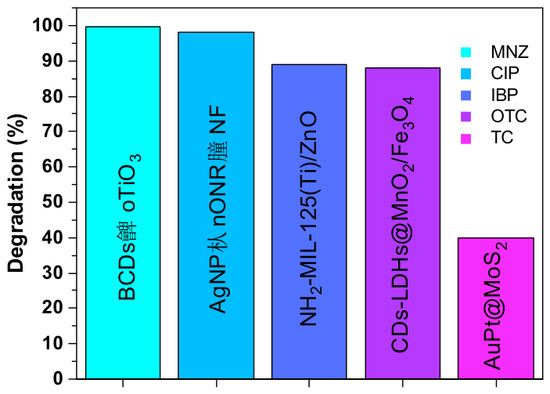
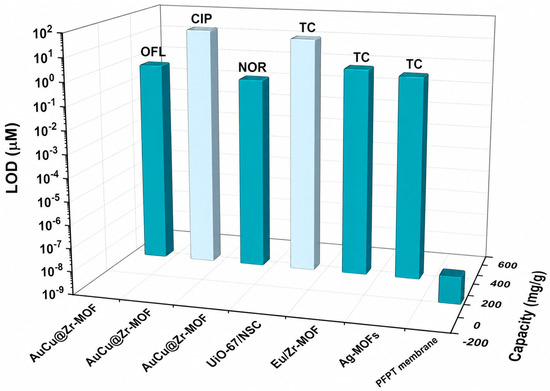
In summary, the AgNP-ZnONR-SNF substrate combines surface-enhanced Raman scattering (SERS) detection with photocatalytic degradation through plasmon-enhanced reactive oxygen species generation under light irradiation [49]. The 3D Zr-MOF-based UiO-67/NSC exhibits dual fluorescence sensing capability (LOD 0.063 mg/L) and high adsorption capacity (427.35 mg/g) toward tetracycline via hydrogen bonding, Lewis acid–base interactions, and π-π stacking, maintaining over 80% removal efficiency after repeated cycles [50]. The magnetic CD–MgAl-LDHs@MnO2/Fe3O4 micromotors integrate colorimetric detection (LOD 0.291 µM) with Fenton and Fenton-like catalytic degradation, achieving up to 87.9% oxytetracycline removal at pH 3 in the presence of H2O2, while allowing magnetic recovery and reuse [51]. Similarly, the trimetallic AuPt@MoS2 nanozyme provides peroxidase-mimicking activity for sensitive colorimetric detection (LOD 0.074 mg/L) and rapid catalytic degradation via hydroxyl radical generation [39]. The hybrid NH2-MIL-125(Ti)/ZnO composite embedded in sodium alginate beads represents an efficient, selective, and reusable platform for both fluorescence-based detection and photocatalytic degradation of ibuprofen under mild environmental conditions [4]. The platforms’ degradation efficiency and adsorption capacity versus analytical sensitivity are depicted in Figure 3 and Figure 4, confirming their removal efficiency and detection performance. Collectively, these materials highlight adsorption, photocatalysis, and nanozyme-driven advanced oxidation as effective, reusable, and sensitive approaches for antibiotic monitoring and wastewater treatment, demonstrating strong potential for practical environmental applications.
4. Comparative Assessment of Nanomaterial Platforms: Advantages and Limitations
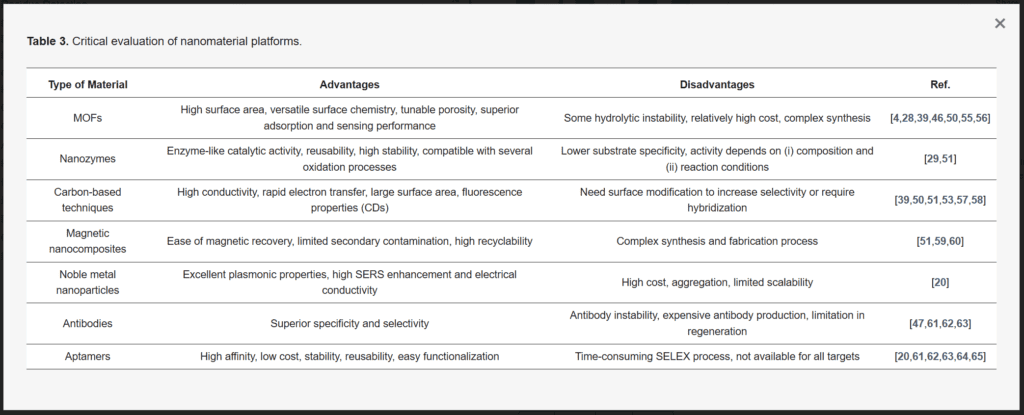
The multifunctional platforms presented above highlight a growing trend towards the integration of sensing and remediation within a single material. However, as summarized in Table 3, no single nanomaterial platform simultaneously fulfils all the requirements for sensitivity, selectivity, catalytic efficiency, stability, and reusability, owing to their physicochemical properties and functional characteristics.
Table 3. Critical evaluation of nanomaterial platforms.
4.1. Metal Organic Frameworks (MOFs)
Metal organic frameworks (MOFs) are one of the most widely investigated material classes due to their high surface area, abundant active sites, and tunable porosity that enable both pharmaceutical detection and removal. Typical MOF-based platforms such as Zn-MOF, UiO-67/NSC, Eu/Zr-MOF, and NH2-MIL-125(Ti)/ZnO achieved excellent photocatalytic degradation efficiencies as well as high absorption capacities [4,28,46,50]. Among the reported systems, AuCu@Zr-MOF successfully integrated ultrasensitive electrochemical sensing with efficient absorption of fluoroquinolone antibiotics [39]. Despite their remarkable analytical and remediation performance, broader implementation of MOFs remains limited by relatively complex synthesis procedures and, in some cases, reduced hydrolytic stability during prolonged exposure to aqueous environments [55,56].
4.2. Nanozymes
Nanozymes have emerged as multifunctional platforms, since they are capable of uniquely combining analytical sensing with catalytic degradation via enzyme-mimicking activity. Representative systems, such as AuPt@MoS2 and CD–LDHs@MnO2/Fe3O4 micromotors, exhibited efficient pharmaceutical detection alongside catalytic degradation through peroxidase-like and Fenton-like catalysis, respectively [29,51]. In comparison with their natural counterparts, nanozymes offer superior chemical stability, prolonged operational lifetime, and reusability. However, their catalytic performance and substrate specificity strongly depend on material composition, reaction conditions, nanostructure [66,67].
4.3. Carbon-Based Nanomaterials
Carbon-based nanomaterials including carbon dots (BCDs) [50,51,53] and multi-walled carbon nanotubes (MWCNTs) [39,57,58] constitute an important class of sensing materials for pharmaceutical sensing owing to their exceptional electrical conductivity, high specific area, and rapid electron transfer kinetics. On the one hand, BCDs improved the photocatalytic performance of CoTiO3, resulting enhanced fluorescence detection of metronidazole [53]. On the other hand, MWCNTs significantly enhanced the electrochemical response of AuCu@Zr-MOF-based sensors [39]. Although carbon-based nanomaterials offer significant advantages in signal amplification and charge transport, they generally require surface functionalization or incorporation into hybrid nanocomposites to improve selectivity and remediation efficiency [68].
4.4. Magnetic Nanocomposites
Magnetic nanocomposites have gained considerable attention due to their ability to achieve rapid magnetic separation and their ease of recovery after use, thereby facilitating material recyclability and minimizing secondary environmental contamination [59,60]. Systems such as CD–LDHs@MnO2/Fe3O4 micromotors and AuNPs/MBs have successfully combined efficient pharmaceutical sensing performance with remediation functionalities [18,51]. Nevertheless, the integration of multiple functional components often results in complex fabrication strategies that may influence the long-term structural integrity and reproducibility of the nanocomposites [69].
4.5. Biorecognition-Based Platforms
Biorecognition-based platforms provide the highest analytical sensitivity through specific target recognition mechanisms.
Antibodies remain the most widely used affinity-based biorecognition elements in environmental biosensors owing to their high specificity and strong binding affinity for target analytes. Consequently, immunosensors have been extensively employed for the detection of pharmaceutical residues, antibiotics, pesticides, and endocrine-disrupting compounds in complex environmental samples, providing excellent analytical performance even in the presence of potential interferents [61,62]. Nanochannel immunosensors employing anti-ibuprofen monoclonal antibodies demonstrated outstanding molecular specificity toward ibuprofen [47]. However, despite their widespread use, antibodies exhibit several limitations associated with their biological origin, including relatively high production costs, limited thermal and chemical stability, batch-to-batch variability, and the need for controlled storage conditions, which may restrict their long-term application to portable sensing platforms [63].
To address these limitations, increasing attention has been directed towards aptamers, short single-stranded DNA or RNA oligonucleotides obtained through the Systematic Evolution of Ligands by EXponential Enrichment (SELEX) process [70,71]. Aptasensors offer advantages in terms of lower production costs, improved chemical stability, and easier regeneration, with the main limitation being the time-consuming SELEX process for aptamer sequence identification [72]. Aptamers can recognize a broad range of targets, including metal ions, small molecules, proteins, and microorganisms, while offering several practical advantages over antibodies, such as chemical synthesis, excellent batch reproducibility, lower production costs, higher thermal stability, and straightforward chemical modification [63,64]. These properties facilitate their immobilization onto nanostructured materials and have contributed to the rapid development of aptamer-based biosensors for monitoring pharmaceuticals and other emerging contaminants in environmental water [65,73]. Aptamer-based nanochannel sensors and aptamer-functionalized AuNP/Au@AgNP systems combined high analytical sensitivity for tetracycline and methamphetamine/cocaine, respectively [20]. Nevertheless, aptamers are not suitable for every target analyte, as the development of high-affinity sequences through the SELEX process remains relatively laborious. Therefore, antibodies and aptamers should be considered complementary recognition elements, with the choice depending on the target analyte and the requirements of the intended sensing application [62].
Despite the fact that nanomaterials have significantly advanced biosensor performance, several challenges still need to be addressed before their large-scale implementation in routine environmental monitoring. Although nanomaterials have substantially improved biosensor sensitivity and detection limits, their performance has been predominantly demonstrated under controlled laboratory conditions. In real environmental matrices, complex sample composition, surface fouling, nanoparticle aggregation, and environmental transformation processes may compromise long-term stability, reproducibility, and operational lifetime [61,62]. In addition, the increasing production and use of engineered nanomaterials have raised concerns regarding their potential biotoxicity, environmental fate, and ecological risks following their release into aquatic and terrestrial ecosystems [74,75]. Current evidence also highlights the need for standardized ecotoxicological testing protocols and comprehensive environmental risk assessment to better understand the bioavailability, bioaccumulation, and long-term ecological effects of nanomaterials under environmentally relevant conditions [74]. Finally, the successful translation of laboratory-scale biosensors to commercially viable technologies will depend on reproducible fabrication protocols, scalable manufacturing processes, and economic feasibility without compromising analytical performance or environmental safety [62,75]. Addressing these challenges will be essential for the development of reliable, sustainable, and field-deployable nanomaterial-based biosensors for environmental monitoring.
Beyond these ecotoxicological considerations, several additional challenges remain before nanomaterial-based biosensors can be translated to routine environmental monitoring applications. Long-term operational stability under complex environmental conditions, reproducibility between sensor batches, scalable manufacturing, and economic feasibility remain important barriers to their large-scale implementation. Addressing these challenges will be essential for the development of reliable and sustainable sensing platforms suitable for real-world applications [62,75].
Another important aspect that should be considered when comparing the analytical performance of different biosensors is the lack of harmonization in the calculation and reporting of the limit of detection (LOD). Although LOD is one of the most frequently used performance indicators, different studies often employ different calculation approaches, including signal-to-noise criteria or statistical methods based on the standard deviation of the blank control and the calibration slope. Moreover, variations in experimental conditions, sample matrices, and validation protocols further complicate direct comparisons among sensing platforms. Therefore, the adoption of standardized performance evaluation and reporting criteria would greatly facilitate objective comparison of biosensor technologies and accelerate their translation to routine environmental monitoring applications [76].
5. Challenges
Detection and simultaneous removal of pharmaceutical contaminants from wastewater is a particularly demanding challenge, due to the complexity of the systems and the variety of the pollutants. One of the essential problems is the appearance of pharmaceutical compounds at extremely low concentrations, which demands nano-bio/chemosensors with high sensitivity and low detection limits. At the same time, it must be ensured that interfering substances that exist in the water environment will not influence the reliability of the measurements [52].
Furthermore, the simultaneous existence of a variety of pharmaceutical compounds and metabolites creates selectivity problems, as the sensing elements should not be able to detect specific contaminants within a mixtures. The development of multifunctional materials that combine detection and remediation requires careful design to avoid competition between the two functions, which can reduce the total performance of the systems [53].
Another key point is the stability and durability of the materials under real-world conditions, such as changes in pH and the presence of ions and organic matters, which can lead to inactivation or degradation of performance. Additionally, effective removal of pollutants often requires the production of reactive oxygen species or other strong oxidizing agents, which can cause secondary pollution or the configuration of toxic byproducts [54].
It should be noted that the majority of the reported dual function platforms have been evaluated under controlled laboratory conditions using ultrapure water or spiked water samples. Although these studies demonstrate potential detection and removal performances, their practicality in real wastewater remains inadequately investigated. The detection of complex matrices, interfering ions, natural organic matter, microorganisms, and variable physicochemical conditions may significantly influence both detection sensitivity and removal efficiency. Therefore, future studies should focus on systematically validating these integrated platforms under complex and variable real-world wastewater conditions, taking into account the effects of coexisting pollutants, organic matter, pH fluctuations, and temperature changes, to further establish their robustness and practical feasibility.
Despite their innovative analytical approach, many of these platforms require complex multi-step synthesis procedures, specialized reagents, and laboratory conditions, which may delay large-scale production and practical application. Furthermore, the use of different chemical reagents and energy-intensive synthesis routes can increase the cost of production and decrease the environmental sustainability of these platforms. In addition, the lack of standard experimental conditions is another major challenge for the reliable assessment and comparison of these technologies. A variety of parameters such as pH, temperature, ionic strength, and sample composition can significantly affect the interaction between pharmaceutical contaminants and sensors, affecting both detection and removal efficiency. Therefore, it remains a challenge for future research to simplify the manufacturing processes and develop cost-effective and more environmentally friendly synthesis strategies [6].
Beyond these technical and operational challenges, the lack of standardized testing protocols and clear regulatory pathways remains a major obstacle to the practical application of multifunctional detection and removal platforms. Harmonized evaluation criteria and standardized test conditions are needed to enable reliable comparison of sensitivity, selectivity, removal efficiency, regeneration performance, and long-term stability of sensors across different studies. Furthermore, large-scale production should be accompanied by comprehensive assessment of material quality, batch-to-batch consistency, potential leaching of nanomaterials or metals, environmental fate, and ecotoxicity. Such assessments, along with appropriate regulatory frameworks and safety criteria, will be necessary to facilitate the transition of these platforms from laboratory-scale research to safe and reliable real-world wastewater treatment applications.
Finally, issues such as the higher cost of materials, the difficulty of scaling up the technologies to an industrial scale, and the need for recyclability and environmental safety are critical limitations for their extensive application. Consequently, the development of stable and sustainable systems that combine real-time detection and removal remains one of the most important research issues in the field of environmental nanotechnology [8].
6. Conclusions
The present review focuses on the increasing development of nano-bio/chemosensor platforms as powerful tools to detect and remove pharmaceutical pollutants, especially antibiotics, from wastewaters. The incorporation of advanced nanomaterials, namely MOFs, hybrid frameworks, magnetic composites, noble metal nanoparticles, and nanozymes, has allowed sensitive detection with low limits alongside effective degradation of pollutants through photocatalysis, adsorption, and advanced oxidation pathways. Electrochemical immunosensors, fluorescence-based sensors, nanozyme-driven colorimetric systems, and aptamer-functionalized nanochannels exhibit outstanding selectivity and analytical credibility in multiple environments. Meanwhile, high removal efficiencies reaching 80–99% have been achieved, maintaining structural stability and reuse in multiple cycles.
Among the systems analyzed here, the MOF composites exhibit high adsorption capacities for antibiotics, nano-enzyme-based platforms catalytically degrade pharmaceutical residues rapidly through the production of reaction oxygen species, and magnetic micromotor systems seem to exhibit reusability and recyclability. Environmental compatibility and functional stability are improved by incorporating hybrid materials into polymers. In spite of the benefits, there is still a need to achieve large-scale performance, continuing stability for real wastewaters, elimination of secondary contamination, and lower costs.
Overall, nano-bio/chemosensors represent a flexible and promising approach for the integrated detection and removal of pharmaceutical contaminants. Further research on material design, mechanistic understanding, long-term stability, reproducibility, and scalability, along with systematic validation in complex real-world wastewater matrices and under variable environmental conditions, will be critical to translate these laboratory-scale innovations to practical water treatment technologies. Particular attention should be paid to cost-effective fabrication, regeneration, and environmental safety to improve the reliability and sustainability of these integrated platforms and facilitate their eventual large-scale application.
Author Contributions
Conceptualization, D.K.T. and A.K.T.; methodology, E.K.T., D.K.T., S.M., V.S. and A.K.T.; investigation, E.K.T., D.K.T., S.M. and A.K.T.; writing—original draft preparation, E.K.T., D.K.T., S.M., V.S. and A.K.T.; writing—review and editing, E.K.T., D.K.T., S.M., V.S. and A.K.T.; visualization, E.K.T. and A.K.T.; supervision, V.S. and A.K.T. All authors have read and agreed to the published version of the manuscript.
