






SEA-LNG publishes new position paper urging DG ENER to protect the mass-balance terminal pathway (liquefaction by equivalence) as it prepares proposed revisions to the RED III implementing framework.
LONDON, UK – 10 September 2026: Industry coalition SEA-LNG is urging the European Commission’s Directorate-General for Energy (DG ENER) to protect the mass-balance terminal chain of custody. This comes ahead of expected proposed revisions in 2026 to the implementing framework for the Renewable Energy Directive (RED III).
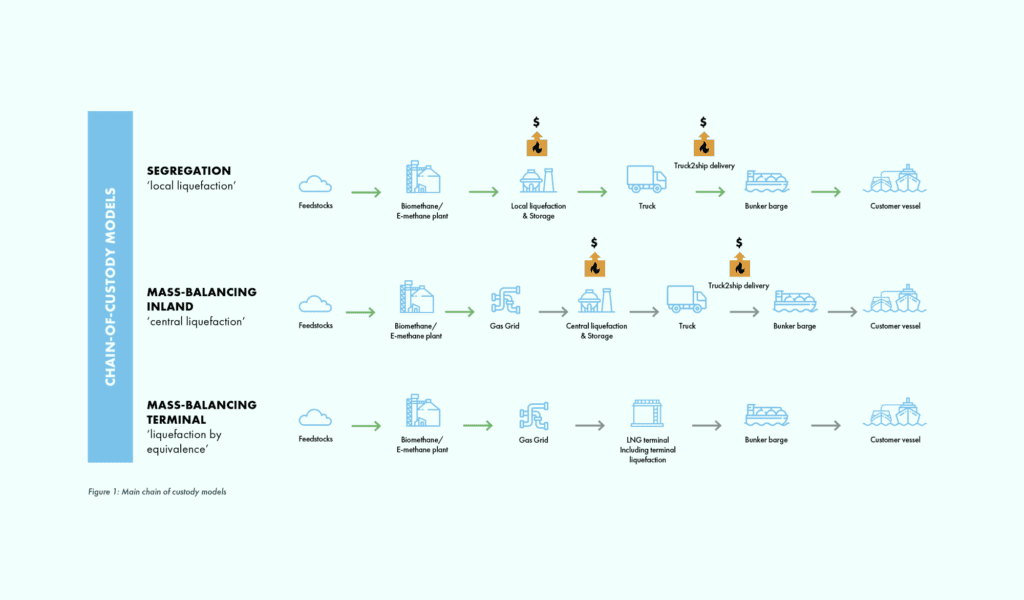
In SEA-LNG’s latest report, ‘Liquefaction by Equivalence Pathways for Liquefied Biomethane: A Policy Framework to Enable Scalable Maritime Decarbonisation’, SEA-LNG argues that liquefied biomethane (LBM), delivered via mass-balance terminal pathways using liquefaction by equivalence, is the lowest-cost and lowest-emission chain of custody for compliance under FuelEU Maritime and EU ETS.
According to SEA-LNG analysis, LBM bunker volumes grew approximately 100-fold in 2025 compared with 2024, with the overwhelming majority delivered via mass-balance terminal pathway. It can leverage Europe’s existing network of more than 33 LNG import terminals and around 200,000 km of gas transmission infrastructure, without requiring new capital investment in liquefaction plants.
DG ENER is currently preparing proposed revisions to RED Annex V, Annex VI and Implementing Regulation (EU) 2022/996, all of which will be binding on Member States and will determine the legal status, GHG accounting treatment and commercial viability of the mass-balance terminal chain of custody. SEA-LNG warns that inadvertent restriction of the pathway through narrow definitions, inflated default emission factors, or inconsistency between the instruments could reduce the availability of compliant low-carbon marine fuel and raise costs for European shipping.
Steve Esau, Chief Operating Officer, SEA-LNG, commented: “The global maritime sector faces a critical decarbonisation challenge with Europe playing an important role in this push. Liquefied biomethane is one of the few fuels capable of meeting Europe’s maritime decarbonisation obligations at the scale and speed the regulations demand.
“The mass-balance terminal route, using liquefaction by equivalence, is why LBM bunkering grew a hundredfold last year. It uses infrastructure that already exists, so it is scalable and lower cost than the alternatives such as physical segregation. Such dramatic growth illustrates the maritime sector’s appetite for decarbonisation. Europe has an opportunity to become a global leader in biomethane, e-methane and renewable methane pathways. Today, DG ENER can unleash Europe’s energy potential.”
SEA-LNG is calling on DG ENER to recognise liquefaction by equivalence and recondenser liquefaction as valid RED III mass-balance pathways, and to assign realistic, differentiated default GHG emission values for each liquefaction route based on measured operational data. The coalition is also urging full regulatory coherence between Annexes V/VI and Implementing Regulation 996, to eliminate definitional inconsistency, alongside preservation of cross-border mass-balance mechanisms, including cross-terminal nominations, consistent with single market principles.
Underpinning all of this, SEA-LNG wants long-term investment certainty through a stable regulatory framework extending beyond 2030. Shipowners and operators will look to commit capital for 20–25-year vessel lives. Any regulatory instability will delay orders and could lead to reflagging to non-EU jurisdictions.
Mass balance is not a novel concept for the maritime sector: it is already the established chain of custody model for bio-based chemicals and plastics, agricultural commodities such as cotton, and Sustainable Aviation Fuel under both CORSIA and ReFuelEU Aviation.
