





METAVASEA survey shows shipping companies raising their climate ambition faster than the sector is building the capacity to deliver it, while seafarers continue to name crew fatigue as their leading safety concern and the public still overestimates the industry’s carbon footprint.
The Wave 2 findings of the METAVASEA survey, released today by HELMEPA, show rising awareness and strategic alignment on maritime decarbonisation across the Eastern Mediterranean. At the same time, they highlight widening gaps in implementation capacity, workforce readiness, and public understanding of the sector’s actual environmental footprint.
Data were collected between December 2024 and November 2025, the period immediately surrounding the initial adoption of the IMO Net-Zero Framework at MEPC 83 in April 2025.
Wave 2 gathered 1,182 responses across five stakeholder groups (seafarers, shipping companies, port administrations, service providers and suppliers, and civil society and port cities), bringing the combined Wave 1 and Wave 2 dataset to 2,080 responses.
These findings are released on World Maritime Day 2026, whose theme, “From Policy to Practice: Powering Maritime Excellence”, was set by the International Maritime Organization for the 2026 to 2027 biennium. The Wave 2 findings map onto that theme. Seafarer familiarity with IMO climate frameworks is rising across every topic measured, while implementation barriers reported by shipping companies are increasing in parallel.
Key findings
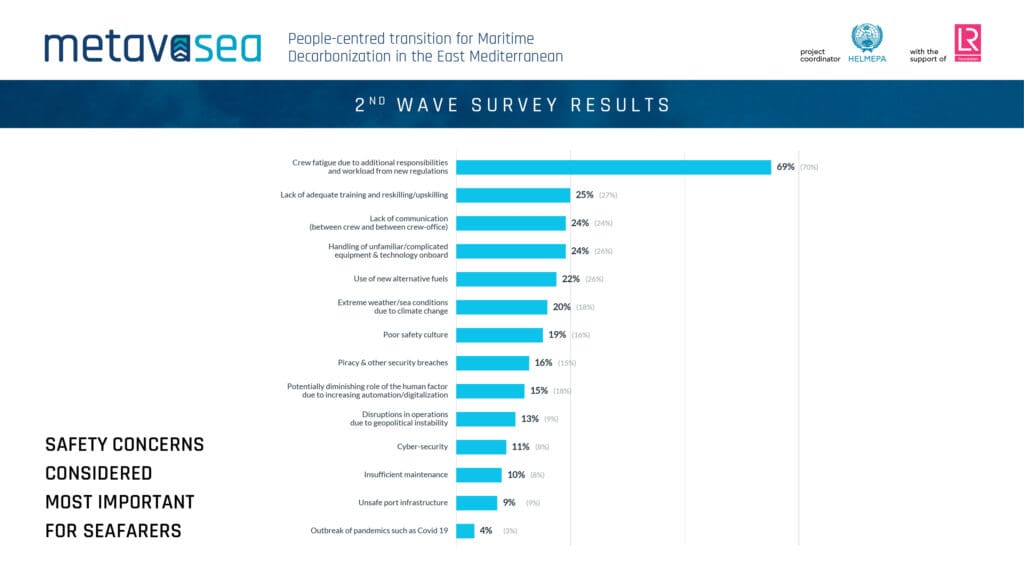
Crew fatigue remains the leading seafarer safety concern. Sixty-nine percent of seafarers selected crew fatigue, driven by additional responsibilities and workload from new regulations, as their most important safety concern, essentially unchanged from Wave 1 (70%). The other top five concerns are lack of adequate training (25%), lack of communication (24%), handling of unfamiliar equipment (24%), and use of new alternative fuels (22%).
Seafarer familiarity with decarbonization frameworks rose across every topic measured. EU ETS familiarity climbed from 34% in Wave 1 to 47% in Wave 2, FuelEU from 33% to 45%, EU MRV from 30% to 41%, and the IMO GHG Strategy crossed the 50% familiarity threshold for the first time, rising from 45% to 56%. ESG indicators rose from 22% to 34%, and EU Fit for 55 from 20% to 29%.
Decarbonization training participation also rose, but the majority still report receiving none. Forty-five percent reported receiving decarbonization-related training in the past two years, up from 36% in Wave 1. Those reporting no such training declined from 64% to 55%. Among those trained, satisfaction (very or extremely satisfied) rose from 56% to 65%. Training content remains concentrated on alternative fuels (66%), EU ETS (36%), MRV (25%), and FuelEU (24%).
Companies and seafarers align on core skills but diverge on resilience and adaptability. Between waves, shipping companies increased their prioritisation of leadership (from 40% to 50%), teamwork (from 36% to 50%), resilience (from 18% to 30%), and adaptability (from 27% to 37%) as required seafarer competencies. Seafarers’ own priorities held flat or moved in the opposite direction: resilience declined from 15% to 9%, adaptability held at 12%, and leadership held at 44%. The widest gaps between the two groups in Wave 2 are on adaptability and resilience.
Strategic alignment is improving, but implementation gaps are widening. Twenty-two percent of shipping company representatives reported a net-zero strategy aligned with the IMO net-zero target by 2050 (Wave 1: 14%), and 9% reported a more ambitious strategy. Fifty-nine percent reported a dedicated Sustainability Manager or department (Wave 1: 49%), and Scope 1 emissions monitoring rose to 78% (Wave 1: 73%). At the same time, three implementation barriers saw increases: financial constraints (from 46% to 59%), limited implementation capabilities (from 29% to 50%), and lack of awareness of available solutions (from 27% to 50%).
Biofuels remain the leading transitional fuel. Biofuels are the most used or planned alternative fuel for shipping companies at 59%. LNG fell from 25% to 9%, methanol from 19% to 11%, and ammonia from 14% to 7%. On long-term potential, biofuels lead at 46%, followed by green hydrogen at 20%, green methanol at 17%, and green ammonia at 15%.
Digitalization is operationally embedded but not yet strategic. Seventy percent of shipping company representatives reported using performance monitoring tools, and 79% of seafarers rated digital transition and basic digital awareness as very or extremely necessary training (Wave 1: 73%). Yet digital and cybersecurity skills as a core seafarer competency were prioritized by only 17% of shipping companies (Wave 1: 12%), 16% of seafarers (Wave 1: 10%), and 11% of service providers (Wave 1: 6%). Cybersecurity as a seafarer safety concern rose from 8% to 11%.
Public concern about maritime decarbonization remains high, and shipping is viewed as a significant GHG contributor. Seventy-three percent of civil society respondents rated the importance of maritime decarbonization as high or very high (Wave 1: 78%), and 78% were very or extremely concerned about local environmental impacts (Wave 1: 87%). Fifty-five percent rated shipping’s contribution to global GHG emissions as very or extremely significant; this rating does not estimate the sector’s emissions share (for context, the maritime share of global CO₂ emissions is approximately 3%). Forty-one percent reported no awareness of any GHG reduction initiatives in maritime transport, and 35% were uncertain which alternative fuel holds the most promise for the sector’s future.
Port decarbonisation readiness remains at an early stage. Wave 2 received a single response from a port administration (Port of Tripoli, Lebanon). Findings for ports are therefore presented based on the combined Wave 1 and Wave 2 sample of 11 ports. Across that combined sample, 73% of ports report no low-carbon fuel infrastructure in place, 45% have no ship emissions monitoring capability, and 36% report no planned decarbonisation interventions.
The findings will be opened to expert dialogue at the 3rd European Conference on Shipping, Intermodalism and Ports (ECONSHIP, Chios, 25 September 2026) and the METAVASEA International Workshop on People-Centred Maritime Decarbonisation at the World Maritime University (Malmö, 2 October 2026). HELMEPA, Lloyd’s Register Foundation and the METAVASEA partnership invite the expert community to interpret and refine them.
Wave 2 has generated its first youth-led spin-off survey on artificial intelligence and autonomous systems in shipping titled Can We Trust the Machine? designed and carried out by HELMEPA Youth Ambassador Leader Sotiris Salamouris, aged 16, engaging 236 maritime professionals between 28 June and 31 July 2026 under the academic supervision of Professor Dimitris Lyridis of the National Technical University of Athens.
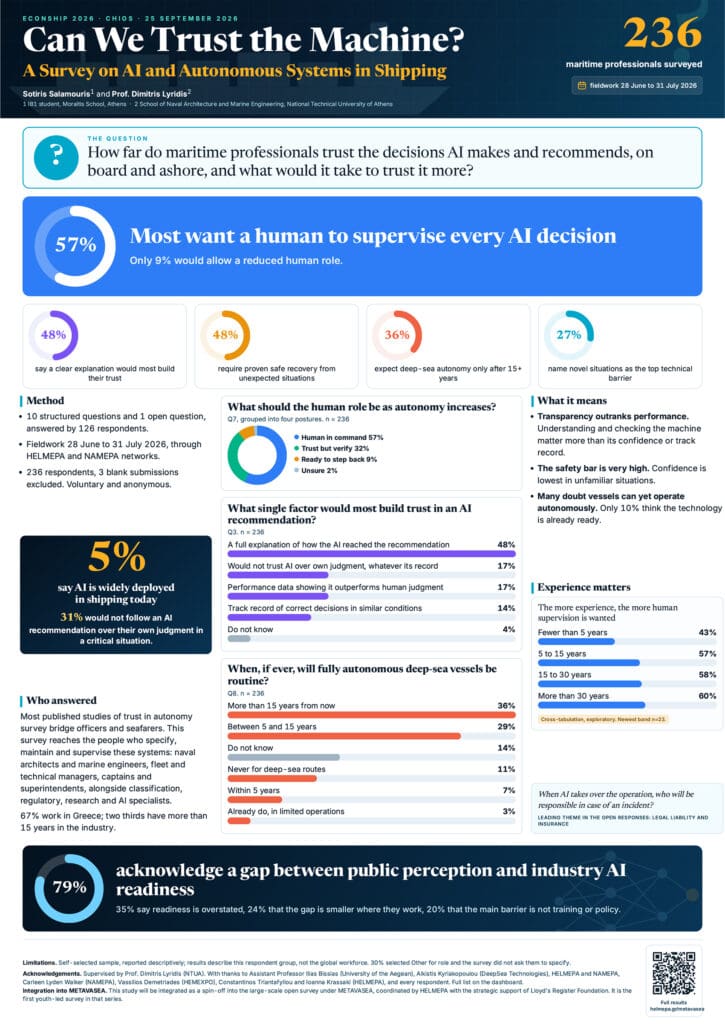
The survey found that 57% of respondents want a human to supervise every AI decision, with only 9% willing to accept a reduced human role. Forty-eight percent say a clear explanation of how the AI reached a recommendation would further build their trust. Support for human oversight rises with experience: from 43% among those with fewer than five years in the industry to 60% among those with more than thirty years.
The second spin-off survey titled Is Training an Investment or a Cost is launched by HELMEPA Youth Ambassador Leader Anna Maria Angelopoulou, under the academic supervision of Mr. Christopher Wiernicki, MIT NAVSEA Professor of the Practice in Mechanical Engineering.
The METAVASEA project adopts a people-centred approach to maritime decarbonisation in the Eastern Mediterranean, a region of strategic importance due to its dense maritime activity and vulnerability to climate change. Coordinated by the Hellenic Marine Environment Protection Association (HELMEPA) with the strategic and financial support of Lloyd’s Register Foundation, METAVASEA (Greek for “transition”) is a five-year initiative running through 2027. It brings together HELMEPA and its consortium partners (Lloyd’s Register, World Maritime University, Cyprus Marine and Maritime Institute, Premium Consulting, MIO-ECSDE, and CYMEPA) alongside 12 associate partners and more than 90 HELMEPA-member companies and contributing stakeholders across the region.
➡️ Download the full Wave 2 Survey Report here
➡️ Take part in Survey Wave 3 by completing the e-questionnaire (~5 min) here
Wave 3 of the survey is currently ongoing, running from December 2025 to April 2027.
For more information, please contact: Constantinos Triantafyllou, Head of Maritime Affairs & Stakeholder Development, c.triantafillou@helmepa.gr
