





| By Elena Sendona on October 1, 2026 |
There is something wonderfully provocative about sending black into the sunlight of spring. For Spring/Summer 2027, Miguel Vieira does precisely that, allowing fashion’s most enduring shade to occupy center stage in “Back To Black,” a womenswear collection in which darkness becomes a study in silhouette, texture, transparency, and handcrafted beauty.

Presented during Milan Fashion Week on September 27, 2026 in Milan, the collection arrived as part of the official Milano Moda Donna Spring/Summer 2027 calendar. For Vieira, whose visual identity has long been intertwined with the graphic authority of black and white, the Milan presentation brought a familiar chromatic language into a particularly concentrated new chapter. Here, black refuses to behave as a background color. It becomes the architecture of the clothes.

That distinction is essential to understanding “Back To Black.” Rather than relying on a conventional spring palette to communicate lightness, Vieira approaches the season through construction. Precise tailoring meets fluidity; sculptural surfaces encounter sheer fabrics; immaculate lines are interrupted by flowers that appear to grow directly from the garments. The resulting tension gives the collection its character: disciplined, sensual, and quietly theatrical.

Vieira begins with the silhouette. Clean cuts and controlled lines frame the body with architectural precision, stripping away unnecessary decoration so that proportion can speak clearly. Yet restraint never becomes severity. Volume enters strategically, disrupting the purity of the line and giving individual looks a sense of movement and dimension.

The contrast between structured and fluid forms runs throughout the collection. A sharply defined shape can suddenly soften; weight can give way to transparency. Pure silk brings movement and an elegant fall, while fine cool wool provides the clarity required for Vieira’s more exacting tailoring. Sequins introduce another register altogether, catching light against the darkness and transforming monochrome into something visually changeable.

Black, under these conditions, is anything but flat. It absorbs light in one moment and reflects it in another. It appears dense across tailored surfaces, almost liquid in silk, and fragile when translated into transparent layers that reveal glimpses of skin beneath. Vieira uses material rather than color to create variation, allowing the eye to register subtle shifts in weight, sheen and opacity.

Then the flowers begin to appear. Botanical forms provide some of the collection’s most expressive gestures, emerging three-dimensionally from lapels, shoulders, necklines and waists. Instead of treating florals exclusively as a printed motif, “Back To Black” gives them physical presence. Handcrafted flowers in fabric and leather project outward from the body, transforming familiar botanical imagery into sculptural construction.

There is a compelling contradiction in that idea. Flowers belong instinctively to the vocabulary of spring, yet Vieira removes the expected explosion of seasonal color. The bloom remains, while its chromatic sweetness disappears. What is left is shape: petals, volume, curves and shadows. It gives the collection a romantic current without surrendering its graphic discipline.

Custom prints developed by the Miguel Vieira studio add another layer to this exploration, while the handcrafted floral details underscore the importance of workmanship throughout the collection. Rather than appearing as ornaments applied at the end of the design process, these elements feel integrated into the clothes themselves. They grow from the silhouette, altering its proportions and changing the way a garment occupies space.
The botanical language continues beyond ready-to-wear. Floral forms also make their way onto footwear and accessories, surrounding them with fluid volume and extending the collection’s sculptural vocabulary from the body down to the final step.

Scarves, ties and bags complete the accessories proposition. The presence of the tie is especially intriguing within a womenswear collection so concerned with the relationship between rigor and poetry. It belongs naturally to the language of tailoring, yet within Vieira’s world it can participate in a softer, more fluid conversation about dressing.

The collection’s stated palette encompasses black and white, colors deeply associated with the Miguel Vieira aesthetic over the years, although “Back To Black” places absolute black at the conceptual heart of the story. The decision feels particularly deliberate for Spring/Summer 2027. Instead of asking color to announce a new season, Vieira concentrates on the physical qualities of clothing: how fabric falls, how tailoring frames the body, how transparency changes perception, and how a three-dimensional flower can alter an otherwise disciplined line.
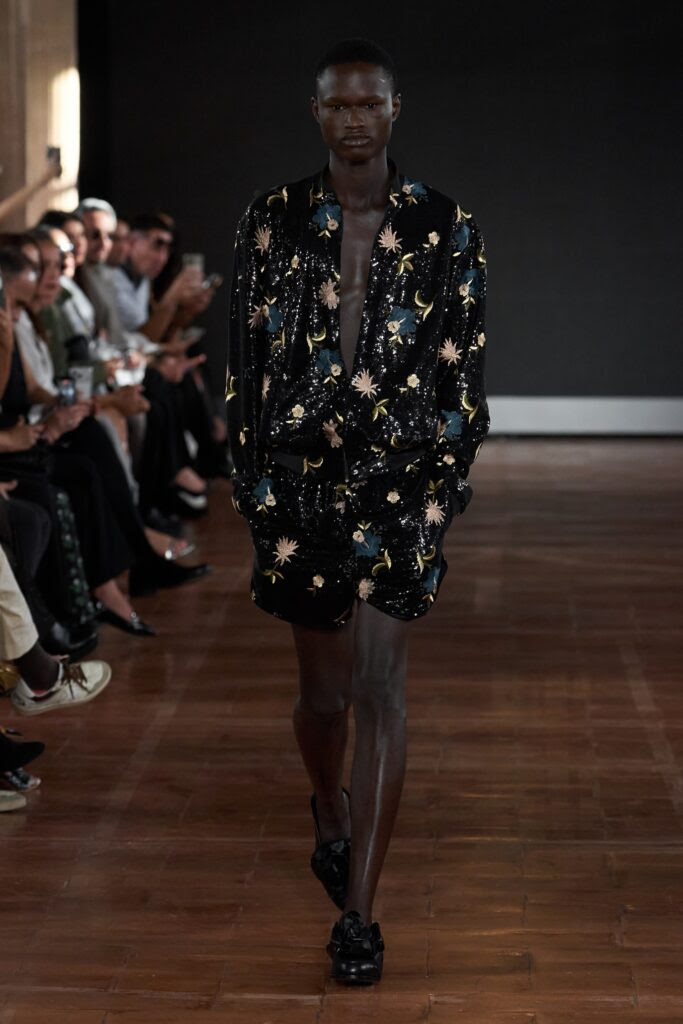
| It is an approach that makes touch seem almost as important as sight. Silk, wool, leather, sequins and lighter translucent fabrics create a tactile landscape in which surfaces continually shift. Smoothness encounters texture. Opacity gives way to skin. The substantial presence of tailoring is relieved by fabrics with an airy quality. Against the visual density of black, these moments of transparency become particularly expressive. That relationship between concealment and revelation gives “Back To Black” much of its sensuality. Skin is suggested rather than aggressively exposed, visible through fabrics light enough to create an almost atmospheric layer around the body. The effect depends on balance: softness against precision, exposure against coverage, movement against control. For Vieira, Milan also represents part of a much longer international story. The Portuguese designer launched his namesake fashion trajectory in the late 1980s and has since developed a universe spanning clothing, footwear, bags, accessories, jewelry, eyewear and interiors. His work has traveled through international fashion capitals while maintaining an aesthetic vocabulary in which tailoring, material quality, elegance and the recurring dialogue between black and white remain central. His Spring/Summer 2027 appearance in Milan was promoted through Portugal Fashion, the project created under ANJE, the Portuguese National Association of Young Entrepreneurs, as part of its work to strengthen the international presence of Portuguese fashion. According to the collection information, the initiative is supported through Portugal 2030 and Compete 2030 with funding from the European Regional Development Fund. Against that international backdrop, “Back To Black” feels remarkably focused. It does not need a kaleidoscope of color to create visual drama. Its drama comes from craftsmanship: a flower constructed by hand, a shoulder shaped with precision, silk moving around the body, a transparent layer floating over skin, or a sequin briefly capturing the light. Perhaps that is the collection’s most alluring proposition. Black can be rigorous and romantic within the same breath. It can sharpen a silhouette and make a handmade flower appear almost surreal. It can carry the weight of tailoring while making transparency feel even more delicate. For Spring/Summer 2027, Miguel Vieira lets black bloom. |
Fashionality.nyc © 2026.
