





Dear institutional stakeholders, dear members, dear colleagues and friends,
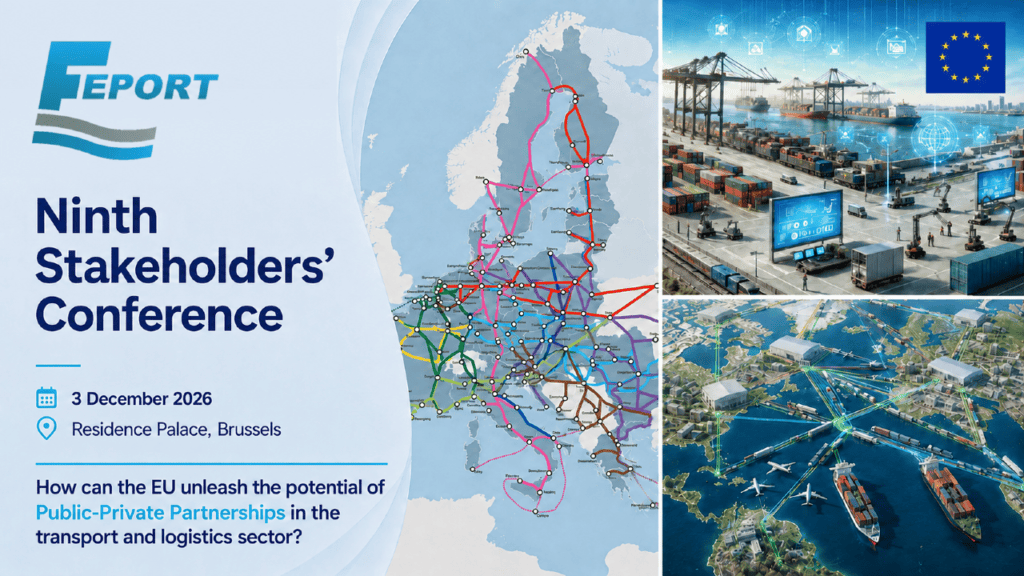
FEPORT will hold its Ninth Annual Stakeholders’ Conference on 3 December 2026 at Residence Palace in Brussels, and we hope you will like the programme we have prepared for you.
We are glad to invite you to join us and are proud to announce that a great line-up of speakers (stay tuned on our LinkedIn page!) will make our conference a valuable occasion for debate and exchange.
Public-Private Partnerships (PPPs) in the EU transport sector must evolve to help overcome funding shortfalls affecting the trans-European transport network. As highlighted by the European Commission’s EU Ports Strategy, modern ports are important nodes in the transport system. They are no longer simply docking points; they have evolved into complex, multimodal and multifunctional industrial hubs. They must simultaneously expand cargo capacity, digitalise supply chains, address growing cybersecurity and organised-crime threats, and act as key hubs for the clean energy transition.
Delivering the green and digital transformation of Europe’s transport infrastructure will require massive investment. The European Commission has estimated that the related infrastructure investment gap amounts to an additional €100 billion per year. Public budgets and Connecting Europe Facility (CEF) grants cannot meet these needs alone. Private capital is therefore not a luxury; it is an operational necessity.
While Public-Private Partnerships offer a proven way to unlock this funding, their deployment can be hindered by several obstacles. Fragmented national legislation, lengthy environmental permitting procedures and competition rules that do not reflect evolving risk allocations are among the significant barriers to attracting private capital.
The conference aims to address these friction points. It will provide a forum to explore how the EU can structurally de-risk and modernise investment frameworks and unleash the full potential of PPPs in the transport and logistics sector.
How can the European Union unleash the potential of PPPs in transport and logistics?
Four sessions will allow us to cover many themes:
Session 1: The Regulatory Unlock Panel
An effective Regulatory Unlock Panel focused on Public-Private Partnerships (PPPs) within the European Union (EU) port sector needs to tackle a unique operational paradox: while the EU demands massive, rapid investments from the private sector to achieve Green Deal compliance (shore power/OPS, alternative fuel bunkering, hydrogen hubs), support military mobility, fight against drugs and prevent cyber risks, its strict regulatory frameworks (State aid rules, environmental rules and competition law) can often create friction, slowing down contract closures and holding back private capital.
Session 2: The Physical Interface Panel
In a European context, the “Physical Interface” refers to critical friction points where a Public-Private Partnership (PPP) can easily break down. These include hinterland connections (where a private terminal operator’s rail tracks plug into a publicly managed national rail network), last-mile bottlenecks (roads, canals), and the physical integration of the Green Deal (grid connections for cold ironing/shore power, hydrogen pipelines, and automated vehicle gates) and military mobility (the dual-use dimension).
In the coming years, rail will be instrumental to the growth and efficiency of the TEN-T network and an important mode for military mobility. What is the future of PPPs in the rail sector?
Session 3: The Digital Security Panel
This panel is at the intersection of digital security and narcotics trafficking in the port sector. Organised crime networks no longer just bribe dockworkers; they hire hackers to breach Port Community Systems (PCS), extract container release PIN codes (known as PIN code fraud), manipulate Automatic Identification Systems (AIS), and track contraband using digital twins.
Cyber resilience is therefore crucial for port operations and for the fight against drug trafficking. Partnerships between law enforcement agencies and national authorities can be effective only if the private sector is involved in developing the solutions to be implemented. How can we strengthen the European Ports Alliance while enhancing cooperation on cybersecurity?
Session 4: The De-Risking Challenge Panel
Historically, de-risking a port or transport PPP meant managing predictable, long-term macroeconomic metrics like inflation and tariff structures. Today, the EU’s ambitious Green Deal timelines (Fit for 55, FuelEU Maritime, and Corporate Sustainability Due Diligence), combined with geopolitical volatility and energy uncertainty, have introduced entirely new risk profiles.
Private investors are hesitant to back concession agreements if they have to bear the full risk of volatile alternative energy prices, sudden European climate policy updates or uncertainty deriving from competition law that does not match new policy objectives, or asymmetric competition from non-EU ports.
How can the European Union unleash the potential of PPPs in transport and logistics?
As you can see, a lot of topics and many more will be discussed and debated.
Stay tuned for the programme, which will be released soon.
We invite you to register through this link. Please note that, as capacity in the conference room is limited, we will send final confirmation of registration a few days before the event.
Registration will close on November 18th, 2026.
We look forward to welcoming you!
Kind regards,
The FEPORT Team
