





First and foremost, I would like to thank the organizers for inviting me to speak in this conference which reminds me that 8 years ago onboard a frigate of the HN I had the honor to celebrate the National Day of Greece – 25ht March 2018 as Commander in Chief of the Hellenic Fleet, hosting Israeli Government Authorities, the Diplomatic Community in Israel and Israeli friends. Very unique moment for me that I keep into my heart.
Concerning the topic of the conference: For years during my navy SoF career I was on the underwater attacking side, and now while I am in a demilitarization phase of my life, I am requested to support with ideas the protection of underwater critical infrastructure.
I can tell you that operating as a Navy Seal underwater for years, it was so easy to achieve your objective and survive. Not all people in the world have the sea into their DNA.
Between the years 2017-2019 NATO added two more operational domains, first CYBER and later on SPACE. Today we are speaking for “Multidomain Operations”, as all mentioned domains are connected through data exchange systems and AI technology.
The underwater world is a unique environment, although a subdomain of the SEA. But the physics in this environment are different from all five domains I mentioned.
The wave propagation underwater falls under different laws of physics, which is an area where scientists globally are developing new technologies with the use of unmanned vehicles and detectors. The technology specialists will speak later on during the conference.
The growing importance of subsea infrastructure is bringing maritime security, economic resilience and political decision-making closer together. The East Med must consider both the protection of essential services and the consequences of a disruption involving several countries.
The current regional initiatives to establish and preserve a Maritime Situational Awareness picture, where the soonest we have to include the Underwater MSA are as depicted on the slide.
The most significant development has been the shift from ad hoc cooperation to institutionalized information-sharing networks and multinational coordination mechanisms.
At the European level, the EU’s Common Information Sharing Environment (CISE) connects maritime surveillance authorities across borders and sectors, allowing civilian and military organizations to exchange maritime security information in near real time. The system is specifically designed to improve awareness of threats against critical maritime infrastructure, including subsea cables, pipelines, ports and offshore energy assets.
In the Mediterranean basin, cooperation is increasingly supported through the Mediterranean Coast Guard Functions Forum (MCGFF), which brings together 24 Mediterranean countries to coordinate maritime security, environmental protection, surveillance and safety activities. The forum serves as a non-political platform for operational cooperation and confidence-building among regional actors.
At the political-strategic level, Greece, Cyprus and Israel have expanded trilateral security cooperation, emphasizing maritime security, protection of critical infrastructure, intelligence exchange and joint exercises. The December 2025 summit reaffirmed commitments to deepen cooperation in safeguarding sea lanes and underwater infrastructure.
One of the most difficult aspects of seabed security is to establish: (1) what happened, (2) who was responsible and (3) whether the damage was deliberate.
Much of the infrastructure is difficult to observe directly. We should also distinguish the risk of sabotage from the evidence in an individual case.
The International “Cable Protection Committee” identifies accidental human activity, particularly fishing and anchoring, as the predominant cause of telecommunications cable faults. Damage is more common in shallower waters, so deep-ocean incidents should not automatically be treated as indistinguishable from routine fishing or anchor damage. Suspicion alone is insufficient to establish intent. It may become visible first as a service failure, while the evidence needed to explain it, is dispersed between operators, vessels and national authorities.
For the East Med, the concern is that uncertainty around an infrastructure incident could interact with existing political tensions and differing jurisdictional positions. A cable fault could quickly acquire a political meaning before the technical facts are established.
The appropriate response is to preserve evidence, exchange verified information and maintain direct communication between the affected authorities and operators. This supports proportionate decisions and reduces the risk of unnecessary escalation.
As a conclusion there is a need for Cross Border Data Surveillance, shared MSA and interconnected national commands and coordination centers.
Finally, there is an urgent need to increase CIV-MIL cooperation and interaction, and mobilize civilian sectors to contribute with information in the common goal of underwater security.
We all are aware of the limited or even scarce states’ resources, when there is a lack of a holistic approach to collect information and an absence of connection between State Intelligence Agencies and the Shipping Community.
The long-term goal is a common operating picture covering shipping, energy infrastructure, subsea cables, offshore platforms, autonomous systems and suspicious vessel activity across the East Med. This would combine military, coast guard, intelligence and commercial data streams.
States increasingly recognize that pipelines, electricity interconnectors and submarine cables are shared strategic assets. Future cooperation will likely include coordinated monitoring, risk assessment and rapid intervention procedures.
A key objective is the creation of a multinational rapid-response mechanism able to investigate cable cuts, cyberattacks or sabotage incidents and coordinate repair efforts more quickly than current national arrangements.
The Greece-Cyprus-Israel framework is gradually evolving beyond exercises toward more structured intelligence sharing, crisis management and maritime security coordination. Several analysts view this as the nucleus of a broader East Med security architecture.
Future systems are expected to integrate governments, navies, coast guards, energy operators, telecom companies and hyperscale cloud providers. Because ownership of critical undersea infrastructure is increasingly private, effective security will require public and private coordination, rather than purely military solutions.
Despite the trilateral evolution, East Med has not yet achieved a fully integrated multinational maritime command structure. A future path is the development of a federated network of national maritime coordination centers, linked to a trilateral information-sharing mechanism, providing a common operational picture while preserving national control over maritime security decisions.
The most realistic trajectory in my opinion is to move toward a federated CIV-MIL regional security architecture using i-cloud technology.
This evolution is driven by growing concerns over hybrid threats, cable sabotage, offshore energy security, and the strategic importance of the East Med as a digital and energy corridor between Europe, Middle East, and the Indo-Pacific. And I am referring to the IMEC.
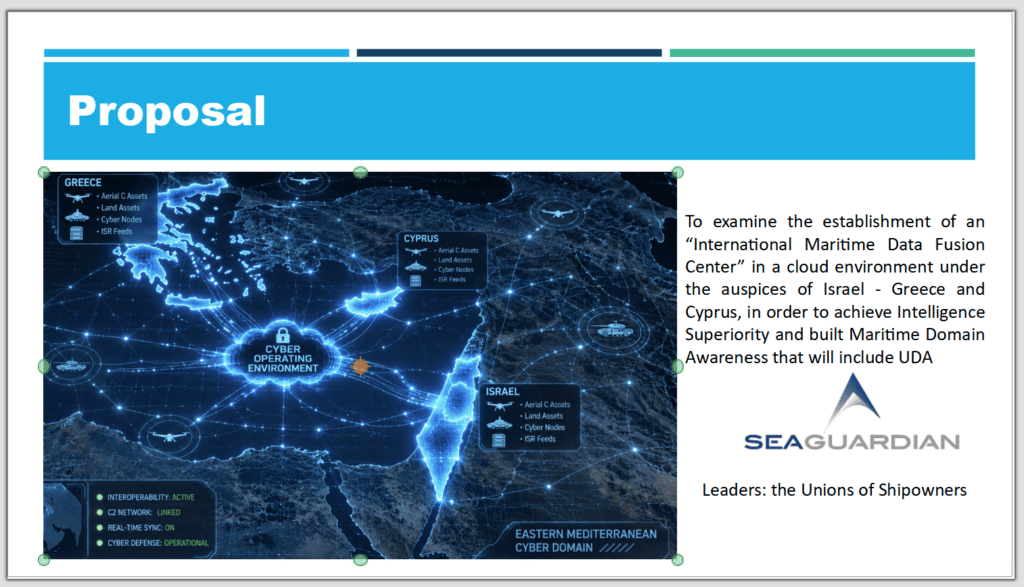
Concluding my proposal is to examine the establishment of an “Regional Maritime Data Fusion Center” in a cloud environment under the auspices of Israel – Greece and Cyprus, in order to achieve Intelligence Superiority and built Maritime Domain Awareness that will include Underwater Domain Awareness (UDA).
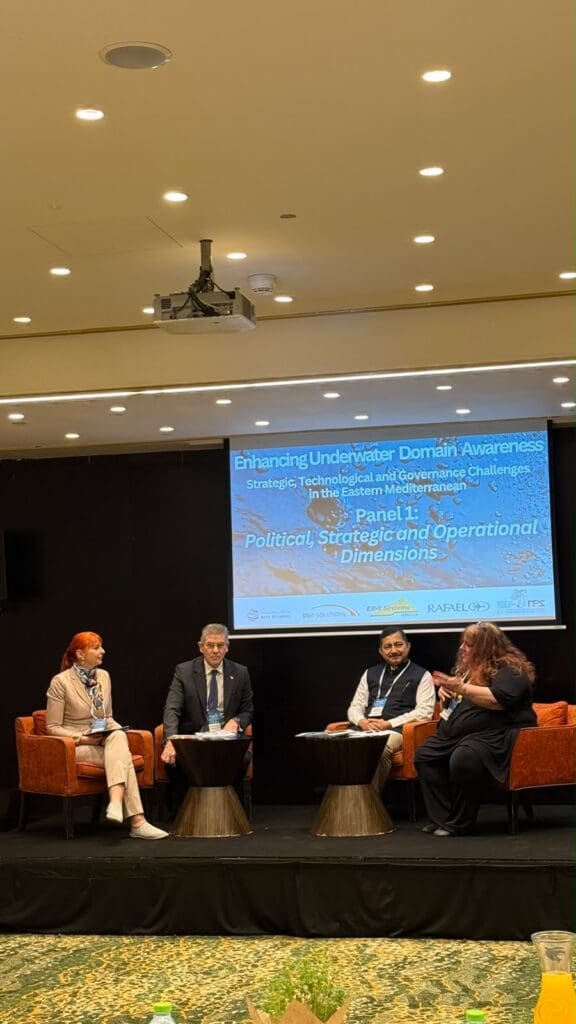
Viewers can see herebelow the panel structure.
