





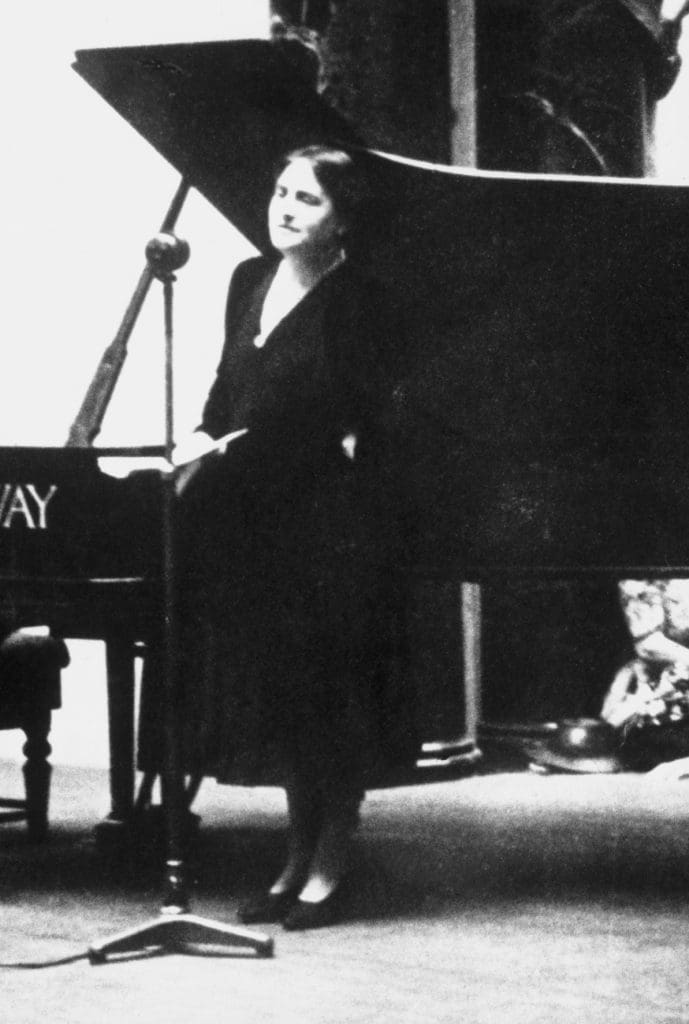
Myra Hess’s wartime concerts defying the bombs are honoured by the National Gallery
By James Brewer
Hitler’s bombers flew deadly missions over England in 1940, causing devastation around the Port of London. In the afternoon of September 7, which became known as Black Saturday, some 350 warplanes, escorted by more than 600 fighter jets, unleashed mayhem on dockland warehouses and nearby homes.
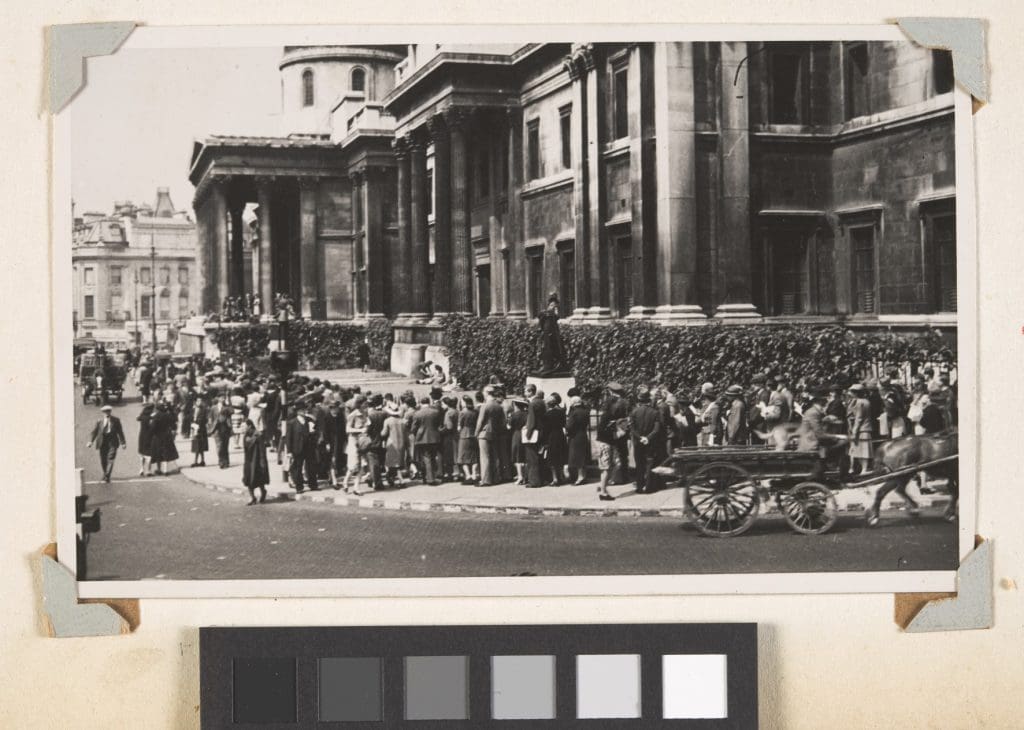
The onslaught failed to deter thousands of men and women who flocked to the celebrated concerts given by pianist Myra Hess and fellow musicians in improvised halls at what was considered the very centre of London: the National Gallery. Every day, eager crowds lined up outside the Trafalgar Square edifice – at the same spot where, late in 2024, enthusiasts for fine art are patiently waiting their turn to view the blockbuster exhibition Van Gogh: Poets and Lovers (which runs until January 19, 2025).
In a separate part of the institution (and with free admission) in a multi-media display on the ground floor, and online, the Myra Hess concerts are being ‘reimagined’ as part of the just-launched project NG Stories: Making a National Gallery. The project brings together archive footage from more than 80 years ago with a newly commissioned soundscape that gives a graphic sense of the atmosphere around the historic against-the-odds concerts. The well-paced narrative is told with clarity, sensitivity and admiration for all who were involved.
At the outbreak of war, the UK government had closed music halls, theatres, galleries and museums for fear of mass casualties from bombing raids. The National Gallery’s location made it especially vulnerable. Containers full of its masterworks left London daily for safekeeping at secret destinations in Gloucestershire and Wales.
Centres of heritage and of the humanities are among the first casualties of war, and Westminster had decreed a “a cultural black-out” of London, as the National Gallery’s director, Sir Kenneth Clark, called it… but the authorities were to be reminded that music cannot be stilled.
When the National Gallery closed on August 23, 1939, the buildings were set to be requisitioned for administrative purposes, until the renowned pianist made an extraordinary proposal. Dame Myra, as she was to become, believed that the arts played a spiritual role in the health of the nation at the best of times – and would play an even greater role in wartime. She made a plea that the Gallery should be opened for concerts. Clark took little persuading and convinced the Home Office and Ministry of Works to grant dispensation from the ban on public gatherings. Asked in a radio interview whether it might be possible to give an occasional lunchtime concert, he replied: “Why not give one every day?”
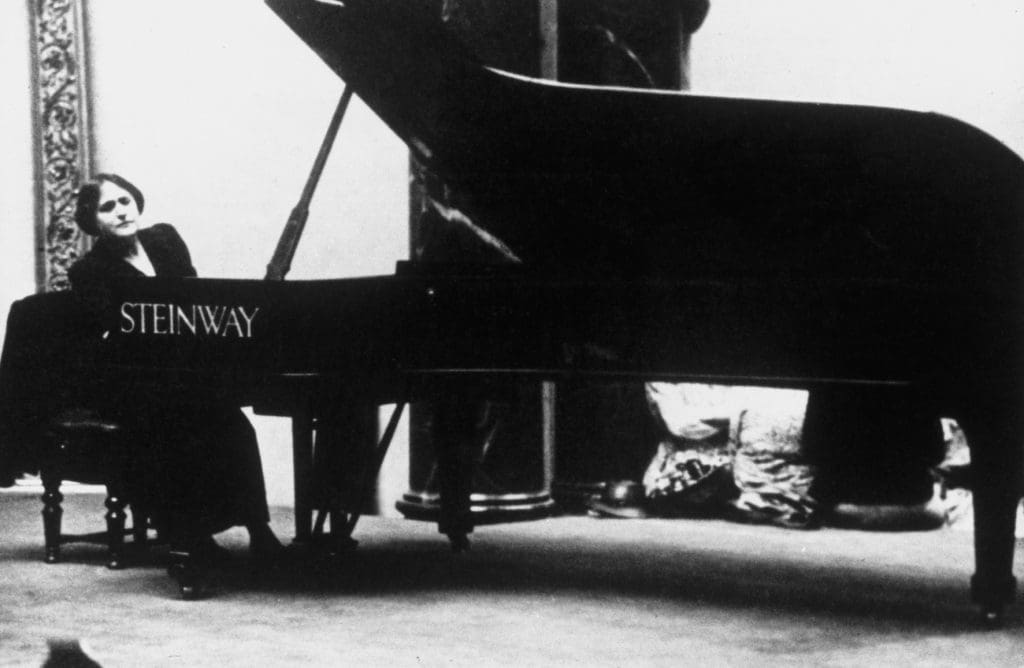
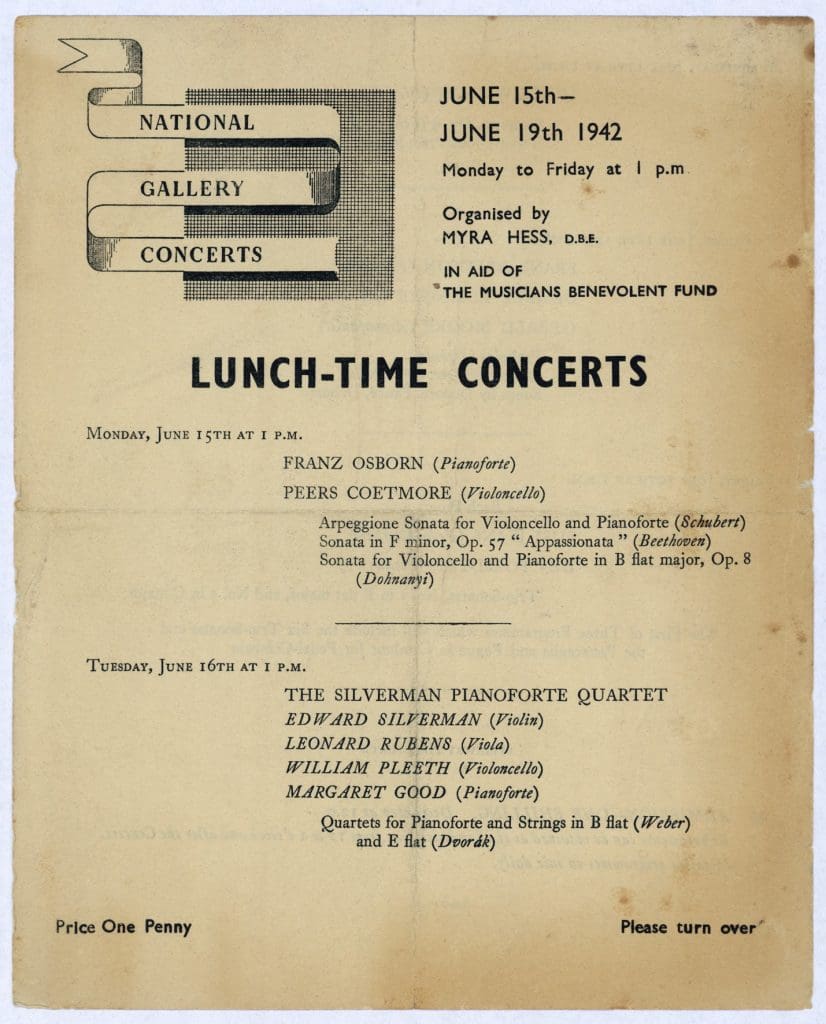
It was agreed that the concerts would take place daily at 1pm, with repeat performances at 5pm on Tuesdays and Thursdays. An admission fee of one shilling would be charged for the midday concert and two shillings for the late afternoon event. Printed programmes were sold for one penny. The first such concert took place on October 10, 1939, Myra and her team having had only a few weeks to book performers, equip the venue, and organise publicity.
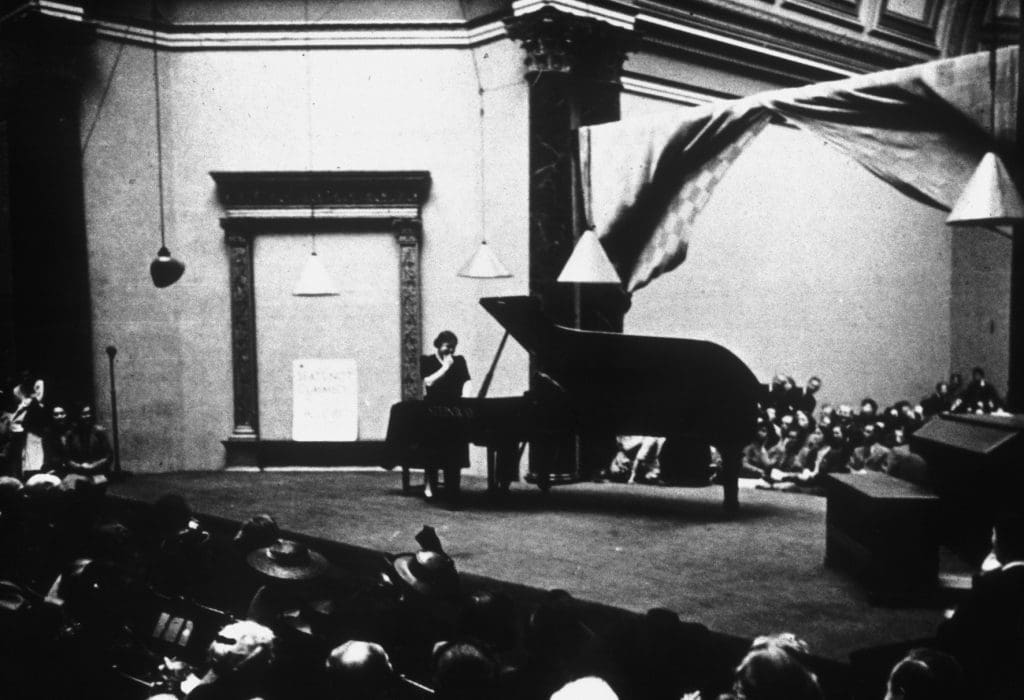
An octagonal gallery with a glass dome was chosen (Room 36) and a wooden platform installed. When Steinway & Sons, a firm with a long tradition of handcrafting world-class pianos, delivered a majestic concert grand, Myra tested it with a burst of Beethoven’s Moonlight Sonata. Fears that, given the unusual shape of the room, the acoustics might be below par were unfounded – the sound was pronounced magnificent. Thus, the genius of a German-born composer was invoked at the inception of the plan. Myra, born to a Jewish family in London, never displayed a shred of prejudice despite Britain being at war with Germany, and never hesitated to programme Lieder by a German singer.
The length of the queue on the first day showed that the concerts were going to be a triumph. Myra had decided to give a solo performance rather than call in more musicians “in case the whole thing is a flop.” She expected 40 or 50 of her friends to show up. Instead, a file of people stretched from the Gallery steps, along one side of Trafalgar Square and right round the corner. Myra played to an audience of 1,000, with many people turned away.
The defiant musical gesture came at a time when German bombers were flying nightly over the capital on their way to attack the North of England. On September 7, 1940, it was the turn of the Port of London, key to the import of food and other essentials, to suffer. In all, 430 workers and other residents were killed and 1,600 injured. Attacks continued for 59 nights in succession, and for months afterwards.
Despite the Blitz, Londoners who waited outside the Gallery would display patience and resilience until the All Clear sounded and performances could begin. Inside the building. the 500 chairs were quickly filled, leaving hundreds more spectators to lean against the walls, stroll around, or sit on the floor. Although conditions were cramped and uncomfortable, the applause was heroic. Joyce Grenfell, a much-loved actor and musician who worked in the canteen on concert days, later wrote: “We made sandwiches that became justly famous for being complementary to the music.” Many brought their own refreshments: audience members were free to eat their lunches and walk in and out as they pleased.
Myra’s first programme began with two short sonatas by Scarlatti and two Bach preludes and fugues, followed by Beethoven’s Appassionata sonata, a group of Schubert dances, a waltz and nocturne by Chopin, the three Intermezzi from Opus 119 by Brahms, and finally the pianist’s much-loved arrangement of Jesu, Joy of Man’s Desiring.
In the summer of 1940, Hitler ordered an air offensive intending to pave the way for an invasion of the British Isles. The severity of daytime bombing meant the concerts had to be moved to the Gallery basement, which had room for only 300 to 400 people. That made for an ordeal when the temperatures rose or fell. Audience members fainted and string players struggled to keep their instruments in tune. In winter, piercing draughts cut through blown-out windows and made audience and musicians bring rugs and blankets. Myra played in a fur coat; and stoves were lit on the platform to stop the performers’ fingers turning blue.
The National Gallery could scarcely hide from the airborne assault and was to sustain damage from nine explosions. In autumn 1940 the building was attacked repeatedly and at 11am on October 15, Myra was told by phone to evacuate the building as a time bomb had fallen. It seemed that the concerts might finally have to cease, but within half an hour a different venue was found. A messenger was sent into Trafalgar Square to redirect the audience to the library of nearby South Africa House, where several hundred people heard the Griller Quartet and the violist Max Gilbert play Mozart string quintets.
The concerts returned to the National Gallery the next day, only for another unexploded bomb to be found in the wreckage. The audience was shepherded to a room in the east wing to hear the Menges String Quartet while the bomb disposal team neutralised the menace. Then a few days later, in the middle of a Beethoven quartet, another device exploded under the old boardroom of the Gallery, away from Room 36 where a concert was taking place. According to one account, no one in the audience stirred and the Stratton Quartet continued their performance without missing a beat.
A combined audience of more than 750,000 attended a total of 1,698 concerts. They saw 238 pianists, 236 string players, 64 wind players, 157 singers, 24 string quartets, 56 ensembles, 13 orchestras, 15 choirs and 24 conductors. Celebrated maestros such as Toscanini and Rachmaninov were among those who donated to keep the concerts going.
Myra had made many successful tours of Europe and the United States by 1939, and when hostilities broke out sacrificed a lucrative tour offer to stay in the UK for the duration of the war. She referred to the National Gallery concerts as her “national service.” The concerts satisfied her ambition to make classical music available to all. A front-row seat at a first-rate London concert had perhaps never been available for one shilling.
She vainly urged that the morale-boosting concerts continue after the war was over, contending that the importance of music would grow in the difficult years ahead. The last in her series took place on April 10, 1946, six and a half years after the first, and Myra chose not to play herself, afraid she might be overcome by emotion. She extended the valedictory honour to the Griller Quartet, who had performed at the concerts from the beginning.
In a video accompanying the new exhibition, Nigel Hess, her great-nephew, says: “I think what she stood for was the healing power of music because obviously everywhere was closed. The National Gallery concerts were really the only form of musical sustenance that Londoners had during the Blitz, and it was very well known that Myra was the founder and the chief mover behind them, and so she just became the darling of the day, she really did.”
Music eventually returned to the Gallery in the 1970s, and in September 2006, a day of recitals commemorated the war-time achievement. Since then, Dame Myra Hess Day has been an annual event with performances by her pupils, including the distinguished pianists Stephen Kovacevich and Richard and John Contiguglia.
Myra Hess was born on February 25, 1890, in Kilburn, London. When only 12, she won a scholarship to the Royal Academy of Music, and her public debut was five years later at the Queen’s Hall, a prestigious venue in central London, with the New Symphony Orchestra and its conductor, Sir Thomas Beecham. She was made a Dame of the British Empire in 1941 in recognition of her wartime service. For her, the message was in the music, and she was on its front line, raising high its banner.
The Gallery’s account is of someone who on stage was a model of dignity and composure, but who would entertain friends with tricks that included playing the piano upside down or with an orange tucked under one hand.
The National Gallery marked its 200th birthday on May 10, 2024, initiating Bicentenary celebrations with a year-long festival of creativity and history including the NG Stories initiative, in two rooms on the Gallery ground floor. It tells of people who worked behind the scenes, such as the Gallery’s first housemaid and the Keepers and porters who lived in the basement to safeguard the paintings around the clock. The digital engagement programme is supported by Bloomberg Philanthropies which backs projects in the areas of arts, education, environment, government Innovation, and public health.
National Gallery Stories runs until January 12, 2025, at the National Gallery, London. Admission is free. Online access is at nationalgallery.org.uk/exhibitions/ng-stories
