





By James Brewer
Ukrainian artist Alina Pyatnova has created a profound tribute to Her Late Majesty Queen Elizabeth II of the United Kingdom with a magnificent portrait entitled Three Faces of Majesty. A London debut for the painting has underlined the strength of the bond between Ukraine and the UK since the eastern European republic came under attack by Russia.
Alina’s pensive yet celebratory portrayal is in essence three visions of grandeur — a moving poetic homage through three symbolic depictions of the sovereign, in themes of grace, transformation, and legacy.
First, as a young queen, the monarch is shown radiating grace and strength, as she sports a corsage of lily of the valley – her favourite flower, which was part of her Coronation bouquet in 1953 and a feature of the Buckingham Palace Garden. Opposite stands the Queen in later life, contemplating her widely acknowledged years of unwavering duty and dignity. A butterfly appears, representing her soul as free and eternal.
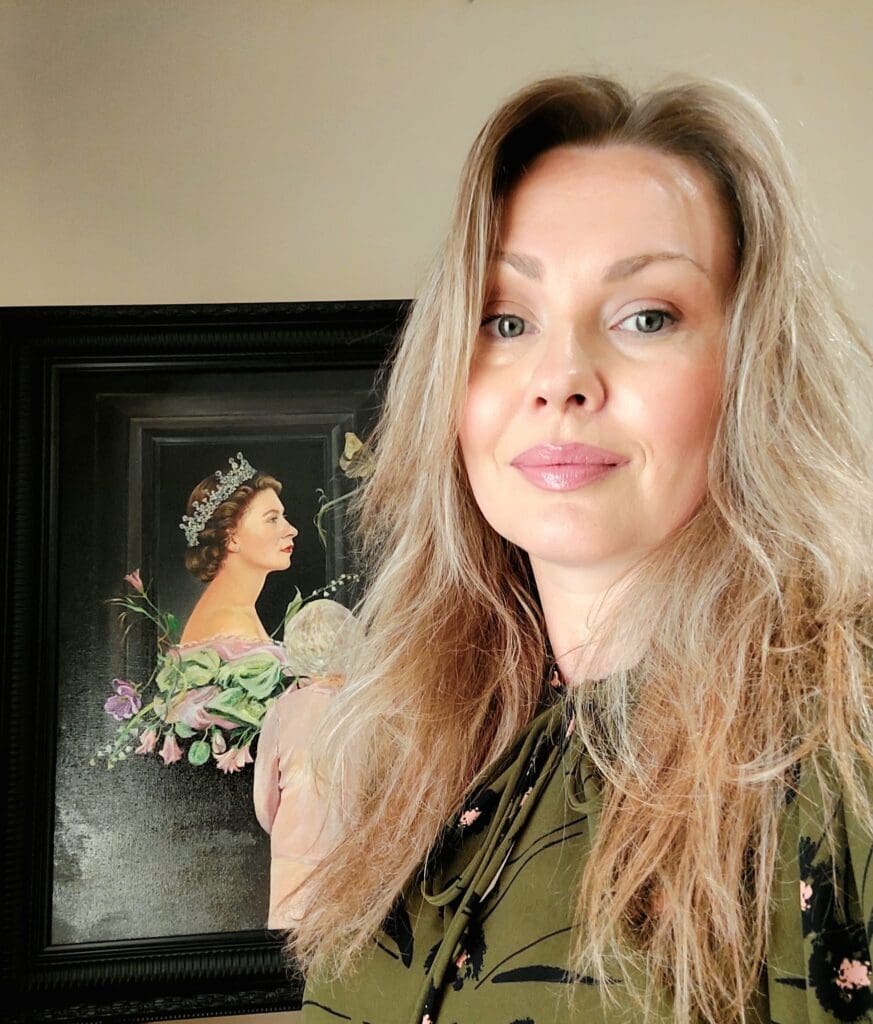
In Three Faces of Majesty the accomplished artist sees herself as honouring a spirit that continues to inspire. The apparent simplicity of her visual eulogy to the late Queen belies a multi-dimensional appraisal of the qualities represented by the beloved monarch. More, it is a gesture of admiration and gratitude to the UK monarchy and British citizens for their support for the people of Alina’s native land.
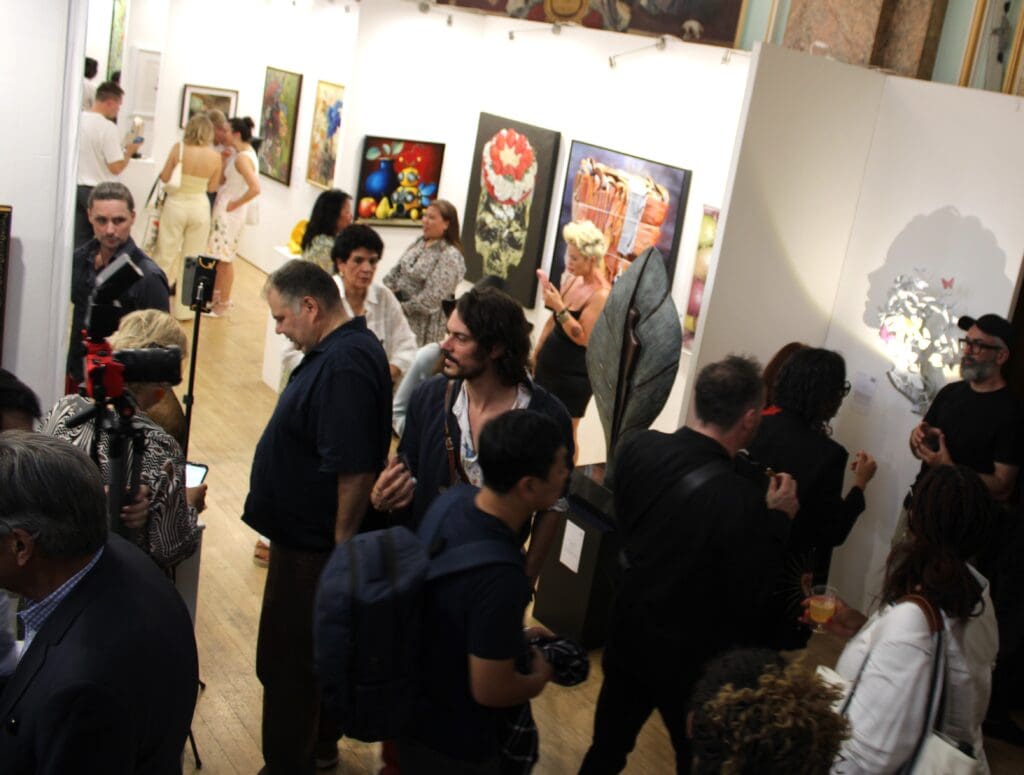
The painting drew admiration at the prestigious London Art Biennale 2025, which ran from July 16-20. It was presented as “a landmark moment in contemporary Ukrainian art” by Ukrainian Art House in London, an organisation which specialises in exhibition and corporate art. From day one of the Biennale, art enthusiasts from London and beyond, and artists and their supporters from across Europe, packed Chelsea Old Town Hall, a Grade II late Victorian building, a premier Kensington venue for art and vintage fairs.
Alina’s oil on canvas, which is 50 x 70 cm, was a stand-out among the exhibited contributions from 350 artists of 60 nations.
Her artistic vision owes something to her architectural background in balancing structural clarity with emotional depth. Her selection for the Biennale marked a significant achievement, spotlighting the vibrancy and resilience of Ukrainian contemporary art on the global stage. In her practice, with a suite of oils, pastel, watercolour, ink, etching, and other mediums, she creates layered compositions that reflect both emotional nuance and technical mastery.
Of her visual concept for the regal paragon, she told us: “I wanted to portray her not only as a Queen but also as a human and a woman, as a mother that is an inspiration for the generations and is kind and generous. It reflects the person and the best of the journey everyone has been through, to see themselves once young but later mature.”
She very much wanted to find a way to portray her exalted subject’s journey from the material world into the spiritual world. To tell of the journey, she adopted a surrealist approach of a frame inside the frame, a portal into another world, yet presenting her as alive.
Alina said it was challenging to find relevant archival material and links online needed to inform her approach for the painting. Ironically, the late Queen was ‘known’ to multitudes: during her reign, the longest of any monarch in British history, she met an estimated four million people.
As a second part of her project Alina has in mind to make a diptych to accord esteem and gratitude to the late Queen’s son King Charles as one who continues the role of the UK in providing a warm home for Ukrainians.
Since special three-year humanitarian visas were created for Ukrainians in 2022 with a subsequent extension scheme, the subject continues to be on the agenda at Westminster including an adjournment debate that was scheduled for Monday 21 July 2025, led by Liberal Democrat MP Martin Wrigley, and is expected to lead to further extended authorisation.
In June 2025, the government repeated its respect for the “Ukrainian government’s desire for the future return of its citizens” and the possibility in principle of switching to a different visa. The Migration Observatory at Oxford University has estimated that 217,000 Ukrainians were living in the UK as of June 2024.
Alina, born into a family of artists and musicians, has a deep affection for Ukraine, where much of her family lives. She was brought up in Dnipro, in central Ukraine, the country’s fourth largest city. She currently lives in Israel with her husband and children and works internationally as much as she can.
