





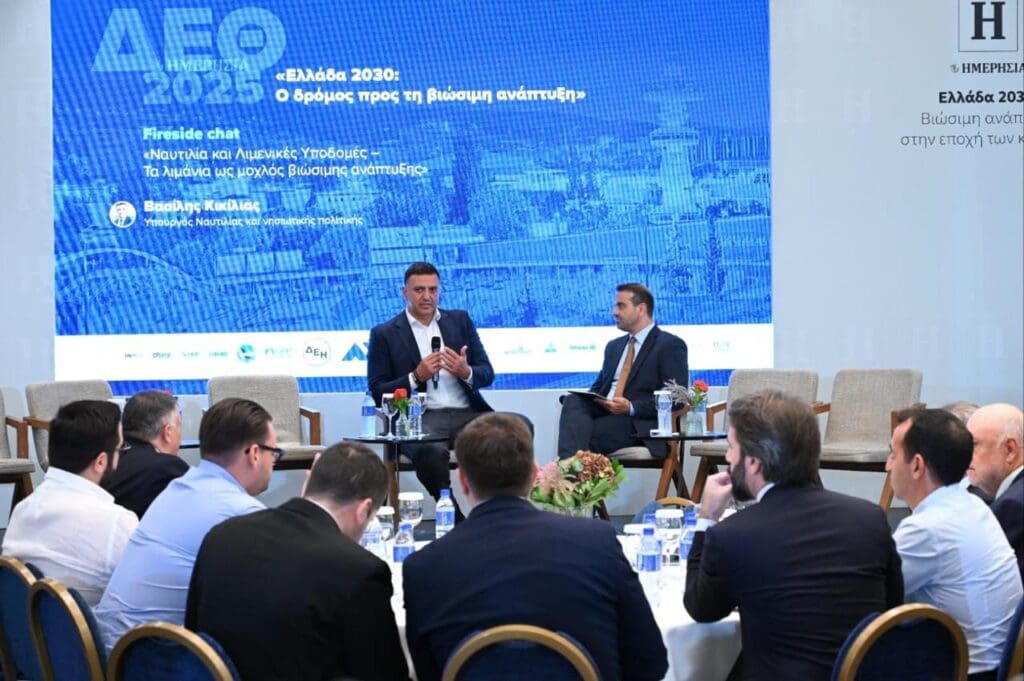
“The spearhead for the economy of Thessaloniki and Northern Greece are the marinas, ports, anchorages, jetties, yachting and everything that can bring revenue to the world,” emphasized the Minister of Shipping and Island Policy, Vassilis Kikilias, speaking at the “Imerisias” newspaper conference in the context of the TIF.
The Minister recalled that, already during his tenure at the Ministry of Tourism, he had highlighted the port as a natural advantage of Thessaloniki, which should be exploited with emphasis on cruising. “At the end of that year, from a single-digit number of cruise ships we reached a double-digit number and last year they exceeded 80. The port of Thessaloniki is now favored by cruises and investment procedures are beginning in the rest of the sector. For many years we did not exploit its enormous potential. I am glad that the required investments are now progressing, because this gives added value to all of the above,” he said.
Regarding cargo infrastructure, he noted that the growth rates in the post-government era were by no means satisfactory, pointing out: “I understand that in order to renovate, obtain environmental approvals, go to auction and complete a port, it often takes so many years that the next generation finally takes over. Here, we are obliged to find a way to speed up the processes. A strategic investment in the port of Alexandroupolis showed how an infrastructure is transformed into a critical energy hub with multiple possibilities. Similarly, we must move at such a pace in cargo, LNG, bulk, but also in the marinas that are missing from our country and our islands.”
Regarding the freeze on coastal shipping ticket prices, Mr. Kikilias stressed that the government’s policy focuses on the middle class and the average Greek family. “With announced increases in coastal shipping of 15% due to a change in fuel to a more ecological one, we found a solution: we made good use of the green fund and provided 50% of the reduction in port fees, while competition brought reductions of up to 32% in ticket prices. In addition, we provided 42 million euros in transport equivalent to the islanders and we are proceeding with a new four-year tender for the barren lines, in order to ensure stability and better service on the islands.”
Regarding the port guards and their presence in the ports, he stressed that the safety of travelers remains non-negotiable. “The port guards must be out in the port with the people. We put 100 officers in the port of Piraeus, 20 more in Rafina, Thessaloniki and the islands. The Port Master is the absolute boss in a port, nothing starts or sails without his consent. If security issues are involved, there is no discount. I prefer to apologize for the inconvenience than to have any risk to the safety of citizens.”
Regarding the upcoming announcements for the conscripts, he stressed: “In all the measures that will be announced, there will be very significant interventions for the military and Security Forces. They deserve it. We must continue to train them, hire others, provide the means and have demands.”
Regarding migration, he said: “The challenges in migration policy are continuous. Libya is a broken country, there is pressure from Gaza, civil war in Sudan. The Coast Guard has operated successfully in the northeastern and southeastern Aegean. On the high seas, its presence is mainly humanitarian.”
Finally, speaking about the new armament program that is “running” at the Ministry of Shipping, he pointed out: “Aegis 2 for the Coast Guard includes satellites, drones, vessels and digitalization of the war room. The goal is to supervise our 16,500-mile maritime borders against illegal immigration, arms and drug trafficking. Northern Greece in particular has a lot to look forward to in the coming period.”
