





By James Brewer
Like many young artists of his time, Konrad Mägi headed for Paris in 1907 hoping to make his reputation and his fortune. He was to be disappointed, condemning potential wealthy patrons as untrustworthy scoundrels.
So Mägi turned his back on France and returned to his native Estonia, as a base to explore life in other European lands, notably Norway. A good thing too, for following his heart with novel personal styles was where his genius for respectively, portraits and landscapes, could flourish. Landscapes to the extent that some people with a keen eye have seen “something of the colouration of van Gogh” in his vibrant studies of fields and forests.
In the first major UK exhibition to feature this pioneer of Estonian modernism, Dulwich Picture Gallery, until July12, 2026, celebrates Konrad Mägi (1878–1925) and the strange magic of his startling play with colours. The captivating display is organised in partnership with one of Mägi’s major champions, the Art Museum of Estonia.

Renowned in his home country for his light, avant garde touch Mägi is understandably feted as the greatest Estonian artist of his generation. He has justly been rediscovered far beyond his native land through exhibitions in Norway, Italy, Finland and Denmark.
The wide revival of interest would have delighted him for he was always in cultural dialogue with new art and ideas.
The Dulwich exhibition collects more than 60 works, including impossible-to-ignore enigmatic landscapes and arresting portraits, many of which have never been seen outside Estonia. Major European movements such as Pointillism, Neo-Impressionism and Expressionism all left their stamp on Mägi, a largely self-taught artist, although his practice owed much to vistas of his homeland.

Only in his mid-twenties did he take commit to the pursuit of art , enrolling in 1902 at the Stieglitz Art School in St Petersburg to study decorative and applied design, including wood carving and furniture craft. From the start, he nurtured an individual streak which developed through his experiences of travel, observation and personal experimentation, rather than strict training.
While studying in the then-imperial capital of Russia, he backed Estonia’s bid for independence, through illegal diaspora groups such as Noor Eesti (Young Estonia) with its rallying cry, “More European culture! Be Estonians but remain Europeans!”
He left art school without a degree, joining La Ruche (the Beehive), a household of impecunious artists which included quite a crowd: notably Amedeo Modigliani, Marc Chagall, Fernand Léger and Diego Rivera. He lighted on Åland, a Swedish-speaking archipelago in the Baltic region of Finland, then Helsinki and eventually Italy, Belgium and… Norway

Exposure to the dawn of much European experimentation set him on his resilient course, ensuring he stood out from the crowd.
Norway was the decisive move, his landscapes bringing him his first acclaim. He went there in summer 1908 with his friend the playwright, artist and fellow Young Estonia enthusiast Aleksander Tassa, taking painting equipment and a violin, and they roughed it in the forests.
The Norwegian landscape confirmed him in his belief that: “Art is the only way out. At the moment when the soul is filled with life’s eternal suffering, Art provides us with that which life cannot offer.” This declaration is painted high on the wall of one section of the Dulwich exhibition, and other quotes of wisdom follow in other rooms.
The exhibition is a field guide to the evolution of his style which traversed influences from Cubism to German Expressionism, the latter from 1918 emerging as a mainstay.
His output between 1908 and 1910 showed a profound connection to the natural world, signified by intense, glittering scenes where every brushstroke counted. He took in his stride a growing kaleidoscopic relationship with colour. His predilection for reds set his landscapes ‘aflame’ and accordingly rouged the women in his portraits.
Embracing the colour mystique with gusto, on the canvas he illuminated lakes, striping skies in wild reflection.

During the summers of 1913 and 1914, he based himself on the largest Estonian island Saaremaa (one of some 1,500 islands and islets of Estonian territory). He hoped that its climate would improve his health, which had been tested by the austere conditions he endured in France, but in any event his eyes found irresistible the variegated Baltic coastline with its stony beaches and dramatic sunsets.
In particular, he was mesmerised by neighbouring Vilsandi, a 9 square km island dominated by its lighthouse. In several paintings that weave sea and sky in fantastic pattern, the 1809-built beacon is picked out in the coastal aura.
His stay in the islands intensified his fascination with the verdure of the land and the vastness of the sea, and the results imbue a sense of calm to the final room of the exhibition. The idyllic lakes become the anchor to the paintings, above which dramatic skies compete for attention.
Rather than figurative views of the ecosphere, Mägi sought to express his inner world which was doused in mindful and arcane doctrines. He practised yoga and Buddhism and was fascinated by theosophy, a belief system in vogue at the time that plumbed the nature of spirituality. Such dimensions he braided with due reverence into his work. Important to him were authors including Edgar Allen Poe, Paul Verlain and Friedrich Nietzsche.
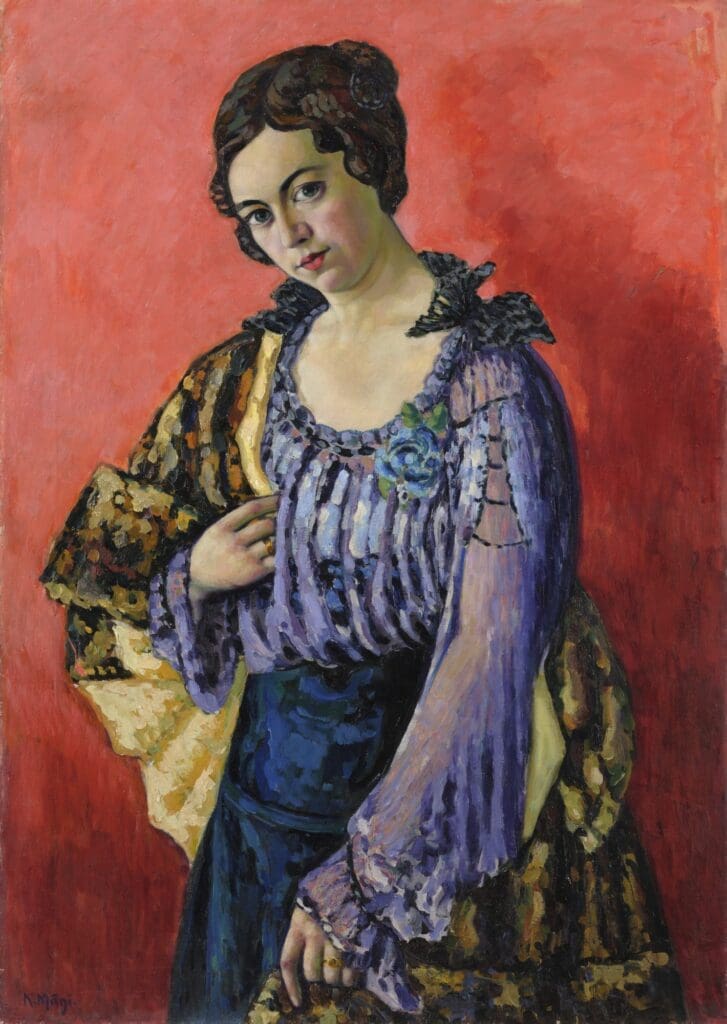
Historically overshadowed by his landscapes, his portraits – many of which have remained in private collections – are back in public favour, and what an impact they exude. Cubism sometimes bursts through in the fragmentation of the brush strokes that build on geometric shapes.
From spring 1913 the portraits were mostly commissioned for considerable fees by wealthy Estonian families and were mainly of women he knew through his cultural and political contacts. The works are the antithesis of conventional likenesses. The style is personal and immediately accessible, with influences of Cubism and Fauvism. He was extending to the human figure his exploration of colour and emotion.
The sitters who were the focus of these new, demonstrative techniques included Marie Reisik and Klaara Holst, co-founders of the Pallas Art Society, leaders in the Estonian Women’s movement and the wives of Estonian politicians.
The female figures are often gracefully extended and with both men and women, the eyes enlarged. He faced criticism that he deliberately made women look ‘ugly’ with the blotches on their faces.
In an intriguing touch, he incorporates into Portrait of a Lady from 1916-17 a reference to Japanese woodcuts which were fashionable in western Europe. The symbols seem to be Mägi’s invention, unrelated to Japanese culture, but helping form a heady atmosphere. In this Portrait of a Lady it is speculated that he worked from a live model.
From 1915-16, in oil on canvas, Portrait of Irmgard Menning (Woman in White) is of a sitter who was born into a German aristocratic family and married to Karl Menning, a diplomat and the first artistic director of the Vanemuine (“old-fashioned”) Theatre in Tartu. That was the first Estonian-language theatre, which is still flourishing despite being bombed in World War II and damaged by fire in 1983.
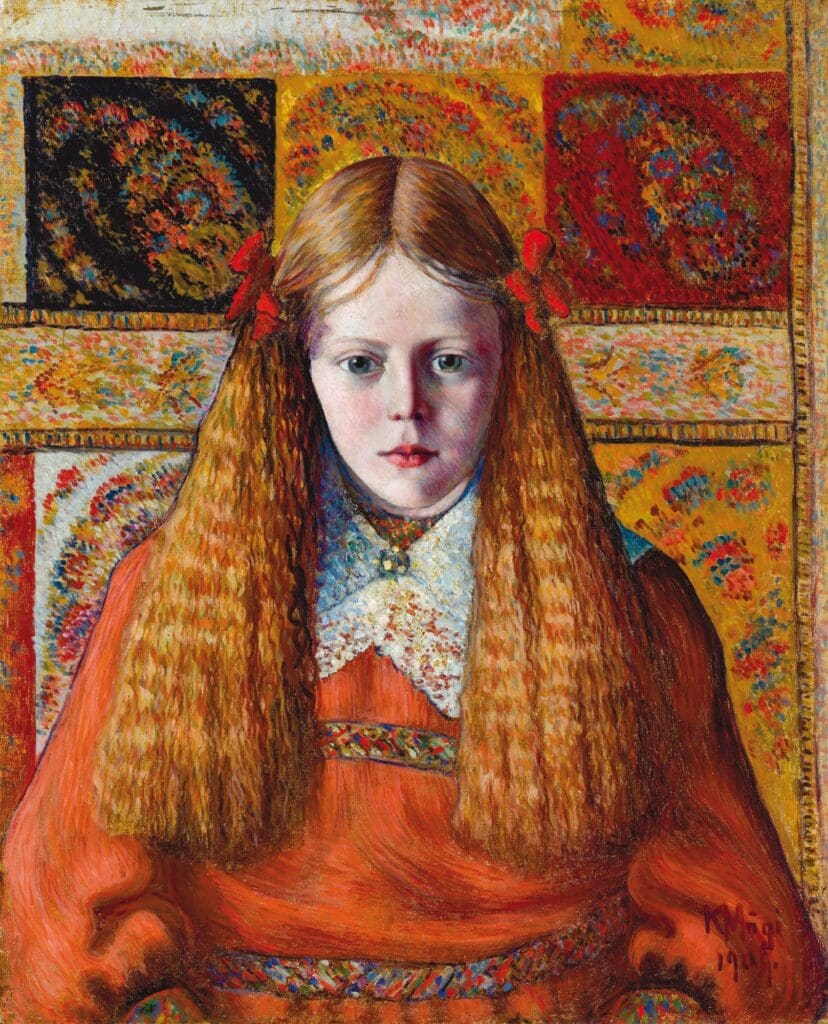
Another of Mägi’s best-known works manifests his ability to make colour animate affection. Portrait of a Norwegian Girl, 1909, is of Gerdi Grieg (née Egede-Nissen), the 14-year-old Bergen-born daughter of his friend Adam Egede-Nissen, founder of the Norwegian Communist Party. Egede-Nissen represented the fishing community in the north of the country. and had close connections with Russian migrants.

In gorgeous national dress and red lipstick, Gerdi is almost as one with the decorated wall behind her. Her distinctive fiery hair, with its matching ribbons, enhances the flowing lines of the composition. Later, as Gerdi Grieg, she became a star of screen and stage, and lived to be 93.
While participating in ever-changing trends of modernism, Mägi helped to create the artistic infrastructure of a newly independent nation. In 1919, he became a founder and the first headmaster of the private institution Pallas Art School in Tartu, laying the groundwork for the following generation of Estonian artists. His friend Aleksander Tassa joined him in the endeavour. The school is still the only applied art college in Estonia.
Mägi’s reputation fell foul in the 1940s and 1950s of Estonia’s Soviet masters, until 1959, when Tallinn Art Museum staged a retrospective.
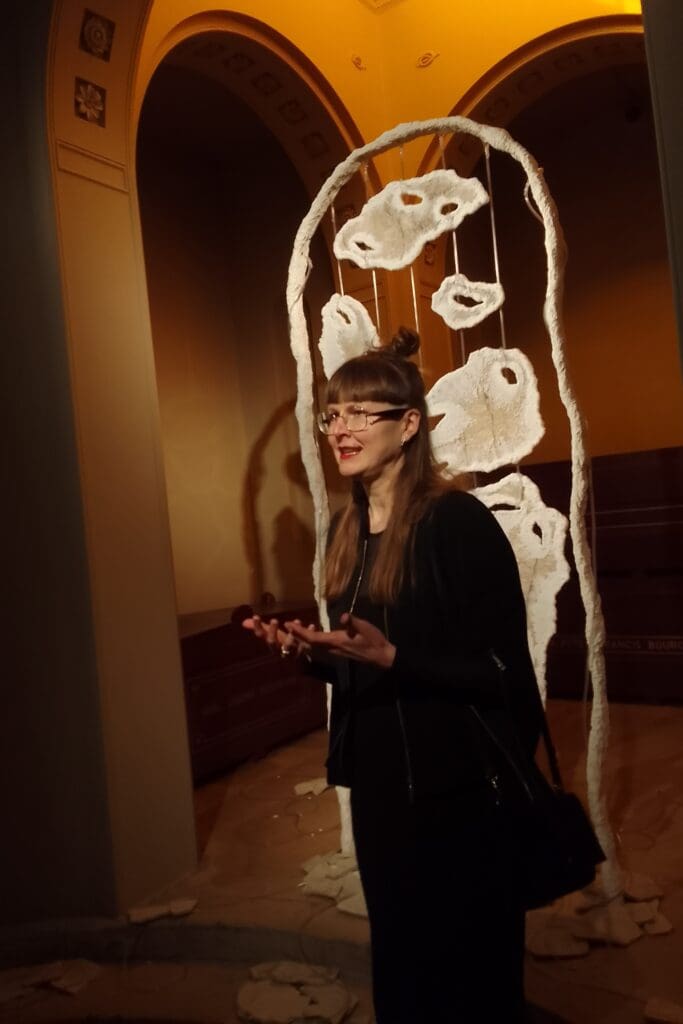
For the Dulwich exhibition, the contemporary Estonian artist Kristina Õllek was commissioned to create a site-specific installation. It draws on her long-term research into the ecology of the Baltic Sea including its oxygen-deprived “dead zones.” With sea salt, cyanobacteria and limestone, Kristina links the ancient marine life of coastal geology – particularly the Silurian limestone of Saaremaa – to its present fragility. The mineral graveyard zones are highlighted by translucent salt panels, and toxic algae bloom is traced. The installation is in the gallery’s eerie circular mausoleum (which was designed as the resting place for the institution’s three founders).
The exhibition is brilliantly curated by Kathleen Soriano, director of Hastings Contemporary and arts broadcaster. She curated Dulwich’s exhibitions MK Čiurlionis: Between Worlds, 2022; and Harold Sohlberg: Painting Norway, 2019.
She said: “Sometimes it is the unfamiliar that gives us pause for thought and that allows us to understand more clearly the interconnectedness of creativity across the world. To be able to consider Mägi in a broader art historical context, and for the first time in a concerted manner in the UK, shows us that there are many more artists out there deserving of attention.”
Sirje Helme, chief executive of the Art Museum of Estonia Foundation, said that the exhibition was a very important event for the Estonian museum. “It is an opportunity to introduce Estonian culture as part of the development of European modernism, emphasising the artist’s uniqueness in depicting the colours and light of nature. The connection with nature is important to us and is also expressed in the work of Kristina Õllek.”
Jennifer Scott, director of Dulwich Picture Gallery, said: “Mägi’s mastery of colour transports us to a place of vibrancy and emotional depth. It is an honour to have these paintings on special loan from Estonia and to introduce UK audiences to Mägi’s unique and captivating vision.”
Image captions:
Portrait of a Lady (Klaara Holst), 1916. By Konrad Mägi. Courtesy of the Art Museum of Estonia.
Portrait of Irmgard Menning (Woman in White) 1915-16. By Konrad Mägi, Oil on canvas. Art Museum of Estonia.
‘Art is the only way out’
Norwegian Landscape, 1909. By Konrad Mägi. Courtesy of the Art Museum of Estonia.
Lake Kasaritsa, 1915-17. Konrad Mägi. Courtesy of the Art Museum of Estonia.
Vilsandi Motif, 1913-14. By Konrad Mägi. Courtesy of the Art Museum of Estonia.
Portrait of a Norwegian Girl, 1909. By Konrad Mägi, Courtesy of Tartu Art Museum.
Portrait of Irmgard Menning (Woman in White), 1915-16. By Konrad Mägi. Oil on canvas. Art Museum of Estonia.
Kristina Õllek, Estonian artist specialising in Baltic marine life impact on humanity.
Konrad Mägi is at Dulwich Picture Gallery until July 12, 2026.
