





By James Brewer
While on a tour of eastern Europe and the Middle East, the Victorian artist Richard Dadd (1817-1886) stopped at Delphi, to drink from the Castalian Fountain, the ancient water source for the shrine. He was disappointed, to say the least. Instead of the high priestess Pythia “raving out” the oracle of the deity, as Dadd put it, washerwomen were raving out abuse at each other, and the once-pure waters used to wash celebrants were full of frogs.
That was one incident (on August 24, 1843) on his extensive but intensive tour, a tour which led to a horrible outcome. Later in the itinerary Dadd was visiting the Nile Valley when he became convinced he was being pursued by evil spirits and possessed by the Egyptian god Osiris to confront the Devil. Back in England, he arranged to meet his father in a park in Cobham, Surrey, and killed him, believing his ‘true father’ to be Osiris. Dadd fled to France where he was apprehended and returned to the UK.
From then on, he was to illustrate the memories of his travels and continue his beloved speciality of painting fairy scenes while in two psychiatric institutions where he was incarcerated. He was no alien soul, though the authorities allowed him access to pencils, paper, paints and easel and the result was to burnish his reputation as an author of fantasy tableaux, under the romantic inspiration of Shakespeare. His instinctive artistry could not be denied.
Since his death, Richard Dadd has been largely neglected. An exhibition at London’s Royal Academy brings him back to his rightful place in history. It is the first major retrospective devoted to him in more than 50 years, showing some 100 of his oil paintings, watercolours and drawings.
Dadd was born and spent his childhood in the Kentish town of Chatham, renowned for its Royal Naval Dockyard. Later seascapes , such as Sailing Ships of 1861, of both the calm and stormy waters of the sea, demonstrate the long-lasting influence of his native town.
Enrolling at the Royal Academy Schools at the age of 19, Dadd won medals for his drawing and painting and was a member of a group of ambitious art students known as the Clique. These artists would gather to create compositions inspired by literature, particularly the works of the great Bard and of Byron. A friend of Dadd wrote at the time of “the exceeding sweetness and gentleness of his nature.”
They would practise their skills by painting portraits of each other. One such by Dadd was of Augustus Egg (1816-63) an admirer of the pre-Raphaelites, a friend of Dickens and a talented actor. Apparently by Dadd’s choice, Egg was shown in the uniform of a 17th-century Civil War Roundhead wearing the characteristic hat, high collar, and military dress.
Dadd created his own vision of Shakespeare’s plays based on imagery by artists such as Daniel Maclise (1806–1870) and Joshua Reynolds (1723–1792). His imagination and trademark precision thrived, with his main source of Shakespearean fairy imagery A Midsummer Night’s Dream.
Recognised for his remarkable skill at rendering detail, he was meanwhile invited in 1842 on an ambitious tour across the Eastern Mediterranean that would shape the course of his life. He was to accompany the Welsh lawyer Sir Thomas Phillips on his grand tour through Greece, Turkey, Syria and Egypt. In return for illustrating highlights, presumed to be for a travel book planned by Phillips, he was paid expenses.
A gallery at the Royal Academy dedicated to Dadd’s touring includes pages from his sketchbook and a selection of watercolours, of the people, architecture and landscapes he saw.
A sketch of the Castilian Fountain originally built around 600-590 BC, where pilgrims, priests, and the Oracle (Pythia) washed to purify themselves before entering the Temple of Apollo. is in the Dadd sketchbook held by the Victoria and Albert Museum.
So is a sketch of Ermoupoli, capital of the Aegean island of Syros and at the time the leading port of Greece. Also with the V&A is a pencil illustration of the Colossi of Memnon at Luxor, twin statues of Amenhotep III who ruled Ancient Egypt from 1386 to 1349 BC.
A watercolour from the V&A is a View of the Island of Rhodes which includes the site of a ruined castle of the Knights of Saint John.
The two men crossed by steamer to Beirut, making their way to what is now territory of Syria and Israel, and to Egypt, where his ‘acquaintance’ with its deities proved disastrous. On the return journey to England, Dadd imagined himself possessed by Osiris.
Dadd and his father arranged to meet on August 28, 1843, in a Surrey park, where the next morning, the father’s body was discovered. He would spend the final 42 years of his life as a patient in Bethlem and Broadmoor Hospitals.
At Bethlem, despite its harsh regime Dadd was encouraged to continue painting, and in 1857, was moved to a more comfortable ward and given access to classical literature including Greek pastoral poetry. The resident physician-superintendent took an interest in Dadd’s work and collected at least 33 of his paintings.
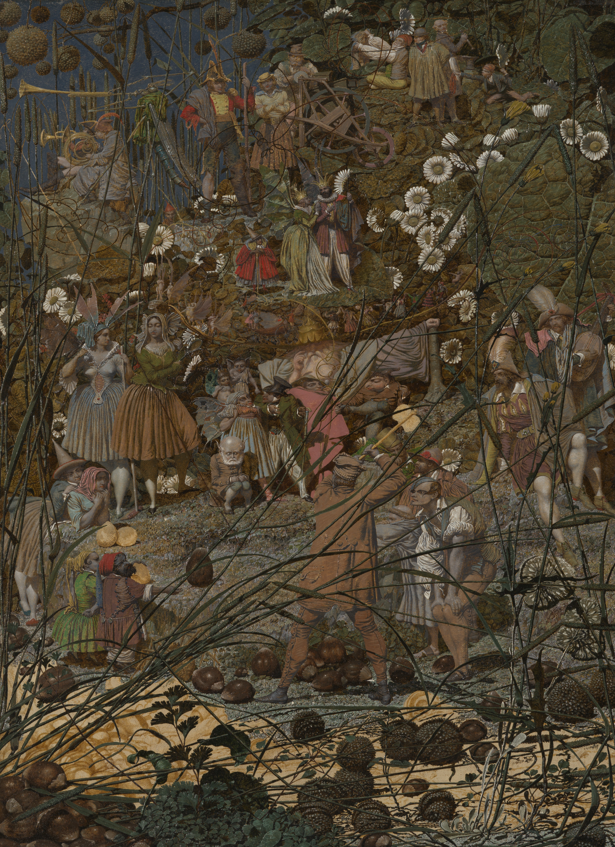
Dadd began painting scenes remembered from his trip around the Eastern Mediterranean and fantasies, among them The Fairy Feller’s Master-Stroke, which hepainted between 1855 and 1864, finishing it at Broadmoor.
Fairies were a popular subject for Victorian artists. Dadd’s tutor at the RA, Henry Howard, painted mythological and Shakespearean subjects. Howard’s sketch Fairies on the Seashore exhibited at the RA inspired a long poem by Letitia Elizabeth Landon.
The subject was at the height of fashion in 1842 – that was the year Felix Mendelssohn wrote the much-loved incidental music and overture for a production of A Midsummer Night’s Dream.
Dadd had already begun to establish himself as a painter of fairy scenes. with his instinctive artistry, but his distinct technique and trademark precision meant that these paintings often took years to complete.
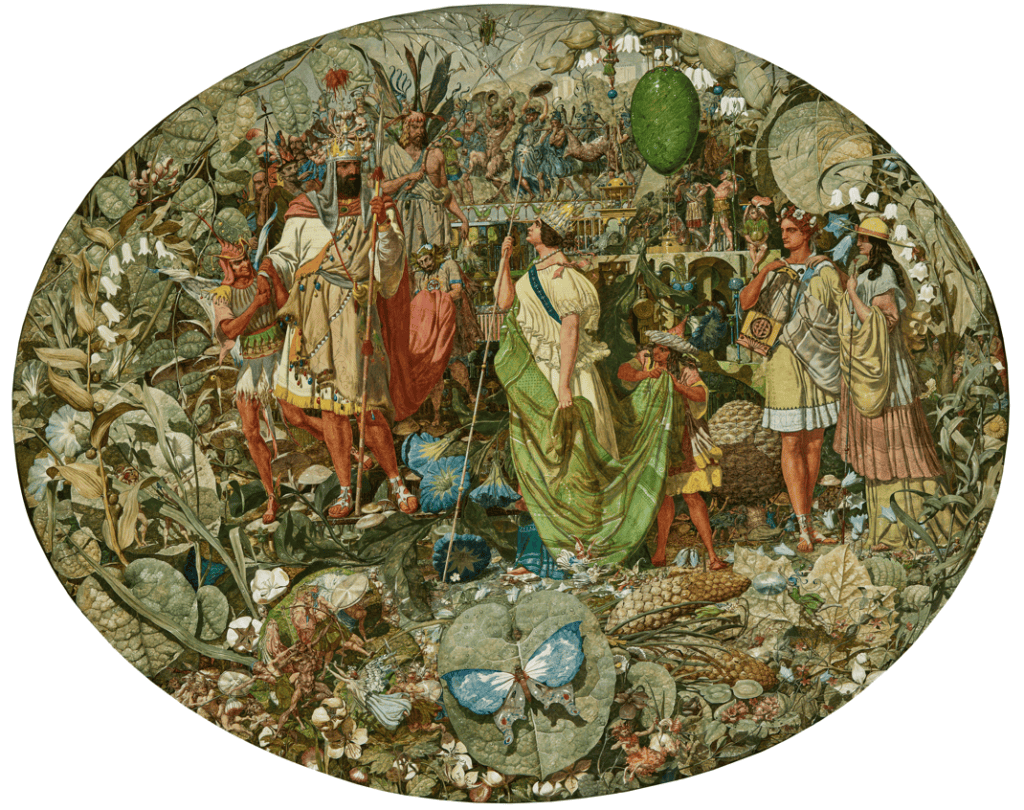
At Bethlem, he produced some of his most celebrated works, including The Fairy Feller’s Master-Stroke, 1855-64 (Tate), and Contradiction. Oberon and Titania, 1854-58 (private collection). The Fairy Feller’s Master-Stroke is considered Dadd’s masterpiece. It was painted for an official at Bethlem, but Dadd was transferred to Broadmoor in July 1864, before being able to complete it .
Queen Mab, a fairy in Shakespeare’s play Romeo and Juliet gallops around at night planting dreams in human heads (so that they dream of love. The thrust of the painting is the Fairy Feller raising his axe to split a large nut which will be used to make a new carriage for Queen Mab. A group of fairy folk gather in the tall grass to watch.
A white-bearded patriarch (= the Pope?) who wears a triple crown raises his right hand, preparing a signal to start. Dadd had seen the Pope while visiting Rome in 1843 – and apparently felt an urge to attack him. A tiny apothecary, in the top right of the picture, is none other than the artist’s father, Robert Dadd. Oberon and Titania appear too, but the rest of the figures are a product of the artist’s imagination.
Gnats and centaurs drive Queen Mab in her old coach, and a dragonfly plays a trumpet. Dadd later wrote a long poem detailing each character’s purpose and role.
Through all this imagery, Dadd intended to represent the children’s fortune-telling rhyme ‘soldier, sailor, tinker, tailor, ploughboy, apothecary, thief.’
The presence of The Fairy Feller’s Master-Stroke faded from public view until in 1963 it was donated to Tate by the war poet Siegfried Sassoon in memory of three of Dadd’s great-nephews, whom Sassoon had fought alongside during the First World War. Spurred by the revived popularity of the painting, Tate curated a full retrospective of Dadd’s career in 1974.
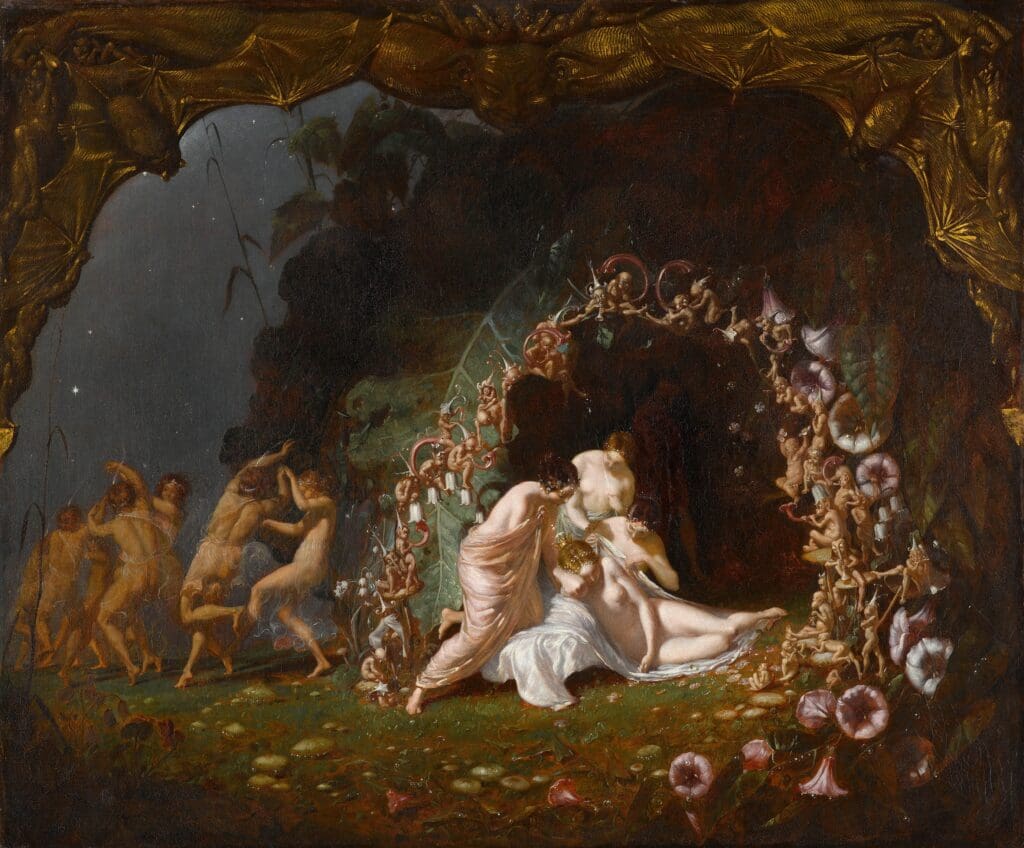
Dadd made his name with Titania Sleeping (Musée du Louvre, Paris) exhibited at the Royal Academy’s Summer Exhibition in 1841 where it appeared with the quotation of Oberon’s speech from Act 1, scene 2 of A Midsummer Night’s Dream which begins I know a bank where the wild thyme blows…
The picture shows the Queen of the Fairies being lulled to sleep at the mouth of a grotto by goblin musicians. Oberon hides in the darkness, preparing to anoint her eyes with a flower juice love potion that will cause her to “madly dote” on the first creature she sees upon waking. The creature will be Nick Bottom, a weaver from Athens whose head has been turned by Puck into that of a donkey.
Marius Petipa, leader of the Imperial Ballet in Russia, created Titania a choreographic miniature for a gala performance at the Palace of the Grand Duchess Elena Pavlovna in November 1866 which may have been the first ballet adaptation of Shakespeare’s play with Mendelssohn’s Incidental Music.
Puck, 1841 (The Harris, Preston, Lancashire) underlines Dadd’s mastery of elaborate detail. The mischievous sprite perches on a toadstool, as naked fairies dance around. In the four corners are figures resembling river gods. The picture was exhibited at the Society of British Artists, accompanied by a quotation from Act 2 Scene 1 of the play:
I do wander every where
Swifter than the moon’s sphere,
And I serve the fairy queen,
To dew her orbs upon the green.
Still with Shakespeare, Hamlet and his Mother; The Closet Scene (1840, or 1846) has the prince confronting his mother, Queen Gertrude, over her marriage to her brother-in-law Claudius. The actors shown are the celebrated Shakespeareans Charles Kean and Ellen Tree.
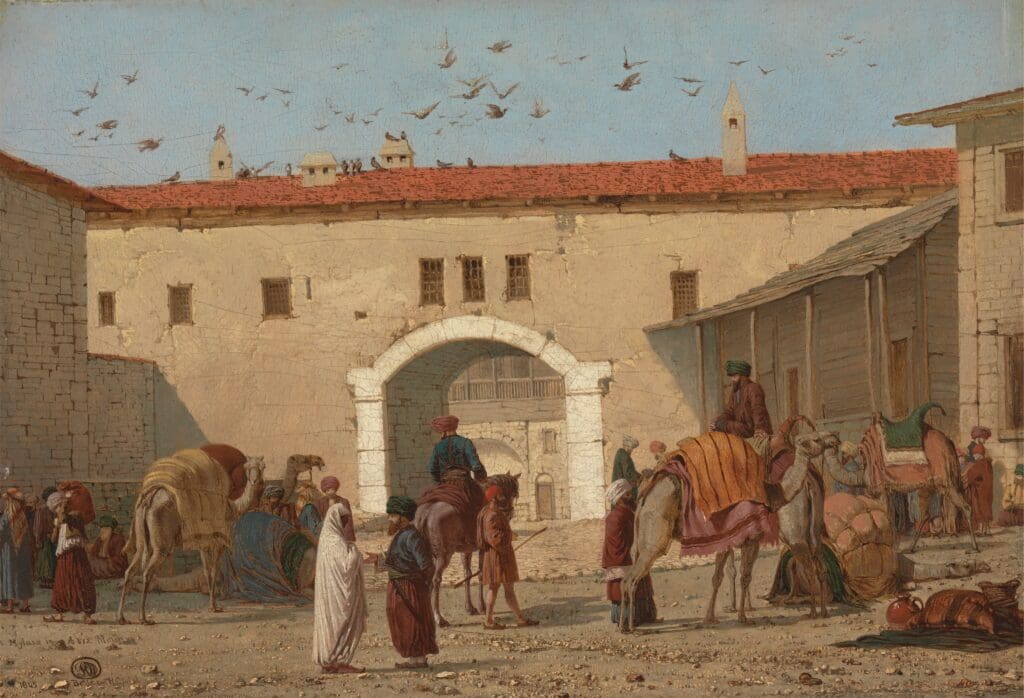
Dadd’s visual memory, notably of his travels, was sharp, although he would have retained his sketches for reference. Caravanserai at Mylasa in Asia Minor (1845) is an ‘orientalist’ view of travellers at what had been the ancient Greek city of Mylasa, now Milas in southwestern Turkey.
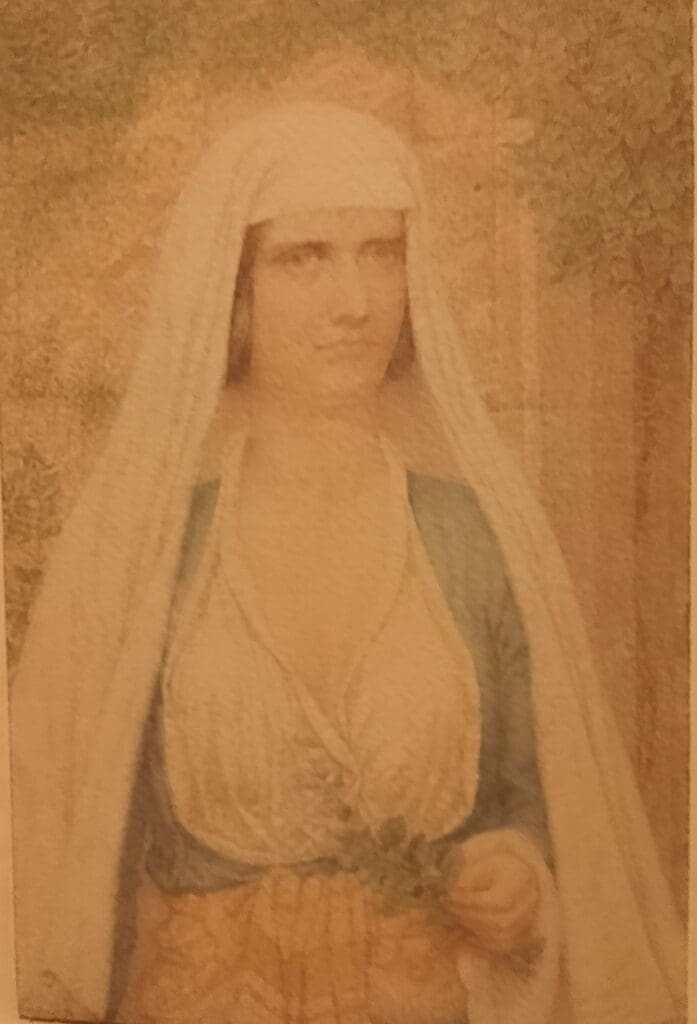
Greek Woman of Asia Minor from 1880 in watercolour over graphite, is lent by Yale Center for British Art. The woman’s delicate appearance is reflected in the soft depiction of her traditional Greek attire, with her apron, veil, and vines.
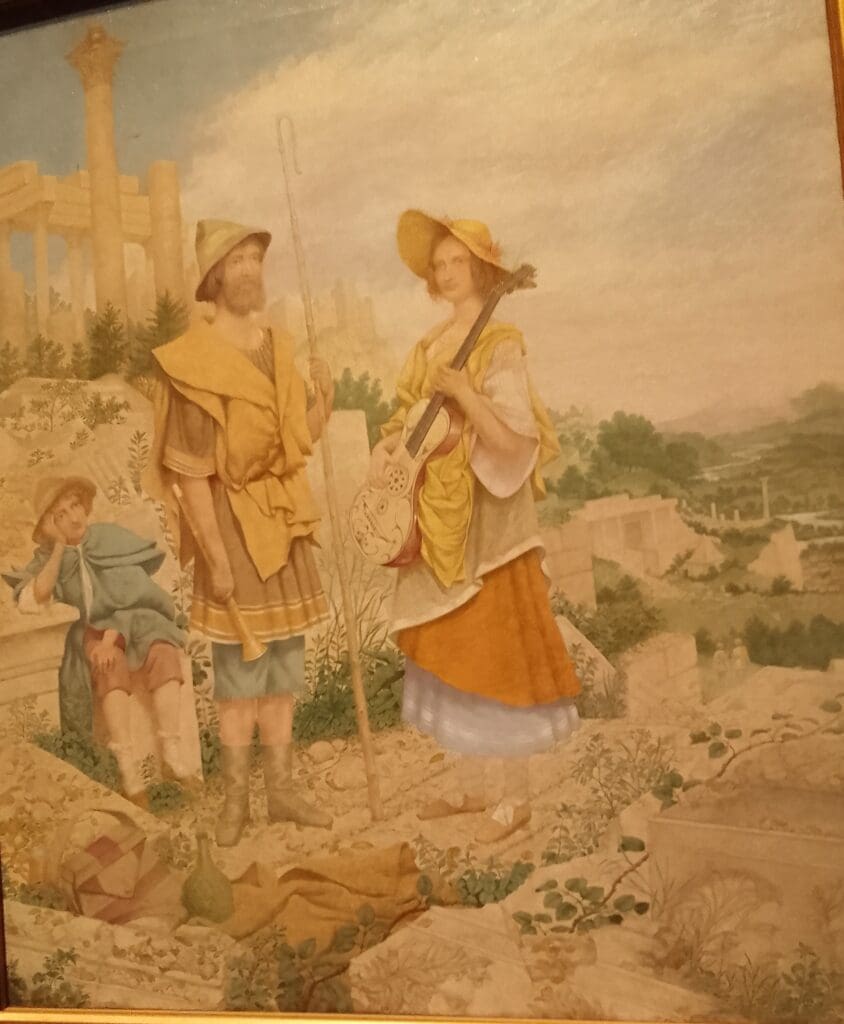
A young family of musicians among the ruins of an ancient civilisation is seen in Wandering Musicians, 1878. The man resembles Dadd, of whom a visitor remarked in 1877: “His violin is a constant companion; he will play by the hour, as a relaxation, weird music – strange variations of old melodies.”
He painted portraits of hospital staff who became supporters and patrons, as seen in Portrait of a Young Man, 1853 (Tate), and contributed to hospital life by making designs for the Broadmoor theatre and certificates for staff prizes.
To this day, novelists, playwrights, painters and musicians have been fascinated by the prism of Dadd’s visionary work. Such include visual artist Cornelia Parker, playwright Angela Carter and the band Queen, who released a song in 1974 by Freddie Mercury entitled The Fairy Feller’s Master-Stroke , with mention of many of the characters from Dadd’s canvas.
The exhibition is sympathetically curated by Nicholas Tromans, author of Richard Dadd: The Artist and the Asylum (2011); with Sylvie Broussine, associate curator at the Royal Academy of Arts. Bethlem Museum of the Mind, Victoria and Albert Museum and Yale Center for British Art provided loans for the exhibition.
The show’s outlook rightly places the emphasis on Dadd the artist. His illness and crime are referred to briefly and in the same spirit his medical records are not shown.
Images:
Titania Sleeping, 1841. Oil on canvas. By Richard Dadd. Paris, Musée du Louvre, Department of Paintings. © GrandPalaisRmn (musée du Louvre) / Jean-Gilles Berizzi.
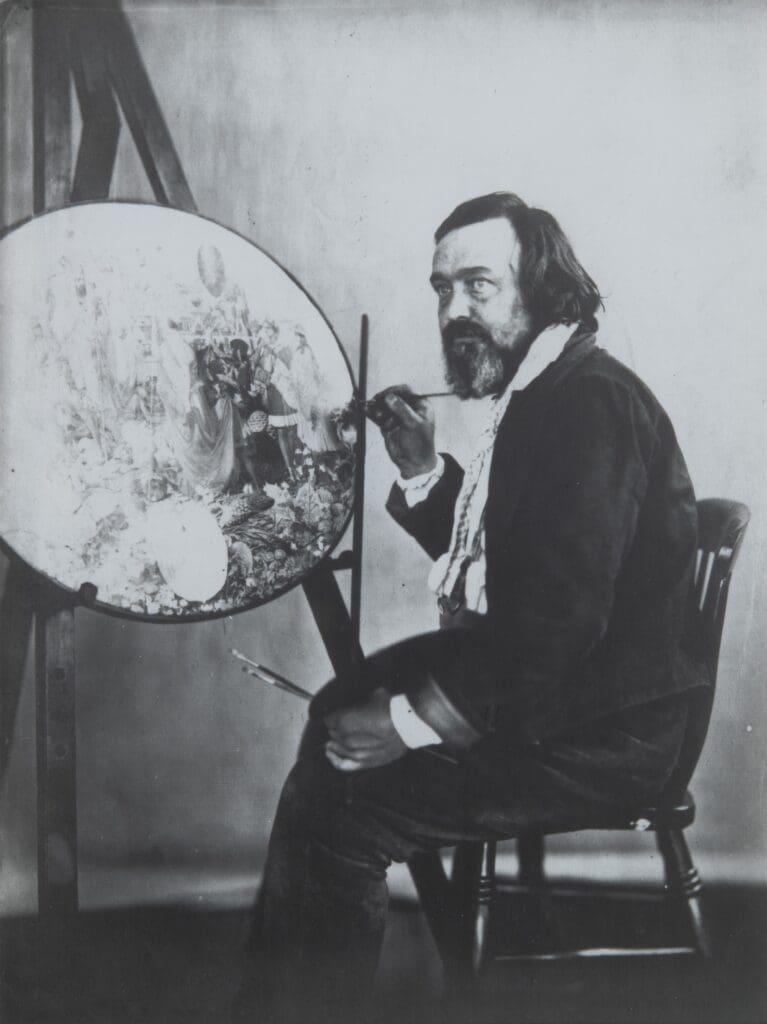
Portrait of Richard Dadd, c 1857. Photographic print. By Henry Hering, Courtesy of Bethlem Museum of the Mind. Alex Fox (Roy Fox Fine Art Photography).
The Fairy Feller’s Master-Stroke, 1855-64. Oil on canvas. By Richard Dadd. Tate: Presented by Siegfried Sassoon in memory of his friend and fellow officer Julian Dadd, a great-nephew of the artist, and of his two brothers who gave their lives in the First World War 1963. Photo: Tate.
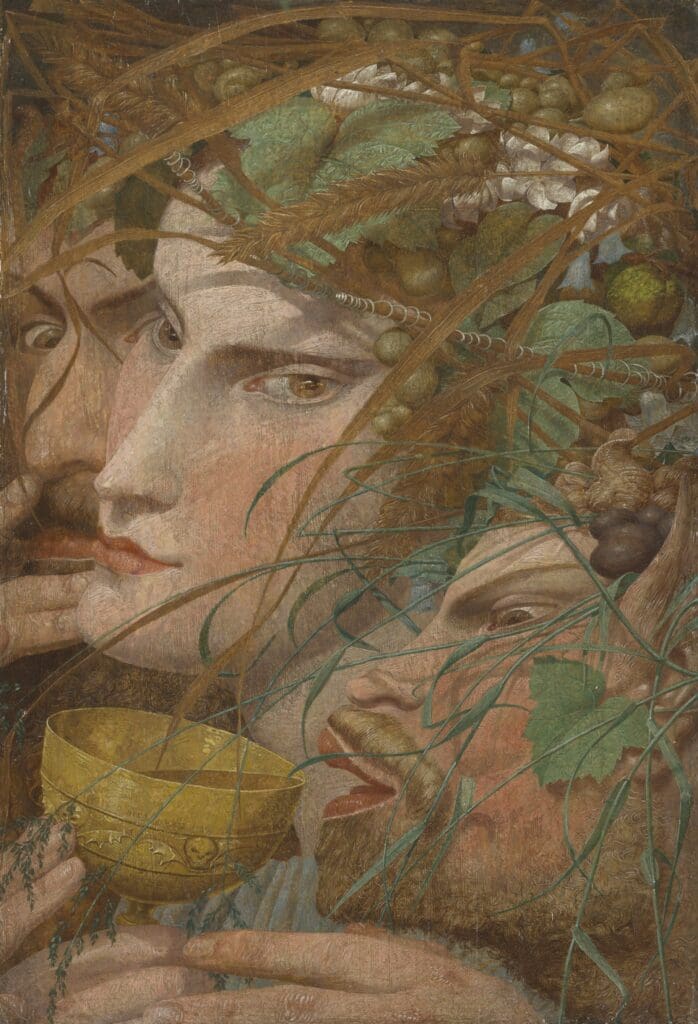
Bacchanalian Scene, 1862. Oil on wood. By Richard Dadd. Tate: lent from a private collection 1993. Photo: Tate.
Contradiction. Oberon and Titania, 1854-58. By Richard Dadd. Oil on canvas. Private collection. Photo © David Parmiter.
Greek Woman of Asia Minor, 1880. Watercolour over graphite. Yale Center for British Art.
Wandering musicians, 1878, oil on canvas. By Richard Dadd. Tate purchased with assistance from Tate Members, 2006.
Caravanserai at Mylasa, 1845. Oil on panel. By Richard Dadd. Yale Center for British Art, Paul Mellon Collection.
Richard Dadd: Beyond Bedlam is at the Royal Academy of Arts, London, until October 25, 2026.
