





Joint study by Thetius and Maritime Passport highlights administrative burdens, security risks, and governance as key issues in establishing an interoperable and verified credential system
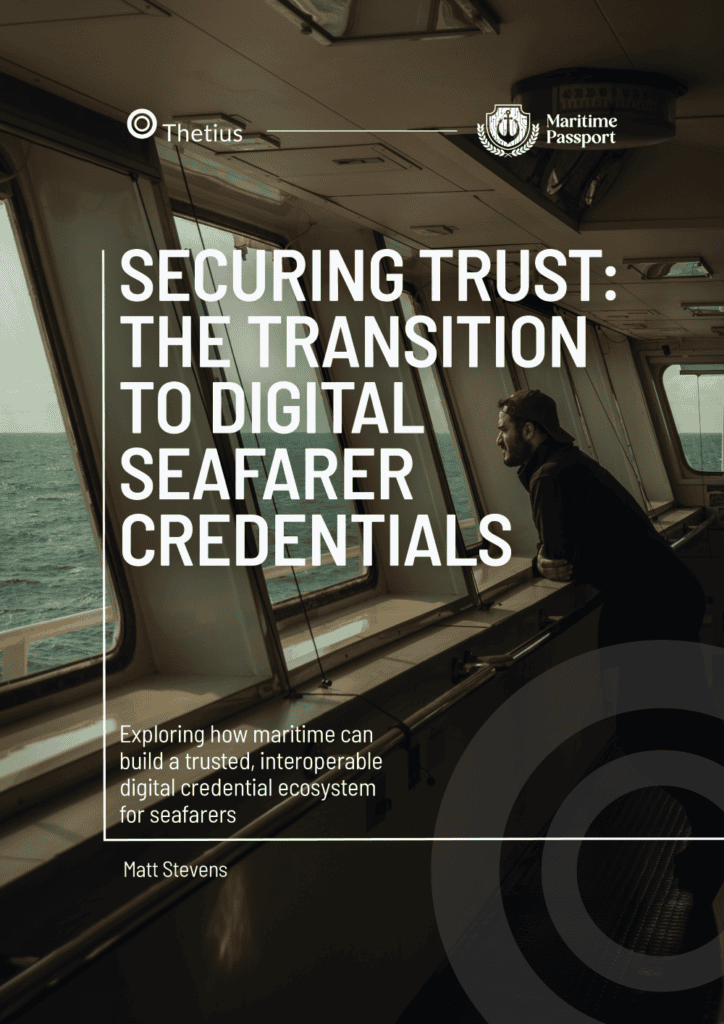
LONDON 26 October 2026. A comprehensive new report entitled Securing Trust: The Transition to Digital Seafarer Credentials, published by maritime technology research firm Thetius in partnership with Maritime Passport, reveals that the global shipping industry’s reliance on paper certificates and disconnected digital copies poses significant operational, security, and administrative risks.
With an estimated 2.57 million seafarers serving on more than 85,000 merchant ships worldwide, maritime professionals are still routinely required to carry physical copies of certificates weighing up to four kilograms. The report emphasises that simply converting physical documents into unstructured electronic PDFs or disconnected digital portals cannot solve the industry’s verification challenge. Rather, there is a need for a globally trusted, interoperable trust framework that offers high levels of security but does not create more work for the various stakeholders – especially seafarers.
“As an ex-seafarer myself, I have long been advocating for greater use of digital technologies in ways that benefit seafarers, and this report highlights the ways in which digital verification can and must evolve. But it’s vital that we do this correctly,” explains Martin White, Co-Founder of Maritime Passport. “Remarkable advances in digital identity, biometrics and secure credential technologies make a transition to digital verification possible, but they also raise important questions around legitimacy, governance, interoperability and adoption. Interoperability is essential, but it must strengthen these principles, never compromise them.”
“In a digital age, trust both in technology but also in chosen partners, is non-negotiable,” explains Peter Phillips, Co-Founder of Maritime Passport. “Moving from paper to digital means protecting a seafarer’s identity, qualifications, and ultimately their livelihood, while safeguarding highly sensitive personal information. Digital credentials must reinforce issuing authority while giving employers, inspectors, and other key stakeholders confidence that every credential is valid, up to date, and held by the rightful individual.”
Key findings of the Report
- Heavy administrative burden: Verifying credentials for a single seafarer can take between one and two hours for crewing recruitment teams. A recent industry survey cited in the report found that port call document preparation averages 191 minutes, with 64% of port calls still relying on paper or mixed paper/digital submissions.
- Operational delays and livelihood risks: Physical certificates and sea service records remain highly vulnerable to loss or damage. Replacing lost paper credentials requires contacting multiple issuing authorities, during which time a seafarer is unable to work, leading to crew change disruptions and vessel delays.
- Security and fraud vulnerabilities: With thousands of training institutions and national formats worldwide, visual inspection of certificates is increasingly unreliable. Forged or fraudulently altered certificates, as well as revoked or expired credentials remaining in circulation, continue to pose safety and regulatory compliance risks. Scanned copies and PDFs do not fix this: credentials need to be linked to verified digital identities that can be checked independently.
- Data protection and privacy risks: Scanned copies of passports and personal qualification records are frequently emailed and stored indefinitely on vessel computers and company servers, creating significant data privacy and GDPR compliance risks.
- Accelerating regulatory momentum: Recent amendments to the STCW Convention (effective January 2025) officially define “original form” to include electronic formats. Additionally, the IMO Strategy on Maritime Digitalisation approved at FAL 50 underlines an urgent industry shift toward standardised, interoperable digital data exchange.
Other findings from the report include the need to preserve the authority of credential issuers rather than build a single global platform, the operational benefits of verified credentials for crew changes, inspections and crewing teams, and the importance of cyber resilience and offline verification.
Recommendations for industry adoption:
- Establish Common Rules: International bodies and flag states must agree on baseline standards for digital credential validity, verification, data protection, and dispute handling.
- Design for a Phased Transition: System must support paper, digital copies, and native digital credentials simultaneously as maritime organisations transition at different speeds.
- Prioritise Interoperability: Buyers and regulators should mandate open standards and exit capabilities to prevent vendor lock-in and isolated digital silos.
- Support Developing Nations: Infrastructure solutions must accommodate smaller or lower-resource administrations to prevent a digital divide within the seafaring workforce.
Report launch webinar: 28 October, 9.00am GMT
The key findings in the report will be discussed by a panel of experts and what they mean for flag states, issuers, crewing teams and seafarers looking to cut verification delays, reduce compliance risk, and build a credentialing system that works for everyone in the chain. Register to attend the webinar here: https://bit.ly/4zzkfca
The report will be available here after the webinar: https://thetius.com/free-research/
About Maritime Passport
Headquartered in London, Maritime Passport is a neutral, interoperable digital identity and credentialing layer built specifically for the maritime industry. The platform connects operations across 193 countries, enabling flag states to issue, manage, and verify seafarer credentials digitally.
By combining decades of maritime operational expertise with government-grade identity infrastructure, Maritime Passport streamlines compliance, eliminates inspection bottlenecks, and gives seafarers secure, portable control over their professional lives without imposing any financial burden on the crew.
Website: https://maritime-passport.com
About Thetius
Thetius is a leading maritime innovation and intelligence organisation providing research, insights, and advisory services to help the global maritime sector navigate digital transformation.
Website:https://thetius.com/
