





By James Brewer
Enchanting is the word for it: Pierre-Auguste Renoir ushers you in to the popular places of rendezvous in the Paris of the 1870s and 1880s. Step in to socialise and to witness the flowering of l’amour in public and in secret.
Let’s all tip our hat to London’s National Gallery for staging a display, open until the end of January 2027, of the idealised picture of the harmony and serenity of quarters that were for the populace to see others and in which to be seen.
Throughout six rooms, the show, organised in partnership with the Musée d’Orsay, Paris, and the Museum of Fine Arts, Boston, focuses on Renoir’s great contribution to Impressionism.
While the admired Renoir loved brightness and effortless beauty, he ignored the harsher realities of his time. Other artists, including some of the grand names among the Impressionists, were lured to the French capital by the gaiety of leisure society, but none captured so blithely the spirit that shone in the faces of revellers and restaurant habitués.
Renoir’s generous, warm perspective set him apart as he recorded the vibrant social scene of 19th-century Paris. If you have never done so before, you will fall for Renoir’s tantalising world in which reigns the romantic chemistry between humans.
As the artist explained his ethos, “a picture has to be pleasant, delightful and pretty — yes, pretty. There are enough unpleasant things in the world without us producing more.”
From the age of 13 he was schooled to appreciate charming motifs, as an apprentice at a renowned porcelain factory in his native Limoges. On teapots, plates, and vases he painted delicate flowers, figures, and Rococo-style details, earning money to support his family.

He was to be the most famous of an artistic dynasty: his eldest son was the actor Pierre Renoir (1885–1952), his youngest was the filmmaker Jean Renoir (1894–1979), and cinematographer Claude Renoir (1901–1969) was his grandson.
The teenaged Pierre-Auguste mastered the intricate brushwork that would later define his style. Energised in due course by the fizzing animation of the Parisian art scene, his aptitude was polished at speed, employing resourceful technique to colour, light, and form.
The National Gallery spectacle immerses us in the French capital’s bustling cafés, dance halls and streets, as he took pleasure in the rich textures and detail of men’s, women’s and children’s attire “jumped” onto his canvases. His close attention to popular fashion was a personal heritage – his father was a tailor, his mother a seamstress.

Garlanding its exercise as Renoir and Love the London gallery assembles with grace and plenty of space no less than 50 impassioned chefs-d’œuvre. It is the most significant exhibition in the UK for 20 years of the maestro’s work, allowing London to gaze on many of his wares for the first time.
Even so, it is a fraction of his output. Throughout his career Renoir (1841-1919) painted some 6,000 pictures. The choice from collections around the world includes some of his most experimental, ambitious and enjoyed canvases, with summer gardens, swirling dance hall scenes and riverside rendezvous by the sparkling waters of the Seine.
After being conscripted in a non-combatant cavalry role when Emperor Napoleon III foolishly declared war on Prussia, Renoir returned to the capital post in 1871 to begin recounting the tenderness and joy he identified as the city burst back into life. He was just one of several Impressionists who came back from overseas, in many instances from London.

Renoir was almost alone in the way he captured the new, seemingly liberated, mentality.
Exhibition co-curator Christopher Riopelle of the National Gallery says: “More than any of his contemporaries, Renoir was committed to chronicling love and friendship and their informal manifestations as keys to modern life. Whether on Parisian streetcorners or in sun-dappled woodlands, he understood that emotion could be as fleeting, as evanescent, as blinding, as his other great and transitory subject, sunlight itself.”
The artist kicked off an expansion of his range with La Grenouillère (1869), literally The Frog Pond, a boating resort with a small floating dock, where one donned one’s Sunday best, He and Claude Monet worked together for a time painting out of doors, which led to Renoir lightening his palette.
By that stage, Paris’s narrow, winding streets had been swept away in favour of long boulevards lined with cafés, restaurants and theatres. Parks and squares added to a network of social playgrounds for the population, which had recently doubled. Riverside cafés continued to take Renoir’s artistic fancy, as locales where social restraint was loosened and the dalliances of lovers could be observed.

At his peak, Renoir made full use of his remarkable and sometimes mischievous gift for picturing couples in the first flush of romance waltzing in the summer breeze, families at a quiet moment and friends sharing a meal. Of a piece with such settings are his recreations – a feast for the eyes – of the 18th-century fêtes galante depicted by Fragonard, Watteau, and Boucher. These eighteenth-century artists employed a style which featured wealthy, aristocratic figures in parties in the countryside. In The Promenade of 1876 a man leads a well-dressed lady by the hand into the bushes: what intrigue is at large?
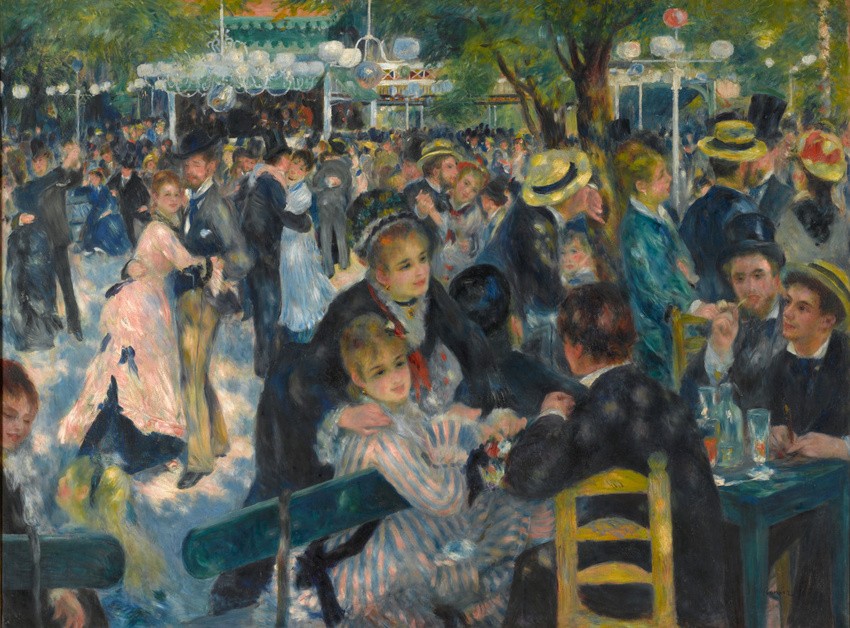
On display in the UK for the first time, the magnificent Dance at the Moulin de la Galette (1876) from the Musée d’Orsay, invites us to stroll through the then-rural Montmartre, enjoying the music and chatter of the day. It is as grand (measuring 131 by 176 cm) as a classical painting of allegory, but it balances technical mastery with scrupulous observation.
The Moulin dance celebrates the gatherings that were hugely popular, with young women – shop assistants, florists, laundresses, and milliners, and with artists and students. Formality is flung to one side as people rejoice in each other’s company at the outdoor dance floor from 3pm to midnight, lit with gas lamps as darkness fell… and gave cover to some of the flirtations,. Renoir ‘connected the figures’ through their gazes and touches. He had a ringside vantage point to observe the goings-on from an apartment he rented nearby, and no doubt prepared some sketches in the open to develop in the studio.

In recent years, Renoir has been admired too much – by criminals and their patrons, as signalled by a spate of thefts from museums. In one of the latest, early on September 8, 2026, thieves stole four paintings from the Renoir Museum – the artist’s last home – in the town of Cagnes-sur-Mer, near Nice. It took only five minutes for the police to arrive, and the suspects dropped two of the four artworks they had grabbed. The two works seized were estimated to be worth a total of €9m ($10.5m).
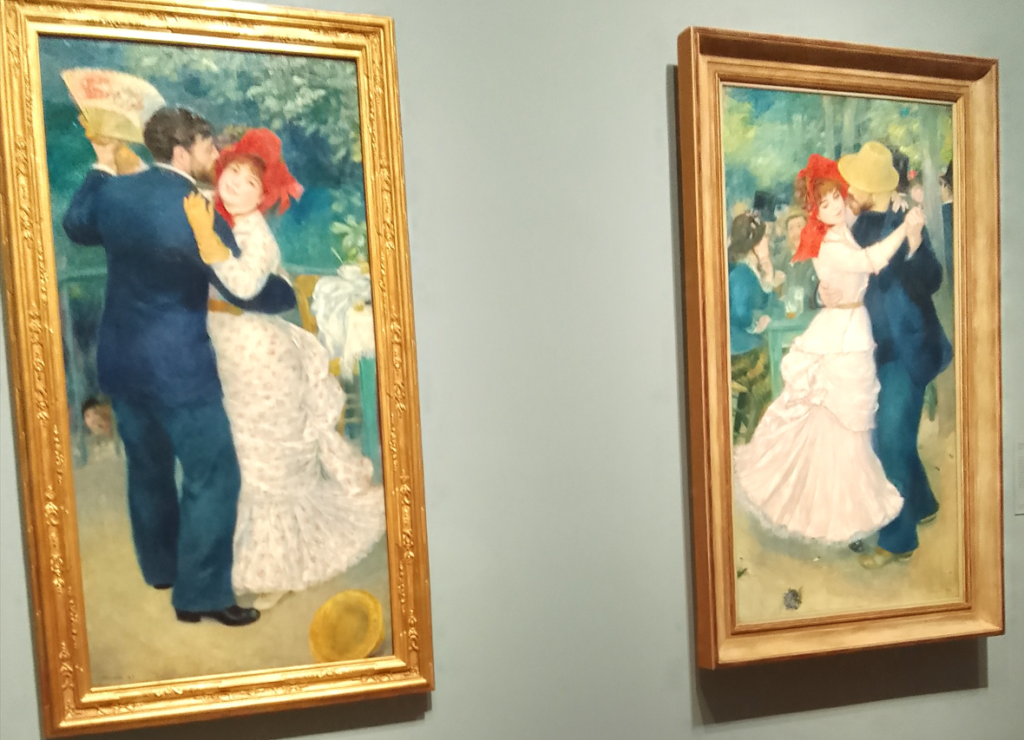
Renoir’s cheerful, more focused dance compositions that pointed up love remain among his memorable ‘snapshots.’ He made a life-size series of three, of couples dancing, entwining romance into different settings. One of them is at a society ball, one at an informal party in the countryside, and one in the small village of Bougival, to the north of Paris. His treatment of the dress fabrics in the pictures emphasises the swaying of the couples, and you can sense the sparks between them.
The first of the trio, Dance in the City, has a formal ballroom framed by marble columns. Dance in the Country (1883) and Dance at Bougival (1883) reflect the light-hearted ambience that spread as the city’s middle class began to frequent the riverside at weekends. In the latter painting, described as the most romantic of the trio, we are at a suburban outdoor café on a relaxed Sunday afternoon.
Even what could have been a prosaic essay, The Umbrellas (1881, reworked 1885), is drawn with sensuous lyricism by way of its full-length figures. Among the array of umbrellas, a man looks as though he is about to offer the shelter of his parapluie to an attractive young Parisienne – a seamstress or dressmaker – we guess, who is perhaps out during her lunchbreak – possibly to initiate what he hopes will be a seduction. In a contrasting cameo, in the foreground, a fashionably dressed mother affectionately regards her youngest daughter who is holding a wooden play-hoop. The intriguing configuration of The Umbrellas led to speculation that the right and left halves of the picture were painted in different phases, with a softer style on the right and his developing more classical approach on the left.

So many personalities populate his sketches. A city scene of a different stripe is Place Clichy of 1880 in which he cleverly foregrounds a smart young Parisienne against a street background of a hazy crowd, in a triumph of her independent spirit and of perspective.
Leaving the Conservatory (1876-77) also introduces a crowd, a close-packed group of nervous young men and women who are leaving an unremarkable building but there are hints of the tension between the sexes.
In his paintings, Renoir sometimes gave unaccompanied young women a central role, but. the unchaperoned figures could be viewed as sex workers. Renoir himself made no such judgments.
The lustrous cityscape of the Pont des Arts, might have been prompted by the Paris Exposition Universelle of 1867. Looking towards the wrought-iron bridge, we see a ferry pulling up to the quayside, crowded with people from many walks of life. Renoir delineates landmarks but pointedly excludes the Louvre where he had works rejected. Along the bottom he includes the silhouettes of figures crossing the bridge, casting long shadows.
In what seems at first a simple narrative conceit of a boatyard by the Seine, View of Bougival, we get to pry into an assignation near a rustic boathouse and small skiffs. Under a broad sky, a woman lets her dog play in the sun, lowering her parasol, as she chats with a man who may have some relationship with her.
Also in the Parisian suburbs, is Oarsmen at Chatou (1879), Renoir has returned to one of his favourite spots along the Seine to delight in the beauty of the glinting water.
Turning to the warmth of domesticity, Motherhood has his future wife, Aline Charigot, nursing their first son; and Madame Monet and her son outdoors.
Renoir painted several works entitled Conversation including one in 1878 showing his friend, the artist Samuel Frédéric Cordey and one of his models in the 1870s, Marguerite Legrand.

And then… in the early 1880s, Renoir remarkably forsook Impressionism. He swung to more classical compositions, with the emotional bonds abated, and an emphasis on the female nude. Of these, during his career he painted several hundred, many in nature settings,.
He travelled to Rome, Florence, and Venice, where he studied Italian Renaissance masters and French neoclassicism.
His large (117.5 by 171 cm) The Great Bathers (1884-87), painted after many preparatory drawings between 1884 and 1887 was poorly received at the time, although later it impressed Picasso and Matisse. It is something of a shock for visitors to this exhibition in its contrast with the more familiar scenes of Paris.
He made two trips to North Africa, immersing himself in the vibrant colours, tropical landscapes, and striking light of the region. His travels to the French colony of Algeria in the footsteps of Eugène Delacroix, a great Romantic painter of some fifty years earlier, led to dazzling portraits and scenes. outdoors
While Renoir might give the impression of being an affable character, he had a darker side. Despite making a living from wealthy Jewish patrons, he was an antisemite, notably in the scandal victimising Alfred Dreyfus, a Jewish army captain who was unjustly found guilty of treason and sent into exile.
The exhibition with its loans from private collections and museums worldwide was initiated by the Musée d’Orsay, which organised it with the National Gallery and the Museum of Fine Arts, Boston. It was shown at the Paris gallery (March 17- July 19, 2026) and will be in Boston from February 20 to June 13, 2027.
The curators are Paul Perrin, chief curator and director of conservation and collections, Musée d’Orsay; Christopher Riopelle, Neil Westreich Curator of Post-1800 Paintings, and Chiara Di Stefano, associate curator of post-1800 paintings, the National Gallery, London; Katie Hanson, William and Ann Elfers Curator of Paintings, Art of Europe, Museum of Fine Arts, Boston; with Lucie Lachenal-Tabellet, head of documentary studies, Musée d’Orsay.
Images:
At right: Dance in the Country,1883. Oil on canvas. Musée d’Orsay, Paris. © Musée d’Orsay, Paris, purchase, 1979. At left: Dance at Bougival, 1883, © Museum of Fine Arts, Boston, Picture Fund.
Dance at the Moulin de la Galette, 1876. Oil on canvas. © Musée d’Orsay, Dist. RMN-Grand Palais / Patrice Schmidt. Gustave Caillebotte Bequest, 1896, Musée d’Orsay.
Pont des Arts, Paris, 1867-9. Oil on canvas. The Norton Simon Foundation, Pasadena, California.
At the Milliner’s, 1878. Oil on canvas. © Harvard Art Museums/Fogg Museum. Bequest of Annie Swan Coburn.
The Umbrellas, 1881-6. Oil on canvas. The National Gallery, London. Sir Hugh Lane Bequest, 1917, in partnership with Hugh Lane Gallery, Dublin.
The Daughters of Paul Durand-Ruel, Marie-Thérèse and Jeanne, 1882. Oil on canvas. © Chrysler Museum of Art, Norfolk, VA, gift of Walter P Chrysler, Jr. in memory of Thelma Chrysler Foy.
Conversation, 1878. Oil on canvas. © Nationalmuseum, Stockholm, purchased 1918 with contributions from Conrad Pineus and GA Kyhlberger.
Oarsmen at Chatou, 1879. Oil on canvas. © National Gallery of Art, Washington DC, Gift of Sam A Lewisohn, 1951.
Madame Monet and Her Son, 1874. Oil on canvas. © National Gallery of Art, Washington, Ailsa Mellon Bruce Collection, 1970.
Renoir and Love is at the National Gallery, London, until January 31, 2027.
