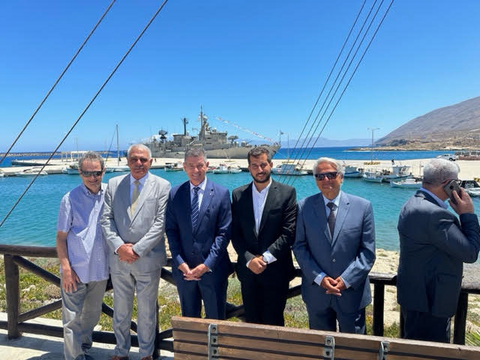



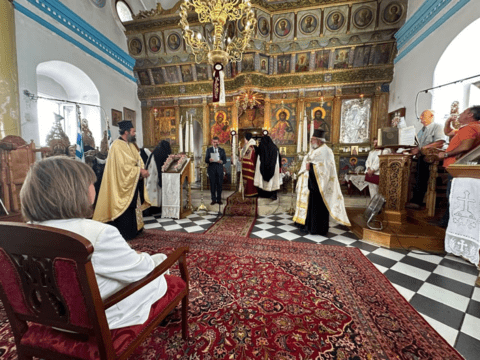
We bring you herebelow in free translation the speech of the Honorary Fleet Commander, Vice Admiral (HN Rt) Ioannis Pavlopoulos which took place on the 16 of June 2024 in the presence of H.E The president of the Hellenic Republic Mrs. Katerina Sakellaropoulou:
Your Excellency Madam President of the Hellenic Republic,
Your Eminence Metropolitan of Karpathos-Kasos,
Distinguished Guests
Dear Cassiotes friends,
The heroically fallen Greek revolutionary fighters and residents of Kassos who were massacred in 1824 by the hordes of the Ottoman Empire, achieve to gather us 200 years later on the island, to reverently honor their memory.
With today’s anniversary speech, with the assignment of which I was honoured by the Mayor of Heroic Kassos, I do not claim historical laurels, therefore I will approach it through the experience of 44 years as a Navy Officer and former Commander of the Hellenic Fleet.
My goal is to shed light on the geostrategic dimension of the naval struggle of the Cassians and the moral elements that led them to sacrifice “until the last drop of their blood”, “being convinced by the laws of the City”.
In the pre-revolutionary years with a population of around 7,000 inhabitants and a commercial fleet consisting of around 100 ships, the Cassian Captains were “plowing” the seas of the Aegean, the Black Sea and the Mediterranean. Through their voyages and contacts, they are introduced to the purposes of the secret patriotic network of “Filiki Eteria” (Friendly Brotherhood) by Themelis of Patmos island, who in turn was introduced by the hero of the Greek Revolution, Papaflessas.
Theodoros, Kantartzis, Markos Malliarakis, Ilias Kakomanolis, Nikolas Makris, Nikolaos Ioulios, Miaoulis Grigoriadis, Mavros, Zarganis, Manolakis, Sakellis and Hatziantoniou, embrace the nationwide alarm that secretly prepares the Greek Revolution for liberation from the Ottoman Empire.
When the aura of freedom blew in the spring of 1821 from the peaks of Taygetus, bringing the joyous news of the national uprising, the Kassians “getting drunk with the immortal wine of the 1821” broke the sweet ties of their peaceful life until then, setting the themselves and their ships at the disposal of the revolution. How else could they act in order to appear worthy of their ancestors, who thousands of years ago campaigned with thirty ships and the rest of the Greeks against Troy? Logic urged them to avoid any involvement in order to preserve their gains and peaceful and secure life, but the longing for freedom had overwhelmed them.
They fortify the island with cannons and munitions and form a battle-worthy fleet under the command of Admiral Ioulios, wreaking havoc and fear on the ships of the powerful Ottoman Empire, sailing past the coasts of Karamania, Syria and Egypt.
With the spirit of the revolution having roused also the Cretan fighters against the Ottomans, the Kassian captains keep their supply of food and munitions uninterrupted, blockade the ports of Crete and flee non-combatants to the safety of Kassos, whenever the circumstances required it.
How many times had the Cretans seen the Kassian revolutionary ships towing to the seashores of Crete, the heavily laden with supplies Ottoman fleets from Constantinople or Egypt? 19 ships were seized in 1822 in Damietta, Egypt, loaded with wheat for Crete, which they towed to Kassos, unloaded and donated them to the Central Revolutionary Government to be used as incendiaries.
While the fleets of the islands of Psara, Hydra and Spetses operate in the Aegean, the Cassian seamen dominate with sea raids throughout the eastern Mediterranean, from Antalya to Cyprus, and from Beirut to Egypt.
In the spring of 1822, Captain Theodoros Kantartzis with ten of his ships besieged the Ottomans who were locked in the castle of Chania, in support of the Cretan rebels. Unfortunately for the struggle, he was mortally wounded during the celebrations after having sunk an Ottoman ship outside Platanias, and he died on the island of Theodorou. Huge loss for the revolution of the so-called “Canaris of the Dodecanese”. At the same time, another Kassian squadron under the command of Captain Malliarakis besieged the eastern coast of Crete.
The Ottomans are trapped inside the castle-cities of Crete, while the Christian rebels dominate the countryside.
The Ottoman Sultan in Constantinople having taught from the experiences of the past three years, realized in 1824 its inability to suppress the Greek revolution. He estimates correctly that the eventual loss of Crete which would serve as a base for the transfer of troops to Peloponnese would also entail the loss of control of the Aegean sea, appeals for help to the powerful Pasha of Egypt, Mehmet Ali. In May 1824, the Egyptian fleet consisting of 114 ships, including 30 warships, sailed to Souda carrying 800 horsemen, 2,000 experienced Turkish-Albanians and 2,000 Egyptians as a regular army. The revolution in Crete is finally suppressed, while Mehmet Alis, who succeeds in obtaining the Sultan’s permission to eliminate Kassos from the Mediterranean chart.
At the beginning of May 1824, a fleet of 30 Egyptian ships with a large army set sail from Souda for a field reconnaissance operation, hoping to intimidate the Cassiotes and the unresisting submission of the heroic sailors. Again, logic dictates surrender and submission.
However, the Cassian fighters, like other Spartans, 2,304 years later, decide to resist by guarding the “Sea Thermopylae” of the southeastern Aegean. Three raids are conducted against the island with dramatic results for the attackers. The poet of that era describes their desperate situation:
“……. That rock is an impregnable fortress of demons. Volcanic crater erupting violently on the shores and the craggy ones”.
After initially successfully repelling the attacks and foreseeing the shortage of food and munitions, the Cassiotes sent messengers to the revolutionary Greek Government requesting for help.
However, it is the period when the Greek civil war has broken out between the Peloponnesians and Stereohelladites/Hydraeans, so the english loan money is used for those unfortunate internal divisions. The Government is satisfied with the lofty expression of wishes to God for their salvation, aleging a lack of money, while the prerogatives of Hydra, a month after the holocaust, write to the Parliament:
“The abuses of the laws, and not the lack of resources, caused the general lack of resources, and from this lack, Crete, Kassos and Psara islands, strategic parts of the Greek revolutionary power, were not helped in time. “Didn’t the same situation occurred 50 years ago in 1974 in Cyprus? The Cassos and Cyprus cases have many similarities.
But let’s get back to the facts. At the end of May 1824, 40 Egyptian ships appeared once again on the horizon under the command of admiral Ismail Gibraltar and the leadership of Hussein Bey, with 3.000 Turkalbanian soldiers. The Cassians, and the Cretan refugee fighters, prepared to repulse the attacks. Unfortunately, here too as in Thermopylae there is a be traitor, named Zacharias, who would guide the hordes of the east to surround the defenders. Hussein initially attempts “naval tactical deception”. All day long he launches attacks on the eastern side of the island where 600 armed Cassians and 600 Cretans, with 30 cannons, strongly resist. The Egyptian ships are anchored of the Makra, the island north of Cassos, and for two days they cannonade the island. At sunset on the 2nd day the attacks are stopped and the ships set course for Crete.
The final celebrations of the combatants rise sky-high, with the impression that the Egyptian fleet is departing, while the beacon of their life and freedom is extinguishing.
At night, 30 boats under the guidance of Efialtis (be traitor) Zacharias, disembark their forces on the western side of the island, Antiperatos beach, where it is guarded by four to five guards and who are easily neutralized. After the first landing and having acquired a strong bridgehead, the second wave follows. The road is now open. In the early morning, 2,000 Turkish Albanians suddenly arrive at the rear the defenders, in the village of Agia Marina. Hand-to-hand combat ensues in a futile resistance by the island’s defenders. The Kassian Captain Diakos Markos Malliarakis with 40 men, as another Leonidas with his 300, continues the resistance from the “Laga” position, where finally his men are killed and he himself captured. Hussain Bey offers him the opportunity to “graze” in exchange for a rich reward if he declares submission and follows him to his campaign to supress the Greek revolution. With a “swan movement” the Captain kills three prison guards to follow his massacre. And what a coincidence: Hero Malliarakis had named his brigantine (ship) LEONIDAS!
For two days the inhabitants are massacred, the houses are burned and destroyed, 2,000 fell dead and over two thousand Cassiotes and Cretans were sold as slaves in Constantinople and Alexandria. Complete desolation and Holocaust.
And the Julian calendar on that fateful day wrote May 31, 1824, with the final liberation and unification with the motherland, Greece, happening 124 years later, in 1948.
The news of the destruction of Kassos spread rapidly in Hydra and Spetses islands, which constituted the largest fleet since the beginning of the revolution under the chief of the fleet Georgios Shaktouris, consisting of 25 ships and 4 fire-ships, and which sailed to the island 11 days later.
He arrives at Agia Marina where he sees only demolished houses and very few people alive. Two days later, sailing from Kassos, the news of the destruction of Psara arrives. The control of the Aegean sea has been lost for the revolutionaries and Ibrahim’s road to the Peloponnese district was opened.
During the commemorative speech on June 18, 1889 in the Metropolitan Cathedral of Athens, the young medical student from Kassos Georgios Mavris describes: “darkness and oblivion covered the martyrdom after the names of those men. Yes, gentlemen, modern Greece threw those brave sea fighters into oblivion and their heroic deeds, after their name and their homeland, were buried in obscurity and darkness”.
Ladies and gentlemen, I will not mention the names of the heroically fallen fighters and residents of the island one by one. Studying the archives I discovered all of you that I meet on the island since 2009. Be proud because you have ancestors the fighters of 1821 and it’s you that you carry today the baton of the struggle to guard this sacred rock.
I appeal to the Academy of Athens with its prestigious historical members, to re-evaluate the contribution of the Cassian fleet to the struggle of national rebirth, to elevate the sacrifice of the Cassian fighters and the destruction of the fleet to the same level of honor as the Trinesian fleet of Hydra, Spetses and Psarra, so that the naming of a frigate of the Hellenic Navy with the name KASSOS by the side of the other three frigates, to follow.
Additionally, the bust of the heroe Captain Diakos Markos Malliarakis is missing in the Field of Mars. A leader of the Kassians who served as “caretaker of the sea”, prefect of Kasos-Karpathos, while he was the representative of Kassos during the second National Assembly in Astros Kynourias, in 1823.
I will close my speech, bowing with respect to the Heroic Fighters of Kasos, with the poem Thermopylae by our great Alexandrian poet Constantinos Cavafy:
“Honor to those who in their lives defined and guarded Thermopylae. Never moved by debt; just and upright in all their actions, but even with sorrow and mercy; brave when they are rich, and when they are poor, still brave in small, again running together as much as they can; always speaking the truth, except without hatred for the false ones.
And more honor is due to them when they predict (and many predict) that the be traitor (Efialtis) will appear at the end, and the Persians will finally pass.”
Long live Kasos and the Kassian Heroes Sailors of 1821.#