


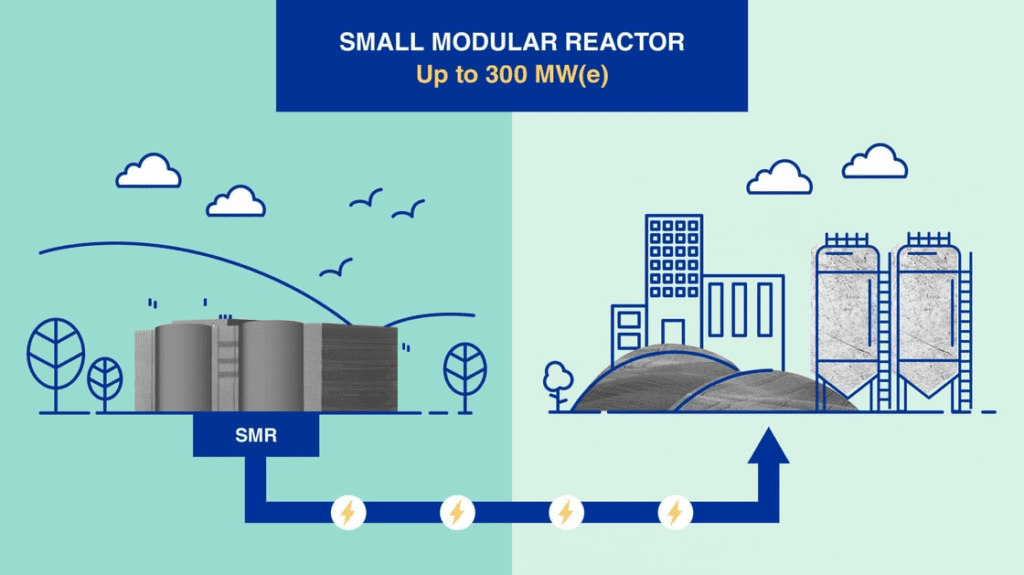
President Trump has signed a series of bold Executive Orders aimed at accelerating U.S. nuclear development. The Department of Energy has been directed to authorise three small modular reactor (SMR) pilot projects, targeting criticality by July 4 2026, while the Department of Defense will commission its own reactor within three years.
To fast-track approvals, the Nuclear Regulatory Commission (NRC) must now license micro and modular reactors within 18 months, and a framework for high-volume licensing is being introduced.
These timelines come as an exciting opportunity for reactor development projects, such as the Molten Chloride Fast Reactor (MCFR) which is currently in development by TerraPower, Southern Company and CORE POWER, and are ambitious but if achieved could allow for the realisation of multiple first of a kind reactors by the end of the decade.
Take a virtual tour of the LOTUS Facility

The National Reactor Innovation Center (NRIC) is establishing the LOTUS facility to accelerate the development of advanced nuclear energy technologies. The experiments which will be conducted within the facility are essential for advancing the understanding of next-generation nuclear technologies and for validating their safety, reliability and performance.
NRIC-LOTUS will utilise the historic Zero Power Physics Reactor Building, which is being adapted to support experimental reactors up to 500 kW thermal. The test bed will offer safety-significant confinement for first critical operations, enabling real-world testing in a controlled environment and will be used for the Molten Chloride Reactor Experiment (MCRE), a key milestone in bringing the Molten Chloride Fast Reactor (MCFR) to the market.
The Molten Chloride Fast Reactor (MCFR) is the world’s first commercial liquid fuel reactor and is being developed by CORE POWER and its commercial partners. Due to its closed-cycle liquid fuel, long period between refuelling, inherent passive safety characteristics, and very low operating pressure, the MCFR is uniquely suited to operate in a marine environment onboard FNPPs and nuclear-powered ships.
Explore the facility layout and infrastructure of the Laboratory for Operations and Testing in the Unites States (LOTUS) test bed in the interactive 360° tour.
| New nuclear in the news |
| Read on for a quick summary of this week’s news or click on the links below for details. |
| INL makes case for setting higher radiation dose limits based on science |
| A new report from Idaho National Laboratory (INL) is challenging decades-old radiation protection standards, recommending that the U.S. eliminate the use of ALARA (“as low as reasonably achievable”) for occupational exposures below 5,000 mrem per year. It also suggests future consideration of increasing this limit to 10,000 mrem “with appropriate cumulative-dose constraints”. The report, Re-evaluation of Radiation Protection Standards for Workers and the Public Based on Current Scientific Evidence, argues that “epidemiological studies have consistently failed to demonstrate statistically significant health effects at doses below 10,000 mrem delivered at low dose rates.”  Read more here. Read more here. |
| Singapore a ‘perfect example’ of nuclear energy says IAEA chief |
| Nuclear energy may soon play a vital role in Singapore’s energy strategy, according to Rafael Marino Grossi, Director General of the International Atomic Energy Agency (IAEA), during his recent visit as part of the SR Nathan Fellowship. Speaking at the launch of the Singapore Nuclear Research and Safety Institute at the National University of Singapore, Grossi described Singapore as “the most perfect example” of a country that needs nuclear energy – citing its “territorial limitations, energy requirements, technological base and institutional maturity.” Read more here. |
| Senate confirms Trumps pick to lead independent Nuclear Regulatory Commission |
| The U.S. Senate has confirmed David A. Wright to lead the Nuclear Regulatory Commission (NRC) for a five-year term, in a 50 to 39 vote. Originally appointed by Trump in 2018 and later named chair in 2020, Wright will now serve till 2030. The NRC is an independent regulatory agency responsible for U.S domestic reactor licensing, commercial nuclear power plants, and protecting public health and safety related to nuclear energy. Wright’s confirmation follows renewed White House pressure to accelerate nuclear development, including an Executive Order pushing for the “quadrupling of the nation’s nuclear power capacity by 2050.” Read more here. |
Upcoming events
Fuel cycle & alternative fuel cycle – 23 September 2025
The nuclear fuel cycle is evolving, with new technologies and alternative approaches shaping the industry’s future. This webinar will dive into the latest advancements in fuel cycle management, including recycling, advanced fuels, and sustainable alternatives. Tune in to discuss opportunities, challenges, and the impact on global energy security.
Interested in attending? This event is for CONVOY members only.
If you’re a member, speak to your account manager about attending. If you’re not, click below to find out more about joining CONVOY.
| ARGO: New Nuclear for Greek Maritime – 25 September 2025 Join us in Athens for ARGO: New Nuclear for Greek Maritime conference, where maritime vision meets cutting-edge nuclear technology. As global industries seek sustainable, scalable solutions to meet energy demands and decarbonisation goals, nuclear has re-emerged as a viable and transformative option. This innovative summit brings together industry leaders to explore the challenges and opportunities of integrating nuclear into the shipping industry and Mediterranean energy mix. |
New Nuclear for Maritime: A New Era for the United States — 16 October 2025
The U.S. is entering a pivotal phase in revitalising its maritime industrial base—and advanced nuclear technology is set to play a leading role.
This October New Nuclear for Maritime: A New Era for the United States will convene policymakers, industry leaders, and innovators to explore how advanced nuclear can become a competitive catalyst for:
 Powering resilient, next-gen maritime infrastructure Driving a resurgence in U.S. shipbuilding Strengthening interagency coordination and regulatory alignment Building a robust workforce and supply chain Unlocking the strategic and commercial potential of nuclear-powered vessels
Be part of this critical moment in shaping the future of U.S. shipbuilding and positioning nuclear innovation at the center of clean maritime power.
Join us this October in Washington, D.C.