





By James Brewer
Against a rainswept sky, with huge cranes looming in the background, the imposing bulk of an ocean-going ship chained to a drydock conveys the dominance of industrial shipbuilding in Glasgow in the 1940s. This was the design of the front stage cloth for Miracle in the Gorbals, a now largely forgotten one-act ballet which was choreographed by famed ballet master Robert Helpmann to a story by theatre director Michael Benthall, with the score by leading composer Arthur Bliss.
It might be a surprise to learn that the set was mapped out by Edward Burra (1905-76), an artist much better known for his cheeky but engrossing watercolours of disreputable scenes from nearly a century ago of the Roaring Twenties in France, and the Harlem Renaissance in turbulent New York. His vivid and quasi-surreal scenes of life in dockland bars, in urban cafes and at cabarets sported a repertoire of provocative characters. In time he went on to produce macabre landscapes reflecting cataclysmic events, including the Spanish Civil War, Second World War, and post-war industrial upheaval in Britain.
In a gripping exhibition (on until October 19, 2025), Tate Britain explores the colourful career of Burra, giving due respect to his lifelong affinity with ballet, opera and theatre through the designs he produced for renowned choreographers Frederick Ashton, Ninette de Valois and Helpmann, and productions for the Royal Opera House and Sadler’s Wells.
He created costumes and settings over three decades to the 1950s, and his designs for Miracle in the Gorbals are regarded as his finest for the stage. Such achievements affirmed his mastery of the drama of visual art, learnt during his earlier indulgent travels.
A close friend, the photojournalist Barbara Ker-Seymer (1905–1993), chronicler of the so-called Bright Young Things – bohemian actors, dancers, writers and artists of the interwar years – would recall that as students, they were great ballet fans and would queue for five hours for tickets to see the daring, radical Ballets Russes.

A master of watercolour, Burra deployed the traditionally delicate medium for vivid scenes that made him one of the most distinctive British artists of the 20th century.
The first Edward Burra retrospective for more than a decade and the first in London for 40 years, the exhibition highlights the artist’s curiosity about society and culture overseas, in which he revelled. More than 80 paintings and drawings are accompanied by previously unseen material from the Edward Burra archive at Tate.
He embarked on his travels despite suffering in his hands, feet and spine from rheumatoid arthritis, and found it easier to work in watercolour – as with the Gorbals ballet set — than in other mediums and on a horizontal surface to relieve his pain. Finding solace in his work, saying that “painting of course is a sort of drug,” his experience of disability may have informed his portrayal of marginalised communities. He came from an upper-middle class family but frequently rebelled against his background and preferred to live frugally.
Burra’s distinct visual language often evinces a queer aesthetic. He encountered both smart, cosmopolitan culture and men and women living on the edges of society, sympathetically including gay men and women, sex workers, itinerants and underworld figures in his compositions. One of the best known of the genre, Three Sailors at a Bar, a watercolour from 1930. celebrates the tightly uniformed trio of mariners and an inquisitive barman in ambiguous poses that prod at an ambience of sexual electricity.

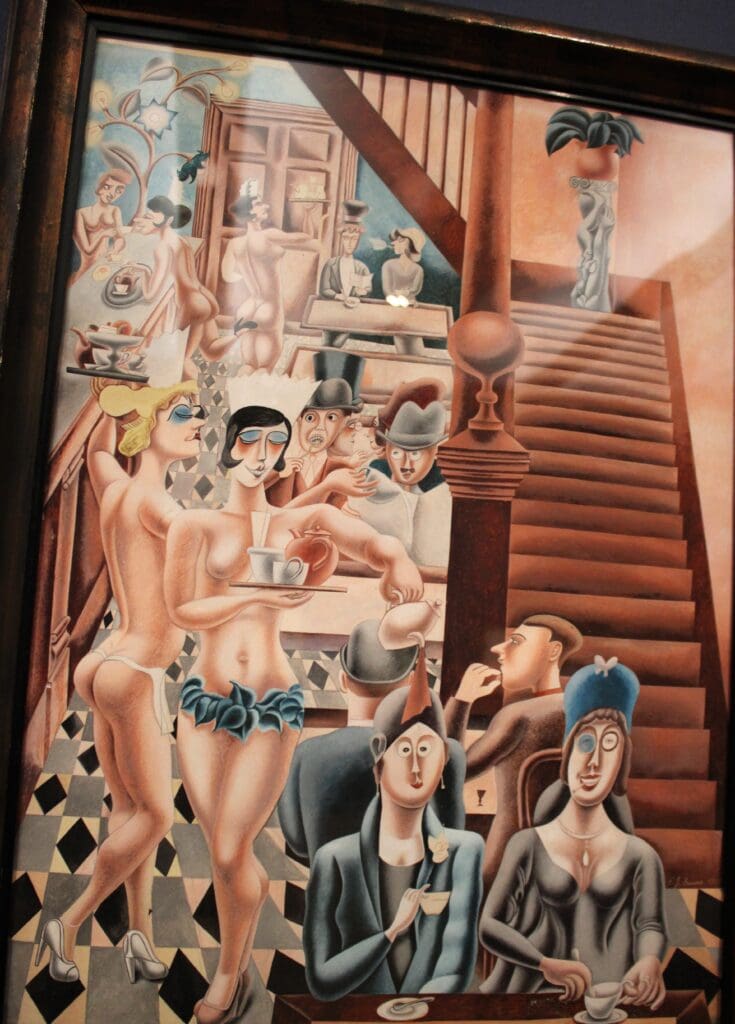
Burra had been even more outrageous the year before with The Tea-Shop (in gouache on paper) in which half-naked dancing girls cavort in the style of the American-born French Jazz Age sensation Josephine Baker (1906-1975). One of them appears so engrossed by her wild dance that she pours tea over the head of a startled lady customer. During his first trip to Paris Burra had seen Baker in her debut in La Revue Nègre at the Théâtre des Champs-Élysées, a high point of Parisian fascination in the 1920s with black culture, dance and music. Though Burra completed works while in France, he painted some scenes from memory after returning home to the picturesque town of Rye, East Sussex.
Sometimes Burra did work in oil paint on canvas, as in Balcony, Toulon, 1929. The painting parodies the lavish lifestyles of bohemians drawn to southern French port towns. Three glamorous figures embody the bohemian lifestyle of many wealthy young people at the time. From a balcony, they overlook the streets of the naval base of Toulon. Although they sit together like friends, their body language suggests ambivalence and wariness. The painting was originally titled Plain Dirt, after a song by the US jazz band McKinney’s Cotton Pickers, which performed in Harlem.
Another classic in oil paint from 1929 is The Railway Gang. A team of labourers repairs tracks that run close to the coast. One worker calls out to the others to warn of an approaching train. The painting is probably based on a train journey Burra made while in Toulon where he stayed for a month, socialising with friends.
Drawn by his love of the hot music of the era – a soundtrack of which we hear in the exhibition – he travelled to America, visiting Boston and New York, in the early 1930s. There he immersed himself in the vibrant nightlife, enjoying crowded jazz clubs flourishing in the Harlem Renaissance, a cultural expression of poetry, prose, painting, sculpture, jazz, opera and dance. Hundreds of thousands of African Americans had relocated to Chicago, Los Angeles, Detroit, Philadelphia, and New York, including some of the greatest minds and brightest talents of the day, in the Great Migration of the early 20th century. The Harlem section of Manhattan, which covers just 3 square miles (7.8 square km), attracted nearly 175,000 such people.

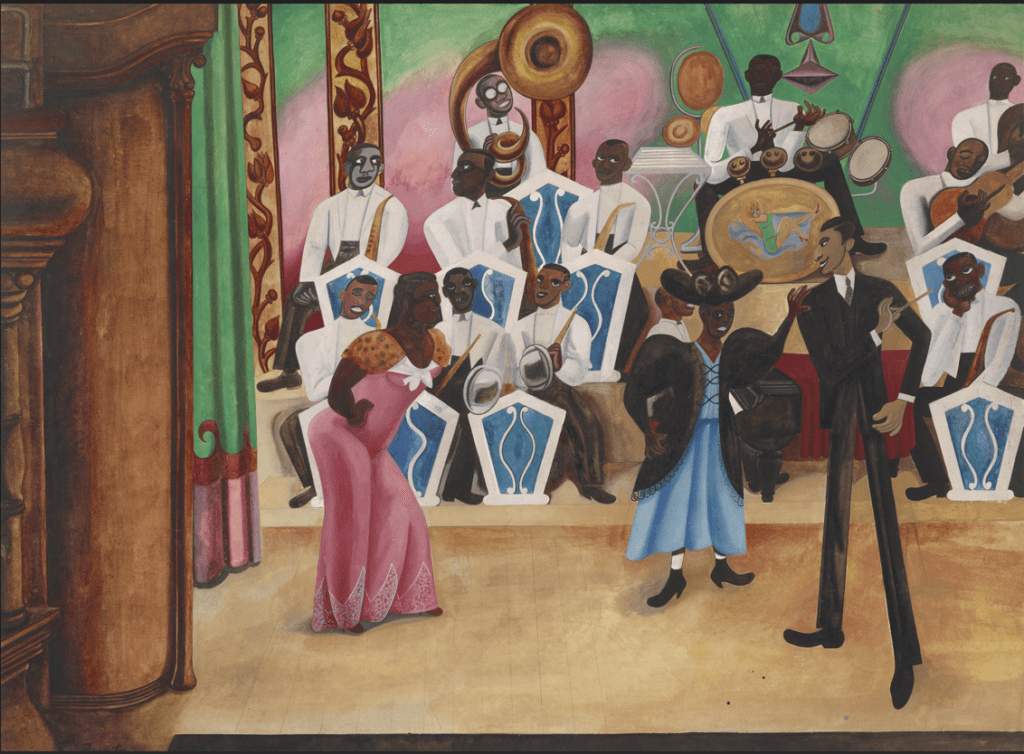
Burra translated the energy and enthusiasm of the Harlem scene into works like Red Peppers 1934-35, possibly referring to a band led by hugely popular Black dancer and singer Cora LaRedd, and The Band from the same time. An article on the website of the British Council Collection about the latter includes the description: “The white of the bands’ dinner jackets glows against the blue music stands, the green walls, the brown skin and the flowing dresses of the ladies in the limelight.” Burra was meanwhile developing a growing interest in Mexican culture and the macabre, as witnessed in paintings such as Dancing Skeletons from 1934.
Conflicts in Europe marked a turning point in his work. After fleeing his beloved Spain at the outbreak of the Civil War in 1936, he followed the news from England, collecting newspaper cuttings which feature in the exhibition. Grappling with the horrors of the political conflagration, his paintings became social commentaries.
Miracle in the Gorbals assumes the second coming of Jesus Christ in the person of the Stranger, danced by Helpmann, to the impoverished Gorbals area of Glasgow. The Messiah resurrects a woman who had died by suicide. Betrayed, he is murdered by a gang of thugs. The ballet was first performed by members of the Sadler’s Wells Ballet at the Princes Theatre in London on October 26, 1944. Burra’s set sympathetically manifests the poverty of the workers. His stage cloth was in watercolour and graphite on paper, and in the exhibition, we see a facsimile of 1944 photographs by Edward Mandinian of the set. These are from the James L Gordon Collection, a remarkable personal collection comprising a total of 5,000 20th-century theatre, film and television designs. Mr Gordon had a distinguished career in interior design, working among other projects on the Cunard liner Queen Elizabeth 2, the Carlton Hotel in Cannes and the Cafe de la Paix in Paris.

Although the Clyde yards were bombed during the war, the industry survived thanks to the dedication of the workforce and community. Commercial shipbuilding in Scotland ceased in 1971, but warships are now being built for the Royal Navy. HMS Glasgow, the first of an order of eight Type 26 frigates, was officially named in a ceremony at BAE Systems’ Glasgow shipyards on May 22, 2025.

Exhibition visitors hear music from the ballets, operas and stage shows which were embellished by Burra. These include Constant Lambert, The Rio Grande for Day in a Southern Port (1931); Bliss, Overture and The Girl Suicide for Miracle in the Gorbals; Georges Bizet, Habanera and Marche du Toreadors for Carmen (1947); and Richard Strauss, excerpts from Don Juan (1948).
In his later years, despite declining health, Burra travelled to rural areas including Cornwall and the Lake District in search of natural beauty. His less-exhibited later landscapes echoed environmental anxieties: in Cornish Clay Mines from 1970 pit-shafts litter mountains, and petrol stations occupy the countryside.
Edward Burra is curated by Thomas Kennedy, curator of modern British art at Tate Britain, with Eliza Spindel, assistant curator at the institution.

Images:
Miracle in the Gorbals. Cloth design for the ballet Miracle in the Gorbals, 1944. Watercolour and graphite on paper. Facsimile of 1944 photograph by Edward Mandinian. James L Gordon Collection.
Tate Britain entrance to the world of Edward Burra.
The Tea-Shop, 1929. Gouache on paper. Private collection.
The Railway Gang, 1929. Oil on canvas. Private collection.
Balcony, Toulon, 1929, oil on canvas. Private collection. © The estate of Edward Burra, courtesy Lefevre Fine Art, London.
The Band, 1934. British Council Collection. © The estate of Edward Burra, courtesy Lefevre Fine Art, London.
Red Peppers, 1934-1935. Dundee Art Galleries and Museums (The McManus). © The estate of Edward Burra, courtesy Lefevre Fine Art, London
Three Sailors at a Bar, 1930. Watercolour. Private collection, courtesy of Hazlitt Holland-Hibbert. © The estate of Edward Burra, courtesy Lefevre Fine Art, London.
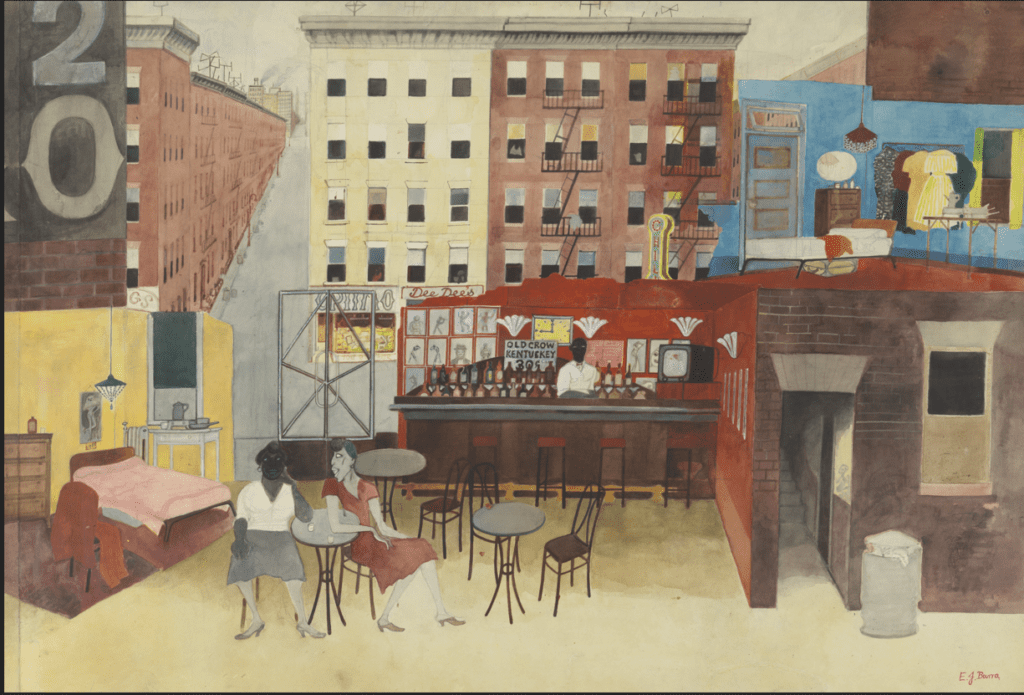
Simply Heavenly Scene in Harlem, 1957. Private Collection. © The estate of Edward Burra, courtesy Lefevre Fine Art, London.
Photograph of Edward Burra by Barbara Ker-Seymer. © reserved. Photo © Tate Photography (Sonal Bakrania).
The exhibition Edward Burra is until October 19, 2025, at Tate Britain in parallel with an exhibition of works by British surrealist Ithell Colquhoun (1906-1988), on one ticket. Both exhibitions are in partnership with major insurance brokerage Lockton.
