





By James Brewer
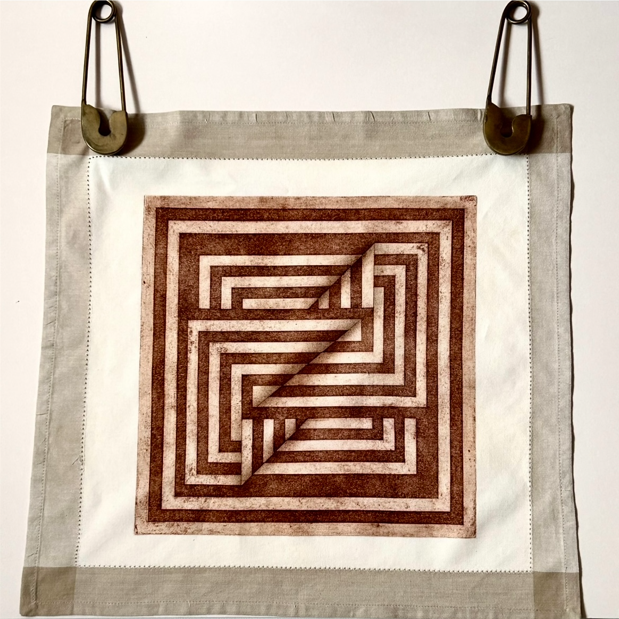
It is an ‘impossible’ design. True, it looks like a handkerchief, 30.5cm square, and is made from linen backed by the very utilitarian material Tetra Pak, the basic packaging favoured nowadays for cartons of milk or juice.
On folds of incised and peeled cardboard, it touches on the riddle of reality. It is a beautiful work created by the remarkably inventive interdisciplinary UK-based artist Sumi Perera. As ever, she infuses a subtle symbolism.
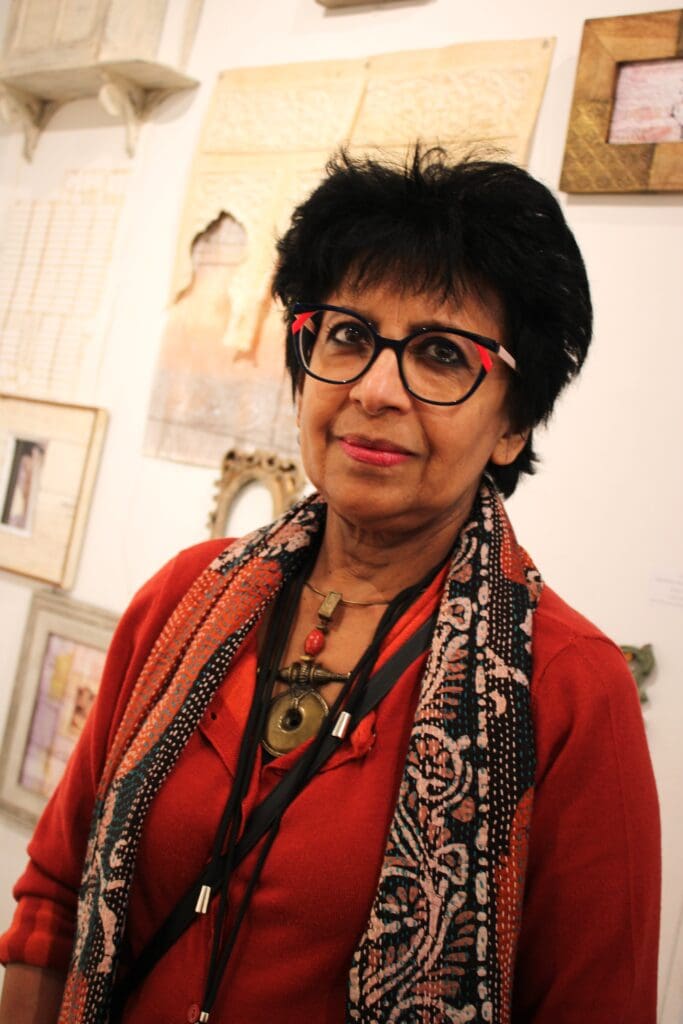
Sumi’s concept entitled MC Escher’s Handkerchief 2, has won for her the UK printmakers prize in the recent Ironbridge Fine Arts Printmaking Open 2025 – an event described as a celebration of printmaking excellence and innovation from across the world. The family-run print making business operates from the Shropshire locality that was the birthplace of the Industrial Revolution.
The ‘handkerchief’ is, in a sense, alive and organic. Sumi says: “This work explores the boundaries of a brief using a series of squares folded and layered, similar to a MC Escher geometric conundrum.” Escher was a Dutch graphic artist renowned for woodcuts, lithographs, and mezzotints inspired by mathematics. He drew ‘impossible’ configurations, such as staircases with the illusion of simultaneously ascending and descending.
Sumi’s fantastic structure, with illogical lines akin to a Moebius strip (an object with only one surface, made by twisting a piece of material and attaching the ends to make a loop), aims to reflect wars with no resolution and life’s unforeseen tragedies.
In a note for the competition, Sumi explained her technical method: “I calculated and designed multiple handkerchiefs, folded to create an impossible 3D structure that remained flat. I used a discarded 12-inch sheet of acid-free Daler-Rowney mountboard/core 1,400 microns thickness and incised and peeled back layers to create tone. The 3D rounded-effect is achieved by selective ink-wiping techniques to create shadows and highlights.”
Praise followed from Brendan Flynn, Ironbridge In-house competition judge: “This delightful mixed media print catches the eye and imagination at the same time. The enigmatic illusionistic geometry of the folded linen is reinforced by the sewn hems and giant safety pins. It recalls a moment from the artist’s childhood when handkerchiefs were pinned to clothing to help prevent cross-infection.”
Appropriately, the prize awarded to Sumi was a powerful Gunning Etching Press, a leading line marketed by the Ironbridge company.
A month earlier, Sumi had presented a different, but just as striking, example of her new work, at LOOP 2025, the annual show of the informal print collective LOOP. The venue was Bankside Gallery, located at Thames Riverside, where 32 printmakers were presenting.
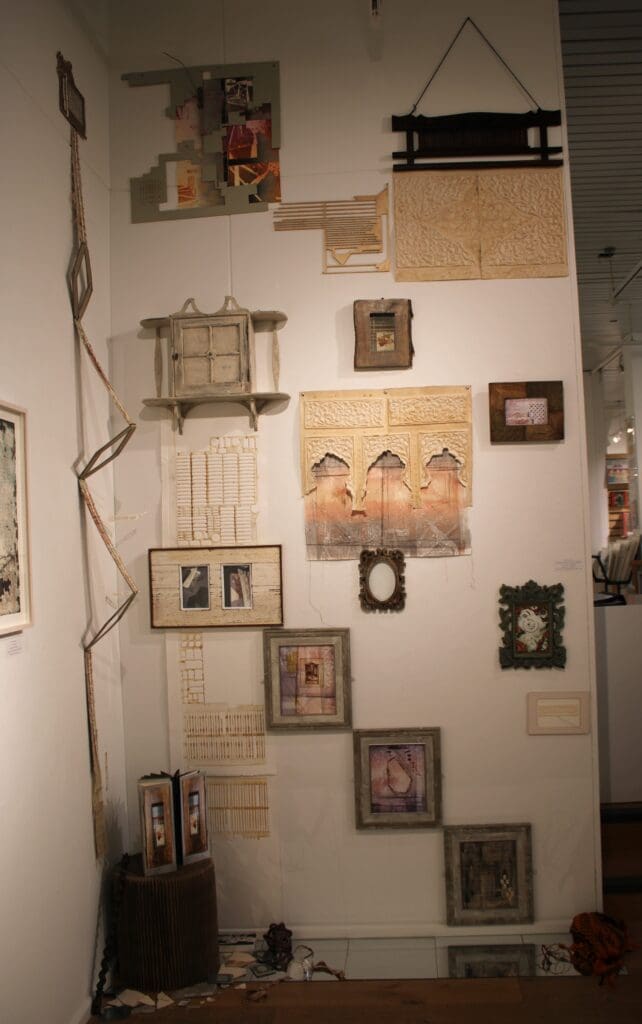
Sumi made Subliminal Spaces XIII as an interactive site-specific work of objects and materials from “all over the world: my birthplace Sri Lanka, mud from Venice (as in the residency and solo show at Scuola di Grafica Internazionale), and ashes from indigenous Xingu communities affected by deforestation and climate change in the Amazon.”
At 300 cm high and 180 cm wide, the installation straddled a corner (a section of Bankside Gallery that she has occupied at many previous LOOP shows). Not content with those physical dimensions,, she had mirrors placed on the floor that appeared to double the height to 600 cm.
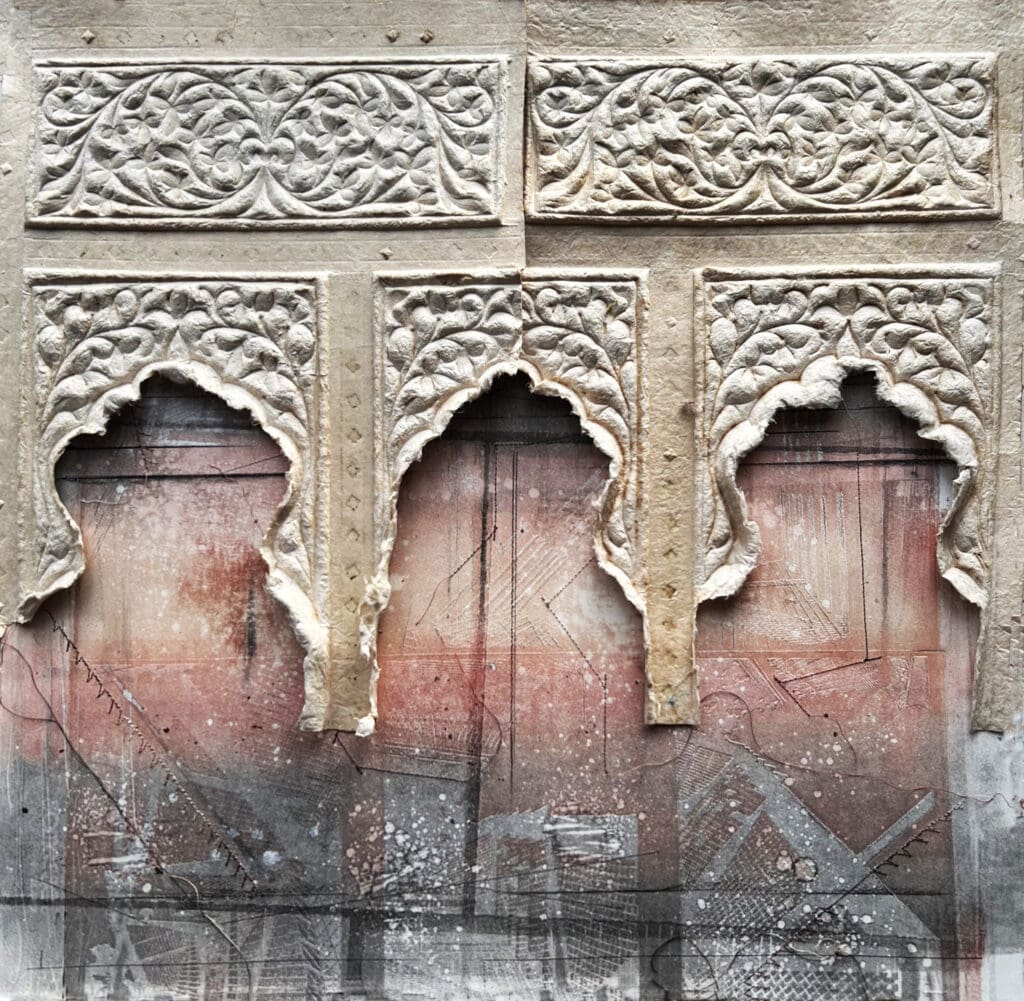
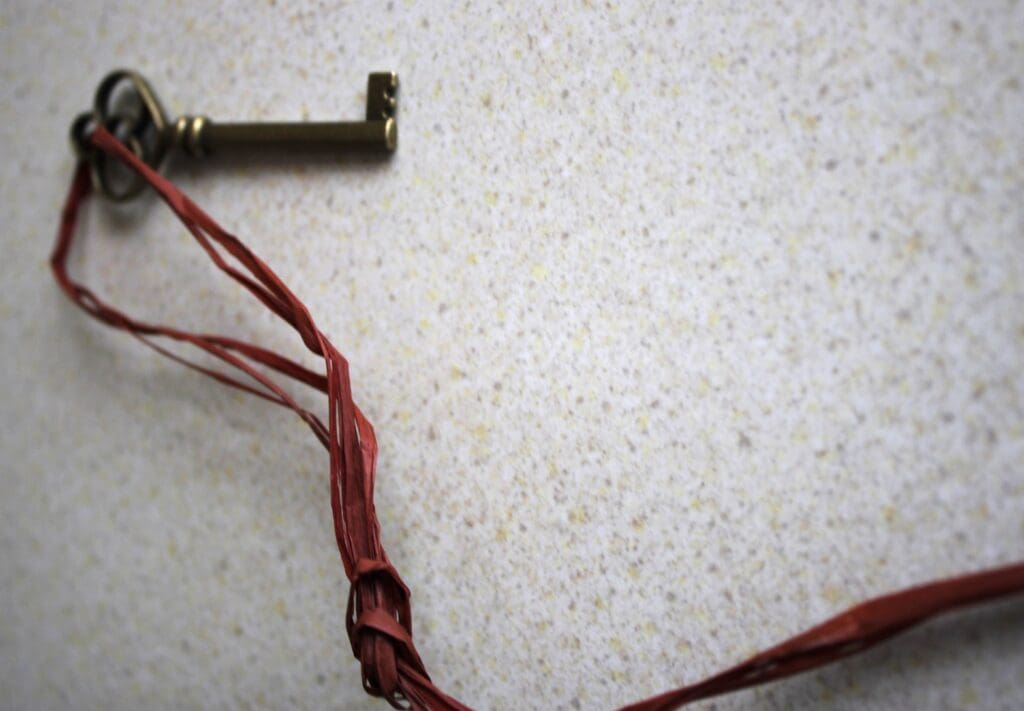
The ensemble invited the viewer, the artist says, to reflect on human thresholds. It included symbols of the displacement of Palestinians: a keffiyeh as the traditional Arab scarf worn as a headdress; and door keys and broken roof tiles represented all that has been left of many homes. Small pieces of textile proclaimed: “Mind the gap,” the gap being between haves and have-nots, and these threw shadows of different hues — depending on viewpoint – onto the walls. Ruined entrances to buildings were represented by paper pulp casts. A broken glass knot (as in a Gordian knot) represented the artist’s current health concerns and personal challenges.
LOOP was founded in 2005 by MA graduates from Camberwell School of Art and maintains the Camberwell connection while broadening its membership. The 20th anniversary exhibition was opened by Oona Grimes, a London-based Royal Academician working with drawing, clay making and film. During the show, ten artists demonstrated their print and film-making processes. Public interest in the pursuit was evidenced by the private view being packed despite a Tube strike .
Features of Sumi’s installation included:
Quadrature of The Circle (Squaring the Circle) referring to a task deemed intrinsically impossible. The term originated from a mathematical conundrum of constructing a square with the area of a given circle by using a finite number of precise steps.
Unbuilding (U N Building; United Nations Building), about negative and positive cohesive forces that help build or unbuild a fractured political situation. “Never been more relevant with ongoing unresolved conflicts throughout the world. Let us hope and wish that those in power can take decisions to alleviate so much suffering in the world.
“You are allowed to touch my work,” adds the artist generously, as she observes: “No two prints are alike,”.
Sumi combines traditional methods of printmaking (mezzotints, etching, engraving, screen-printing, drypoint etc), with contemporary techniques such as Computer Numerical Controlled (CNC} laser cutting and engraving, sandblasting and print installations.
Her works are cut by laser beam through the layers. For some parts of Subliminal Spaces XIII, she concentrated the sun’s rays through a bottle to burn a hole in the paper. “Singeing like a torch is to me preferable to a clean cut and gives unexpected results.”
In November 2025, the installation Subliminal Spaces XIII will be in the formats XIV and XV at both the London Group Open at Copeland Gallery, London SE15; and at East London Printmakers Festival of Print at Mile End Park, Clinton Road, London E3.
Sumi has work in public collections including nine examples at Tate Britain; and at the Victoria & Albert Museum, British Museum, Royal Collection, Ashmolean, and the Yale Center for British Art in the US.
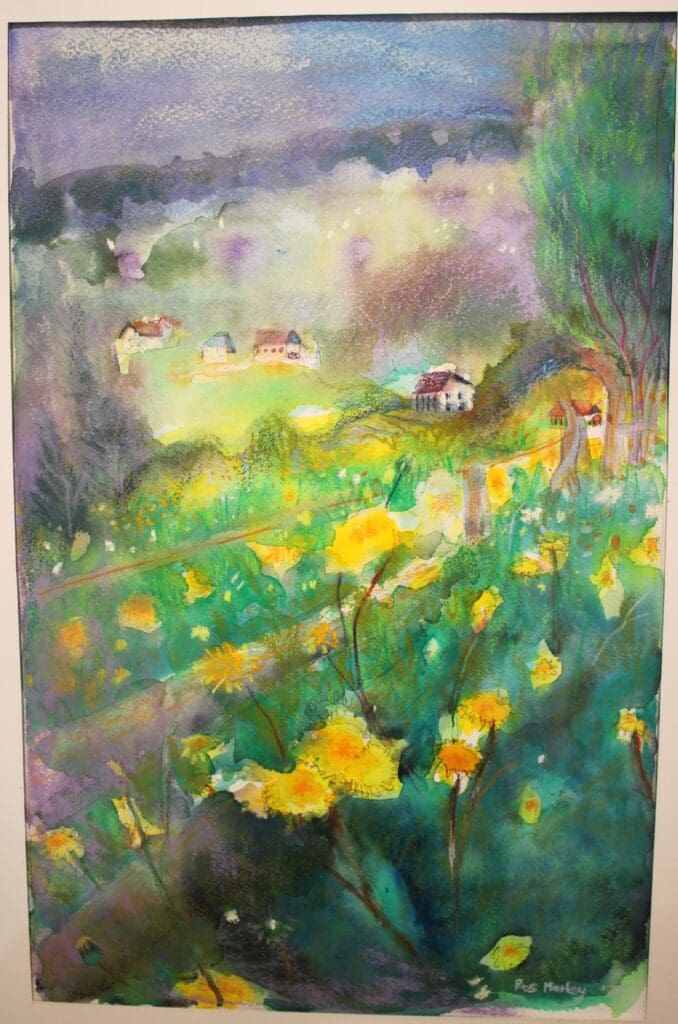
At LOOP 2025, in a more figurative mode were several works including the watercolour Mountain View with Yellow Flowers by Ros Morley, many of whose paintings and prints are dazzling landscapes inspired by travels in Romania.
