





By James Brewer
There is a poignancy about the beautiful, naturalistic paintings by the Baroque-era artist Michaelina Wautier.
While her sitters radiate enduring charisma, just as moving is the fact that her feats of artistry remained mostly out of public sight for centuries.
Contemplating the joyful and self-assured men, women and youth of myth and reality she depicted so sympathetically, it is easy to imagine Michaelina herself sporting a modest and beatific smile.
For years, a typical attitude to her artwork – if it were considered at all – would be to ascribe it to one of several distinguished male artists because “a woman would not have been capable of painting it.”
The patriarchal establishment insisted that female artists lacked the aptitude and imagination to produce paintings other than portraits and bowls of still-life fruit and flowers.
Such misogyny persists. The hard-to-categorise German artist Georg Baselitz who died at the age of 88 in April 2026, said in an interview 13 years earlier that women do not paint very well, and repeated that nine years later. Baselitz (who began his career painting and exhibiting his canvases upside down) argued that the relative scarcity of women at the top of the art market reflected more than structural disadvantage. He later retracted some of his comments and expressed admiration for Tracey Emin and Artemisia Gentileschi.
Active in Brussels, Michaelina Wautier (about 1614–1689) challenged the limits imposed on female artists by applying versatility and prowess to a wide range of subjects: yes, flowers and portraits, but also grand history paintings. The last-named category with its complexity and scale was usually reserved for the gentlemen who were masters of the discipline.
Visitors to a stunning new exhibition at the Jillian and Arthur M Sackler Wing of the Royal Academy of Arts might verify that whether depicting biblical stories, myths, scenes from everyday life or society figures, Michaelina’s proficiency surpassed that of many of her contemporaries.
Emitting a powerful sense of a woman exercising freedom of action, she rewrites art history, although her part in the rewrite remained under wraps for many years.
Countering the forces of erasure and displaying the splendour of her genius the Royal Academy puts Michaelina Wautier back in her rightful place as one of Europe’s most important artists. Make sure to see the show before it closes on June 21, 2026.
It is the most comprehensive survey to date of her alluring work: we see 25 of her paintings, and selected works by her brother Charles (1609-1703) and her contemporaries Sir Peter Paul Rubens and David Teniers the Younger.
Despite in her heyday being hugely successful, receiving commissions from patrons and notable collectors, Michaelina’s breathtaking paintings and her place in the annals of art were as good as lost.
Along the years, her works were misattributed to others including Rubens and Jacob van Oost (that was quite a compliment, though, indicating that her accomplishments were of the highest order), and to her brother. The shameful cancellation originated in the 18th century: accounting to a degree for the gross neglect were the vagaries of art fashion.
Much about her life and oeuvre remains to be uncovered. There are only a few clues to the story. She never married, and no personal letters or other documents from her have survived. Six years after her death, her last will and testament vanished in the French bombardment of Brussels when thousands of houses and many artistic treasures were destroyed. For now, we must settle for the scant knowledge gleaned from her artworks.
The name Wautier has until recently been unfamiliar even to connoisseurs of Old Master painting, but it is beyond doubt that she produced paintings of remarkable ambition and sophistication. She is acknowledged as an equal of her successful contemporary, the Italian-born Gentileschi (1593–1654), who challenged convention even more profoundly than she did, and some of whose works have similarly been rediscovered only recently.
Michaelina’s sitters included high-ranking officers of the Spanish army, noblemen and a Jesuit missionary who was close to her most important patron, Archduke Leopold Wilhelm, the governor of the Spanish Netherlands, a territory of the Habsburg dynasty, who ruled Spain and the Holy Roman Empire, which then encompassed large swathes of modern-day Germany and Austria. The archduke’s collection later passed to the Kunsthistorisches Museum in Vienna.
Michaelina goes well beyond mere technical skill, with the humanity of her works a revelation in this mechanistic modern age.
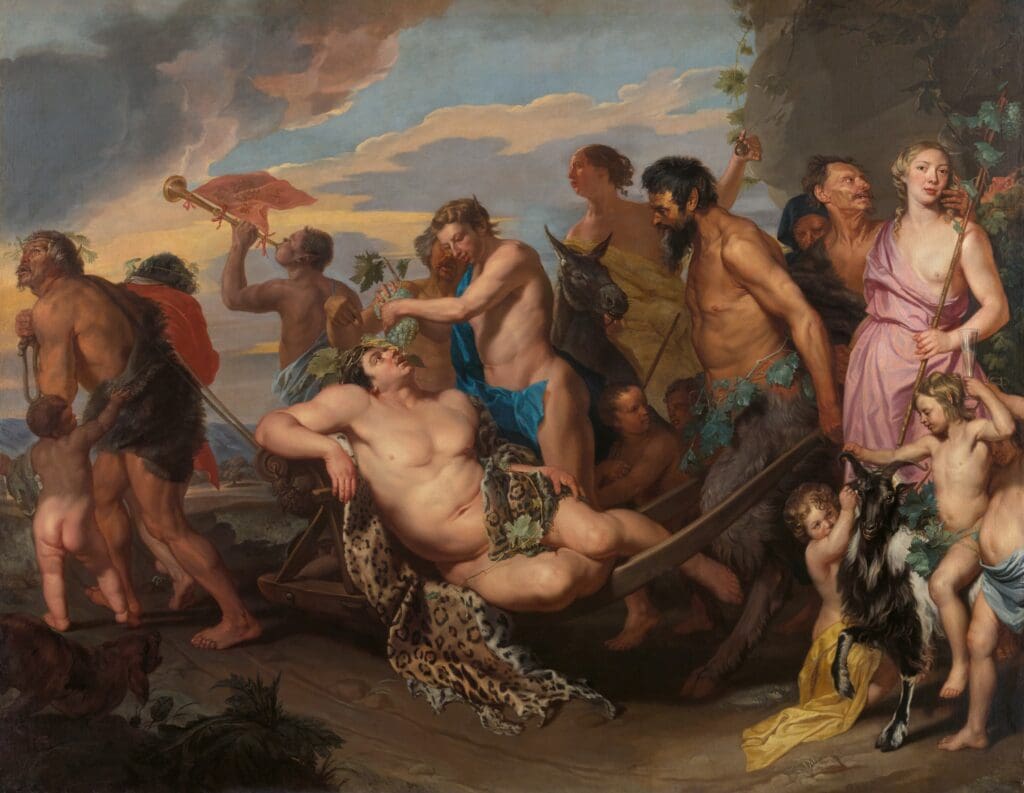
The critical moment for her recent re-establishment was confirmation she was the hand of the monumental The Triumph of Bacchus (about 1655-59, from the Kunsthistorisches Museum). For years, the 3.5-metre-wide canvas was variously said to be by the School of Rubens, a copy after Rubens, by Luca Giordano or by Cornelis Schut. The real author was staring the experts in the face: the painting includes a self-portrait daringly casting herself as a pagan reveller standing tall and deshabille as one of those carrying the god of wine. An inscription even identifies who was the maker.
Without dispute this is a masterpiece of a talented and free-spirited artist, and it is no surprise that it was once part of the archduke’s renowned collection. The scale of the picture is remarkable, while the variety of figures shows an ability to paint the male nude: men of different ages, skin colours and physiques.
Astonishingly this flouted restrictions on women drawing such scenes. How and where did Michaelina train to represent so well the male form? Experts presume that she drew and studied the body not from classical sculptures or prints but directly from life models, who would have attended the studio of her brother Charles.
In 1903, Gustav Gluck, the first curator of the Kunsthistorisches Museum, observed: “Even in our age of female emancipation, one would hardly wish to ascribe this picture, which shows a highly vigorous, almost coarse conception, to a woman’s hand.”
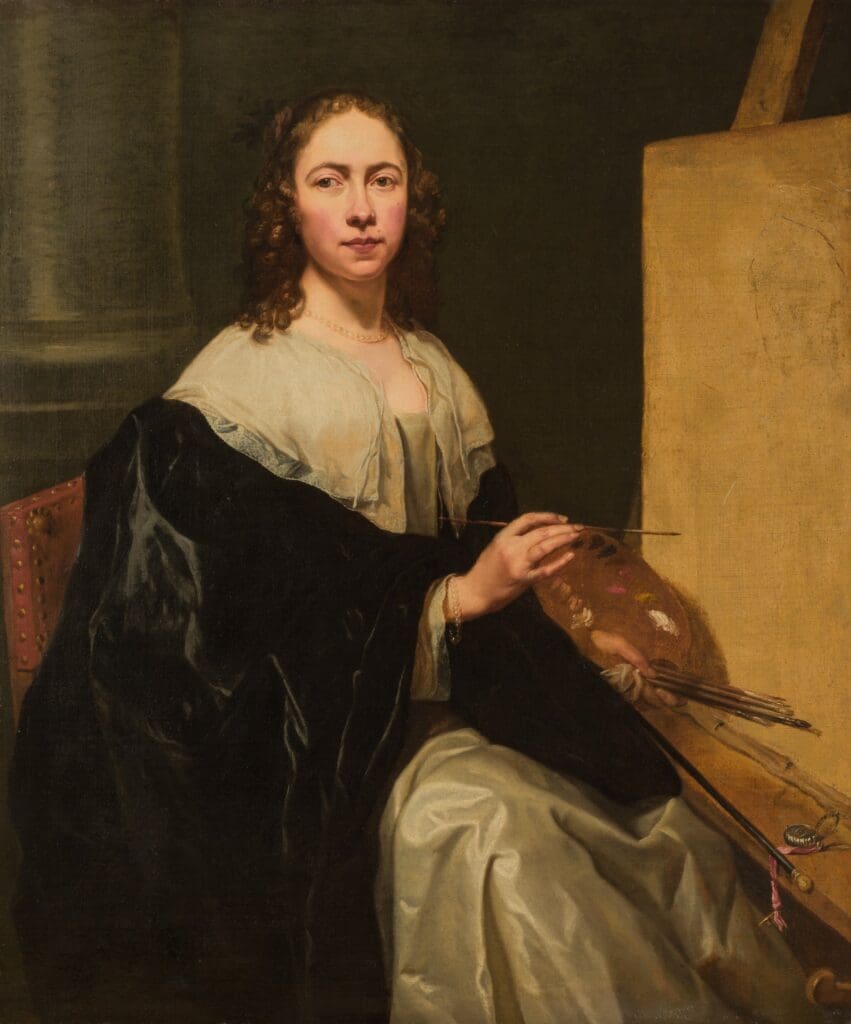
Michaelina was adept in delineating elegant fabrics, the hair of men and women, and skin texture. She consciously fashioned her own image for different moments and settings in her career. Witness her Self-portrait from about 1650 in which she is sitting confidently (but without vanity, it seems), wielding palette and brush as she paints what appears to be the head of a saint. The incongruity is that here she is wearing an outfit more suited to sitting for a portrait than for painting one. She clothes herself in fabrics that would be too costly to risk being splashed with pigment. Her white silk dress, a wide, black-velvet mantle and a pearl necklace reflect her distinguished social status, an aura that skilfully emerges despite a restricted colour schematic.
She was born as Michelle (later using Michaelina as her artistic name) in the city of Mons in the Spanish Netherlands. While women artists faced serious challenges her family was secure enough to support her, and her older brother, Charles also a painter and probably instrumental in her education.
Michaelina and Charles lived together in Brussels, near the royal court and its presumably heady atmosphere, where she in effect presented herself as a courtier. They probably shared a painting studio. The fact that she remained single must have afforded her an enviable amount of professional freedom.
Religious paintings were an unusual pursuit for women artists, but her altarpiece-sized canvases reveal her command of complex compositions and her nuanced approach to sacred subjects. For such sublime pictures she employed a palette which included the expensive blue pigment ultramarine.
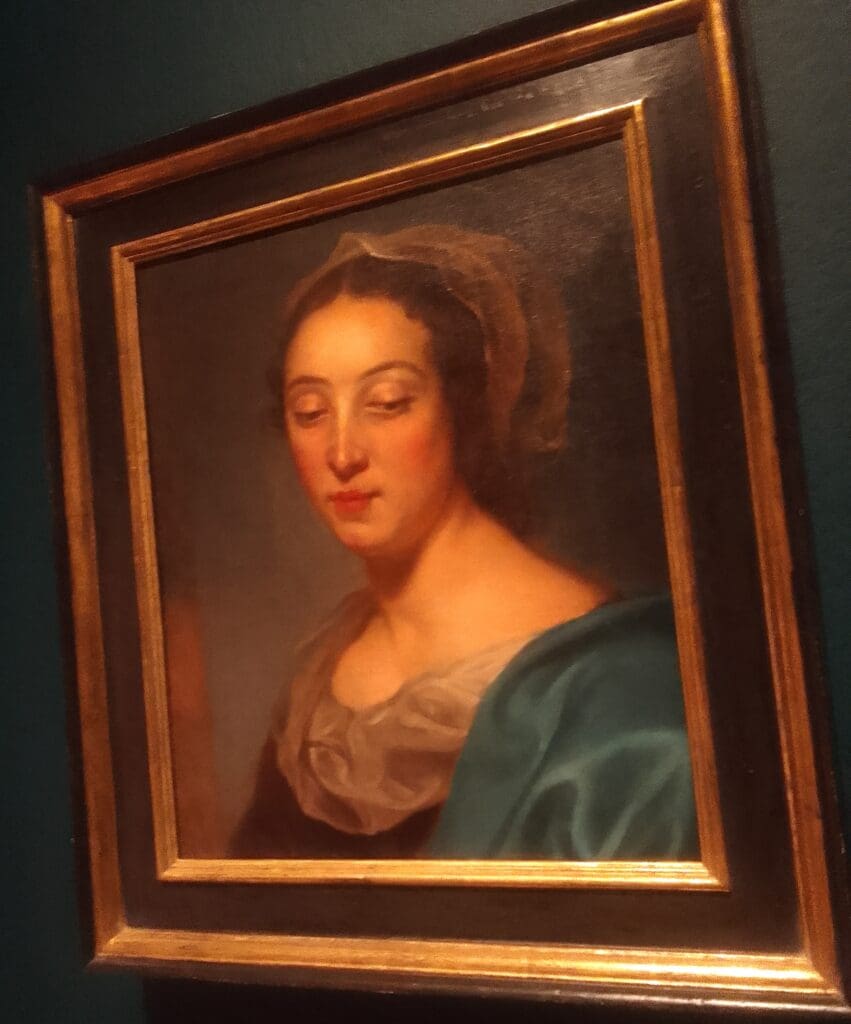
One of the most moving of this genre is Study of a Female Saint from about 1645-1649. The subject is endowed with a very modern but modest look. Eva van Zuien, an independent restorer, completed the restoration recently, commissioned by the Antwerp-based Phoebus Foundation, which said that Michaelina’s distinctive touch is easily recognisable in the soft features, the eyes and the drapery.
The artist signed the work in her typical manner, with her full first and last name in the upper left corner. Phoebus said that the removal of old overpainting revealed an original underpainting, leading to speculation that the bust of the saint might have been painted on the edge of a larger canvas.
The Phoebus Foundation, named after Phoebus Apollo the protector of the muses, is supported by companies in the Katoen Natie trade and logistics group and in the Indaver chemical processing group.
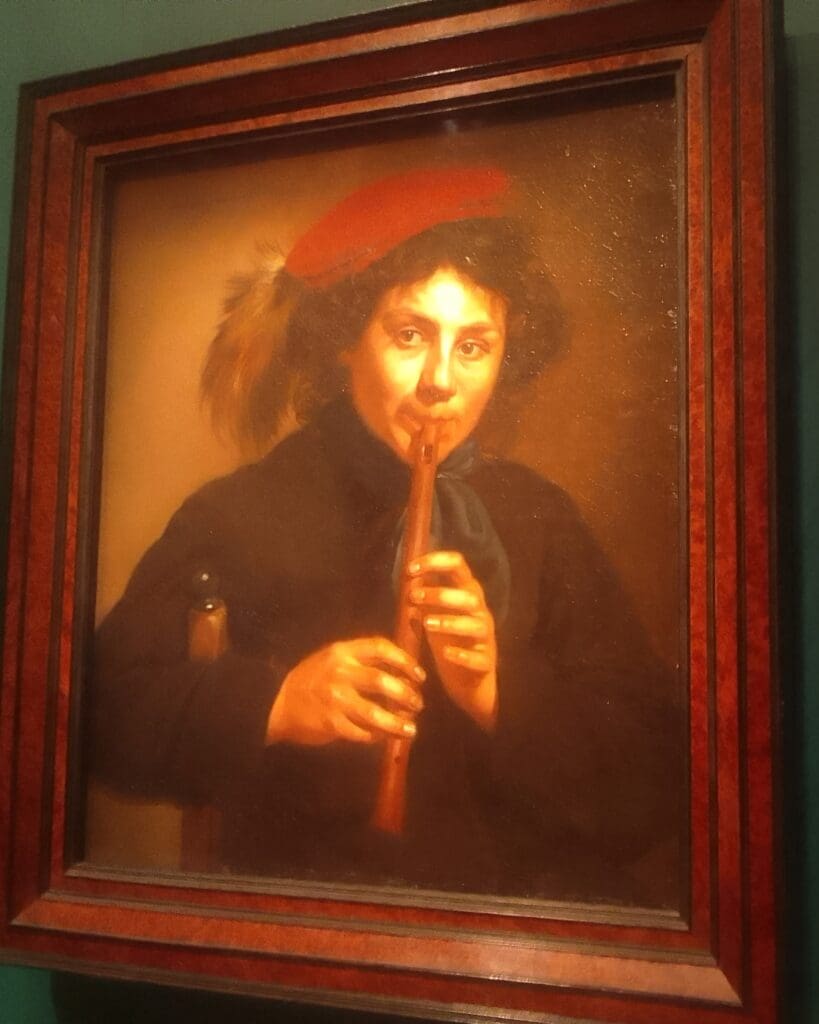
Michaelina brilliantly highlights the individuality of her sitters in her recently rediscovered series The Five Senses of 1650. Each sense (Sight, Hearing, Smell, Taste, and Touch) is pictured with playfulness, in the form of a young boy each time. Those children of around 10 years old she probably encountered in Brussels. The result is a kind of multi-sensory experience insofar as it presents physical markers of perceptible sensations.
Her solution confounds traditional allegorical series that portrayed the senses with idealised women enjoying the aroma of a flower, for instance. Smell depicts a boy wincing at a rotten egg he is holding; the boy in Hearing is ready to play his recorder or wooden flute.
The seriesemploys a limited number of pigments (which corresponds with the colours on her palette in Self-portrait). Using colours sparingly was the acme of artistic superiority.
Michaelina pulled in the light and conjured the colour blue by juxtaposing hues. Blue pigment was expensive, so instead she creates with precision an optical illusion with contrasting colours making the scarf of the boy with the recorder appear to be blue. The same colour device is used in the backgrounds of three other Senses and in The Triumph of Bacchus.
Considered lost until it resurfaced at auction in 2019, The Five Senses is being presented for the first time in public in Europe.
More of her knack for capturing aspects of childhood is seen in Boys Blowing Bubbles but this is also about life being as fragile as a bursting bubble, for the picture includes a fading candle, an hourglass and a worn book. Added to these, a skull was revealed after layers of overpaint were removed in 2025 during conservation.
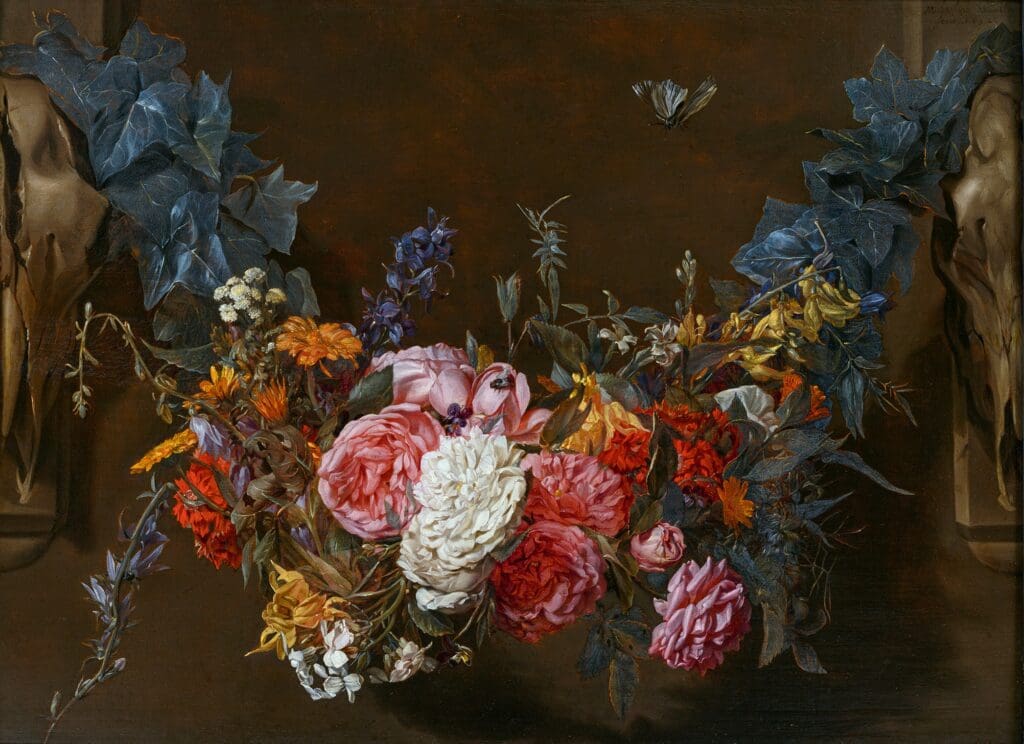
The Bacchus canvas is flanked by two of Michaelina’s flower paintings. The pair are from Het Noordbrabants Museum, the Netherlands, where they are on long-term loan from a private collection. Only two such pictures by this artist survive.
Flower Garland with a Butterfly and Flower Garland with a Dragonfly were painted on wood panel, embossed with an Antwerp mark. Whether she travelled to or studied in the port city has not been determined, but it is thought that she admired the work of Daniël Seghers (1590-1661), a great exponent of paintings of flower garlands. Again, she brings in the elements of ‘memento mori’ – a reminder of mortality – with a pattern of ox skulls and garlands, with pink and white roses prominent.
‘In dialogue’ with Michaelina’s Self-Portrait is displayed a self-portrait by Rubens, to illuminate the contrasting self-fashioning strategies of the two contemporaries.
Standing by a column, a feature traditionally used to project a steadfast and cultivated image, Rubens depicts himself sumptuously dressed in black in the manner of a courtier or diplomat. From Teniers we see Portrait of Archduke Leopold Wilhelm of Austria from about 1652 . Teniers, who was both the archduke’s court painter and the curator of his art collection in Brussels, references one of his patron’s military victories, the 1652 siege of the French port of Gravelines.
With her last known dated painting completed in 1659. it is unclear whether she renounced painting almost 30 years before her death. One would think that such a celebrated painter would have had the right to step back, having used her creative gifts to such depth, although only over a span of 16 years, from when she was in her late 20s.
Art historian Katlijne Van der Stighelen started on the modern trail to Michaelina when she came across an unsigned painting in storage at the Kunsthistorisches Museum. She traced it back to the artist, and her further research led to the landmark 2018 exhibition Michaelina: Baroque’s Leading Lady at the Museum aan de Stroom in Antwerp. Newly attributed paintings and ongoing scholarship have continued to transform our understanding of the achievements of this great artist.
The RA exhibition is organised in collaboration with the Kunsthistorisches Museum, where Gerlinde Gruber is initiating and curating the show to run from September 30 – February 22, 2027.
In London, the exhibition is curated by the Royal Academy’s Julien Domercq, assisted by Rina Sagoo.
Image captions in detail:
Self-portrait, c 1650. By Michaelina Wautier. Oil on canvas. Private collection.
The Triumph of Bacchus, c 1655–59. By Michaelina Wautier. Oil on canvas.. Kunsthistorisches Museum Vienna. Photo: © KHM-Museumsverband.
Study of a Female Saint, c 1645-1649. By Michaelina Wautier Oil on canvas. The Phoebus Foundation, Antwerp.
Hearing, from the series The Five Senses,1650. By Michaelina Wautier Oil on canvas. Rose-Marie and Eijk Van Otterloo Collection.
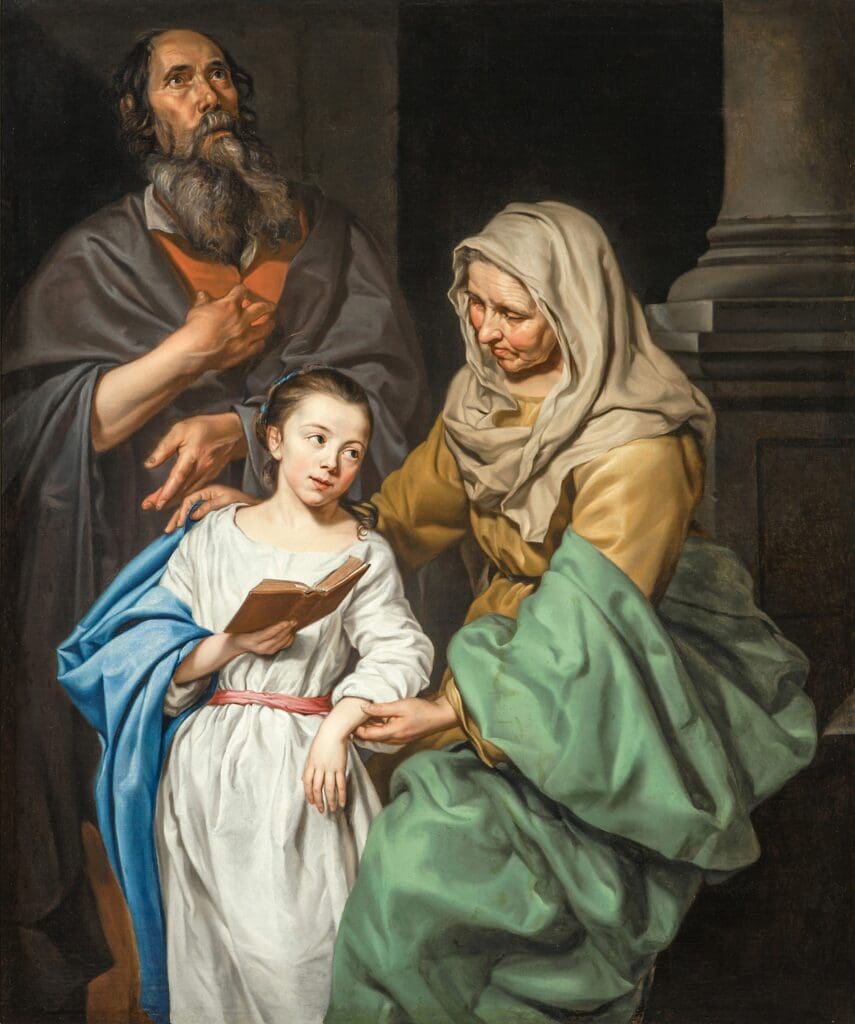
The Education of the Virgin, 1656. By Michaelina Wautier. Oil on canvas. Private collection, by courtesy of the Hoogsteder Museum Foundation.
Flower Garland with a Butterfly, 1652. By Michaelina Wautier. Oil on panel. Het Noordbrabants Museum, ’s-Hertogenbosch, The Netherlands. Longterm loan of private collection. Photo: Peter Cox.
Self Portrait (detail), c 1638. By Sir Peter Paul Rubens. Oil on canvas. Kunsthistorisches Museum, Vienna.
The exhibition Michaelina Wautier is at the Royal Academy of Art, London, until June 21, 2026.
