




By Myrto Maria Barbaris
Design governs every aspect of human activity. It is fundamentally an exercise in decision-making — a process shaped by logic, purpose, and the reasoning behind every choice. Within the shipping industry, this principle is evident at every level of operation, from corporate strategy and maritime logistics to the vessels themselves and, ultimately, the offices from which these operations are managed.
Shipping companies continuously design and redesign their operations in response to a complex network of variables. Every vessel is the result of meticulous design, engineered not only to transport cargo efficiently, but also to withstand demanding environmental conditions while accommodating its two principal occupants: the cargo it carries and the crew who live and work on board. Capacity, speed, fuel consumption, durability, and navigational efficiency must exist in careful balance to achieve optimal results. The architecture of a ship is therefore inseparable from performance.
This same philosophy extends naturally into the architecture of shipping company offices. These buildings are not merely containers for administrative functions; they translate the company’s values, hierarchy, and the operational culture into built form.
The architectural expression of a shipping company begins with the building’s presence and its relationship to its surroundings. Through its form, scale, and materiality, the office building becomes a physical representation of the company it accommodates. Decisions regarding location, orientation, and the organisation of space therefore become fundamental considerations, shaping not only the performance of the building but also the quality of the working environment it provides.
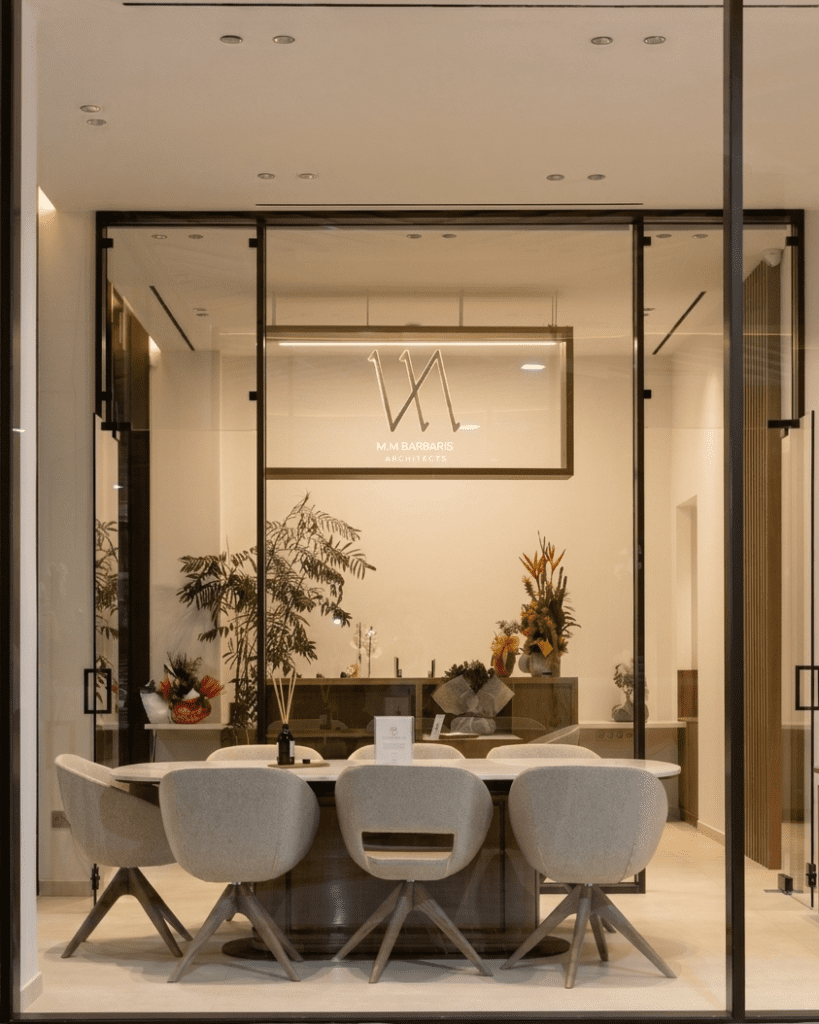
At the scale of the building envelope, orientation is one of the most influential architectural considerations. Natural light remains one of the most important considerations in workplace design. Northern light is often preferred within office environments due to its consistency and softness, creating comfortable working conditions without excessive glare or overheating. In cases where southern exposure is unavoidable, contemporary façade systems and environmental technologies allow direct sunlight to be filtered and diffused throughout the workspace, maintaining visual comfort while improving energy performance.
Beyond orientation and daylighting, the relationship between a building and its wider context remains a fundamental architectural consideration. For shipping companies specifically, the connection to the sea carries both practical and symbolic importance. Ideally, many companies seek proximity to the waterfront, valuing visual and physical engagement with the maritime environment despite the challenges associated with coastal conditions. Humidity, salt exposure, and stronger weather conditions accelerate material deterioration and increase maintenance demands, yet the presence of the sea reinforces the identity and culture of the industry itself. The office becomes not only a workplace, but an extension of the maritime world it represents.
While the exterior establishes the building’s relationship with its environment and expresses the identity of the company, the interior must translate its operational structure and working culture into space. Architecture should reflect management philosophy and the way teams interact within the business. Transparency and collaboration are increasingly essential within contemporary workplaces, particularly in industries where coordination and rapid communication are critical. Departments must operate efficiently both independently and collectively, encouraging interaction while maintaining the capacity for concentration and privacy where necessary.
As a result, the modern shipping office requires a diverse range of spatial conditions. Open collaborative environments support communication and teamwork, while breakout areas provide informal settings for rest, discussion, and the exchange of ideas. Smaller meeting booths accommodate private conversations and focused work, whereas larger meeting rooms remain essential for strategic discussions and presentations. Flexible workstations and hot-desking systems further respond to evolving patterns of mobility and adaptability within the workplace.
At the same time, financial realities continue to shape architectural decisions, reinforcing the need for spatial optimisation and efficiency. This is intensified by the increasing cost of land and construction, which places greater pressure on every square metre to serve a clear purpose. Contemporary office design can no longer afford wasted space; each area must justify its existence through functionality, adaptability, or experiential value. Successful architecture therefore emerges through intelligent planning, in which circulation, orientation, environmental conditions, accessibility, and user experience form a coherent whole.
Ultimately, the architecture of shipping company offices is driven by the same principles that define the maritime industry itself: precision, efficiency, resilience, and adaptability. Good design is not simply an aesthetic pursuit, but a strategic tool that enhances performance, supports people, and reinforces organisational identity. When architecture aligns operational needs with environmental and human considerations, it becomes far more than a building; it becomes an active contributor to the culture, productivity, and long-term success of the organisation.