





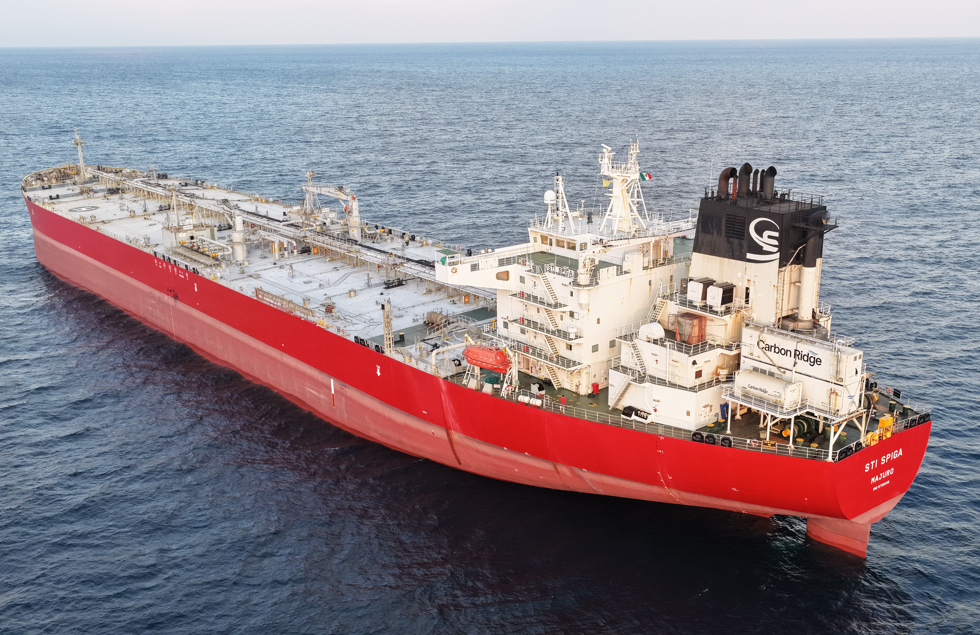
DNV confirms Carbon Ridge’s centrifugal OCCS system reaches peak CO2 capture rate of 98% DNV’s technical evaluation of the installation onboard Scorpio Tankers Inc pilot confirms Carbon Ridge OCCS performance results.
An assessment from global classification society DNV, using its Recommended Practice for performance verification of onboard carbon capture and storage (OCCS), has confirmed Carbon Ridge’s centrifugal onboard carbon capture system can reach CO2 capture rates of as high as 98%. This is the first maritime deployment of a centrifugal OOCS system, which during the testing was set up to capture and treat a part of the emissions stream generated by a LR2 product tanker owned by Scorpio Tankers Inc.
The results were reached using data gathered over a scheduled five-month pilot period, which commenced in July 2025 at Besiktas Shipyard in Turkey, on the 109,999 dwt, 2015-built STI Spiga as the vessel undertook regular commercial operations.
DNV reviewed and validated the associated methodologies, calculations, and reported performance metrics and based on the data provided was able to corroborate peak CO2 capture rates of over 98%, with 55% of the observations falling within a range of 86–98%.
“This evaluation under DNV’s Recommended Practice validates the capability of Carbon Ridge’s modular centrifugal OCCS technology to significantly reduce the emissions of existing and newbuild vessels,” said Chase Dwyer, Carbon Ridge CEO & Founder. “The initial data and learnings from the STI Spiga trial further underpin our ambitions to scale Carbon Ridge’s OCCS across the global fleet. This work would not be possible without industry partners like Scorpio Tankers Inc supporting the deployment of these critical technologies.”
Chara Georgopoulou, Head of Onboard Carbon Capture, DNV Maritime, said: “Independently verified carbon capture rates will be vital to building out a commercially viable business model for OCCS. At DNV we are applying our new OCCS verification Recommended Practice to make sure performance reporting can be accurately and consistently applied across the industry and to help OCCS scale. This has been a great cooperation with Scorpio Tankers and Carbon Ridge, and we look forward to taking the next steps, moving from periodic verification to continuous assurance by using real-time data.”
Scorpio Tankers Inc. chief operating officer Cameron Mackey said: “We’re pleased that DNV has validated the results of our trial with Carbon Ridge. For any shipowner that foresees higher prices or stricter regulations for carbon, Carbon Ridge’s OCCS is an attractive solution. Their system is both straightforward to install and places a low operational burden on the crew. Carbon Ridge has demonstrated the technical capability and understanding required for marine deployment, and we look forward to building on this partnership.”
The Scorpio Tankers Inc pilot marks the first deployment of a centrifugal OCCS system in maritime operations, establishing Carbon Ridge as the pioneer in bringing this method of carbon capture to the shipping industry.
The technology’s compact design means that space requirements are reduced by up to 75% compared with conventional OCCS columns, while its flexible installation options, vertical or horizontal depending on vessel constraints, can accommodate the requirements of shipping’s diverse and globally operational fleet. Captured CO2 is compressed, liquefied, and stored safely for the duration of the voyage.
