





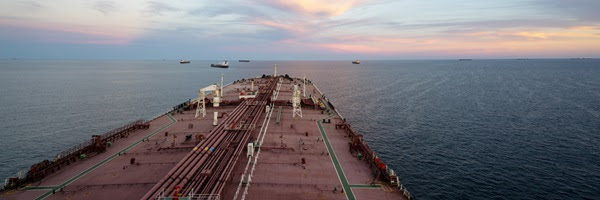
| Crew annual inspection of Permanent Means of Access on oil tankers |
| Download Class News |
Applicability: Shipowners, ship operators, ship managers and ship masters.
Amendments by the International Maritime Organisation (IMO) highlight new interpretation requirements for Permanent Means of Access (PMA) on oil tankers (of 500gt and above) and bulk carriers (of 20,000gt and above) constructed on or after 1 January 2006.
IMO MSC.1/Circ.1572/Rev.2 updates the unified interpretations to SOLAS Regulation II 1/3 6: Access to and within Spaces in, and forward of, the Cargo Area of Oil Tankers and Bulk Carriers.
Although the revised unified interpretations introduce several changes to the previous text, including those related to maintenance, inspection and record-keeping, this Class News focuses on the following:
- Requirement for yearly inspection of the means of access by the crew or a competent.
- Concerns about the practicality of such cargo area surveys on oil tankers.
- Recommendations to shipowners and operators.
Annual inspections
These changes were driven by IMO concerns regarding the condition of means of access, particularly PMA installed in tanks and holds. As part of this, the unified interpretations prescribe that portable and permanent means of access should be examined annually, as stated in paragraph 1.4:
“The means of access arrangements, including portable equipment and attachments, should be annually inspected by the crew or competent inspectors and the inspections should be recorded in Part 2 of the Ships Structure Access Manual. In addition, prior to any space examinations that utilised the permanent means of access, an inspection to confirm the condition of the permanent means of access should be recorded for each space.”
PMA practicalities in cargo tanks on oil tankers
Some Lloyd’s Register (LR) clients have raised concerns about the practicality of conducting annual surveys of PMA inside cargo tanks on oil tankers, particularly because:
- Cargo tanks on oil tankers are kept closed and maintained in an inerted atmosphere.
- Inspecting the permanent means of access inside these tanks requires the tanks to be gas-freed prior to inspection and fully re-inerted afterward before returning to service. The decommissioning and recommissioning cycle of a cargo tank is significantly time‑consuming, has an environmental cost and impacts the operation of the vessel.
- Generally, cargo tanks on oil tankers up to 10 years of age are gas‑freed and opened once every five years, while cargo tanks on oil tankers over 10 years of age are opened twice every five years.
Factors contributing to PMA deterioration
The main factors contributing to PMA deterioration are:
- Contact damages during loading and discharging of cargo holds (bulk carriers);
- Corrosion accelerated by atmospheric exposure and seawater (ballast tanks on all ships).
In contrast, cargo tanks on oil tankers are not subject to the same mechanisms of degradation. Their structure is not exposed to mechanical impacts during cargo operations, and the inerted atmosphere significantly reduces corrosive effects. Based on LR’s experience, PMA in oil tanker cargo tanks does not present a significant concern.
Recommendations to shipowners and operators
While unified interpretations are not mandatory, they are subject to interpretation and decision by the flag Administration. Lloyd’s Register is not authorised to issue dispensation letters, as such letters may only be granted by the Administration.
Accordingly, LR recommends that shipowners, operators, managers and masters contact their flag Administration to request dispensation, submitting supporting documentation, such as:
- Justification for requesting a dispensation letter (e.g. the time each tank would remain out of service).
- Planned Maintenance System schedule for cargo tank inspections and associated PMA.
- Latest cargo tank PMA inspection reports, including sample photographs.
- Copy of this Class News.
If the flag Administration agrees to grant a dispensation, the document or email should be retained in the Ship’s Structure Access Manual as documentary evidence.
Further information
For more details, please contact Lloyd’s Register Global Technical Client Care via TechnicalExperts@lr.org or access LR Client Portal.
