





By James Brewer
Along one side of the room are doll-like profiles under the title ‘Porcelain Flesh’ and portraits of royalty. Facing them (although facing as we shall see is not quite the appropriate word) from the other wall are images – by a different artist – of religious leaders from many of the world’s dominant faiths.
This was the format of an extraordinary exhibition entitled Between Silence and Surface. The Appearance of Skin.
It summoned the work of two multidisciplinary artists from differing backgrounds: Limpika Lilac (the pseudonym of Ukrainian-born Alina Pyatnova) and British-born Anthony-Noel Kelly. The enterprise was on view in London (from May 15 to June 30, 2026). It was hosted at 49 Linden Gardens, London W2, a Notting Hill venue with historic links to the Ukrainian community in Britain. The address continues to serve as a key cultural space for exhibitions, archival work, and public programming, connecting Ukrainian heritage with contemporary artistic practice.

Informed by a wide purview of the spirit of contemporary art, the encounter approached the premise of the portrait “not as a fixed representation of identity, but as a site where visibility is continuously negotiated and questioned.”
How did this work here? Rather than being a dialogue between two national or stylistic traditions, “a shared curatorial condition in which the portrait is tested at its limits: between withdrawal and saturation, absence and over-presence,” is propitiously constructed
Anthony invests deep contemplation in his portrait series Ambassadors. He is ‘met’ by Alina’s disquieting Porcelain Flesh portraits and her depictions of the late Queen, of King Charles III, and of the Princess of Wales, resulting in a what is said to be a tension between British and Ukrainian approaches to the human image.

The exhibition set out to examine contemporary portraiture as an unstable field of perception, where the human face oscillates between disappearance and excessive material presence. Those coming afresh to contemplate such concept might come up with an immersive, or… an ambivalent response.
Within this unstable framework, say the curators, “realism is not treated as a descriptive language, but as a field of tension in which the image is no longer stable, and the act of seeing becomes uncertain, provisional, and constantly reconsidered.”
Behind the venture was Ukrainian Art House in London, in partnership with the Association of Ukrainians in Great Britain (AUGB) and the Shevchenko Library & Archive and other entities. It was supported by the Embassy of Ukraine in the United Kingdom.

Alina and Anthony in their different ways are innovators pouring intense energies into wide-ranging practices.
Alina’s classical art and architecture training informs her compositional clarity, structural awareness, and psychological sensitivity. This is sublimated into meticulous technique, symbolic depth, and a focus on identity and emotional states. Anthony in his current series, Ambassadors, presents in reflective portraits a pure interpretation of the global religious diaspora.
A curatorial statement for the exhibition takes an open-minded approach. “The two practices presented here do not complement one another, nor do they seek equilibrium. Instead, they produce a rupture. One image refuses to fully appear, the other becomes excessively present.”

The statement questions the status of portraiture today: “Can the image still sustain presence when it either vanishes or becomes too dense? Is portraiture still possible after the erosion of trust in the image itself?” One could interpret that as a burning topical challenge given the distortion by technological means of the ‘appearance’ of reams of what might or might not now be defined as art.

From Alina, the exhibition features two interconnected series embodying the poetic interface between painting and sculpture:
• Shiny Dolls – Early works exploring porcelain dolls as symbolic figures. The paintings construct scenes reflecting vulnerability, social identity, and the human condition, introducing the visual metaphor of porcelain as a lens for fragility, reflection, and time.
• SHE / Porcelain Flesh – A series of contemporary female portraits developing a distinctive visual language defined by luminous, porcelain-like skin. Referencing classical portraiture, live models, and with careful compositional design, figures are placed between living presence and sculptural form, capturing both the individuality of the subject and the spirit of the age.

Alina sees porcelain as a metaphor for the duality of human nature – fragile yet enduring, cold yet luminous. Skin is rendered with luminous, glazed smoothness that evokes both human presence and sculptural form.
Part of her presentation was Alina’s tribute to the British monarchy and citizenry for their support for the Ukrainian population under fire from Russia. This included a portrait of Charles III under the title The Reflection of the Crown, 2025. In this evocative work, the artist turns to a pivotal moment in contemporary British history: the coronation of Charles, viewed not as grand spectacle, but as an intimate, internal transition.
The monarch is depicted from behind, while pensive and almost melancholic face appears in an ornate mirror, the mirror as a mystical portal, revealing not only the outer form but also the invisible presence of memory and legacy, a bridge between worlds past and present, life and legacy. Perched on the King’s shoulder and visible only in the reflection is a butterfly, representing the soul and enduring presence of his late mother Elizabeth II. The butterfly, ephemeral and weightless, becomes a quiet allegory of spirit, transition, and unseen guidance.
So, this is more than a royal portrait; it is a meditation on power, identity, and the sacred continuity of the soul.

In The Voice of the Crown Alina shows Catherine, Princess of Wales, adorned in crimson; beside her, the silhouette of her husband in royal blue. Together, they form a living emblem of the Union Flag.
Three Faces of Majesty stands as a tribute to Queen Elizabeth II, depicted through three symbolic incarnations. In her youth, the Queen emanates poise and fortitude, emerging from a cascade of lily of the valley, her most cherished bloom. Opposite her is the Queen in her later years, a figure of reflection, embodying a lifetime of steadfast service and quiet dignity. Above, a butterfly hovers an emblem of her soul:
The series holds particular significance in the context of this exhibition, as the Royal Family has supported the Association of Ukrainians in Great Britain since its foundation in 1946. It was felt especially meaningful and symbolic to present these works within the Association’s historic premises.
Founded in 1946 by post-war émigrés, the Association of Ukrainians in Great Britain is the largest representative organisation for Ukrainians and people of Ukrainian descent in the UK. A central part of its activity is the preservation and promotion of Ukrainian heritage, notably through the Shevchenko Library & Archive in London, one of the most significant collections of Ukrainian printed works and artefacts in Western Europe.

Anthony’s series Ambassadors 2016 – 2026 (unfinished) is a contemplative exploration of faith, devotion, and shared humanity through portraiture. Comprising 19 oil paintings on prepared gesso board, it portrays members of the world’s major religions and spiritual traditions. The sitters are real, individual religious leaders, community representatives, and dedicated worshippers selected to embody the living presence of their respective traditions.
The series spans Christianity, Islam, Hinduism, Buddhism, Judaism, Sikhism, Jainism, the Baháʼí Faith, Shinto, Confucianism, Taoism, and Zoroastrianism, reflecting both the diversity and unity, it is said, of global spiritual life. Christianity is represented by the Roman Catholic, Church of England, Orthodox, Jehovah’s Witness, and Latter-Day Saints communities; Islam by Sunni and Shiite communities.
In each portrait the sitter is presented in profile, with eyes cast in contemplation, prayer, or meditation. Anthony says that the quiet stillness of these works encourages the viewer to encounter faith not through dogma but through an appreciation of devotion, humility, and ethical engagement.
Among the sitters are Dr Harshad N Sanghrajka, a Jain scholar and community leader, the Ven Galayaye Piyadassi, a Sri Lankan Buddhist monk and founder of the Sri Saddhatissa International Buddhist Centre in London; Saori Sugiyama a Shinto priest of the Koromo Shrine in Toyota city, Japan, and Khalifa Ezzat and Mohammed Saeed Moussavi Khalkhali, key Islamic religious leaders in the UK.
The curatorial statement says: “In Kelly’s work, the figure is not simply reduced but almost slips out of the field of visibility. At close proximity, the viewer attempts to stabilise the gaze, yet finds no visual anchor: contours remain unresolved, form appears to withdraw before it can be fixed. A moment of uncertainty emerges, almost a perceptual failure of vision, where the expectation of image is not fulfilled. This absence generates a tension in which presence is intensified precisely through incompletion.”
Anthony, who celebrated his 71st birthday during the inauguration of the exhibition, says that his current work came about while interviewing heads of faith for a previous series, Gods & Men. “The fact that all religions agree in the common quest for happiness and the end of suffering yet have independent ways of dealing with this intrigues me,” says the artist.
“ I’m on my final two portraits out of 16, not so much of leaders but of practitioners in faith, ambassadors for faith; these are people who believe – who [would] die for their belief.” Anthony has just returned from China: “All the way to China to paint these two new portraits, my Confucius and my Taoist.”
In his work more generally, his manner of fragmenting an object into parts is a recurring theme, to physically deconstruct and separate elements and consider the parts a total of the whole. “It’s still intriguing for me to see parts of the body together rather than joined up. Look at the Greek torsos without heads. They’re uncharacterised without a head, an anonymity and your imagination can run wild; it’s not Mr. and Mrs. anymore.”
Ambassadors will not be sold but will be donated to a religious cause.
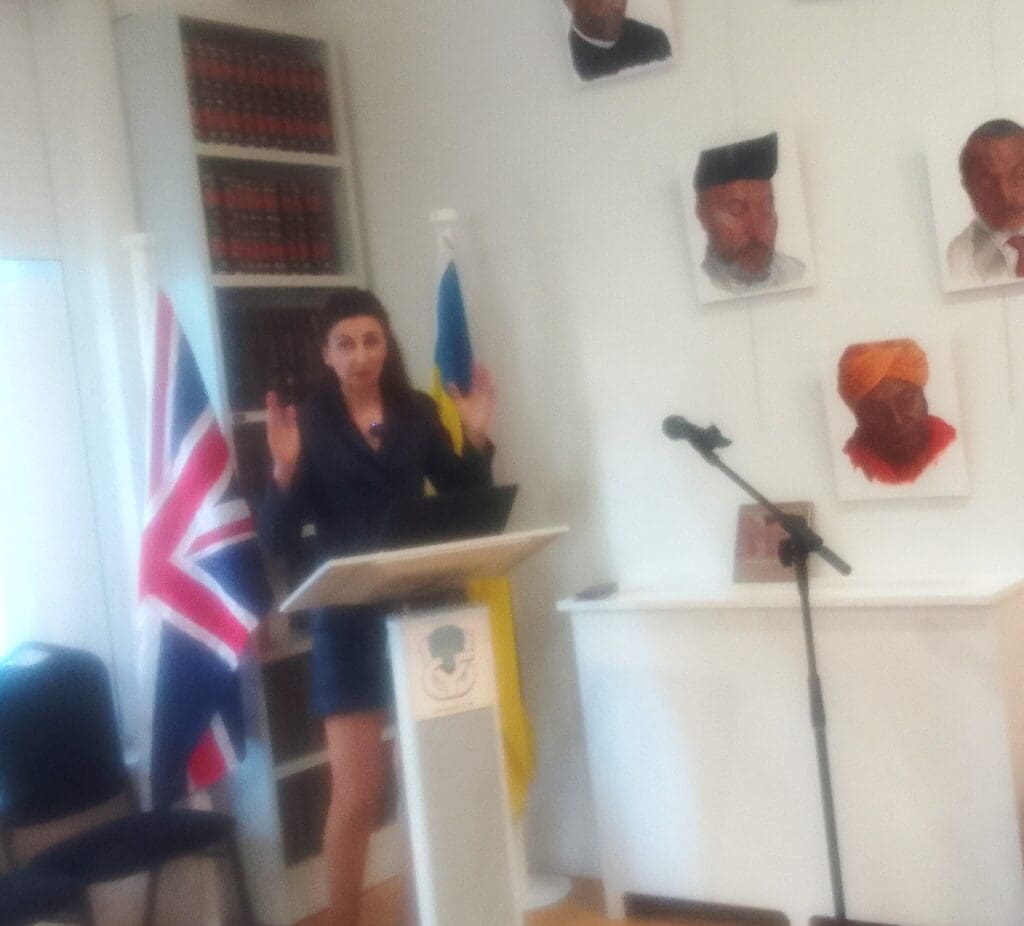
Welcome addresses at the private view were given by Inna Yehorova, Second Secretary at the Embassy of Ukraine to the UK; Dr Ludmila Pekarska, co-curator of the exhibition and Custodian of The Shevchenko Library & Archive; and Nataliia Horbenko, founder and director of the Ukrainian Art House in London who specialises in international cultural promotion, contemporary Ukrainian art, and cross-border exhibitions. She curates projects that highlight the artistic, historical, and social significance of Ukrainian creativity on a global stage. The curatorial trio was completed by Dr Tetiana Bairaka, an independent curator engaged in contemporary art projects connecting Ukraine and the international art scene.
A series of talks, artist conversations, and educational events has accompanied the exhibition, including a live joint painting demonstration by the protagonists.
Without doubt, the initiative has testified to a marvellous opening of new approaches and deepening of current ideas.
Images:
Anthony-Noel Kelly with a section of his Ambassadors portraits.
Alina Pyatnova.
The Reflection of the Crown, 2025. By Alina Pyatnova. Oil on canvas.
Alina Pyatnova with The Voice of the Crown, a tribute to the Princess of Wales.
Soft Glaze, 2026. By Alina Pyatnova. Oil on canvas.
Slavonic Beauty, Soft Glaze, 2026. By Alina Pyatnova. Oil on canvas.
Studying Anthony’s Ambassadors series during the private view
A welcome from Inna Yehorova, Second Secretary Embassy of Ukraine to the UK.
Dr Ludmila Pekarska, exhibition co-curator and Custodian of The Shevchenko Library & Archive
Nataliia Horbenko, founder and director of the Ukrainian Art House in London.
Between Silence and Surface. The Appearance of Skin is at 49 Linden Gardens London W2 until June 30, 2026.
