





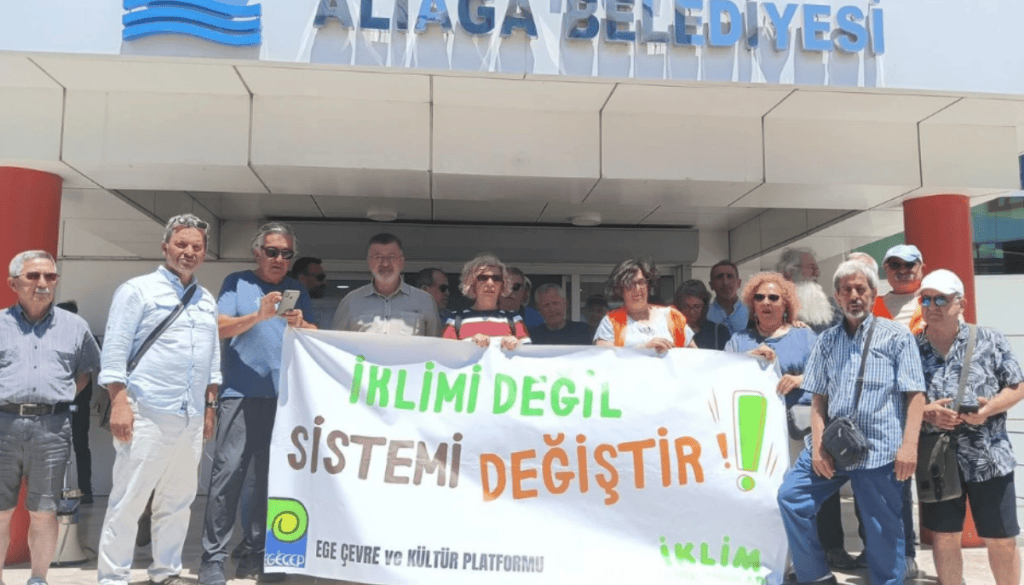
A coalition of Turkish civil society organisations and professional chambers criticised the revised Environmental Impact Assessment (EIA) application for ship recycling facilities in Aliağa, calling it inadequate and not reflecting the reality on the ground, and urged authorities to reject the current process until a real evaluation for the region and a proper facility-by-facility assessments are conducted.
The public consultation of the EIA procedure was held on 23 June. The Turkey Ship Recycling Monitoring Coordination stated that the revised EIA fails to provide a real environmental assessment of ship recycling activities in Aliağa, and cannot be accepted as such. The Coordination condemned the new EIA document, calling it a legal cover for existing unlawful practices and past environmental harm in Aliağa caused by the shipbreaking industry.
What are the problems with the new EIA that the civil society groups highlight?
- The EIA application features an “increase in the operational area,” although the referred additional coastal land created by “sediment accumulation” is already being used to store metal waste, ropes, equipment and vehicles, as shared.
- The application therefore appears to seek approval for an existing situation. Nevertheless, it provides no maps, boundaries, measurements or clear explanation of how the areas were formed and are currently used.
- It contains no field studies, facility-level assessments or current pollution measurements. Risks related to land formation, geology, earthquakes, biodiversity, agriculture and the marine environment are not assessed.
- Hazardous waste, wastewater and drainage systems are not meaningfully addressed. No facility-level data is provided on the types and quantities of waste generated, stored, transferred or disposed of.
- Finally, the application was submitted by the Ship Recyclers’ Association, which does not itself operate the facilities. This appears contrary to Turkey’s EIA Regulation, which requires the application to be made by the project owner
| “This EIA application fails to assess the key environmental, technical and occupational risks of ship recycling in Aliağa, despite previous studies identifying ship recycling as a serious source of pollution in the region. In light of four worker deaths in the last eight months and the lack of transparent data on injuries, occupational health and safety risks also require a holistic assessment, together with environmental aspects. Yet the data shared during the meeting remain incomplete, misleading and far from reflecting the reality on the ground,” says Selma Akdoğan from the Chamber of Environmental Engineers, İzmir Branch. |
| The critique comes amid serious concerns over occupational safety. Since October 2025, four workers have lost their lives in fatal incidents in Aliağa ship recycling facilities, two of which occurred in EU-listed yards. Most recently, on April 25 2026, 65-year-old Galip Avcı lost his life at the EU-listed Sök Denizcilik yard after being crushed by a heavy metal part during cutting operations. Further concerns regarding oversight at the same yard arose on 26 June, when customs authorities reportedly discovered a large quantity of illegal fuel on board a vessel that had arrived for dismantling. |
Unclear standards of Turkey’s New Regulation on the Authorization of Ship Recycling Facilities
Apart from the EIA procedure, a new Regulation was published on 22 June 2026, that introduced a new authorisation system in line with the Hong Kong Convention. It requires facility-level and ship-specific recycling plans, and establishes approvals and sanctions in line with guidelines. The Ministry of Environment, Urbanization and Climate Change must also adopt a separate regulation within one year setting out environmental requirements for ship recycling.
However, key requirements remain unclear, as the Regulation relies on unspecified national and international guidelines without clearly defining them, whether they are binding, or where they can be accessed. The Regulation also lacks concrete environmental requirements for permitting, pollution control, monitoring and transparency. Its effectiveness will depend on binding environmental rules and a broader assessment of the risks of landing-based ship recycling.
Concerns Highlighted in Site Inspection Reports on Leyal and Avşar Incidents
Following serious pollution incidents that occurred in January and February, the European Commission carried out unannounced inspections at the EU-listed Leyal and Avşar yards in March 2026. The inspection reports, published last month, raise significant concerns about pollution containment, as well as incident documentation and reporting.
In January, GNV Antares (IMO 8503797), being dismantled in Leyal yard, collided with an oil platform located in the neighbouring Metaş shipbreaking yard. Another incident was reported in February, when unidentified liquid substance was discharged into the sea during the dismantling of the Lily Ha (IMO 8116972) vessel in Avşar.
According to the EU Inspection Report of Leyal, the GNV Antares suffered a hull rupture and uncontrolled flooding on 8 January 2026. Inspectors later observed extensive water and oily residues inside the vessel, but the facility provided no incident report, management records, water samples or sufficient documentation. The extent of any environmental pollution could therefore not be verified or quantified. The findings were categorized as a deficiency.
Concerning Avşar, satellite imagery confirmed that Lily Ha collided with a platform at the neighbouring Metaş yard on 19 February 2026. However, the source of the subsequent marine pollution could not be conclusively attributed to either facility or to the collision. Inspectors found no incident report, root-cause analysis or supporting documentation, and considered the yard’s spill-response method uncertain and potentially impractical. The incident’s cause was concluded as “inconclusive”. The report also identified three inconclusive items, nine deficiencies and five areas for improvement, including repeated worker-safety concerns.
To the best of our knowledge, no public information has been made available on the condition of the platform in Metaş following the collision or on any damage it may have sustained.
EU-listed yards must be able to identify pollution sources and demonstrate how pollution was prevented, contained, collected and safely disposed of. These findings reinforce the need for fully contained recycling of ships, thorough environmental impact assessments, and strict legal enforcement.
[1] Landing is a shipbreaking method practiced in Aliağa. It consists of a ship being dismantled on the shore, while the back of it remains in water. A ship is then pulled to the shore by cranes and dismantled gradually. This method does not ensure full containment of hazardous waste and spills.
