





by Arietta Pouliou*
Spirituality infused with art, cultural treasures, historical surprises, lofty viewpoints and symbols standing against the horrors of war
Alternative at heart, trailblazing in the trends it embraces and uncompromising in the pace at which it moves, Berlin has become synonymous with the idea of a modern, unconventional metropolis. It always seems ready to embrace anything innovative and forward-looking, while at the same time preserving every fragment of its turbulent past as a precious reminder and an essential part of its identity. In other cities, such an often raw coexistence of old and new might seem incongruous, even jarring. Berlin, however, has a remarkable talent for bringing the most disparate elements into harmony, often transforming their very contrasts into something genuinely extraordinary.
Some of the city’s historic churches are a case in point. Far more than religious monuments and magnificent examples of architecture, they offer visitors a series of unexpected experiences. Some house small, specialised museums others provide atmospheric settings for musical performances. Some invite us to explore temporary exhibitions, while others offer sweeping views across the German capital from lofty vantage points. And some leave a particularly profound impression -or even move us deeply- through the way they bear witness to defining moments in history. In all these ways, the role of the following churches extends far beyond that of places devoted solely to faith and religious worship.
- Berliner Dom
Majestic and imposing, its spectacular dome seemingly vying for attention with the Fernsehturm’s sharp silhouette on the horizon, Berlin Cathedral is undoubtedly one of the city’s great landmarks, while also bearing eloquent witness to Kaiser Wilhelm II’s penchant for grandiose architecture. Its monumental scale was intended to provide a German answer to the magnificence of St Peter’s Basilica in Rome and the elegant design of St Paul’s Cathedral in London, reflecting the imperial desire to project power and prestige. It is worth remembering that the lavish, intricate decoration we admire today, both inside and out, is in fact a more restrained version of the original cathedral, following the restoration carried out in 1975. Before that, came three different designs submitted by architect Julius Carl Raschdorff for the replacement of an earlier church, the consecration of the new cathedral in 1905, severe damage during World War II and, finally, the division of Berlin, which placed the cathedral in East Berlin.
A flight of black-marble steps leads into the dazzling interior, where High Renaissance grandeur meets exuberant Baroque. Amid this feast of ornamentation, magnificent mosaics coexist with gilded reliefs and dynamic, expressive statues. Admire the altar, exquisitely carved from marble and onyx, the white marble baptismal font, the monumental painting adorning the Tauf- und Traukirche Chapel, the colossal organ and the soaring 85-metre-high dome — but do not miss the cathedral’s two most distinctive experiences.
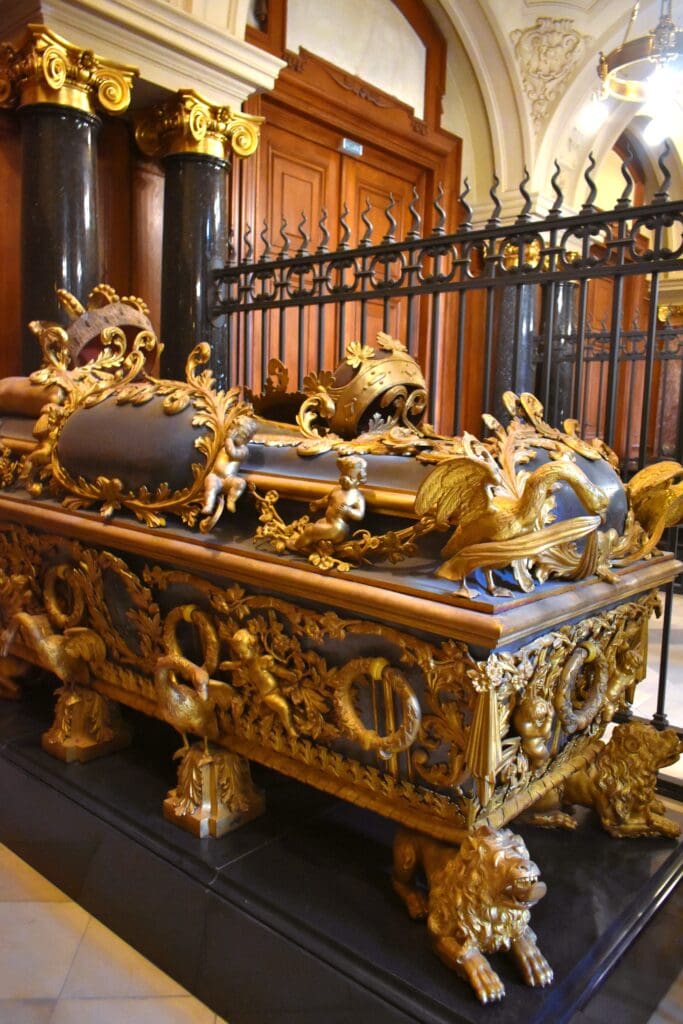
The first lies below ground: a descent into the Hohenzollern Crypt, which reopened to the public this March after 16 years of planning and an extensive restoration project. Unique in Germany and rare by European standards, it is the burial place of an entire dynasty. As the official church of the Hohenzollern royal house, the crypt contains 91 funerary monuments belonging to kings, princes and members of their families, among them that of Frederick William, the Great Elector. It’s a remarkable museum-like space where elaborate marble sarcophagi and tombs fashioned from stone, metal or wood -some modest, others richly adorned with crowns and cherubs, and even draped in velvet and brocade- reflect the aesthetic fashions, royal funeral customs and traditions of a 500-year period, from the late 16th to the early 20th century.
Once you have completed your exploration of the cathedral’s lower level, now enhanced by an interactive model of the crypt and an abundance of informative material, it is time to head very much higher. Specifically, you will climb the 270 steps leading to the outer walkway encircling the dome, where an impressive panoramic vista unfolds from the viewing platform – yet another exhilarating experience at the Berliner Dom. The richly decorated Imperial Staircase was originally intended for the Kaiser’s use, although less athletic visitors can take the lift, installed at the request of Emperor Wilhelm II, an enthusiastic champion of new technologies. From the viewing platform, pick out the cultural institutions that make up Museum Island and surround the cathedral, the Humboldt Forum directly opposite and the cityscape stretching beyond Alexanderplatz. And if, on the day of your visit, one of the approximately 100 concerts hosted by the cathedral each year happens to be taking place, stay for yet another memorable experience.
- Friedrichswerdersche Kirche

Although Kaiser Wilhelm II rejected Karl Friedrich Schinkel’s designs as being too austere for a cathedral, the great Prussian architect demonstrated through his neo-Gothic Friedrichswerdersche Kirche that excess does not always equal superiority. His exquisite creation, with its twin towers and enormous arched stained-glass window dominating the façade, stands just a few hundred metres south of the Berliner Dom and was originally intended to serve the German and French communities in the area. Although Schinkel’s first designs embraced the Neoclassical style, ensuring that the church would complement the nearby Altes Museum, which he was designing at the same time (1824–1830), he eventually bowed to the wishes of Crown Prince Frederick William IV, who wanted the place of worship beside the palace to be completed in a ‘’Old German” – that is, Gothic- style. Retaining his original proportions but working with severely limited funds, Schinkel designed a single-nave church inspired by English collegiate chapels. Red brick was chosen as the building material, deliberately matching the nearby Gothic churches of Nikolaikirche and Marienkirche, yet an exceptionally unconventional choice for the period. The result was the Friedrichswerdersche Kirche, ultimately recognised as the first major brick-built work of its kind since the Middle Ages.

Severe damage during World War II, followed by a seven-year restoration completed in 1986 to mark the 200th anniversary of Schinkel’s birth, and its official reopening the following year, coinciding with Berlin’s 750th-anniversary celebrations, all form part of the church’s more recent history. Since 2000, the building has been part of the Staatliche Museen zu Berlin, serving as a sculpture gallery of the Alte Nationalgalerie and housing a permanent exhibition of works from the early 19th century. Bathed in the gentle light filtering through its stained-glass windows — some of them original — and retaining the pulpit and altar as reminders of its former religious purpose, the church and its delicate Gothic arches provide an ideal setting for works of remarkable expressiveness and sculptural vitality. Among them are a statue of the architect himself, created by Friedrich Drake, and a bust of Schinkel by Christian Friedrich Tieck; mythological figures rendered in plaster or bronze; and marble compositions such as August Kiss’s monumental allegorical figures of Faith, Charity and Hope. Together, they offer a brief yet remarkably rich journey through the sculpture of the 19th century.
Outside the Friedrichswerdersche Kirche, pause for a moment by the charming Bärenbrunnen fountain. Alongside its playful little bears, take a closer look at the view beyond: in the distance, the Berliner Dom makes a graceful appearance across the cityscape.
- Nikolaikirche

The oldest religious building in Berlin presides over the heart of the much-loved Nikolaiviertel, its elegant silhouette and distinctive pointed towers keeping watch over the picturesque neighbourhood, where the city’s medieval atmosphere has been brought vividly back to life. Today, it is one of three museums tucked among the quarter’s cobbled lanes and, although rebuilt in 1987, it retains unmistakable elements of earlier structures, including details such as the western portal with its gilded relief decoration. Temporary exhibitions, primarily devoted to contemporary art, are held here, but it is the permanent collection that offers the most fascinating glimpse into the past. Sections such as “The Pantheon of Berliners,” “The Coin Treasure” and “In Search of Historical Traces” explore not only the rich architectural, ecclesiastical and musical history of the Nikolaikirche, but also the urban development of Berlin during the Middle Ages.

Authentic artefacts, architectural fragments, liturgical objects and funerary monuments belonging to prominent families, dating back to 1230, when the first church was built, bring to life the structural and stylistic transformations the building has undergone over the centuries. They also bear witness to the devastating bomb damage and the collapse of most of the church, which left it in ruins until 1984. At the same time, the collection reflects the city’s economic growth and social evolution, as the church also served as the Ratskirche -the church of the City Council- where its first assembly was held in 1809. The Nikolaikirche’s role in the Protestant Reformation is also explored, as is its later significance as the setting for the city’s first parliament in 1991, shortly after German reunification. And the musical tradition of this remarkable architectural monument and museum continues to evolve through regular concerts and artistic events. Every Friday, for instance, the church organ brings classical melodies to life, often accompanied by strings, while this summer, the glittering evening “Gala Concert: Music as a Light of Hope” commemorated the 350th anniversary of the deaths of composers Johann Georg Ebeling and Paul Gerhardt.
- St. Hedwigs-Kathedrale
In the case of St. Hedwigs, Rome served as an inspiration rather than a rival. The cathedral, with its striking greenish dome forming one of the defining landmarks of Bebelplatz and serving as the seat of Berlin’s Catholic archdiocese, was modelled on the Pantheon, one of the finest surviving monuments of ancient Rome. The church was funded by Frederick the Great, King of Prussia, whose equestrian statue presides over the square, and its construction was prompted by his army’s conquest of Silesia. Seeking to honour the region’s Catholic faithful, Frederick commissioned St. Hedwigs, built between 1747 and 1773 by Johann Boumann the Elder, to a design by Georg Wenzeslaus von Knobelsdorff.
As captivating as the church’s massive dome may be, its story as a symbol of religious tolerance is equally compelling, as is the bold transformation its interior has undergone in recent times. As the first Catholic church built in Protestant Berlin after the Reformation, it was given a Modernist interior in 1930. Then, in 1952, following an air raid that left only the outer shell standing, reconstruction began, accompanied by a radical redesign of the interior. Eleven years of work resulted, among other things, in the incorporation of eight chapels on the lower level.
Yet, it is the cathedral’s most recent redesign that has transformed St. Hedwigs into a case study in groundbreaking ecclesiastical architecture – not without controversy, given the results, which were unveiled in late 2024. Minimalist aesthetics, a restrained spiritual atmosphere, subtle symbolism, clean lines and pristine white walls now define the space, giving it an almost contemporary-art-gallery feel. The radically renewed interior is completed by the closure of a large opening in the floor that once connected the main church with the lower level, the relocation of the altar to the very centre of the space, with the congregation gathered around it, and the complete redesign of the cathedral’s underground level.
Give yourself time to absorb the uncluttered aesthetic and the airy sense of lightness that characterise its new era. Stay for an organ recital on the instrument built in Bonn in 1978, admire the Neapolitan Nativity scene with its exquisitely crafted 18th-century figures, and then descend into the crypt. Here lie the remains of the beatified Bernhard Lichtenberg, a cathedral priest from 1938 onwards who stood against Nazi terror, publicly prayed for persecuted Jews, was arrested and died while being transported to a concentration camp. From the crypt, you can pass directly into the Bernhard Lichtenberg House, with which the cathedral forms not merely an architectural and functional whole, but also an important place of remembrance. The first floor is home to a café and bookshop.
- Kaiser-Wilhelm-Gedächtnis-Kirche

Perhaps nowhere else in West Berlin is the horror of war and the devastation it leaves in its wake captured with such shocking immediacy as at the Kaiser Wilhelm Memorial Church, rising above the bustling Breitscheidplatz. The bomb-scarred bell tower of the original church, built in 1895 by Wilhelm II in memory of his grandfather, Kaiser Wilhelm I, stands broken and battered, compelling passers-by shopping along the commercial artery of Kurfürstendamm to look up and imagine the Allied bombs raining down on the heart of the German capital.
The massive monument -affectionately dubbed the “hollow tooth” by Berliners- and the vestibule of the original Neo-Romanesque church are the only surviving sections, spared from demolition after a public referendum saw roughly half of Berlin’s residents reject plans to tear down the ruined building. Today, they form part of a new religious complex built between 1957 and 1961 by Egon Eiermann, comprising a stylised octagonal church and a hexagonal bell tower in the same distinctive style. Entering both parts is an unforgettable experience. On one side, the memorial to the horrors of war is profoundly moving in the stark traces left by the bombs. The surviving sections of the vestibule, meanwhile, evoke the splendour of another age: the extraordinary Hohenzollern mosaics, alive with colour and intricate detail -particularly the depiction of the enthroned Emperor Heinrich holding his sceptre and orb, scenes from German imperial history rendered in thousands of tiny tesserae against shimmering golden backgrounds, the statue of Christ, miraculously spared from destruction and the bomb-damaged staircase framed by mosaics depicting Prussian dukes. Beside the shell of the church, just 68 metres remain of the tower that once soared 113 metres above the city, making it Berlin’s tallest.

Step into the new church, with its steel framework seemingly enclosing it in a tightly woven wire mesh, and colour almost disappears. Especially as the sun begins to set, an intense, almost otherworldly deep-blue light filters through the glass blocks behind the altar, where a golden figure of Christ with outstretched arms appears almost suspended in mid-air. A total of 22.200 glass blocks were manufactured in France for the new church and its bell tower, transforming the light in extraordinary ways and creating a dreamlike atmosphere during evening concerts performed on the church’s magnificent organ, with its 5.100 pipes. Numerous objects commemorate military units and preserve the stories of soldiers of different nationalities who lost their lives during World War II, while powerful exhibitions devoted to the conflicts still ravaging the world are regularly hosted here. And somewhere between the ruins, the luminous blue glass and the haunting silence of the memorial, a thought inevitably emerges: how much of the lesson history has tried to teach us have we truly understood? At the same time, you realise that you are standing in a city that has never attempted to hide from its past – a city that has chosen, instead, to keep its wounds visible, so that they may continue to speak.
__
*Arietta Pouliou is a Travel journalist, Fashion lover, Foodie, Dreamer, Arts and Sculptures lover, Ice cream addict, Wine enthusiast, you name it. A great contributor to allaboutshipping.co.uk on very special issues accompanied by great photos!
