





By James Brewer
Frida Kahlo – everyone loves you; but does everyone respect you, especially those who appropriate your image?
The rhapsodising and commercialisation of the Mexican artist throughout Tate Modern’s impactful 2026 exhibition raises the question. Frida: The Making of an Icon focuses on her art, but also what appears to be a cosmic destiny, an afterlife that she would never have anticipated.
Tate is simply – but simply is not the word, given its selection of a trail of “after-works” by many of her admirers and imitators – the latest to explore and exhibit the ever-burgeoning posthumous fantasy.
Frida’s impact was from the box office green-light the highest pre-selling exhibition in Tate records, with more than 50,000 tickets snapped up.
No wonder! She is the Mona Lisa of the 20th century, to legions of followers an untouchable goddess, one of the most influential and widely recognised figures in and well beyond the arts world.
The show sets out, we are told, to demystify and demythologise an international icon of our age, while proving that it is impossible to erase the magic. The pandora’s box: of her indelible vision and energy cannot be snapped shut.
Her independence, supreme self-possession, and the way she dealt with her physical suffering ensure she is unforgettable for all time. Her story and the forthright images she created have since been served up on all manner of wares, artworks and beyond: t-shirts, earrings, tote bags, socks, cups, dolls, and more recently model skateboards to affix to your living-room wall.
The larger-than-life Frida dispersed her identity into many selves from the one fount, in which she was for the most part poised and calm. She was, and is, a two-sided but indivisible unity.
Many of those who visit the gallery will know, at least in outline, of her personal tragedies, and will be overawed anew about how she openly challenged the world with them. Feminist, revolutionary, bisexual, gender-fluid, disabled (she was diagnosed at the age of six with polio which left her right foot and leg crippled, was badly injured in a bus crash when she was 18, and had surgery all her life, more than 30 operations). Proudly Mexican, and always unapologetically herself, it is no surprise that she remains of contemporary significance to defenders of the socially excluded .
Tate presents more than 30 of her best-known works, and lesser-known ones including self-portraits that introduce the ‘many selves’. Visitors walk by her treasured garments, jewellery, photographs and memorabilia, before being introduced to 200 works, variously homages and peculiarities by her contemporaries and by later generations – nothing is deemed sacrosanct. The new generations continue to reimagine and reclaim her remarkable story.
Frida’s name first appeared in US artistic circles in the early 1930s, followed by recognition in France. During the late 1960s, the US Chicano movement of Mexican Americans embraced her as an emblem of cultural pride and political resistance.
Her self-portraits, featuring cropped hair, hummingbird eyebrows and masculine attire, and her depictions even of her own birth and of female sexuality, undermined widespread cultural norms.
In the current century, ‘pop’ attention was stirred when the singer Madonna bought one of her works, and one work sold at auction for a record sum of achieved $54.7m. El sueño (La cama) (1940), shows Frida asleep in bed beneath an exploding skeleton,
The new exhibition is all the more important because there are no paintings by Frida currently in UK public collections. When Tate Modern last held a major Kahlo exhibition in 2005, more than 50 paintings, including two owned by the American pop idol, were borrowed for public display. Given their cultural value, organisers of the new show inevitably had a struggle to secure some works from the government of Mexico and private collectors.
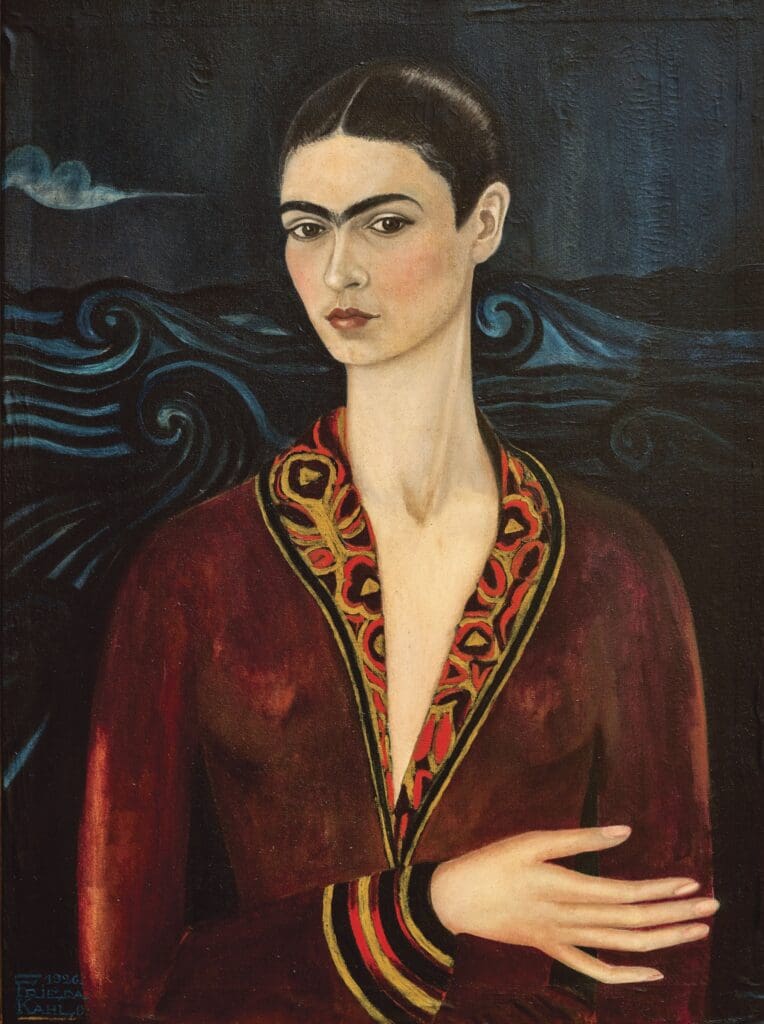
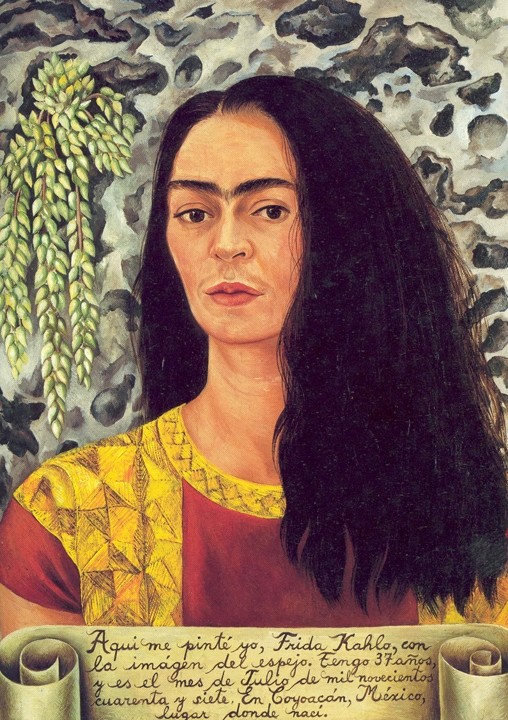
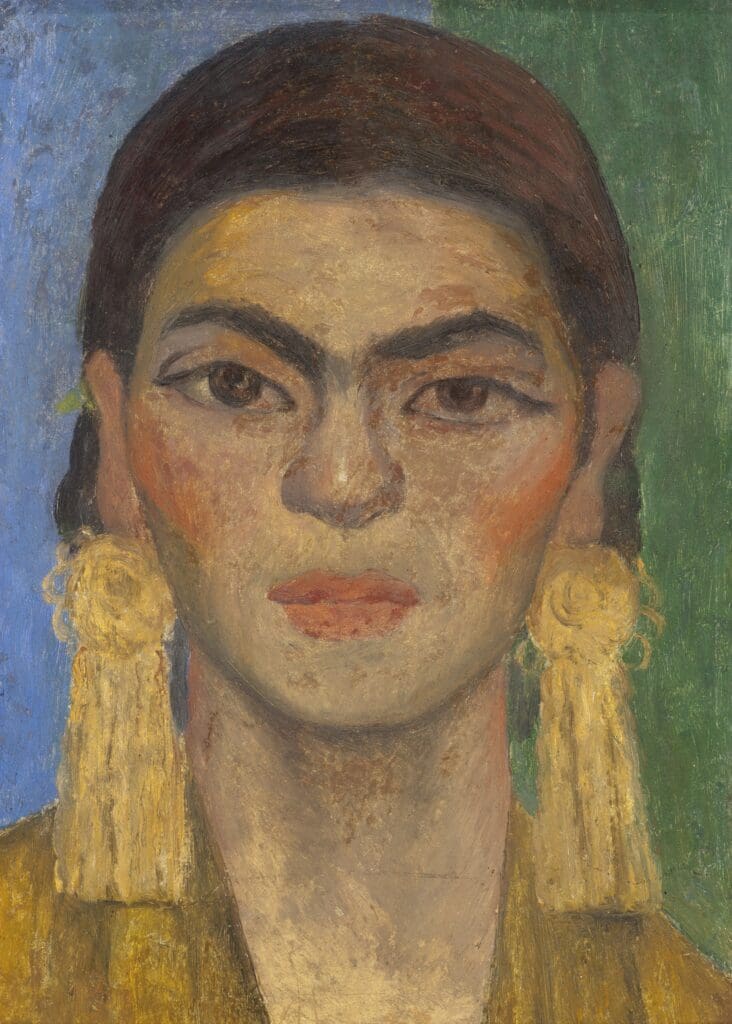
The self-portraits are the biggest draw. Compare Self-Portrait (With Velvet Dress) made in1926 as a present for her then boyfriend; and 20 years later, the poignant Self-Portrait with Loose Hair 1946, made while she was recovering from spinal surgery which she had in New York, and her somewhat wistful gaze therein.
Such as these are presented ‘in dialogue’ with works by other artists of the ‘Mexican Renaissance’, such as her husband Diego Rivera’s Portrait of Frida Kahlo c1935 and Dream and Premonition 1947 by María Izquierdo (1902-55) a direct contemporary.
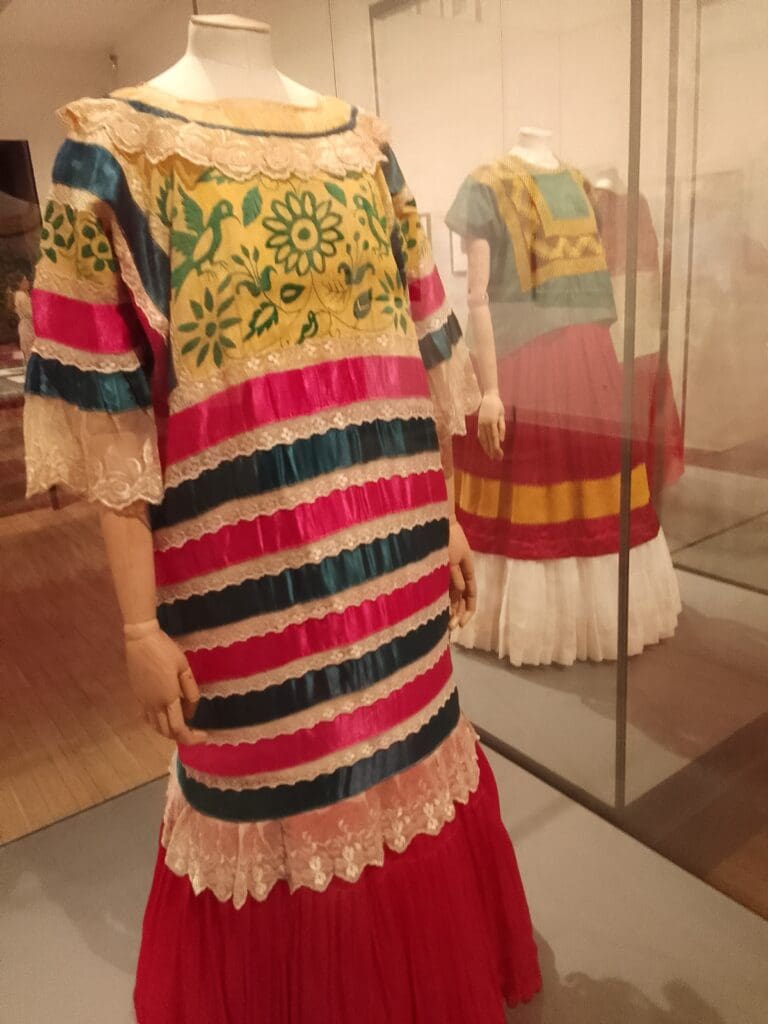
Photographs and archive materials include Frida’s brilliantly patterned, hand-stitched tehuana dresses, which are worn by Zapotec women in the province of Oaxaca. Since the Mexican Revolution of 1910-20, that type of dress has been a symbol of Mexican pride and resistance against oppression and it was part of Frida’s signature look fostered by her husband Diego Rivera. The long, wide skirts and loose-fitting blouses of tehuana outfits meant too that she could hide bodily disfigurements.
Treasured possessions include a display of Frida’s jewellery with chiselled silver and glass fused earrings, gold filigree earrings, dye-cut silver necklace, glass and moulded silver ring, and polished turquoise and silver laminated ring.
Diego encouraged her to paint and introduced her to Surrealist practitioners. Saying that her work was of reality and not of dreams, she rejected applying the Surrealist label to herself despite parallels with their concepts although the movement’s founder André Breton declared her “a self-made Surrealist.”
She said: “I paint self-portraits because I am so often alone, because I am the person I know best.” In all, she completed 55 self-portraits.
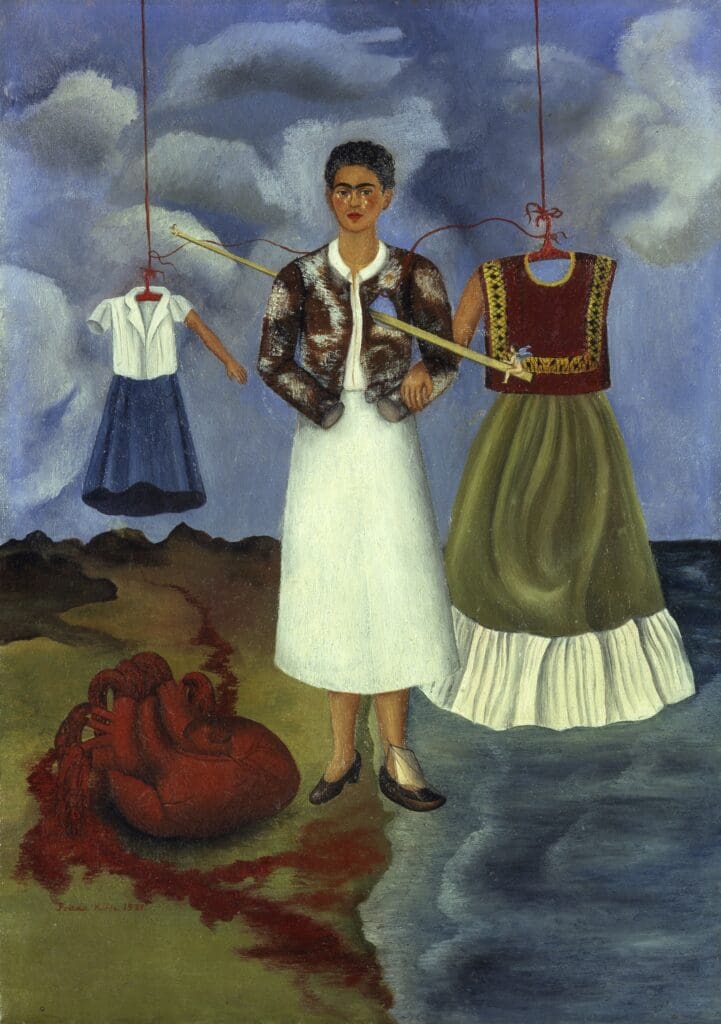
In a distressed emotional state, she appears in her 1937 painting Memory (The Heart), tearfully lamenting the affair between Diego and her sister Cristina. Her body is pierced by a steel rod with cupids at either end. She stands with one foot on dry land, one foot in the ocean. On the ground, a damaged heart lies bleeding. Her gorgeous hair is cropped, and she is in European clothing, not Mexican. Her school uniform hangs to one side and her tehuana dress to the other.
The following year, she had her first solo show at the Julien Levy Gallery in New York. It was the success of that exhibition caught the attention of Breton, who invited her to exhibit in Paris,, where the French national collection acquired her self–portrait The Frame which is to be seen at Tate Modern.
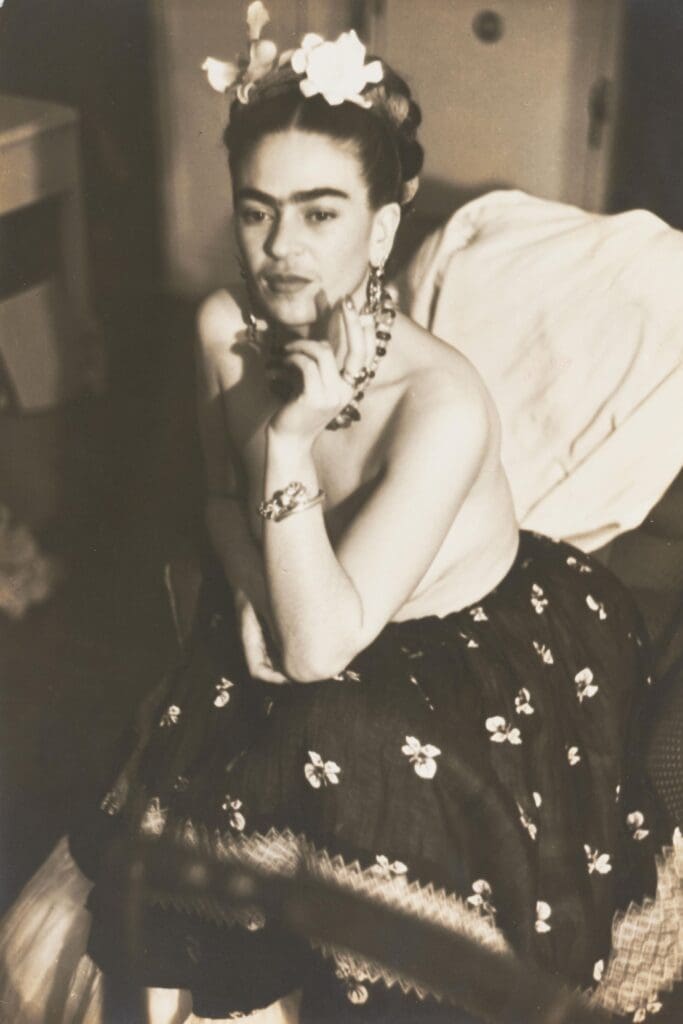
US-born Levy (1906-81)was fascinated by Frida and introduced her work to American art collectors. Besides promoting her paintings, he photographed Frida in various poses including some in the nude.. He described her hair ritual as a “fantastic liturgy” but his revealing photographs were not made public during her lifetime. “They express Kahlo’s newly found confidence in her body,” say the curators.
The photography is a huge plus. We see colour photos of her by one of her lovers, Nickolas Muray; and a friendship with the Italian-born photographer Tina Modotti attracted her to the idea that she might achieve a liberated, modern life as an artist.
Frida’s style was even featured in Vogue in 1937 with a full-page colour portrait by American photographer Toni Frissell, showing her raising above her head a large purple shawl.
The exhibition explores how works such as My Dress Hangs There dated 1933-8, would have resonated with Mexican migrants. Frida illustrates the detritus of US society which grated on her when she and Diego spent three years in the US where he had a commission.
The Frame is a memorable piece painted on aluminium and viewed behind painted glass. Frames like this were often used to hold religious images, mirrors and photographs. Other standouts presented by Tate include Diego and Frida of 1929, Survivor 1938, and Girl with a Death Mask 1938.
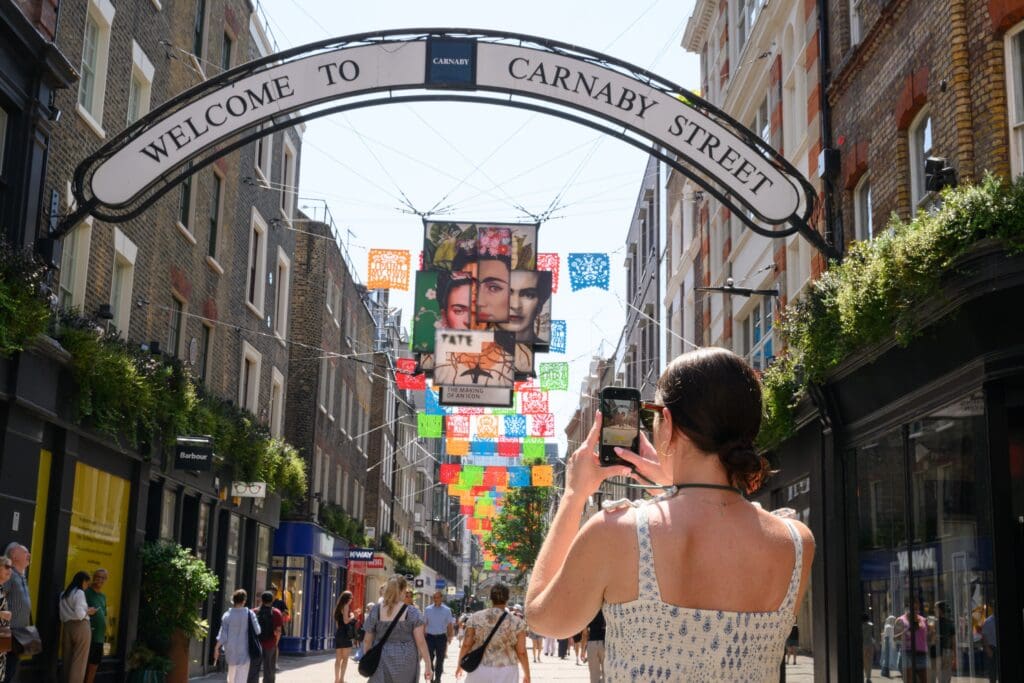
Coinciding with the opening at Tate Modern, he gallery’s initiative¡Frida Icónica! extended the presentation beyond the gallery and onto the streets of London. It ‘took over’ for several weeks Carnaby Street in London’s West End, with displays including garlands of papel picado – the Mexican art of decorative paper cutting — designed by artist Alejandra Ballesteros, with motifs and scenes inspired by Frida and an anamorphic (stretched image) mural composed from four portraits of Frida, and contemporary artists displayed Frida’s recognisable profile.
On the other side of the Thames in Bankside six large public murals were created by artists aged under 25 to reflect aspects of her identity and are due to remain in place for several years.
Frida was born Magdalena Carmen Frieda Kahlo y Calderón. Her father was Carl Wilhelm Kahlo, born in Pforzheim, Germany, in 1871. Her mother was Matilde Calderón y González, born in Oaxaca, with a mixed Indigenous (Purépecha) and Spanish background. Their daughter thus had the traditions of Lati America in her blood. Frida met Rivera when she was a 15-year-old student and he was at 37 already an accomplished artist, painting a mural at her school. Several years later, they met again and married. It was Rivera’s third marriage.
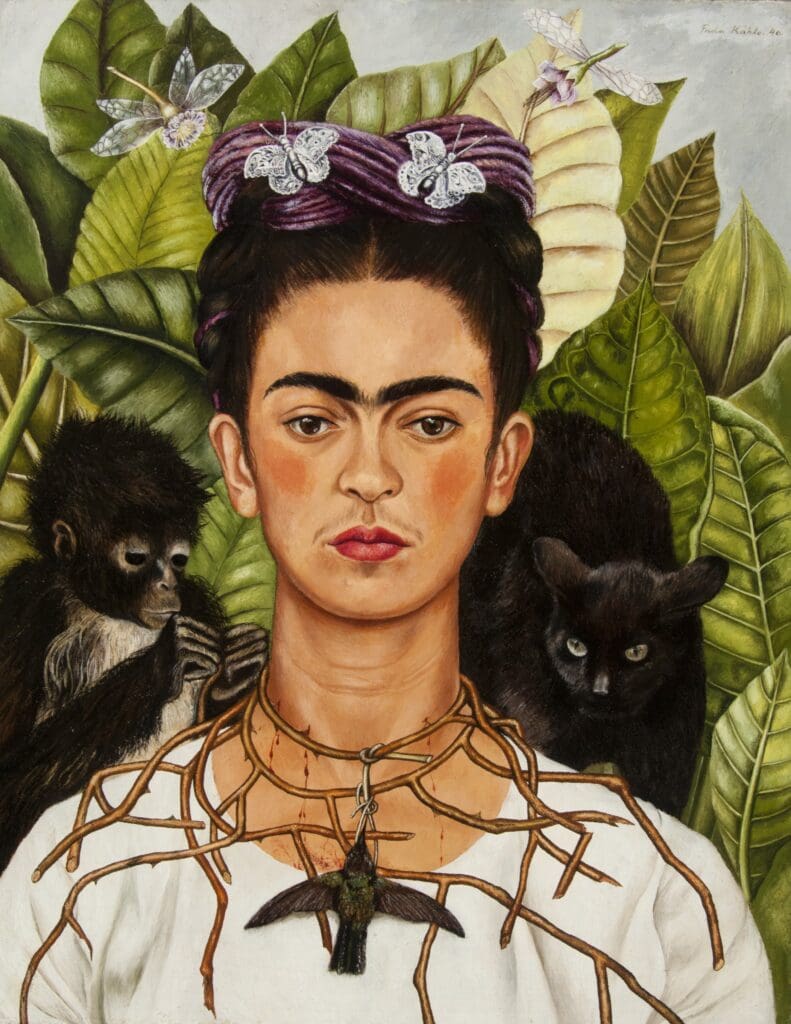
She was intrigued by animals. In the widely known Self-Portrait with Monkey, she makes play with the monkey’s fur, besides making a feature of her hair. As often the case, she adds flowers and leaves to her portrait. Flowers are transformed into erotic motifs that assert her love of life.
She reinvented the genre of still life painting. Rather than using the term naturalezas muertas, (dead natures) she used the term natualezas vivas (live natures) stressing their vitality and included folk and popular elements, references to the body and symbolism as a metaphor for her sexuality and reproductive concerns.
Frida was inspired by the tradition of the ex-voto, small paintings with inscriptions dedicated to saints, offering thanks or asking for their interventions. She adopted the format at one stage. Tate shows the example of a 18th century ex-voto commissioned by a young Mexican woman who went through an operation for breast cancer, and this is painted by Peres Maldonado in frank detail in oil on canvas. This may at one stage have been owned by Diego Rivera or André Breton.
Shown alongside an immense diversity of paintings and photographs by Latin American artists and others who latched on to her heritage, Tate Modern examines their shared fascination with motifs of masks and skeletons, and the Mexican fixation on death and dreaming.
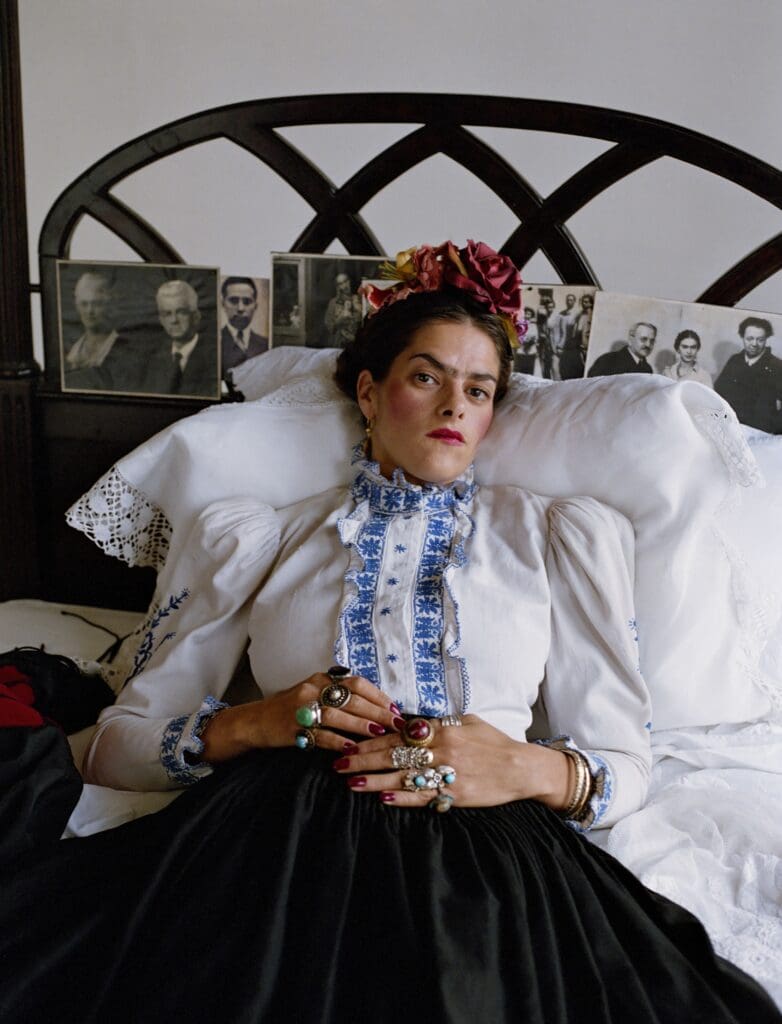
Photographer Mary McCartney has Tracey Emin in 2000 lying in bed, dressed and made up as Frida. The British artist, whose work was for several months concurrently on display at Tate Modern, is pictured before she underwent a series of major operations, so the bed is a compelling symbol for both artists. Frida painted despite ill-health confining her to bed.
The exhibition switches tack abruptly with Frida’s transformation into a global brand, with dozens of items of merchandise generated for the mass market.
Frida: The Making of an Icon is organised by the Museum of Fine Arts, Houston, in collaboration with Tate Modern. The exhibition is in partnership with lead global supporter, Bank of America. The exhibition is curated by Tobias Ostrander, Estrellita B Brodsky curator at large, Latin American Art and Beatriz García-Velasco, assistant curator, International Art.
Images and captions:
Self-Portrait (with Velvet Dress),1926. By Frida Kahlo,. Private Collection.
Untitled (Self-portrait with thorn necklace and hummingbird), 1940. By Frida Kahlo. Nickolas Muray Collection of Mexican Art.
Self-Portrait with Loose Hair, 1946. By Frida Kahlo. Private collection.
Memory (The Heart), 1937. By Frida Kahlo. Private Collection.
Portrait of Frida Kahlo c.1935. By Diego Rivera. Los Angeles County Museum of Art.
Frida Kahlo, 1938. By Julien Levy. © Courtesy Philadelphia Museum of Art.
Being Frida, London 2000. By Mary McCartney. © Mary McCartney. Courtesy the artist.
Garments from Frida Kahlo’s personal wardrobe on display from Museo Frida Kahlo. Banco de México. Diego Rivera & Frida Kahlo Museums Trust.
View of ¡Frida Icónica! on Carnaby Street in London’s West End, August 2026.
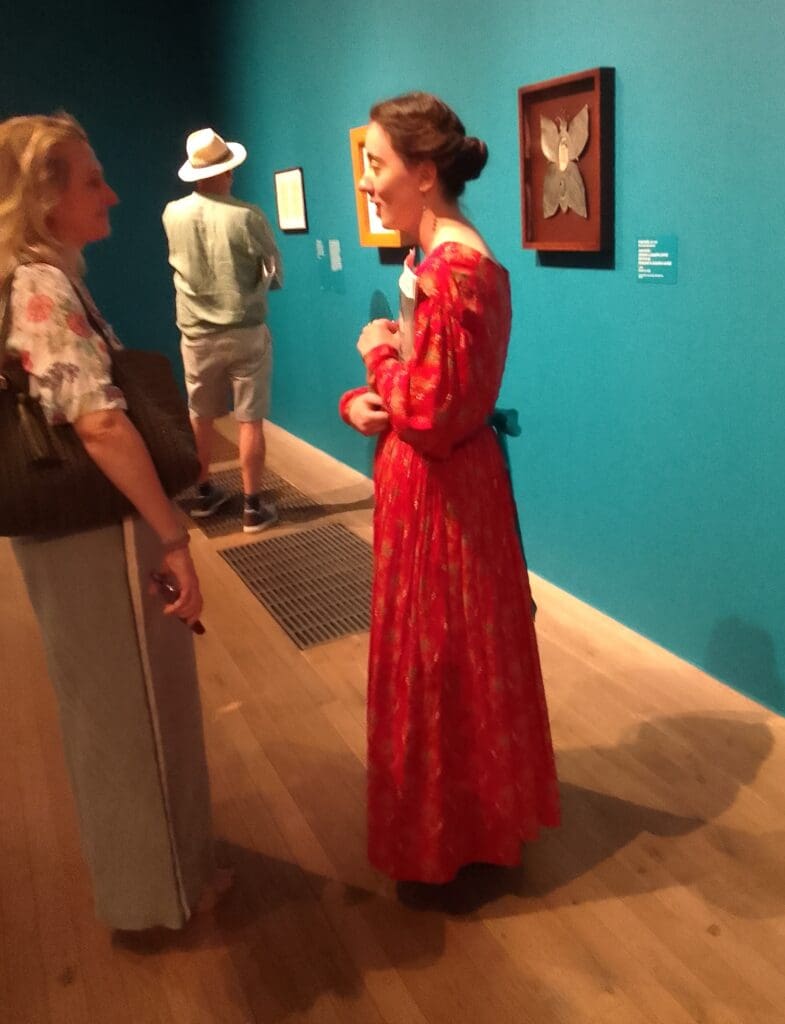
Visitors in the Gallery with the Frida fashion vibe.
Frida: The Making of an Icon is at Tate Modern until January 3, 2027.
