





THREAT / RISK — SECURITY & SAFETY WEEKLY BULLETIN
Brief assessment • Brief Update No 12-1/2026
• Reporting period 29 August – 06 September 2026
In reference to:
- Threat / Risk Security & Safety Assessment — Monthly Report No 12/2026, 30 August 2026
- SEA GUARDIAN Threat / Risk Security Weekly Bulletin No 11-1, 06 Aug 2026 (Week 1)
- SEA GUARDIAN Threat / Risk Security Weekly Bulletin No 11-2, 13 Aug 2026 (Week 2)
- SEA GUARDIAN Threat / Risk Security Weekly Bulletin No 11-3, 20 Aug 2026 (Week-3)
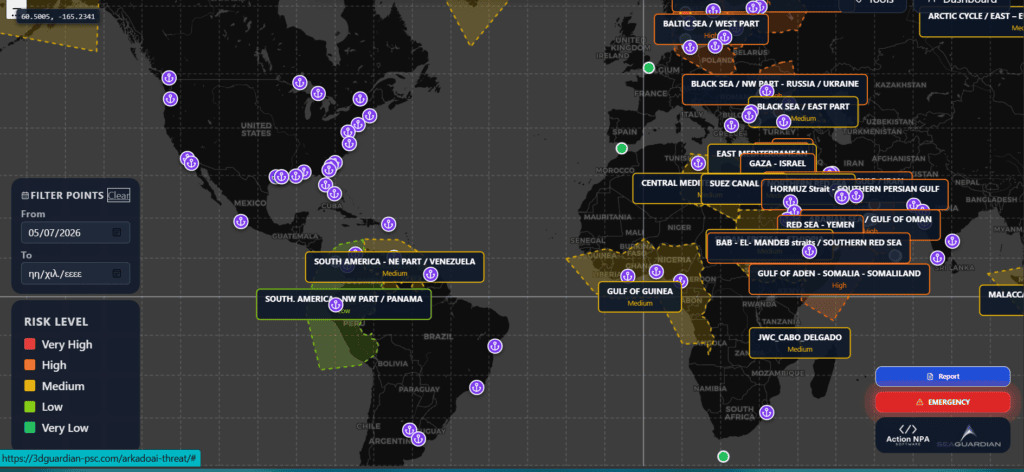
INSIDE — GLOBAL RISK SNAPSHOT
Regional maritime risk remains elevated due to the ongoing conflicts, strategic competition and climate disruption. Key concerns include Red Sea and Horn of Africa instability, renewed Somali piracy, strikes in the Black Sea, heightened US–Iran tensions in the Strait of Hormuz, threats to subsea infrastructure, Russia’s Arctic shipping ambitions, and operational disruptions linked to Panama Canal drought conditions and Singapore haze.
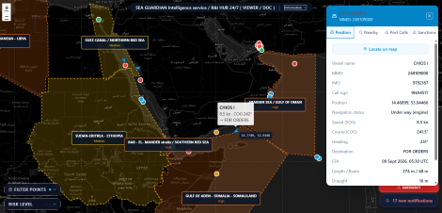
- The most significant maritime-security development is the escalation in the Strait of Hormuz. It is the first time with IRAN in open sources publishing a list of sanctioned vessels threatened to be targeted in case of sailing through Hormuz strait or the Persian Gulf.
ANNEX TO WEEKLY REPORT No 12-1, updated September 06, 2026
- Renewed Somali piracy, highlighted by the seizure and recovery of MV LUTUF, confirms an active threat to merchant shipping off Somalia and reinforces the need for heightened vessel security measures.
- Panama Canal transit reductions caused by drought present a growing operational risk, with likely delays, congestion, draft restrictions and increased freight costs.
CORPORATE CONCLUSIONS
The maritime threat situation is likely to stay high for this week, with the US-Iran dispute in the Strait of Hermes (Hormuz Strait) being the biggest threat driver. Maritime traffic volume continues to be considerably low, while the danger from Iranian activities, mine or attack threats, as well as navigational hindrances continue to pose significant dangers to ships operating in the Gulf region.
The recurrence of Somali piracy is a major threat in the Gulf of Aden, Horn of Africa and the Western Indian Ocean after the MV LUTUF hijacking case, while the Panama Canal drought restrictions are still posing challenges.
THE OBSERVER PERSPECTIVE — COMING WEEK
- The Strait of Hormuz will continue to be the area with the most significant maritime security threats in the coming week due to the presence of US and Iranian forces and the participation in escorts for commercial vessels passing through the region.
- In the waters off Somalia, the MV LUTUF case shows that piracy is a serious threat that will require constant vigilance from merchant ships.
- The Panama Canal limitations will start to become more significant in terms of schedule delays and shipping costs because of the limitation of 34 ships per day, which is set to decline to 32 on September 15th.
SEA GUARDIAN — Overall Conclusions
Political: Saudi Arabia has developed political ties with Sudan due to its strategic interest in the Red Sea, whereas Ethiopia continues to pursue sea access, which could result in heightened regional competition. Unresolved political tensions continue in Guinea-Bissau, Libya, Israel, and the Taiwan Strait.
Economic and Resources Performance / Restraints: The importance of critical minerals, Venezuela’s oil, offshore phosphate mining, and port-logistics development has increased. Governments have been trying to gain greater influence over the supply chain, processing facilities, energy reserves, and maritime trade.
Military / Paramilitary Actions – Terrorism: Military threats exist along the Strait of Hormuz (Hermes), Red Sea, Taiwan, Black Sea, Lebanon, Sudan, and Yemen. The use of missiles, drones, naval, and ground forces could destabilize the regions, critical infrastructure, and merchant shipping activities.
Piracy / Organized Crime / Boarding Conditions: The MV LUTUF attack is indicative of a piracy threat by Somalia in the western Indian Ocean. There could be more such incidents, crew kidnappings, and boardings by force. The ship was released by a coalition of Turkish, US, French, and Somali ships, boats, and personnel, either in exchange for ransom (2 million out of the 10 million the pirates asked for), with the freight supposedly being military and the hijacking on August 17 conditions not clearly defined so far.
Hijacking / Kidnapping & Firing of Small Arms: The case of MV LUTUF highlights how commercial ships can still be hijacked and crews kidnapped in Somalia. Military intervention might be a response to such an event, but prevention methods are necessary. This intervention is not a trend for all hijacking incidents, as this hijacked vessel proved to have military freight.
Transportation Route / Resource Considerations: Hormuz, the Suez Canal, Panama Canal, the Arctic passage, Duqm, Anaklia, and the Nacala Corridor continue to be significant. Drought, conflict, sanctions, investments, infrastructure development, and diversification of transportation routes will impact maritime trade flows, while the development of the Arctic cycle navigation route is heavily reimbursed not only by Russia and China but also by other East Asian states.
GNSS / ECDIS / AIS Electronic Interference – Cyber Attacks: Cyber and hybrid threats are growing; this is especially true in the case of Estonia and the Baltic Sea region. Email filtering, protection of underwater infrastructure, drone defense, and maritime cybersecurity are becoming higher priorities.
Nautical Safety & Environmental Factors: Drought-based restrictions on the Panama Canal, climate-driven infrastructure risks for Mozambique, and seabed phosphate mining plans for Namibia are environmental and safety concerns. Droughts, extreme weather conditions, and environmental risks will affect the maritime industry.
SEA GUARDIAN — Major Observations
Political risks: There is competition in the Red Sea and the Horn of Africa region over Sudan, Ethiopia’s access to the sea, ports, and regional security partnerships, while Somaliland is becoming of high importance for the Horn of Africa.
Military threats: Threats of military conflict are highest in the area of Hormuz, the Red Sea, Yemen, Lebanon, Sudan, Ukraine/Black Sea, and Taiwan, where missile strikes, drones, naval and ground forces are threats to regional stability.
International trade: Energy, mineral, and container shipments remain subject to conflict, sanctions, droughts, and competition over control of strategic supply routes and infrastructure.
Maritime routes: Routes through Hormuz, the Red Sea, Somalia, Panama, Suez, and the Arctic are exposed to multiple risks of conflict, piracy, water scarcity, sanctions, and operational challenges.
Organized crime: The MV LUTUF case confirms increased risk of Somali piracy in the region, involving hijacking of vessels, crew abduction and detention, boarding by force, and potential criminal activity.
Cyber vulnerabilities: Increased risks of cyberattacks and hybrid warfare are compounded by AIS dark sailing and subsea cable risks, requiring advanced maritime surveillance and cyber protection.

Viewers can log here below and read the full report:
