






Long associated with specialised shipping, Luxembourg is now making its way onto the shortlist of Greek commercial shipowners.
By Thierry Zois, Founder & CEO, Stanley Group
When I first started speaking more actively with Greek shipowners about Luxembourg, the reaction was often immediate:
“Luxembourg? A flag?”
Sometimes it was even more direct:
“Luxembourg? For ships?”
It is understandable.
For most people, Luxembourg means banking, investment funds and European finance. It is a landlocked country and certainly not the first jurisdiction that comes to mind when discussing merchant shipping.
But Luxembourg is not new to shipping.
Its public maritime register dates back to 1990 and, over more than three decades, it has developed particular expertise around sophisticated and technically demanding tonnage.
Names such as Jan De Nul, Cobelfret and Bourbon have long been part of Luxembourg’s maritime landscape. Dredgers, offshore vessels, supply vessels and other highly specialised assets have been operating under the flag for years.
That matters.
An administration accustomed to technically complex vessels and demanding international operators develops a particular kind of maritime expertise.
What is changing today is that this same registry is increasingly entering another conversation:
Greek commercial shipping.
The best argument is what owners do next
When SEA CARYATIS, operated by Mediterranean Car-Carriers Line – MCCL – joined the Luxembourg register, it represented an important step into the Greek market.
What interested me more was what happened afterwards.
MCCL did not treat Luxembourg as a one-vessel experiment. SEA PATRIS followed, with the company deciding to extend the Luxembourg flag across its owned fleet.
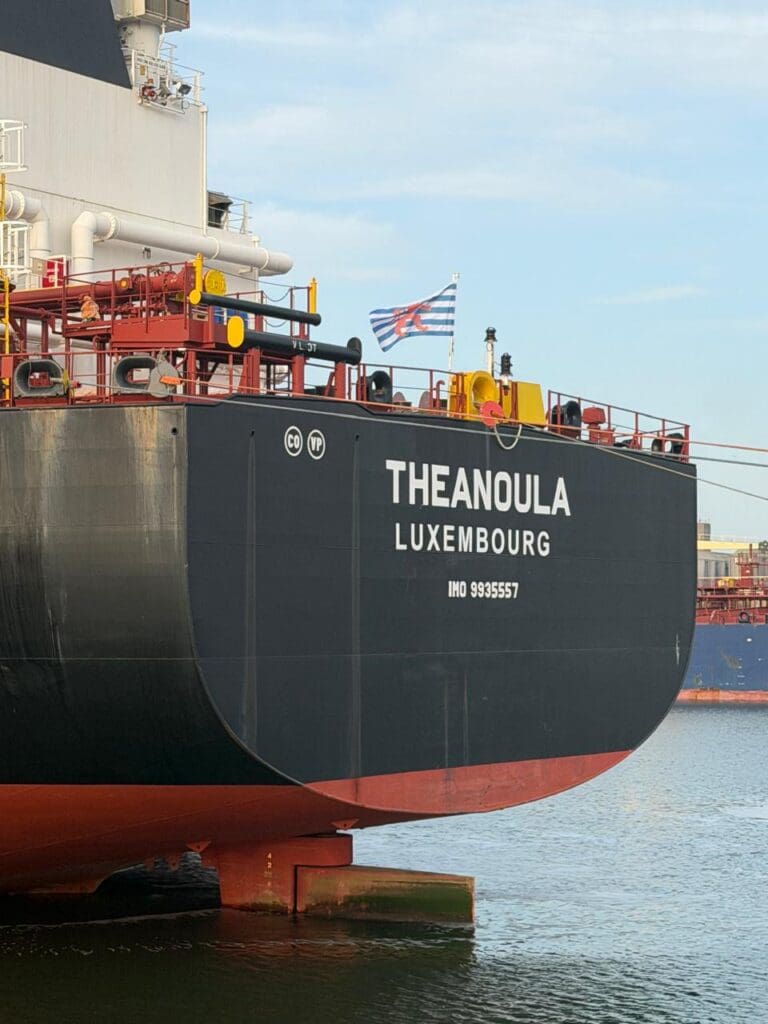
Then came THEANOULA, operated by the Tomasos family’s Super Eco Tankers.
Following their first experience with Luxembourg, a second vessel, ELEKTRA, followed.
And now another segment is entering the picture.
METIS MARU, a 2016-built Ultramax bulk carrier operated by Metis Ship Management, is preparing to join the Luxembourg flag at the beginning of October.
RoRo. Tankers. Dry bulk.
Different owners, different operating models and very different technical requirements.
That progression is more interesting than any headline number.
It suggests that Luxembourg is no longer being considered for one isolated type of vessel or transaction.
It is increasingly being considered simply as a flag option.
What owners actually care about
Shipowners rarely want a long presentation about a registry.
The questions are practical.
How responsive is the administration?
Will the flag work efficiently with the owner’s existing management structure, classification society and financing bank?
And what happens when something urgent goes wrong?
These are the right questions.
A flag is part of the operating infrastructure of a vessel. Its real value is often discovered not when everything is going smoothly, but when the master, technical department, owner or lender suddenly needs an answer.
This is where I believe Luxembourg has one of its strongest advantages.
The Commissariat aux Affaires Maritimes – CAM – remains a comparatively compact administration. Communication is direct. Technical matters reach people capable of dealing with them, and the administration is accessible to owners and their advisers.
In shipping, responsiveness is not a luxury.
Sometimes it is the difference between resolving something today and losing several operational days.
There is no race for tonnage
Perhaps the most important characteristic of the Luxembourg model is the way success is measured.
CAM is not run against a commercial KPI requiring its team to add a predetermined number of ships or millions of gross tonnes to the register.
That changes the dynamic fundamentally.
If success is primarily measured by making a register larger, every prospective vessel is additional tonnage.
If the objective is to protect the standard of the register, every vessel must first be assessed on its merits.
I have seen that distinction first-hand.
And this is where the word quality needs to be properly understood.
Quality does not mean new. Quality means track record.
CAM looks beyond the age of the vessel. It considers its historical performance, the owner, the manager, their existing and previous fleets, Port State Control history, deficiencies, detentions and the wider information available across international maritime databases.
A relatively new vessel operated within a poor-performing structure is not automatically a quality vessel.
Equally, an older eligible vessel, properly maintained and operated by an experienced owner with a strong record, may present an entirely different profile.
The relevant question is not simply:
“How old is the ship?”
It is:
“Who operates it, how have they operated their ships historically, and what does the evidence tell us?”
And CAM is prepared to say no.
I have seen prospective registrations not proceed because the administration was not satisfied with the quality profile.
Those vessels would have increased Luxembourg’s registered tonnage.
The administration was nevertheless prepared to forego it.
For me, that says considerably more about a quality registry than any marketing slogan ever could.
Luxembourg has remained on the Paris MoU White List since 1999 and has ranked within the top ten in each of the two latest performance lists.
For a comparatively compact registry, where even a small number of poor-performing vessels can have a disproportionate impact, that record reinforces the importance of remaining selective.
Now the administration itself is changing
There is another reason why the timing is interesting.
Luxembourg is preparing one of the most significant modernisations of its maritime framework in decades.
The reform currently moving through the legislative process is intended to simplify and centralise the machinery surrounding vessel registration and maritime mortgages.
Among other changes, the direction is to bring the maritime register and mortgage functions closer together within CAM, reduce administrative fragmentation, allow greater use of English-language documentation, digitise processes and facilitate modern ship-financing structures.
For owners and banks, that could be transformational.
A vessel may be delivered in Asia while the financing bank sits in Europe and transaction counsel is working across several time zones.
Shipping does not operate according to the opening hours of an administrative counter.
The ambition is therefore to move towards an infrastructure capable of supporting transactions at shipping speed, including same-day and ultimately out-of-hours – effectively 24/7 – mortgage-registration capability.
For Luxembourg, one of the world’s most established financial centres, the connection between shipping registration and ship finance should be a natural strength.
The proposed reforms can make that relationship considerably more powerful.
Luxembourg needs to be on the shortlist
I do not expect Luxembourg suddenly to become the first flag discussed in every shipowner’s office.
Nor should that be the objective.
Luxembourg does not need to be the biggest registry.
It needs to remain a registry that the right owners want to join – and one that banks, managers, class societies and charterers are comfortable seeing on the stern of a vessel.
That is the opportunity I see between Luxembourg and Greek shipping.
Greece brings one of the world’s deepest concentrations of shipowning entrepreneurship and technical maritime expertise.
Luxembourg brings a stable European jurisdiction, a major international financial centre and a maritime administration small enough to remain accessible and selective.
Being both Luxembourgish and Greek, I see that opportunity from both sides.
And increasingly, I believe Luxembourg’s main challenge in Greece has never really been the substance of its maritime offering.
It has been awareness.
A year ago, many of my conversations started with:
“Luxembourg? A flag?”
Increasingly, they are starting with a very different question:
“Which vessel should we bring first?”
And that, to me, is the clearest sign that the conversation is changing.
