





By James Brewer
“Ah Millet! Millet! How that fellow painted humanity and the ‘something on high’, familiar and yet solemn… to think that that fellow wept as he started painting.” Thus wrote Vincent van Gogh from Saint-Rémy-de-Provence in a letter to his sister Willemien on February 19, 1890.
London’s National Gallery in an engrossing and instructive display, Millet: Life on the Land, helps explain why “that fellow” had such a powerful impact on the Dutch master, whose inner self haunts the chosen exhibition room – which is, appropriately, one might say, Room Number One. The first UK exhibition in nearly 50 years dedicated to Jean-François Millet (1814–1875) presents 15 of his paintings and drawings, mostly from British public collections, and including the National Gallery’s The Winnower from about 1847‒8.
Vincent van Gogh spent much time studying Millet’s biography as well as his artistry. Others to marvel at Millet were Impressionists and Post-Impressionists including Edgar Degas and Camille Pissarro.
Millet recorded unsparing scenes of the rude life of the farmhands of 19th-century France, portraying young men sowing seeds and sawing logs; older men and women gathering tree branches for fuel; and girls as shepherds, gooseherds, and milkmaids. With a deft touch and quiet intensity, he imparted the worthiness that others could not see, but resisted sentimentality: no romanticised mystique, no bucolic idyll; absolutely no frolicking in the fields.

It is poignant on the 150th anniversary of his death to discern Millet’s simply drafted yet sophisticated paintings and drawings, the fruit of his familiarity with farm life. He knew the rural landscape and its denizens intimately: born into a farming family in Normandy, he moved to the village of Barbizon where at the centre of his practice he put the impecunious land-workers. He knew and respected the shabbily but practically clothed men and women. His uncompromising, realistic approach to portraying them was new. It was a new way of understanding them. He perceived the nobility and grandeur of the workers, conferring on them a status usually reserved for prominent personages.
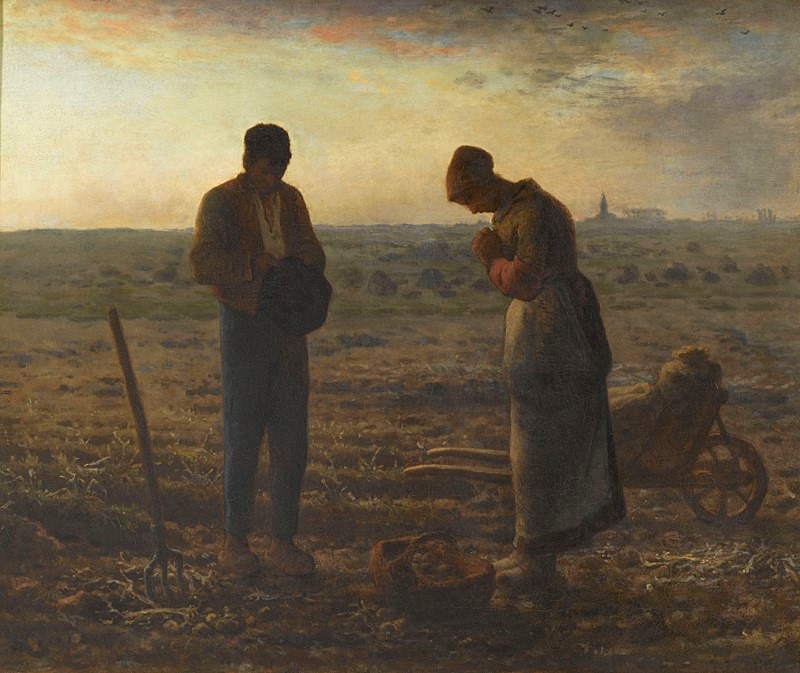
A notable loan from the Musée d’Orsay, Paris, of L’Angélus (1857‒9) is the centrepiece of Millet: Life on the Land and is typical of the dignified way he pictured working people. A husband and wife, their barrow and pitchfork at rest, stand with heads bowed. Silhouetted by an almost ethereal light, they have taken a break from harvesting potatoes to say the Angelus, a prayer and bell-ringing tradition which commemorates the Angel Gabriel’s revelation to the Virgin Mary that she would miraculously bear a son to be named Jesus. The invocation is traditionally recited at dawn, noon and dusk, as Millet remembered from his childhood.
The devotional prayer is conspicuous in the pages of French literature, for instance in Madame Bovary by Gustave Flaubert, published in 1856: “One evening when the window was open, and she [Emma], sitting by it, had been watching Lestiboudois, the sacristan, trimming the hedge, she suddenly heard the Angelus ringing…. In the distance cattle moved about; neither their steps nor their lowing could be heard; and the bell, still ringing through the air, kept up its peaceful lamentation. With this repeated tinkling the thoughts of the young woman lost themselves in old memories of her youth and schooldays… and it was unconsciously that she went towards the church, inclined to no matter what devotions, so that her soul was absorbed and all existence lost in it.” The call rings out too in De l’Angélus de l’aube à l’Angélus du soir (1888-1897) by the pastoral poet Francis Jammes, and Guy de Maupassant’s short story, L’ Angélus in which the ringing of the bell intersperses the anguish of a woman trapped in a cruel marriage.
L’Angélus conveys the stillness of meditation, accentuated by a sunset aura. Originally known as Prayer for the Potato Crop, the painting was commissioned by a prosperous American of Irish descent, Thomas Gold Appleton, possibly stirred by memories of the Irish potato famine. Appleton in the end refused to accept the painting, leading Millet to try to make it more saleable by adding a church tower in the distance and changing the title to The Angelus.
It is hardly surprising that the Musée d’Orsay rarely loans the painting. The piece grew in value as it passed through numerous hands. When Millet died his works were beginning to be eagerly collected, bringing several into public collections in the UK. In the late 19th century, it was the best-known oil painting globally and sold for the considerable sum of 553,000 francs at auction to the American Art Association in New York. Such valuations were remarkable – remember that hard-up artists like Millet used to paint over some pictures because they could not afford to buy new materials. Eventually The Angelus was donated in 1909 to the French state by the collector Alfred Chauchard.
For Salvador Dalí the picture aroused erotic fantasies which informed his surrealist works, as spelled out in a book he wrote in the early 1930s, but was not published until 1963. He found the painting full of unconscious meaning, troubling and enigmatic.
During the 1850s Millet moved to the village of Barbizon in the Fontainebleau Forest, where he became associated with what was known as the Barbizon school of painters, whose emphasis was on realism.
The reality was that the piety of the peasants reconciled them to their unrelenting, cheerless, unrewarding work and the despair of achieving earthly salvation. Any expectations of succour from the French revolutions including those of 1789 and 1848 failed to materialise. No smiles, sunshine is absent. Millet did not challenge the status quo but clearly sympathised with the plight of the workers around him.
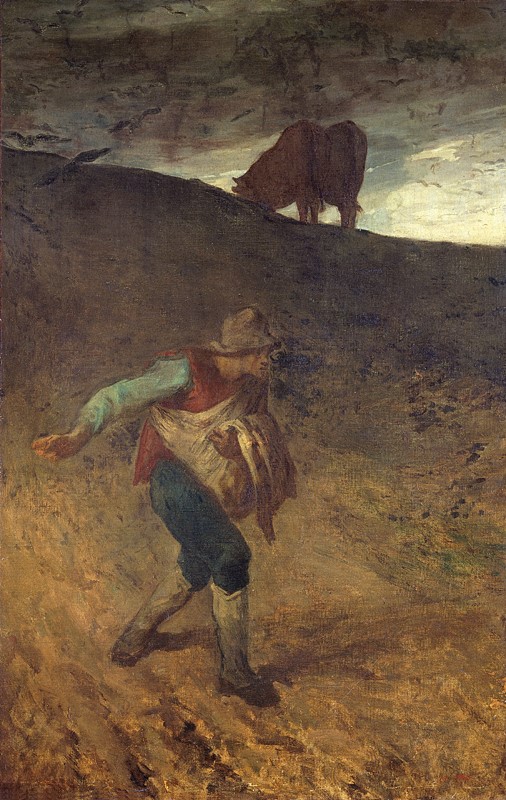
The first section of the exhibition focuses on woodcutting and sowing, including The Sower, of 1847–8, held by the National Museum, Cardiff. The Sower, complete with its eager flocks of birds, had a big influence on Van Gogh who said that “the peasant appears to be painted with the earth that he is sowing.” Vincent had copied the works of Millet many times before, but he aspired to paint his own version of the Sower, a figure he related to in Biblical terms, and he set to work in bright colours on the project in the autumn of 1888.
One of Millet’s first paintings on the theme of rural labour was The Winnower, which was exhibited at the Paris Salon of 1848 where it was well received. Later works shown at the Salon led to discord – between those who adopted such themes for their progressive agendas and those who branded him subversive. The National Gallery acquired The Winnower in 1978.
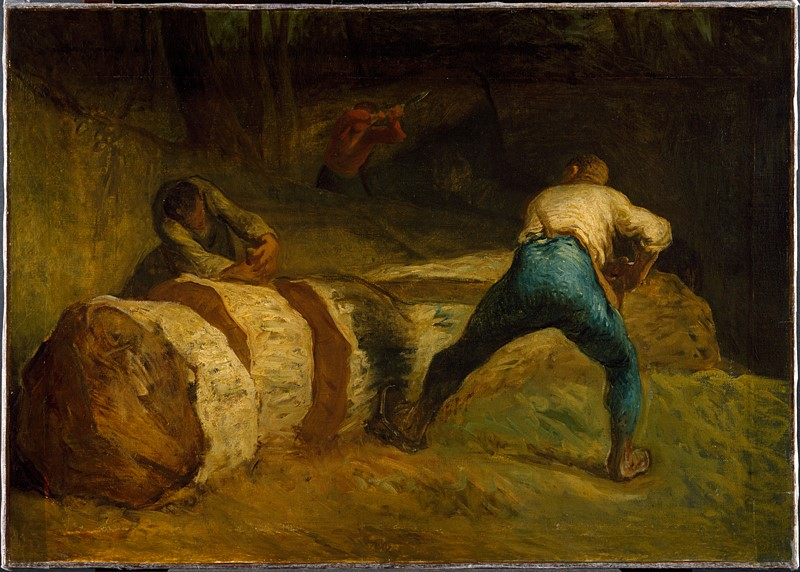
With the Wood Sawyers of 1850–2, bequeathed to the Victoria and Albert Museum by Constantine Alexander Ionides (1833-1900) a London stockbroker and collector of Greek descent, we behold the exertions and contortions of the muscular labourers, especially the man in the foreground. Despite their daily grind, landless woodcutters and other rural workers endured a precarious existence. Of similar lustre are A Man ploughing and another sowing, 1849–52, from the Ashmolean Museum; and Wood choppers, about 1850, of the National Gallery of Scotland.
Especially affecting are paintings and drawings of women at work including The Goose Girl, from 1854‒6, where the landscape shares its high horizon and silhouetted cow with that of the Sower. Millet portrayed peasant girls, sometimes bathing, but mainly as lone figures in charge of their flock. Often a girl would be charged with looking after both geese and sheep.
The Goose Girl is set prominently in a lush landscape. Swathed in layers of clothing, she wearily leans her head on her folded hands, alone with the flock of raucous geese.

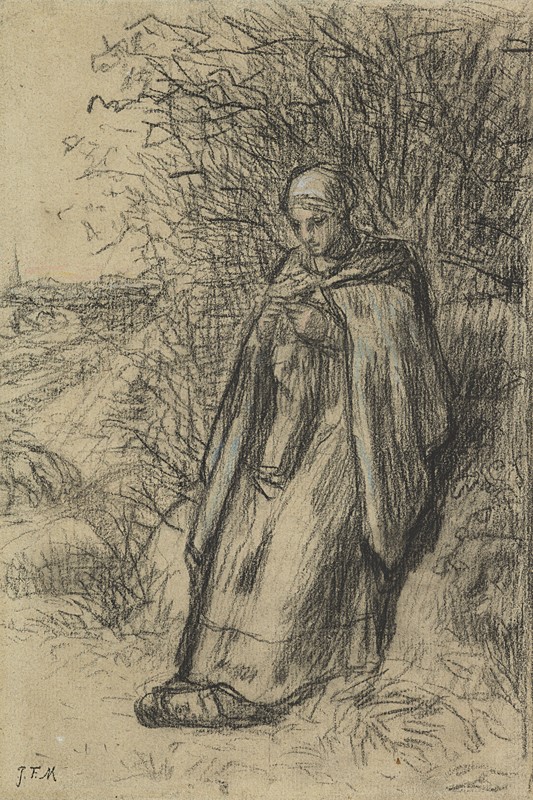
Two drawings of shepherdesses, from the Cooper Gallery (Barnsley) and the Fitzwilliam Museum (Cambridge), are shown together for the first time. The idealistic view of the shepherdess might be that she never ages, but the truth was emphatically otherwise.
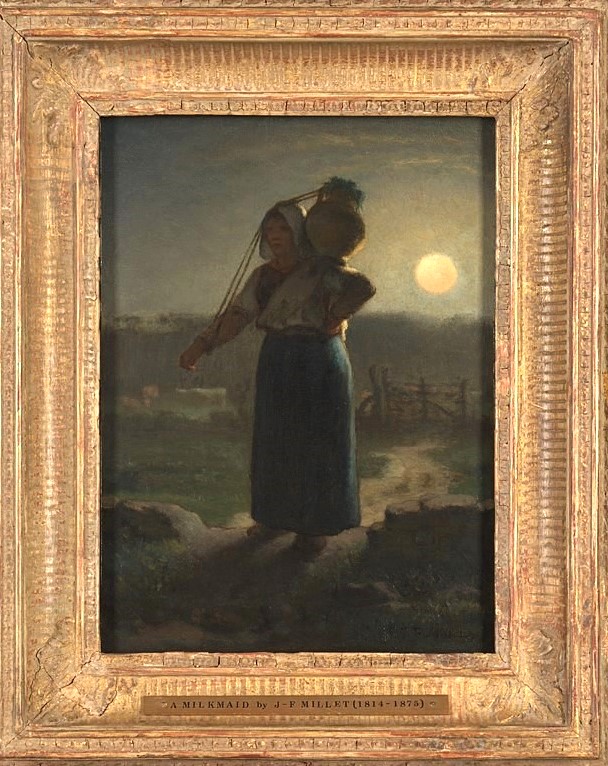
The Milkmaid, from about1853, is loaned by the Barber Institute of Fine Arts, Birmingham. Millet treated this subject many times. A Normandy milkmaid would carry her copper can of milk on one shoulder, held taut by a leather strap around her wrist. The top of the can was stuffed with grasses to protect the liquid. Here she is a dignified and statuesque figure, her silhouette catching the silvery light of the rising moon.
The last section of Millet: Life on the Land highlights wood gathering (including The Faggot Gatherers, 1850‒55, National Gallery of Scotland). Millet was fascinated by the custom of gleaning, the right of poor women and children to collect stalks of grain left in the fields after the harvest. The back-breaking gathering of sticks and twigs for fuel was the lot of vulnerable, often older women. The artist found the theme an eternal one, linked to stories from the Old Testament.
Millet’s last years were spent in Paris, when along with countryside scenes, he turned to views of the sea and cliffs.
Sarah Herring, associate curator of post-1800 paintings, said: “Millet endowed rural labourers with dignity and nobility, depicting them in drawings and paintings with empathy and compassion.” The director of the National Gallery, Sir Gabriele Finaldi, said: “The exceptional loan of L’Angélus, Millet’s most celebrated work, will focus the public’s attention on this fascinating artist – a painter of rural life, who was sometimes accused of being a dangerous anarchist. Salvador Dalí’s obsession with L’Angélus made it even more famous.”
Millet did have a splendid legacy. His life made Vincent see parallels to his own. In 1885, when Vincent was 32, he produced a painting of kindred mien to those of his hero, but its dark aspect and the appearance of the figures in The Potato Eaters was disparaged. Its creation was part of a process, though, and not finale. Van Gogh went back to Millet’s studies and made yet more copies or “translations” of that work. Thankfully, he was to revert to further creations of “life on the land” when he moved to the south of France.
Captions in detail@
The Goose Girl at Gruchy, 1854-56. By Jean-François Millet. Oil on canvas. Lent by Amgueddfa Cymru — Museum Wales. Bequeathed by Gwendoline Davies in 1952.
L’Angélus, 1857- 9. By Jean-François Millet. Oil on canvas. Musée d’Orsay, Paris. © Musée d’Orsay, Dist. Grand Palais Rmn / Patrice Schmidt
The Faggot Gatherers, about 1850-5. By Jean-François Millet. Oil on panel. © National Galleries of Scotland. Accepted in lieu of estate duty by HM Government from the Craigmyle Collection, and allocated to the National Galleries of Scotland, 2020.
A Milkmaid, about 1853. By Jean-François Millet. Oil on canvas. © The Henry Barber Trust, The Barber Institute of Fine Arts, University of Birmingham.
A Shepherdess, about 1856. By Jean-François Millet. Black chalk with touches of blue chalk on pale buff paper. © National Galleries of Scotland. Mr A E Anderson Gift 1929.
The Sower, 1847-8. By Jean-François Millet. Oil on canvas Lent by Amgueddfa Cymru — Museum Wales. Bequeathed by Gwendoline Davies in 1952.
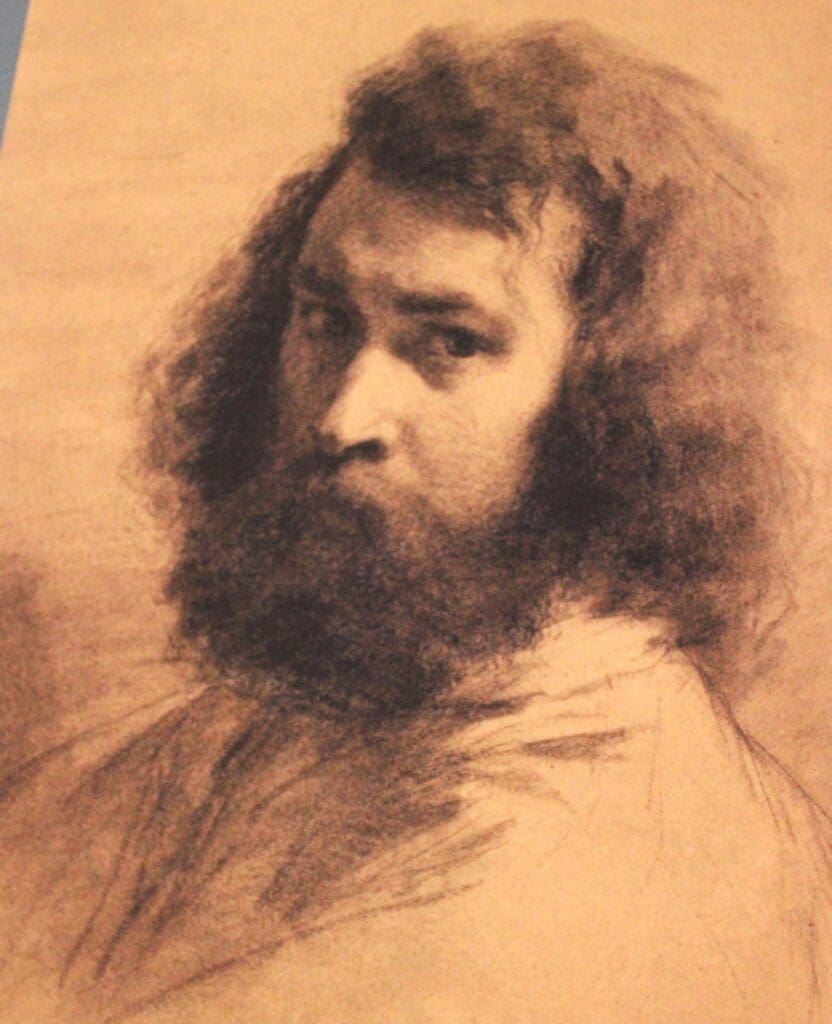
Self-portrait. By Jean-François Millet, undated. Charcoal on grey-blue paper. Grand Palais RMN (Musée d’Orsay, Paris/ Tony Querrec.
The Winnower, about 1847-8. By Jean-François Millet. Oil on canvas. © The National Gallery, London.
The Wood Sawyers, 1850-2. By Jean-François Millet. Oil on canvas. Victoria and Albert Museum, London. Bequeathed by Constantine Alexander Ionides. © V&A Images.
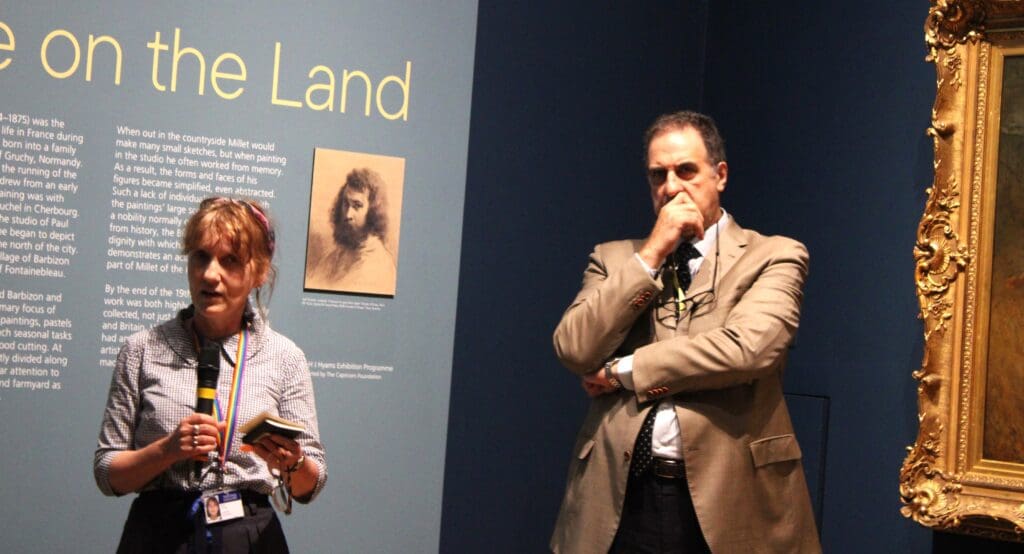
Sarah Herring, curator, and National Gallery director, Sir Gabriele Finaldi.
Millet: Life on the Land is at the National Gallery, London, until October 19, 2025. Free to all visitors.
