





by Prof. Dr. Eng. Evangelos Markopoulos, Visiting Professor in Knowledge Management and Artificial Intelligence, and Senior Fellow at the University of Turku, Faculty of Technology, Department of Mechanical and Materials Engineering, Turku, Finland.
There are moments — and they occur quite often — when one realizes that the tremendous impact of applied knowledge management and its applications across industries does not always originate from academic or industrial research. Instead, it often emerges from the wisdom of people who have spent a lifetime working under challenging conditions that shaped them both as professionals and as human beings.
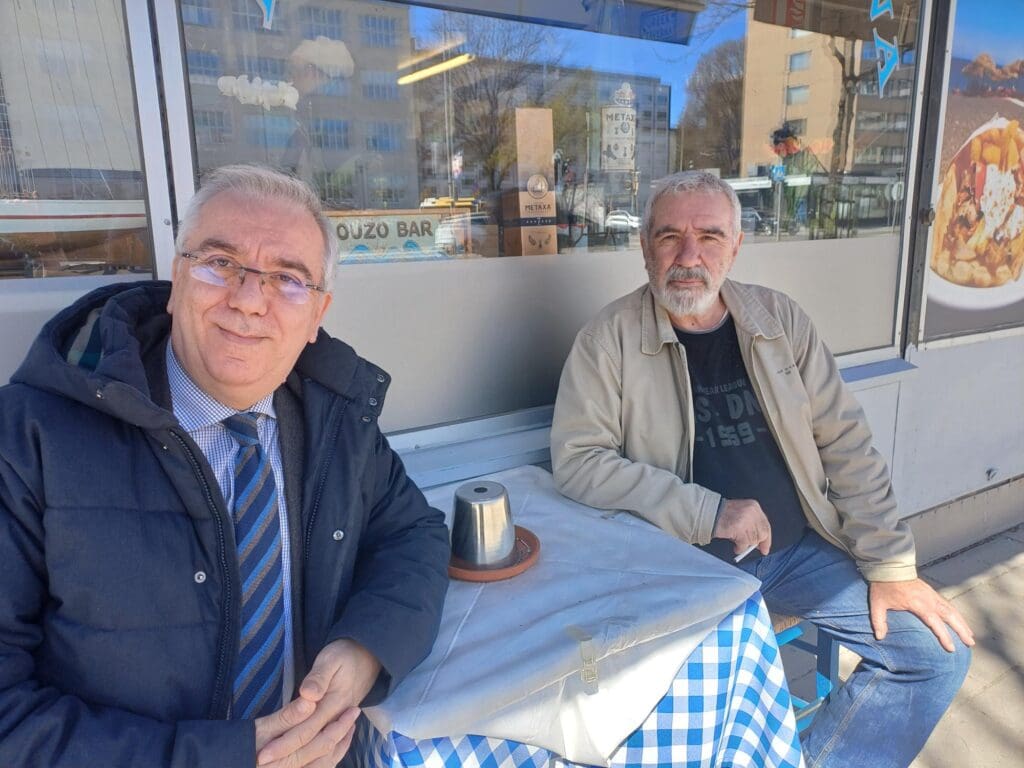
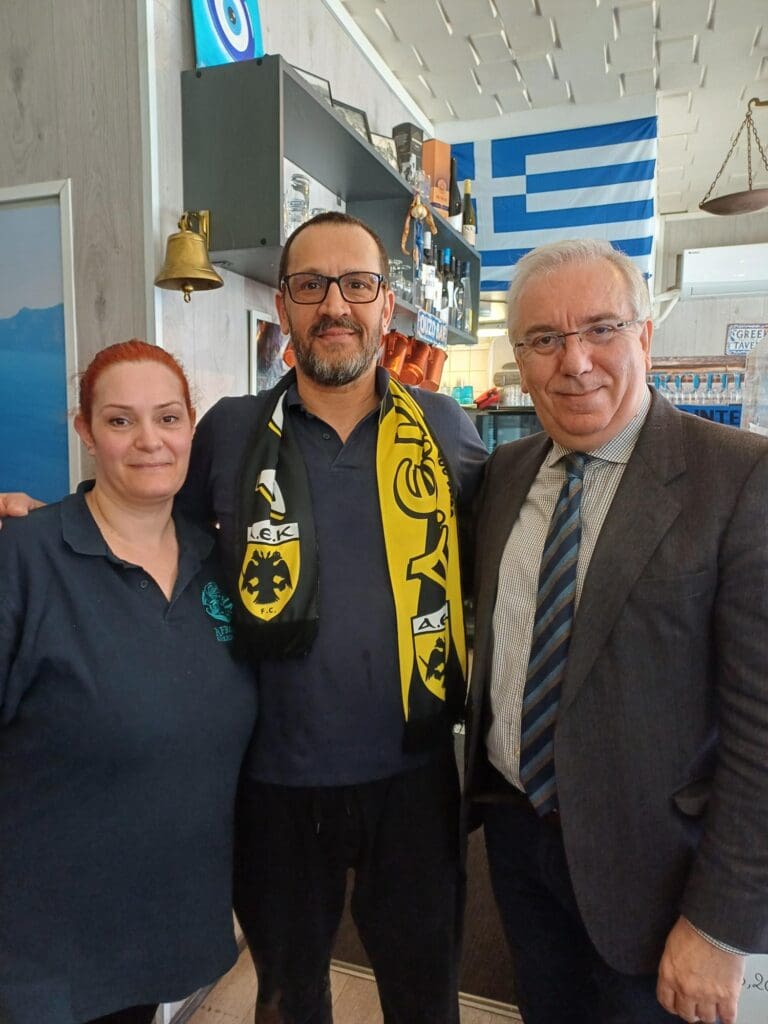
During my recent trip to Finland to deliver a course on Knowledge and Innovation Management, I had the privilege and opportunity to meet Mr. Michalis Kostoulis at AFRODITI TAVERNA, the only Greek restaurant in the city of Turku. What began as a friendly discussion with the wonderful owners of the restaurant Mr Christos and Mrs Eleni, evolved into a significant learning experience when Mr. Kostoulis humbly joined our conversation. His modest yet highly impactful contributions made me realise that organisational knowledge for operational improvement can exist in places we may never expect or even imagine. More importantly, such knowledge can often be translated into valuable insights capable of addressing entirely different organisational problems — many of them highly critical.
Due to my past experience and research in knowledge management within the maritime sector, I naturally focused much of the discussion on the use of AI and futuristic interactive technologies (VR, AR, Metaverse, Digital Twins) to better understand human behaviour aboard vessels. The objective of this work has been to predict potential human errors, operational risks, uncertainties in execution, decision-making limitations, and failures in critical thinking.
Over the years, I have worked extensively with eye-tracking technologies to analyse the state of mind of operators by studying what individuals observe, for how long, and what actions they perform before and after visual interaction with critical operational elements. In parallel, I also worked with hand-tracking, finger-tracking, and other sensor-based technologies to correlate visual attention with body movement and behavioural responses. The purpose was to better understand which environmental elements influence people to act in particular ways when making decisions or executing operational tasks — correctly or incorrectly.
Many of my published papers explore these areas in depth, several of which have received awards and international recognition. This work has contributed to my practical and academic credibility in the fields of knowledge management, human behaviour analysis, and maritime and shipping operations.
My discussion with Mr. Michalis Kostoulis, however, made me reconsider much of my overall work on knowledge elicitation, analysis, and utilization. I realized that while I have spent years trying to improve vessel operations by understanding human behaviour, I had overlooked an important reality: there are often deeper and much simpler factors that shape why people behave the way they do.
My research has focused extensively on understanding behavioural patterns through advanced technologies and AI-driven systems. I worked intensively with eye-tracking technologies to analyse the state of mind of crew members during operational activities, examining what they look at, for how long, and how they react before and after taking decisions or executing actions. I also explored hand tracking, finger tracking, and other sensor-based technologies to connect visual attention with body movement in order to understand how environmental conditions influence human actions, critical thinking, and operational decision-making.
This work, particularly within maritime operations and shipping management, has been part of several of my publications, including award-winning research papers that contributed to my recognition in the fields of knowledge management and human behaviour analysis in high-risk operational environments.
Despite this extensive work, my discussion with Mr. Kostoulis revealed something remarkably simple, yet profoundly important. I had always been aware that seafarers face difficult conditions: long periods away from their families, limited communication, isolation, operational pressure, fatigue, and psychological stress. However, I had never fully considered how fundamental the quality of food onboard can be to their physical and mental balance.
Mr. Kostoulis, who served for many years as a head cook and travelled extensively around the world, explained in simple but powerful terms that good food calms people down, while bad food intensifies tension and frustration. Even when seafarers face personal struggles and demanding operational workloads, a good meal helps them emotionally reset, relax, and return to their duties in a more balanced psychological state. In contrast, poor-quality food worsens stress and frustration because there are no alternative dining options onboard and no possibility to “escape” the environment.
What fascinated me most was the realization that such a seemingly simple factor can significantly influence operational safety. The frustration deriving from consistently poor meals can contribute to emotional instability, poor concentration, reduced patience, and ultimately increase the likelihood of operational mistakes, unsafe decisions, conflicts, or accidents onboard vessels.
This was a perspective I had never fully appreciated before. What I learned from this experience is that complexity often derives from simplicity. For years, I attempted to solve highly complex operational problems through advanced technologies designed to analyse and predict human behaviour, yet I had not sufficiently considered that many of the causes behind those behaviours may originate from simple everyday human experiences. Something as basic as a good meal may influence far more than we imagine.
This realization reshaped my thinking on knowledge management and knowledge elicitation. Researchers often search for sophisticated answers in complex systems while overlooking the practical wisdom of people who have spent decades living and working within those systems. True operational knowledge does not always emerge from laboratories, models, or algorithms. Very often, it comes from lived experience, observation, and human wisdom developed through years of practice under difficult conditions.
I strongly believe that researchers across all disciplines should spend more time identifying and understanding this form of wisdom. However, to achieve this, we must first recognize that wise individuals are often overlooked—not because they are difficult to find, but because researchers themselves are not always wise enough to see them, value them, and communicate with them properly.
I would therefore like to wholeheartedly thank Mr. Michalis Kostoulis for the wonderful discussion we had and for the wisdom he shared with me, which has significantly influenced my thinking and perspective. I would also like to thank the owners, Mr. Christos and Mrs Eleni of the authentic Greek restaurant ‘AFRODITI TAVERNA’ for patiently allowing us to engage in such a meaningful discussion during an extremely busy evening, when the restaurant was full and people were queuing outside to enjoy their wonderful food and hospitality.


