





Brief Update: No 13/2026 Date: September 30, 2026
- This document has been approved for distribution by SEA GUARDIAN S.G. Ltd / Intelligence & Analysis Department. The provided Information and Intelligence derives from open sources, the Institute for the Study of War (ISW), the Joint Maritime Information Center (JMIC) and the United Kingdom Maritime Trade Operations (UKMTO) respective Web Pages. Additional products retrofit the company’s Strategic/Operational and Security situational awareness process for threat and risk assessment impacting Maritime Security in multiple areas. All rights reserved, “no part of this risk assessment may be reproduced in any form (electronic, mechanical, paper, or other means) without written permission by SEA GUARDIAN S.G. Ltd, which maintains the rights for personal data of the document writers”. Under no circumstances can SEA GUARDIAN S.G. Ltd be held responsible for any loss or damage caused by a reader’s reliance on information obtained by this assessment, especially on its firms, company’s management, or individual decision-making.
| Objectives |
- To provide the maritime industry and security stake or shareholders in a monthly cycle, with:
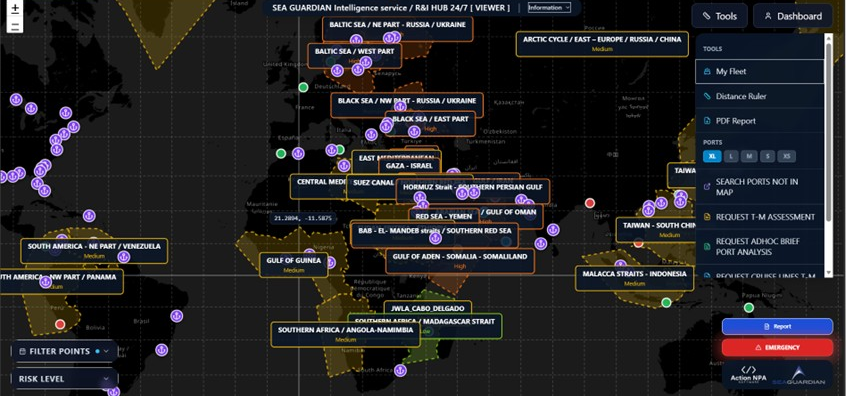
| Major maritime security incident summary and analysis in Geo-strategic frame for Operational Security and NAVIGATIONAL SAFETY of Shipping for the period AUGUST 29 – SEPTEMBER 29, 2026. Assessment updates concerning military operations – terrorism – piracy and cargo theft, hijacking and detentions, smuggling, stowaways, ships fired, crew losses and cyber-threats, covering a wide spectrum of threats/risks from Maritime Security to Navigational Safety. |
- SEA GUARDIAN, pursues innovative approach by analyzing Maritime Security in accordance with international standards and a certain frame of Geo-policy, establishing synergy with a subject matter expert (SME) entity for Cyber-defense including the most important sectors of policy, methods and training to mitigate cyber threats and risks.
Important notes:
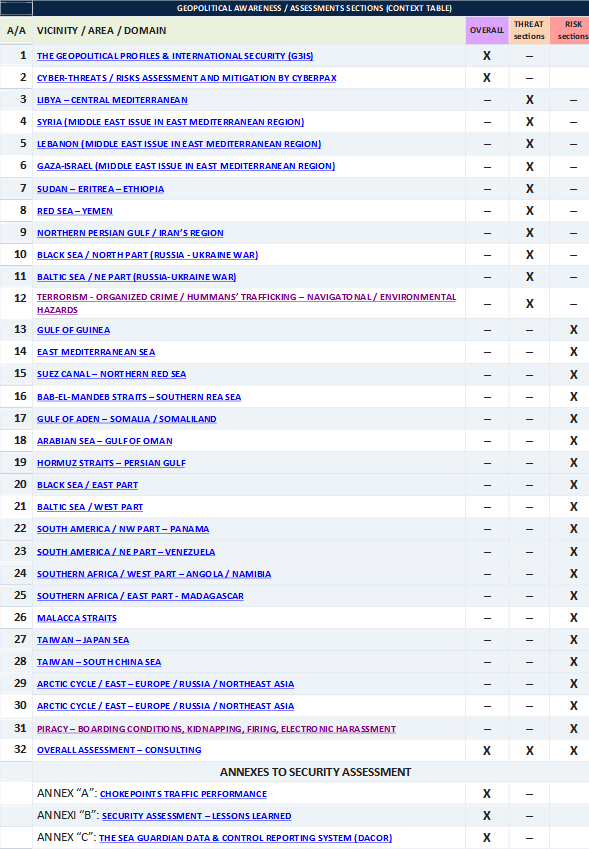
- The Assessment is produced by the R&I team in a global approach covering 27 different maritime regions in total, offering to readers the opportunity to study it as a whole, or focusing on areas of interest through the context table.
- You can navigate directly to:
Terrorism – organized crime / hummans’ trafficking – navigatonal / environmental hazards
- Terrorism: Risks from missiles, drones, and attacks by armed groups remain high globally. The major threats at sea include activities of the Houthis near Bab al-Mandeb, Iran-US tensions in the Hormuz Strait region, the Russia-Ukraine conflict in the Black Sea and the Baltic, and China’s pressure near Taiwan.
- Organized Crime / Human Trafficking: Weak governance and conflict situations are continuing to allow smuggling, trafficking and stowaways, especially in Libya, Yemen, Sudan, Haiti and the Horn of Africa. Ferry terminals in Europe are also vulnerable to risks related to migrant access, cargo security and cyber threats.
- Navigational / Environmental Hazards: Military activity is likely to impact shipping routes and ports in the Hormuz, Bab al-Mandeb, Taiwan, and eastern Mediterranean regions. Smoke in Singapore and extreme weather due to climate change will affect navigability.
Piracy – Boarding conditions, kidnapping, firing, electronic harassment
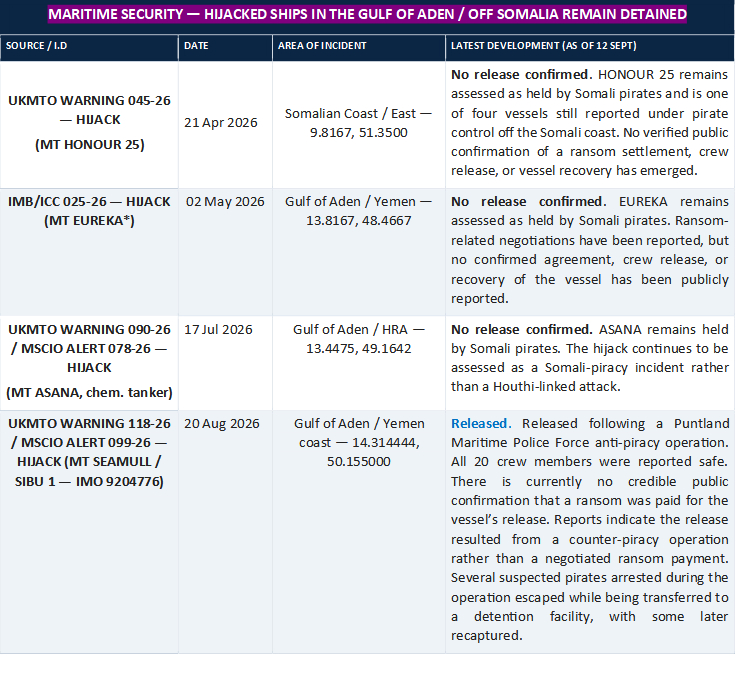
- Threats to maritime security persist at a high level due to conflict, piracy, hybrid attacks, cyber threats, and pressure in strategic chokepoints. Somali piracy has returned; the release of MV LUTUF, MV SWARD and MT SIBU 1 following long periods of being held for ransom, indicates that piracy continues to be a risk for crews and vessels, along with other vessels and seafarers still being in captivity.
- Cyber and navigational resilience are crucial factors. The Baltic countries are reinforcing defenses against Russian cyber-attacks, drones, GNSS, and submarine cable systems, while demands from Iran to attack underwater cables near Hormuz illustrate the vulnerability of maritime communications infrastructure.
- Migrant and stowaway threats at ferry terminals and Mediterranean ports necessitate strict procedures for port and vehicle security.
- Vessels must retain enhanced vigilance, anti-piracy and access controls, independent GNSS/AIS verification, secure communications, and dynamic route planning alternatives.
Overall Assessment – Consulting
- Diplomatic tensions: The hot spots of diplomatic contradictions are the Strait of Hormuz, the Red Sea, Taiwan, the Baltic, and the Arctic, with increasing military cooperation and rivalry for maritime strategic access and energy pathways.
- Political instability: The ongoing fighting and unstable governments in Yemen, Sudan, Libya, Lebanon, Syria and parts of Africa raise concerns regarding spillover into different regions, displacement, terrorist threats and disruption of strategic transportation networks.
- International trade: Trade in supplies of energy, critical minerals, and rare earths is increasingly being disrupted by sanctions, wars, and criminality at sea. Alternative sea routes such as the Arctic and the Middle Corridor gain significance, but the implementation of planning for new land alternative routes is a solution for the future.
- Maritime trade: Ships remain under threat of missile and drone attacks, military interference, piracy, and restricted access to routes like the Strait of Hormuz, Bab al-Mandeb, the Gulf of Aden, and the Black Sea. Shipping is slowly recovering in some areas like the Suez and Bab al-Mandeb. The weaponization of international shipping during conflict periods is a fact that will last a significantperiod, while the normalization of international trade will appear again when USA, China and Russia will found new balances in a multipolar world.
- Overall assessment:
- The maritime security environment remains HIGH RISK, particularly around Hormuz, Bab al-Mandab, the Gulf of Aden, Black Sea, Baltic and conflict-affected waters. Missile/drone attacks, military activity, piracy and regional instability may cause sudden disruption, delays or diversions.
- NAVIGATIONAL AIDS HAZARDS: GNSS/AIS interference, communications disruption, military activity and changes to maritime routes may affect safe navigation. Vessels should maintain enhanced bridge watch, independently verify position and cross-check GNSS/AIS with radar, ECDIS and official navigational warnings
- Shipping companies should conduct voyage-specific security assessments, maintain diversion/emergency plans and continuously monitor maritime-security developments before and during transit.
Overall consulting:
- A Voyage-Specific Security Clearance will be necessary for any high-risk transit, including the Strait of Hormuz, Red Sea, Bab al-Mandeb, Gulf of Aden, Somali Basin, and the Black Sea. Factors to consider include current threat intelligence and assessment, vessel/cargo characteristics, vulnerability of the crew, port security, insurance, sanctions, navigation risks, and rerouting.
- The Master should maintain the right to delay, divert, suspend, or cancel operations in case residual risk exceeds company risk tolerance. Maintain increased bridge and security watches, engines and rudder ready, rapid reporting, and intelligence monitoring. Report to UKMTO, MSCHOA, and relevant authorities as applicable.
- Double-check GNSS/AIS information against radar, visual, chart, gyro, dead reckoning, and other independent sources. Implement cybersecurity protections, secure communication, strict access controls, anti-piracy and stowaway measures, and port/agent arrangements verification.
Future Outlook
Looking Ahead,
SEA GUARDIAN is committed to further enhancing the digital capabilities and expanding service offerings. The focus remains steady on leveraging data analytics to drive personalized customer experiences and explore new market opportunities. There is confidence that SEA GUARDIAN strategic initiatives will support our partners for sustained growth and successful decision making. Digital, Control & Reporting System – DACOR, digitalizes the maritime security environment in harmonization with new equipment, training updates, and synergies with the cyber sector, in order to provide a holistic physical and digital security environment with supplementary function to the available networking systems of control, intelligence, and share maritime situational awareness, to better assess risk management studies.
Partners (shipping companies) willing to experience the DACOR system for a 10day free of charge trial should communicate with SEA GUARDIAN for a user name and password.
Copyright and Confidentiality
This document has been generated by processed information (intel) which in-house SEA GUARDIAN database and algorithms produces in near-real time with SEA GUARDIAN R&I team mankind staffing-work and it is a service to partners with SEA GUARDIAN. Intellectual property is provided as service for specific clients and reasons, prohibited to be distributed outside the frame of its company without a written consent of SEA GUARDIAN in accordance with GDPR rules.
Sea Guardian S.G. Ltd / Intel Department (www.sguardian.com / +30 6944373465) can support your operational planning, assist in determining the risk assessment and aid in decision making by producing tailor-made assessments upon request on ports in the region, on routes, on cargos and specific merchant vessels. You can refer to our previous Threat & Risk assessment analysis briefs for more information and background analysis on the events and situation for each specific region.
_____
Viewers can read here the full report.
Viewers can also see and read here below last month’s report:
