





By Emma Collier, Founder and Partner, Strategy & Ventures at Further & Further
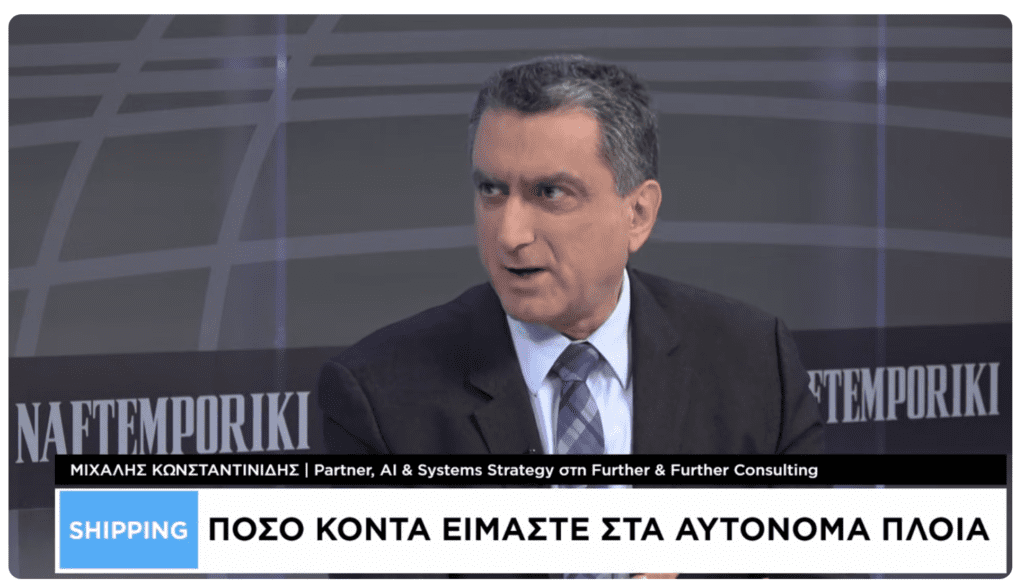
Mike Konstantinidis, my partner in AI & Systems Strategy at Further & Further, was on NaftemporikiTV yesterday discussing the need for AI strategy in maritime leadership.
It’s the first time I’ve seen Further & Further out in the world like this and I’ll admit to a bright moment of all-encompassing, semi-irrational joy as I watched it.
The conversation explores AI adoption in maritime and the geopolitical sensitivities that come with most AI companies being US-based, with countries that aren’t traditional allies already seeking alternatives and ways to protect their data. Unlike the common narrative, he doesn’t position Greek shipowners as behind either and places them surprisingly ahead in considering digital transformation a competitive advantage. Greek shipping leads because it is a culture of calculated risk-taking with adaptability as identity rather than afterthought. This is just another arena where that entrepreneurial instinct applies.
Shipping, he points out, has a particular advantage right now: vast amounts of data scattered across formats and locations, and where traditional IT required organization before utility, AI can work with the mess, understand it, process it, make it actionable. Mike calls this rationalizing decision-making: real data rather than assumptions, because wrong decisions across the industry so often trace back to incorrect inputs.
The 95% of AI pilots delivering no measurable ROI in this well-known MIT study we’ve all heard about? Run in isolation, disconnected from systems people actually use, without plans for long-term implementation. Executives leaving it to their employees to figure out how to implement AI with minimal guidance, rationale, or investment in change management. Imagine feeling like you’re engineering your own replacement. How ambitious would that make you?
These are consequences of action without strategy.
AI isn’t just another tool. It’s a strategic hire for your business. You need to know why you’re hiring someone and what you want them to do better for the company than it is currently being done. There’s an orientation process. You introduce them to the team, walk them through your systems, tell them who to report to and support. They’re socialized into their role and monitored. Access to all the company’s most sensitive data isn’t immediately handed over. It builds over time. Trust comes from results, and results build confidence.
Mike borrows an old adage that works well here: we are only old when we stop learning new things, refuse to admit their necessity. Treating AI as peripheral rather than strategic is the choice that will age you.
Humans still make the decisions. AI is our tireless assistant. That’s what we’re hiring it for.
Link to the episode: https://www.youtube.com/watch?v=iCnrSRXu9OE
