





BRIEF TAILOR-MADE ASSESSMENT
REGION: Baltic Sea
Reference: This is not a Joint War Committee area
Issue date: Thursday, March 12 12:00GMT, 2026
Source: SEA GUARDIAN Security Assessment and DaCoR system (Data Control & Reporting system providing near-real time information / you could follow up by log-in upon request)
Geopolitical Situation
- The Baltic Sea remains a high-risk maritime area due to tensions between Russia-NATO and the activities of the shadow fleet. Interception of the Baltic Spirit was one of the most significant incidents, which could have escalated tensions, as the crew was entirely Russian shipmen. At the same time, the conflict between Ukraine and Russia continues, with stalled US-mediated peace talks and Russian airstrikes on Ukraine, including attacks on Odesa’s power infrastructure, serving as an example.
- The NATO Defense Ministerial spring summit is not expected to ease tensions. Any factors contributing to de-escalation are more related to the end of the war and the atrocities committed during ship detentions, than to any new NATO decisions to increase involvement in the crisis.
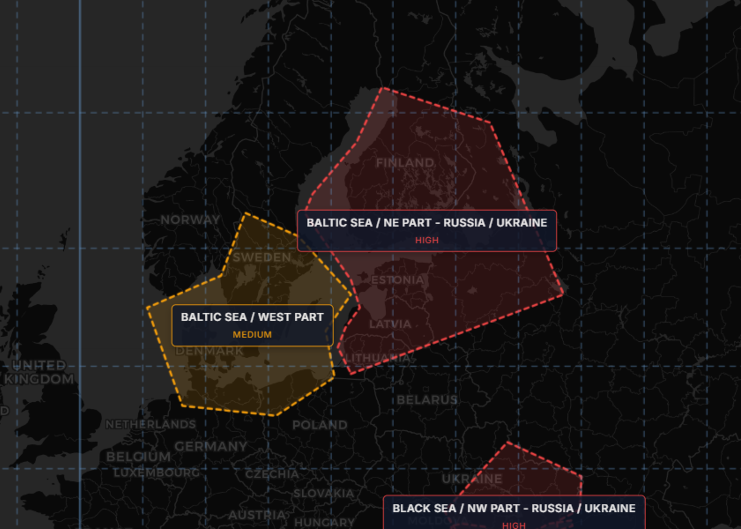
- In response, NATO is advancing Task Force X Baltic to strengthen intelligence, surveillance, and multidomain naval capabilities through closer allied and industry cooperation, incorporating lessons learned from recent regional incidents.
- Lately, there has been a strong effort by Finland and Sweden to execute intense operations for Grey/shadow fleet detentions, which could escalate tension between Russia and NATO, while Russia implements its plan to position extra special officers onboard its vessels related to its security and intelligence services.
- Recent -Key Developments
- Monday, 2 March, 2026: According to information collected by RTBF from several sources, Belgium seized the oil tanker ETHERA during the night. The 180‑meter ship, built in 2008 and sailing under the flag of Guinea, was arriving from the English Channel. It was intercepted off the coast of Ostend and first held at sea and then escorted to Zeebrugge, where it was seized. BALTIC SEA / WEST part TRANSPORTATION ROUTES AND RESOURCES
- Monday, 9 March 2026: The Swedish Prosecution Authority announced on Monday that the Russian captain of a vessel seized in the Baltic Sea Friday, 6 March 2026, has been arrested on suspicion of using false documents, as well as violating Sweden’s Maritime Act and Ship Safety Act. The Swedish Coast Guard announced it had boarded a Russian false-flag vessel in Swedish territorial waters as part of “Operation Black Coffee.” The cargo ship CAFFA was sailing under the Guinean flag when it was boarded off the coast of Trelleborg, a town in southern Sweden. According to Svenska Dagblaget, the captain of the vessel has been in custody since last Saturday. BALTIC SEA / WEST part TRANSPORTATION ROUTES AND RESOURCE
Wednesday, 11 March 2026: A new investigation by the Organized Crime / Corruption Reporting Project (OCCRP) and partner news organizations have found that Russia is placing seamen with military and intelligence background aboard oil tankers used to transport sanctioned crude through the Baltic Sea. Reporters analyzed crew lists from 20 tanker voyages and found that vessels leaving Russian Baltic ports often carried two additional Russian seamen listed as “supernumeraries,” meaning they are not part of the standard operating crew. Of the 17 Russian seamen identified without maritime credentials, at least 13 were linked to security organizations such as the Wagner Group, Russian paratrooper units, or the GRU, Russia’s military intelligence service. BALTIC SEA / NE part // RUSSIA – UKRAINE side-war MILITARY / PARAMILITARY ACTIONS – TERRORISM
BALTIC SEA / NE PART – RUSSIA / UKRAINE
Risk Level: HIGH
Last Updated: Mar 9, 2026 at 12:07 UTC
Most Important Threat
Military/Paramilitary Actions – Terrorism and GNSS/GPS Interference
Assessment
Operational Advice: Maintain heightened vigilance near enforcement zones and politically sensitive waters. Ensure navigation and communication systems are fully operational. Use contingency routing to avoid conflict-prone or high-surveillance areas. Summary: Baltic Sea operations carry high maritime risk, especially near enforcement zones and sensitive areas. Strict precautions and situational awareness are essential for safe transit.
Consultancy
1) Underwriting & Insurance • Expect elevated war-risk premiums due to NATO-Russia tensions and sanctions enforcement. • Negotiation leverage: Emphasize NSR piracy and planned risk mitigations (AIS discipline, restricted routes) to control premium costs. • Policy coverage: Ensure explicit inclusion of military action, sanctions enforcement, hybrid threats, GNSS interference, and demurrage extensions for inspection or seizure-related delays.
2) Security Guards • Embarked armed security recommended for high-value cargoes or vessels under risk-sensitive flags. • Operational measures: Enhanced bridge watchkeeping, strict AIS compliance, and avoidance of high-risk shadow fleet zones. • Port-side coordination: Consider advisory security only if inspections or enforcement risks spike.
3) Demurrage & Delay Risk Mitigation • Contracts: Include war-risk, sanctions enforcement, and hybrid threat clauses. • Operations: Minimize port stays, pre-clear documentation, and maintain alternative ports/routes.
Threat Category Breakdown
Military / Terrorism: 39.0%
Piracy / Brigandage: 0.0%
Hijacking / Life Loss: 22.0%
GNSS / GPS Interference: 39.0%
BALTIC SEA / WEST PART
Risk Level: MEDIUM
Last Updated: Mar 9, 2026 at 12:07 UTC
Most Important Threat
GNSS/GPS Interference
Assessment
Operational Advice: Maintain heightened vigilance throughout transit. Ensure GNSS and navigation backup systems are fully operational. Monitor shadow fleet movements and regional maritime notices. Plan contingency routes to avoid congested or high-risk corridors. Summary: Baltic Sea waters carry a medium maritime risk, primarily due to GNSS interference and hybrid threats. Operational vigilance and robust navigation measures are essential for safe passage.
Consultancy
1) Underwriting & Insurance • Expect moderate premiums due to high GNSS interference and hybrid/shadow fleet risks. • Negotiation leverage: Highlight low piracy and hijacking risk to limit war-risk surcharges. • Policy coverage: Include GNSS interference, hybrid threat disruptions, and operational delays, with optional demurrage protection for inspections, rerouting, or operational pauses.
2) Security Guards • Embarked armed security not required; hijacking risk is low. • Operational measures: Maintain vigilant bridge watch, AIS discipline, and avoid congested shadow fleet areas. • Compliance: Align with flag state and P&I Club guidance for hybrid-threat regions.
3) Demurrage & Delay Risk Mitigation • Contracts: Include clauses covering GNSS interference and operational delays. • Operations: Pre-clear documentation, maintain alternative routes, and minimize anchorage near high-risk or congested areas.
Threat Category Breakdown
Military / Terrorism: 0.0%
Piracy / Brigandage: 0.0%
Hijacking / Life Loss: 20.0%
GNSS / GPS Interference: 80.0%
Overall assessment and consulting
- There is a situation where hybrid threats and GNSS are of utmost importance, while Russian expansion using special intelligence personnel onboard merchant vessels could create significant implications for bilateral relations between Russia and the Nordic States.
- SEA GUARDIAN advises shipping to take measures against any sudden rise in political tensions, as well as to focus on safety conditions, such as GNSS interference and internationally recognized certifications, to avoid being involved in any situation that could lead to inspections and detentions.
CY: +357 25 351125 | GR: +30 210 9703322 info@sguardian.com | www.sguardian.com
Sea Guardian SG Ltd Intel & Security
