





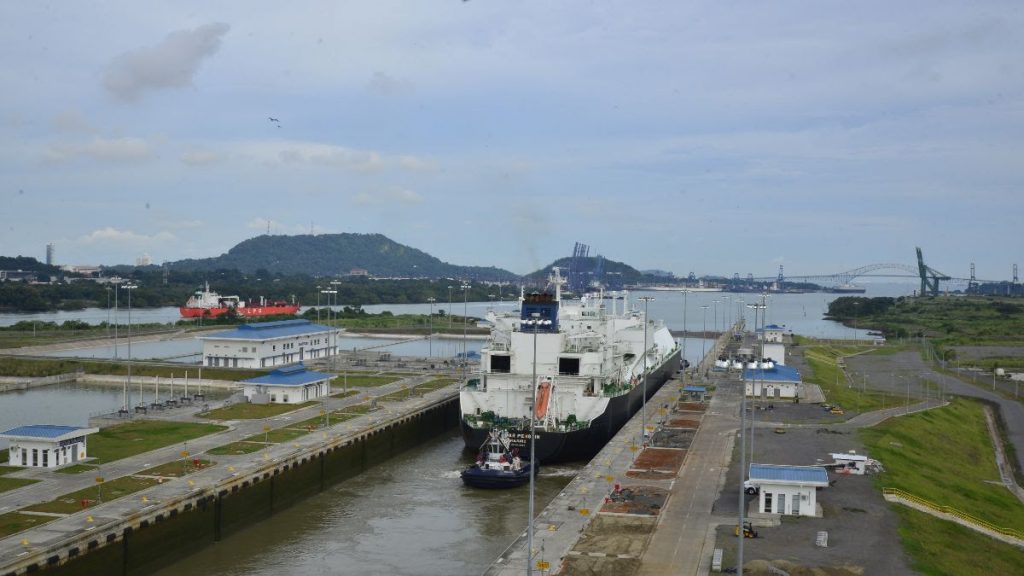
Operations Continue to Run Efficiently and Without Congestion
Panama City, April 22, 2026.- The Panama Canal recorded an increase in transits and tonnage during the first half of Fiscal Year 2026, along with greater demand for its reservation system, reflecting the evolving dynamics of international maritime trade.
These developments were shared during a market update hosted by Anna Milne, Managing Director of Emerging Markets Corporate Research at Bank of America Merrill Lynch.
The virtual briefing featured Panama Canal Administrator Dr. Ricaurte Vásquez Morales, Deputy Administrator and Chief Sustainability Officer Ilya Espino de Marotta, and Vice President of Finance Víctor Vial. Together, they presented first-half FY2026 results and provided updates on port development initiatives, a gas pipeline, a logistics corridor, and the Río Indio project.
The event also gave canal leadership an opportunity to address the maritime industry directly, offering clarity on the waterway’s status amid a recent surge in vessel traffic.
“The Panama Canal is open and fully operational, thanks to the dedication of some nine thousand Panamanians who keep this waterway running,” said Administrator Ricaurte Vásquez Morales.
He added: “Amid all the geopolitical complexities in the world today, the shifts and various factors affecting international trade, the Panama Canal remains open and reliable. With water levels currently at optimal levels, we are accommodating an ever-growing volume of traffic.”
The Administrator also highlighted that “there is strong performance coming from container traffic and liquefied petroleum gas. Energy products are playing an increasingly important role in the volumes we are handling here at the Panama Canal.”
First-Half Results
During the first half of FY2026 (October 2025 through March 2026), the Panama Canal recorded 6,288 transits, an increase of 224 transits year-over-year. Over the same period, 254 million PC/UMS (Panama Canal Universal Measurement System) tons moved through the waterway, which translates to approximately 5% more than the 243 million tons recorded in the same period of the prior fiscal year.
Performance has been particularly strong in recent months, with daily averages of 34 vessels in January and 37 in March, and peak days recently surpassing 40 transits.
Safe and Predictable Operations
Regarding the uptick in reservations and the results of certain slot auctions, which are part of the services the Panama Canal offers, Vice President of Finance Víctor Vial clarified that while some vessels have paid over one million dollars at auction, these figures reflect only temporary conditions driven by heightened demand.
The Panama Canal offers the maritime industry several advance reservation mechanisms for scheduling transits, including the Long-Term Slot Allocation system (LoTSA) and a dedicated booking system for Liquefied Natural Gas (LNG) vessels. All vessels are required to hold a reservation before transiting.
For vessels that do not book in advance, the canal offers options such as last-minute reservations and an auction mechanism, with three to five slots made available through auction each day.
According to Vial, the average auction price before the Middle East conflict was between $135,000 and $140,000. Following the outbreak of the conflict, that average climbed to approximately $385,000 between March and April.
Vial also noted that since the majority of vessels book their transits in advance, there is no queue, which provides greater certainty for users. Auctions are conducted using specific time slots already built into the Panama Canal’s schedule, with no impact on vessels holding confirmed reservations or on the established transit order.
Prepared for Potential Drought
Water availability at the Canal was another key topic during the Bank of America briefing. Deputy Administrator Ilya Espino de Marotta noted that, in anticipation of a possible El Niño event, the Canal has been monitoring conditions since early in the year and has implemented preventive water conservation measures.
She also explained that unusually heavy rainfall during the dry season has kept Gatún and Alhajuela Lakes at maximum levels. The goal is to maintain these levels in order to manage a potentially strong El Niño later in the year, ensuring continuity of service.
“We don’t anticipate anything significant between now and December, but we continue to monitor the situation closely. We want to keep the lakes as high as possible heading into the next dry season, so we can continue delivering a high-quality service,” said Espino de Marotta.
