The prospects for security in the Horn of Africa and the Red Sea remain uncertain. Heightened tensions in Tigray and Yemen, coupled with alleged military activity in Somaliland, indicate continued instability in the region, whereas Maersk’s return to the Suez Canal suggests improved security in the Red Sea.
News finds this week (top three most important)
Yemen: Escalating violence poses a challenge to the tenuous ceasefire and the potential for escalation, while the possible involvement of Houthis in piracy complicates the issue of organized crime, with detention being at a high rate and high duration. Somaliland: The construction of a military base emphasizes the rising strategic rivalry around the Bab al-Mandab Strait. Suez Canal: The resumption of activities by Maersk indicates rising confidence in the safety of the Red Sea region.
Corporate conclusions
International threats to maritime and commercial activities are heightened and interlinked: political instability, security hotspots and cybersecurity threats at important straits have increased the costs, stricter conditions and routing complexities of shipping and energy transport, while presenting criminal opportunities in the strained passages.
The observer
In the coming week, risks are likely to remain elevated rather than to normalize, particularly in the Strait of Hormuz and the geopolitical and military situation surrounding it. Issues relating to shipping, insurance, and routing are expected to remain volatile, requiring high cybersecurity and guarding against any criminal opportunity-taking.
SEA GUARDIAN overall conclusions
POLITICAL: The balance of power among alliances in several regions have become unpredictable and dynamic, with fast changes in access, sanctions, and security guarantees.
ECONOMIC AND RESOURCES PERFORMANCE/RESTRAINTS: Availability of new offshore energy sources and the need to relax Arctic regulations add to supply issues despite high logistic and regulatory risk near key strategic straits.
MILITARY/PARAMILITARY OPERATIONS – TERRORISM: Increased military activities, including counter-terrorism actions and development of new bases near Bab el-Mandeb, increase chances of disruption of port and maritime logistics operations.
PIRACY/ORGANIZED CRIME/BOARDING CONDITIONS: No significant new cases, but Bab el-Mandeb, Gulf of Aden, and Western Indian Ocean continue to be susceptible to boarding and intimidation of crews.
HIJACKING/KIDNAPPING & SMALL ARMS FIRING: Continuing dangers to crew members and ground transportation in certain regions in Africa and the Middle East despite general focus on the operations.
TRANSPORTATION ROUTES AND RESOURCES: Hormuz is closed, and attacks on Malacca and Suez are kept open and restored, and Panama Channel is put under pressure because of U.S.–China competition.
SMUGGLING – CARGO THEFTS / STOWAWAYS / PORT CRIMES: No specific incident reports, yet areas of chokepoint stress and contentious ports provide more chance for illicit activities.
GNSS / ECDIS / AIS ELECTRONIC JAMMING – CYBER WARS: Cyberwarfare by states through logistics-dependent systems indicates the use of cyber activities affecting visibility, trading and trust in humanitarian aid.
NAVIGATION SAFETY / ENVIRONMENTAL: No significant accident reports, but conflicts in the vicinity of chokepoints and threat of mines/unmanned vehicles call for contingency plans.
SEA GUARDIAN major observations
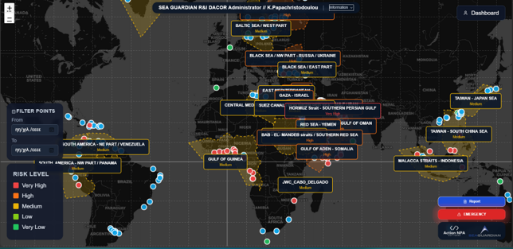
Overall, the risks-cape is one of elevated and interconnected risks at sea, concentrated in chokepoint areas and surrounding landscape of maritime and trade traffic, including energy and logistics visibility.
Political risks: Relations and balances of power are now more flexible and transactional, with great powers using access, sanctions and security guarantees to their political advantage.
Military threats: The threat level remains high from strike cycles, base activities in proximity to important straits and counterterrorist operations around Hormuz, Bab el‑Mandeb, the Red Sea and parts of the Black Sea.
International trade: Energy and container flows can expect routing problems, increased insurance costs and politicized access choices, despite certain finds and alternative sources for resources.
Maritime routes: Important maritime corridors (Hormuz, Suez, Malacca, Bab el‑Mandeb, Black Sea, Panama) are simultaneously safe and contested, complicating routing and risk assessments.
Organized crime: Tensions and competition in key chokepoints and ports create possibilities for hijackings, piracy, theft of cargo, and criminality in ports.
Cyber vulnerabilities: Increasingly, state-affiliated hackers conduct attacks against logistical and other networked systems, which affects the visibility and trust of weapons and trade flows.