





B rief Update: No 10-1/2026 Date: June 29, 2026
Executive summary
- This document has been approved for distribution by SEA GUARDIAN S.G. Ltd / Intelligence & Analysis Department. The provided Information and Intelligence derives from open sources, the Institute for the Study of War (ISW), the Joint Maritime Information Center (JMIC) and the United Kingdom Maritime Trade Operations (UKMTO) respective Web Pages. Additional products retrofit the company’s Strategic/Operational and Security situational awareness process for threat and risk assessment impacting Maritime Security in different areas. All rights reserved, “no part of this risk assessment may be reproduced in any form (electronic, mechanical, paper, or other means) without written permission by SEA GUARDIAN S.G. Ltd, which maintains the rights for personal data of the document writers”. Under no circumstances can SEA GUARDIAN S.G. Ltd be held responsible for any loss or damage caused by a reader’s reliance on information obtained by this assessment, especially on its firms, company’s management, or individual decision-making.

To provide the maritime industry and Security Stake or Shareholders in a monthly cycle, with:
- Major maritime security incident summary and analysis in Geo-strategic frame for Operational Security and Security of shipping for the period May 29 to June 29, 2026.
- Assessment updates concerning military operations – terrorism – piracy and cargo theft, hijacking and detentions, smuggling, stowaways, ships fired, crew losses and Cyber-threats, covering a wide spectrum of threats/risks from Maritime Security to Navigational Safety.
- SEA GUARDIAN, pursues innovative approach by analyzing Maritime Security in accordance with international standards and a certain frame of Geo-policy, including synergies with a subject matter expert (SME) entity for Cyber-defense including the most important sectors of policy, methods and training to mitigate cyber threats and risks.
- Important notes:
1. The Assessment is produced by the R&I team in a global approach covering 23 different regions in total, either offering to readers the opportunity to study it as a whole, or focusing on areas of interest through the context table.
- You can navigate directly to:
[MARITIME SECURITY INCIDENTS] or [ASSESSMENT’s SECTIONS CONTEXT TABLE]
June 18
- Thailand has revived a $30.5 billion “land bridge” project linking the Gulf of Thailand and the Andaman Sea to reduce reliance on the Strait of Malacca. The plan includes new ports and a 90 km transport corridor to cut shipping times and costs, but it faces concerns over cost, environmental impact, and investor interest.

June 19
- Colombia’s prosecutor’s office has opened an investigation into former president Álvaro Uribe over alleged links to paramilitary groups and massacres during the country’s armed conflict. Uribe denies the accusations. The probe relates to events in Antioquia in the 1990s, including alleged involvement in killings and paramilitary formation. His previous conviction over related accusations was overturned and remains under review.
June 20
- Iraq plans to unify customs systems between the federal government and the Kurdistan Region to improve trade management, reduce customs evasion, increase non-oil revenues, and strengthen economic reforms. The move includes unified electronic systems, shared databases, and better monitoring to support investment and reduce dependence on oil income.
- Hezbollah has rejected Israeli accusations that it breached the ceasefire agreement, describing the claims as false and baseless. The group said the allegations are being used to justify continued Israeli attacks and actions against Lebanon.
- The Israeli military said it killed two militants in Gaza, including an Islamic Jihad commander and a Hamas operative, during targeted strikes. The IDF claimed both were involved in past attacks on Israel and recent militant activity, describing them as an immediate threat.
- It was stated that disruption in the Strait of Hormuz reduced global oil supply and could have sharply increased prices due to low demand elasticity. However, prices stayed lower than expected because of futures market expectations, use of commercial oil inventories, and large strategic petroleum reserve releases by the U.S. and the International Energy Agency, along with reduced imports from China.

Russia conducted naval drills in the Baltic Sea involving missile launches and bombing exercises, including operations near its Kaliningrad exclave. The exercises coincided with major NATO BALTOPS drills in the region, which brought together forces from multiple countries. The activity comes amid heightened tensions between Russia and NATO around the strategically important Baltic area.

June 22
- Nigeria’s new High Commissioner to Ghana, Ambassador Shehu Ilu Barde, has arrived in Accra to begin his assignment. Appointed by President Bola Tinubu, the experienced diplomat is expected to strengthen relations between Nigeria and Ghana and promote cooperation between both countries.
- Donald Trump suggested that Syria could take a greater role in countering Hezbollah and criticized Israel’s military campaign, saying it has not effectively weakened the group. He said he had discussed the issue with Syrian President Ahmed al-Sharaa, though Syria has not confirmed any military involvement. The comments sparked regional reactions, with Israel rejecting the idea and Syria previously denying plans to intervene in Lebanon.
- Telecom Armenia and Azer Telecom have signed an agreement to allow internet traffic transit between Armenia and Azerbaijan. The deal aims to improve regional connectivity, diversify data routes, and strengthen telecommunications infrastructure across the South Caucasus.
- A drone attack on civilian vessels in the Black Sea reportedly killed an Egyptian crew member and injured others aboard a Turkish-owned cargo ship flying a Panamanian flag. Several ships were also damaged or targeted, prompting evacuations and assistance from Ukrainian forces. Ukraine accused Russia of violating maritime law and endangering civilian shipping.
- Australia has agreed to sell its over-the-horizon radar system to Canada in a $1.8 billion deal to strengthen Arctic defence and long-range surveillance. The agreement, Australia’s largest defence export contract, will enhance cooperation between the two countries and support early-warning capabilities amid rising global strategic tensions.
- Skyborn Renewables has sold a 25% stake in Germany’s Gennaker offshore wind project to Stadtwerke München. The nearly 1 GW wind faAustralia has agreed to sell its over-the-horizon radar system to Canada inrm in the Baltic Sea will become Germany’s largest offshore wind installation and is expected to power around one million homes. The project is moving toward construction, supported by financing plans and a major power deal with Amazon.

- Despite continued disruptions in the Strait of Hormuz, the Suez Canal is operating normally and handling increased traffic. Canal authorities reported higher ship tonnage in early 2026 compared to the previous year, with strong growth across oil tankers, LNG carriers, and container ships. The canal remains a key global trade route supporting energy and cargo flows between regions. also handling logistics and money laundering operations.
June 23
- Iran has proposed fees to regulate maritime traffic in the Strait of Hormuz, saying they would fund security and navigation services. The plan has sparked international criticism over potential risks to free navigation and higher global shipping and energy costs, while its implementation remains uncertain.
- Libya’s oil production has reached its highest level since 2013, with output rising to about 1.4 million barrels per day, close to its official target of 1.5 million. The National Oil Corporation expects further growth by 2026, supported by new deals with international energy companies. Production has recovered significantly in recent years after sharp declines following Libya’s 2011 conflict.
- An article was published for the speech of Hossein editor of Iranian regime mouthpiece arguing that Trump’s threats against Iran show weakness after an alleged defeat, and calls for Iran to respond with stronger actions. It advocates closing strategic waterways, restricting shipping access, targeting U.S. and allied interests, and taking action against Israeli-linked vessels as retaliation.
June 24
China’s Taiwan Affairs Office said that dialogue with Taiwan can resume only if the DPP accepts the 1992 Consensus and abandons “Taiwan independence” efforts. It blamed Taiwan’s leadership for regional tensions while stating that China supports a peaceful reunification, but will not rule out the use of force.
June 25
- Somalia’s claims disregarding the reality that Somaliland has operated independently for decades with its own institutions, are raising by the Somali government. Mogadishu uses nationalist and anti-Israel rhetoric to strengthen its position while facing internal political and security challenges. The article highlights Somalia’s dependence on foreign support, internal divisions, and the struggle with Al-Shabaab, arguing that its focus should be on domestic stability rather than trying to reverse Somaliland’s separation which is a fact the last 30 years.
- It was stated that Ethiopia’s government is shifting blame for its internal crises onto external actors. It claims the Tigray War was driven by domestic conflicts, criticizes Ethiopia’s recent rhetoric toward Eritrea, and calls for respect of sovereignty and regional peace.

ne 26
- It was stated that the Houthi leader Abdul Malik al-Houthi threatened to target any Israeli presence in Somaliland, accusing Israel of seeking control over strategic Red Sea routes. The remarks follow reports of possible Israeli military cooperation with Somaliland, raising regional tensions over the Bab al-Mandab and the Gulf of Aden.
- IMO has temporarily suspended its ship evacuation operation in the Persian Gulf after an attack on a vessel near the straits of Hormuz/Gulf of Oman. Officials cited safety concerns for seafarers and the need for clearer security guarantees. BIMCO warned that the attack could delay the resumption of maritime traffic and urged shipowners to carefully assess risks in the region.
June 27
- Two powerful earthquakes struck Venezuela, causing widespread destruction and a rising death toll. Rescue teams and civilians continue searching through collapsed buildings, with some survivors being found, bringing hope amid the tragedy. At least 1,430 people have died, with many more injured or missing.

- China is preparing to open a new LNG terminal in Longkou that could receive Russian LNG from the sanctioned Arctic LNG 2 project. The terminal is expected to start operating around October and would increase China’s ability to import Russian gas despite Western sanctions.
June 28
- Former US defense official Tony Hu warned that increased Chinese activity around waters east of Taiwan could have future military implications. He urged closer monitoring, stronger US-Taiwan security cooperation, and continued defense spending to maintain deterrence against a possible Chinese attack.
MARITIME SECURITY & NAVIGATIONAL SAFETY INCIDENTS June 19-28, 2026
| SOURCE / I.D | DATE | TYPE | SECURITY/SAFETY AREA |
| SG INTEL REPORT 004-26 | June 19, 2026 | MILITARY ATTACK | Black Sea / NW part / Ukraine |
| SG INTEL REPORT 003-26 | June 19, 2026 | MILITARY ATTACK | Black Sea / NW part / Ukraine |
| IMB/ICC 036-26 | June 20, 2026 | ROBBERY ATTACK | Philippines / East of Singapore |
| UKMTO 072-26 | June 21, 2026 | SUSPICIOUS ACTIVITY | Gulf of Aden / Yemen |
| SG INTEL REPORT 005-26 (MV VICTRESS) | June 21, 2026 | MILITARY ATTACK | Black Sea / NW part / Ukraine |
| SG INTEL REPORT 006-26 | June 22, 2026 | MILITARY ATTACK | Black Sea / NW part / Ukraine |
| SG INTEL REPORT 007-26 | June 22, 2026 | MILITARY ATTACK | Black Sea / NW part / Ukraine |
| UKMTO 074-26 – ATTACK | June 25, 2026 | MILITARY ATTACK | Hormuz straits / Gulf of Aden |
| UKMTO 076-26 – ATTACK | June 27, 2026 | MILITARY ATTACK | Hormuz straits / Gulf of Aden |

The Geopolitical Profiles & International Security (G3IS)

Geo-political / Geo-Strategic profile:
- The United States is extending the terrorism labels to cover Brazilian criminal gangs and retains Cuba as an entry in the terrorism list, with Brazil and Cuba rejecting these actions as interference that violates their sovereignty. The result is increased diplomatic tensions and decreased cooperation in security matters. On the high seas, interactions like Russia firing warning shots against Western shipping show how congested and competitive the waters have become, but all parties describe such incidents as being part for their own safety and not an escalation into outright confrontation. In Europe, the far right is moving further with terrorist extremism by online radicalization, ideological support from abroad, and financing through cryptocurrencies.
Geopolitical / Geo-economic Profile:
- About global energy competition and chokepoint issues, the shipping industry is trying to set contingency plans in relation to both threats and risks posed, in order to apply new routes and investments to be planned, particularly towards Africa and the Arctic Cycle. The Posidonia 2026 exhibition in Athens early June, offered the opportunity to the international community to share its concerns and to highlight that the demand for shipping remains clearly high, despite all the political risks, sanctions, and decarbonization challenges, while its direct connection with geopolitical issues is the new era situation.
International Security / Strategic sector:
- In 2026, a fragile global environment of regional conflicts, cyber operations, and pressure on key trade and energy routes is increasingly intersecting with global organized crime. Criminal networks exploit porous borders, weak governance, and conflict zones to expand kidnapping for ransom, human and drug trafficking, and financial crime, often overlapping with terrorist tactics and funding channels. The Peshawar High Court’s decision to keep the Dr Warda Mushtaq kidnapping-for-ransom case under Anti‑Terrorism Court jurisdiction reflects how states are treating severe organized‑crime activities as terrorism‑linked offences, using tougher legal frameworks to deter violent criminal enterprises and signal zero tolerance amid wider instability.
Global Maritime Security / Navigational safety profile:
Maritime security in 2026 is increasingly fragile, with key chokepoints exposed to physical, cyber, military and criminal disruption. Severe crimes such as kidnapping for ransom are being treated under anti‑terrorism laws, signaling tougher responses to violent organized crime. At the same time, European authorities report more sophisticated drug‑smuggling methods and routes, including via maritime supply chains, with synthetic opioids, new substances, and cocaine driving violence and enforcement pressure. These trends keep trafficking, cargo crime, and stowaway risks high across global shipping, despite improved naval cooperation and lower traditional piracy.
[return to CONTEXT TABLE]
Cyber-Threats / Risks assessment and mitigation by CYBERPAX

- Machine-Speed Attacks and the Human Decision: Maritime Cyber-Defense When AI Moves First
- Feature on AI-driven autonomous attacks and why the trained human decision has become the decisive control; The most important shift in maritime cyber risk this year is not a new chokepoint or a new conflict. It is a change in the tempo of attack itself. Threat reporting for 2026 describes maritime cyber incidents rising by more than one hundred per cent over the previous year, but the harder number is speed: AI-assisted tooling now lets a single actor run almost the entire attack — from finding a weakness to extracting data — with little human involvement, and the gap between a vulnerability becoming public and being exploited has collapsed from days to, in some cases, minutes. For the people who run ships, ports and terminals, this means the comfortable assumption that someone will notice and respond “in time” is quietly expiring.
- The deception layer has changed too. A large share of phishing aimed at crews now arrives in the seafarer’s own language, generated to read as natural and trusted. Voice-cloning has moved from novelty to operational tool, with attackers imitating the speech of executives and managers to authorize transfers and approvals that look entirely routine. The danger here is not a dramatic strike on a ship’s systems. It is a finance clerk, a duty officer or a shore-based coordinator receiving an instruction that sounds exactly like the person they expect — and acting on it. After such an incident, the question is no longer whether the machine made an error. It is why it was trusted in the first place.
- This is precisely where technology stops being the answer and the trained human decision becomes the control that matters. And it is worth being exact about why. A vessel can hold every certificate, pass every audit and run every recommended system, and still lose everything the moment one watchkeeper acts on a spoofed instruction or one clerk approves a cloned-voice payment. Readiness of this kind does not average out. You cannot offset a well-drilled bridge team against an untrained one, or strong firewalls against a single unverified trust decision. Cyber-defense is only ever as strong as its weakest gate — and AI-driven attacks are built specifically to find that gate and walk through it before anyone reacts.
The practical lesson for 2026 is that maritime training has to change shape. It is no longer enough to teach people to “spot the glitch.” The new discipline is verification under time pressure: confirming the source of an instruction through a second channel, recognizing when an unusually urgent or perfectly-worded request is itself the warning sign, and escalating before authorizing rather than after regretting. In an environment where attacks move at machine speed, the decisive advantage is not faster software. It is a crew and a shore team trained to pause, verify and refuse — at exactly the moment a convincing machine is counting on them not to.
Two-line risk snapshot- • AI-driven, machine-speed cyber disruption of maritime operations, payments and OT environments: HIGH
- • Readiness of crews and shore teams to verify, escalate and refuse under compressed reaction time:CRITICAL
- [return to CONTEXT TABLE]
- THREAT ASSESSMENT UPDATE:
- Military Operations
- Libya – Central Mediterranean
- There is still the possibility of military and terrorism threats due to the fragmented nature of militias and weak central governance, which could lead to sabotage and interruption of crucial infrastructure such as energy sources and transportation hubs. This kind of situation is responsible for maintaining a volatile baseline level of security that may deteriorate quickly in important operational regions.
- Piracy and organized crime have mainly been brought about by smuggling and other criminal activities rather than piracy per se. Areas near the coast are highly vulnerable because of increasing social tensions related to migration, which raises the probability of interference with ships as well as hijackings in poorly secured ports and anchorages.
- GNSS interference and cyber threats exist due to limited regulation and challenges in institutional capabilities. In addition, there is ongoing criminal activity in ports, including theft and other disruptions.
- Overall threat/risk level: “MEDIUM” // Analyzed in: Military/Paramilitary/Terrorism: “HIGH” – ICC/Piracy: “MEDIUM” – Hijacking/Fired/Kidnapping: “LOW” – GNSS interference: “LOW”.
- Triggers and Indicators per area remain as in SEA GUARDIAN SECURITY ASSESSMENT 25/06, April 15.
- [return to CONTEXT TABLE]
- Syria (Middle East issue in East Mediterranean region)
- The security risks associated with Syria continue to be significant in terms of the Russian basing strategy, as well as the pressure on the Syrians by the Americans to play a more active part in dealing with Hezbollah / Lebanon.
- The increased flow of cargo and oil makes Syria vulnerable to criminal activities, such as smuggling, hijacking, kidnapping, and extortion. Poorly developed security practices leave the country open to GPS jamming, spoofing, and cyber-attacks on navigation and terminal systems.
- The existence of corrupt practices and the involvement of armed groups in ports and their surrounding causes regular theft and manipulation of cargo.
- Overall threat/risk level: “HIGH” // Analyzed in: Military/Paramilitary/Terrorism: “HIGH” – ICC/Piracy: “NSR” – Hijacking/Fired/Kidnapping: “MEDIUM” – GNSS interference: “MEDIUM”
- Triggers and risk indicators remain unaltered per area as initially cited in SEA GUARDIAN SECURITY ASSESSMENT 25/23, November 13
[return to CONTEXT TABLE]
Lebanon (Middle East issue in East Mediterranean region)
- Lebanon continues to pose a high-risk profile due to ongoing disputes between Hezbollah and Israel, as well as frequent incidents across the border that pose a realistic threat of attack, kidnapping, and civilian and infrastructure casualties.
- The deployment of the Lebanese army in some of the southern parts of the country provides an increase in state influence but does not eliminate the risk of escalation or local conflict, while a civil war between the Lebanese Armed Forces and Hezbollah cannot be excluded.
- Organized crime and militant groups continue to take advantage of the porous nature of the border as well as conflict zones to increase the risk of intimidation, extortion, and possible cargo or hijackings.
- Overall threat/risk level: “HIGH” // Analyzed in: Military/Paramilitary/ Terrorism: “VERY HIGH” – ICC/Piracy: “NSR” Hijacking/Fired/Kidnapping: “HIGH” – GNSS interference: “HIGH”.
- Triggers and risks indicators remain unaltered per area as initially cited in SEA GUARDIAN SECURITY ASSESSMENT 25/23, November 13.
[return to CONTEXT TABLE]
Gaza-Israel (Middle East issue in East Mediterranean region)
- The Israel-Gaza marine area is still very dangerous because of the ongoing conflict, terrorist threats, and the unstable situation regarding the ceasefire regime, which keeps the chance of interceptions and detentions, disruption of the flow of ships and humanitarian assistance still very high.
- Constant attacks carried out by Israel against the militants, and external cases of counter-terrorism connected with Hamas, indicate a wide range of threats that can manifest themselves through attacks on the maritime targets in the region.
- The amount of humanitarian aid to Gaza is growing, but it still remains at risk because of possible access limitations, security issues, and political disagreements regarding the control line.
- Overall threat/risk level: “HIGH” // Analyzed in: Military/Paramilitary/Terrorism: “VERY HIGH” – ICC/Piracy: “NSR” – Hijacking/Fired/Kidnapping: “HIGH” – GNSS interference: “MEDIUM”.
- Triggers and risk indicators remain unaltered per area as initially cited in SEA GUARDIAN SECURITY ASSESSMENT 25/23, November 13.
[return to CONTEXT TABLE]
Sudan – Eritrea – Ethiopia
- Sudan is currently very unstable due to the splitting of the RSF from the army, the use of drones and artillery, and the targeting of civilians, causing significant risk to military-terrorism and life-safety along critical supply chain corridors.
- The attempts by the RSF to create dual defense systems increase the likelihood of protracted warfare, local atrocities, and escalation that could affect movement through the roads and borders.
- The weakening of the state’s control due to the conflict is making it more prone to smuggling, extortion, and cargo theft, which increases the risk of being hijacked or attacked for carrying high-value cargo.
- Overall threat/risk level: “MEDIUM” // Analyzed in: Military/Paramilitary/Terrorism: “HIGH” – ICC/Piracy: “NSR” – Hijacking/Fired/Kidnapping: “LOW” – GNSS interference: “LOW”.
- Triggers and risk indicators remain unaltered as cited in SEA GUARDIAN SECURITY ASSESSMENT 25/15, July 10.
[return to CONTEXT TABLE]
- Vulnerability continues to reign in Yemen and in the southern Red Sea region, given the missile, drone, and coercive boarding threats, which create serious military-terrorism dangers to shipping and shore-based logistics operations. Food insecurity, resulting from conflict, economic instability and the disruption of aid, has led to an emergency hunger situation, which in turn incentivizes smuggling, cargo theft, and attacks on humanitarian and commercial shipping vessels.
- The arrest of United Nations and other aid personnel, combined with increasingly difficult conditions for relief efforts, has resulted in decreased humanitarian access and the ability to leverage international aid staff and cargo as political pawns.
- In accordance with SEA GUARDIAN’S assessment, there are faint signs, but also signs of involvement of Houthis and Somalians in Piracy activities, as it had been warned through this procedure three months ago. In practice, one of the ships detained for at least two months now, is detained in Aden, Yemen. Piracy will be exploited by actors that want to cancel the establishment of a sovereign State in Somaliland.
- Overall threat/risk level: “HIGH” // Analyzed in: Military/Paramilitary/Terrorism: “HIGH” – ICC/Piracy: “HIGH” – Hijacking/Fired/Kidnapping: “HIGH” – GNSS interference: “HIGH”.
- Triggers and risks indicators remain unaltered as in SEA GUARDIAN SECURITY ASSESSMENT 25/15, July 10.
[return to CONTEXT TABLE]
Northern Persian Gulf / Iran’s region
- As of now, the Northern Persian Gulf and Strait of Hormuz are of medium risk with tension associated with Iran causing an ongoing, albeit manageable, military and terrorism risk. While missiles, drones, and proxies are still of concern, such risks will cause only temporary disruptions of commercial traffic in the region.
- Smuggling and evasion of sanctions persist, while there are not many occurrences of coerced boarding and hijackings, meaning that risks associated with piracy, organized crime, and the safety of lives remain at a medium level. Politically sensitive vessels need increased caution, particularly in constrained waterways.
- Interference with GNSS and cybersecurity risks are occasional and typical, creating a medium risk of a disruptive nature for navigation and port systems. Strong governance and control measures in critical ports in the region prevent criminal activities, although fraud and cargo manipulation continue to pose a risk to operations.
- Overall threat/risk level: “MEDIUM” // Analyzed in: Military/Paramilitary/Terrorism: “MEDIUM” – ICC/Piracy: “NSR” – Hijacking/Fired/Kidnapping: “MEDIUM” – GNSS interference: “HIGH”.
- Triggers and indicators per area remain as in the SEA GUARDIAN Threat & Risk Assessment 08-1/2026, April 30.
[return to CONTEXT TABLE]
Black Sea / NW part (RUSSIA – UKRAINE WAR)
- The Black Sea continues to be a high-risk theater for conflict, with drone attacks and infrastructure and maritime traffic strikes creating an elevated military/terrorist threat to ships, energy facilities, and crews. Recent activity off Constanța and against civilian-flagged merchant ships highlights the possibility of both collateral and targeted attacks on merchant traffic, including tankers’ shadow fleet.
- While piracy and organized crime are of secondary importance, the use of sanction-busting tonnage creates risks for shadowy ownership and port-side facilitation issues. The most important form of “hijacking” will involve damage, capture, and/or interference through misidentification or association with disputed logistics activities, rather than straightforward pirate acts.
- GNSS jamming and electronic warfare are structural parts of the Black Sea operating environment, raising the risks of navigation disruption and rogue drones, and near misses between sensitive assets. Port security and cyber risks exist but are secondary to kinetic risks in terms of significance for terminals handling valued, energy-related, or sanctions-related cargo.
- It has been lately noticed an enhanced attacking activity against merchant vessels with the use of hybrid weapons, with Russian attacks on vessels, which are supposed to support the logistics of Ukraine, and the Ukrainian-Russian grey/shadow fleet supposedly within the frame of Western countries and the EU mandate to control this fleet.
- Maritime companies are advised to treat the issue very carefully, receiving special consulting from the Maritime security domain if needed.
- Overall threat/risk level: “HIGH” // Analyzed in: Military/Paramilitary/Terrorism: “VERY HIGH” – ICC/Piracy: “NSR” – Hijacking/Fired/Kidnapping: “MEDIUM” – GNSS interference: “MEDIUM”
- Triggers and indicators per area remain as in the SEA GUARDIAN SECURITY ASSESSMENT 25/20, September 30 and SEA GUARDIAN SECURITY ASSESSMENT 25/19, September 16 .
[return to CONTEXT TABLE]
Baltic Sea / NE part (RUSSIA-UKRAINE WAR)
- The Hybrid Environment in the Northern Baltic remains highly risky as Russian military signaling combined with NATO Posture rreates a controlled yet tense deterrence relationship. Recent exercises of the Russian navy and air force in the Baltic Sea, taking place along with NATO exercises and Swedish command over NATO forces in Finland, show how easily miscalculations in air and sea corridors can take place in the region.
- Although piracy and ordinary maritime crime committed at sea has not been an issue, the main risks come from state activities: UAV use, electronic warfare, and grey zone activity that can interfere with shipping and critical infrastructure, rather than direct hijacking or criminal boarding of ships.
- GNSS interference and cyber-attacks continue to be structural risks, and increased awareness of any activity related to Russia and .ru domain names shows constant danger of phishing, viruses, and intrusion of network and other systems.
- Overall threat/risk level: “HIGH” // Analyzed in: Military/Paramilitary/Terrorism: “HIGH” – ICC/Piracy: “NSR” – Hijacking/Fired/Kidnapping: “MEDIUM” – GNSS interference: “HIGH”
- Triggers and indicators per area remain as in the SEA GUARDIAN SECURITY ASSESSMENT 25/20, September 30 and SEA GUARDIAN SECURITY ASSESSMENT 25/19, September 16 .
[return to CONTEXT TABLE]
Terrorism – Piracy, cargo theft, smuggling, stowaways, organized crime/drugs trafficking
- As it has been referred to the SEA GUARDIAN weekly bulletin, the previous monthly assessment and in the above paragraphs for the Geo-politic view of threats and risks (choose context beside here and navigate automatically to the relevant paragraph).
[return to CONTEXT TABLE]
Risk Assessment update:
- The security situation in Nigeria has become increasingly influenced by profit-driven kidnapping and attacks using methods similar to those used by terrorists, leading to governance challenges and allowing militant/criminal elements to create risk in the coastal and maritime environments.
- Piracy and other forms of organized crime are supported by these kidnap-for-ransom organizations, creating higher threats of hijacking and personal injury to expatriates, crew members, and high-profile citizens, both onshore and offshore.
- While GNSS jamming and advanced cyber-attacks have not yet become common in Nigeria, the structured and profit-motivated organization of the groups indicates that simple cyber weapons could be used in targeting activities in the future. Stowaway and port crime pose a significant risk due to poor control and corruption at ports in Nigeria.
- Overall threat/risk level: “HIGH” // Analyzed in: Military/Paramilitary/Terrorism: “MEDIUM” – ICC/Piracy: “HIGH” – Hijacking/Fired/Kidnapping: “HIGH” – GNSS interference: “LOW”
- Military threat analysis for Gulf of Guinea states: Nigeria Cameroon Ghana Congo Ivory Coast Angola Very High High Medium High High Medium
- Triggers and indicators per area remain as in the SEA GUARDIAN SECURITY ASSESSMENT 25/20, September 30 and SEA GUARDIAN SECURITY ASSESSMENT 25/06, April 15.
[return to CONTEXT TABLE]
East Mediterranean Sea
- Eastern Mediterranean/Levant: This area is regarded as one where there are tension levels, but which remains under control from a maritime point of view. There is a credible U.S. Navy presence that serves as a deterrent in the case of any state-to-state tensions or major maritime attacks.
- Maritime threats in the area are limited and manageable, such as cyber or navigation interference incidents or port crime cases involving stowaways, without really changing the overall picture of the region in terms of threat levels.
- Overall threat/risk level: “MEDIUM” // Analyzed in: Military/Paramilitary/Terrorism: “MEDIUM” – ICC/Piracy: “NSR” – Hijacking/Fired/Kidnapping: “LOW” – GNSS interference: “MEDIUM”.
- Indicators altering the “risks levels” as in SEA GUARDIAN SECURITY ASSESSMENT 25/22, November 12, 2025.
[return to CONTEXT TABLE]
Suez Canal – Northern Red Sea
- Maritime and overall security risks in the Eastern Mediterranean/Egyptian region are low to moderate, with a robust posture of the Egyptian military forces and presence in the sea helping in controlling terrorism, piracy, and disruption of maritime activities. Physical risks remain mostly opportunistic, whereas GNSS jamming and cyber threats are the main structural risks faced by maritime and logistic operations, along with occasional low-moderate port crimes and stowaways.
- On shore, the high level of drug trafficking and associated violence in Jordan, highlights the strong organized crime structure that may have an impact on the conditions of boarding and the interface between land and sea. The political situation in the region, including the stance of Jordan against Iran, along with rising Chinese-Egyptian security cooperation, helps create a deterrent and stable environment around important routes like the Suez Canal, which is functioning normally with increasing traffic.
- Overall threat/risk level: “MEDIUM” // Analyzed in: Military/Paramilitary/Terrorism: “LOW” – ICC/Piracy: “LOW” – Hijacking/Fired/Kidnapping: “LOW” – GNSS interference: “HIGH”.
- Indicators altering the “risks levels” as initially cited in SEA GUARDIAN SECURITY ASSESSMENT 25/17, August 13.
[return to CONTEXT TABLE]
Bab-El-Mandeb Straits – Southern Rea Sea
- The level of terrorist attacks and military threat is relatively low at present, but unpredictable due to the Iranian messaging, Houthi statements, and mine countermeasures deployment that may result in escalation. Piracy and criminal threat level is assessed as medium to high. This is not because of the operational range of pirate activities; it is due to the geographical profile of the region that do not permits detention of vessels or escape maneuvers. Hijacking is assessed as medium with an opportunity for rapid escalation in case of an attack against poorly hardened vessels.
- The port-related crime threat is considered to be medium because of the corruption activities, stowaways, and extortion from crews and agents. It means that the proper access control and stringent shore-based procedures should be implemented. In general, the corridor is navigable but vulnerable; commercial shipping companies should have their BMPs strengthened and maintain good cooperation with the international maritime forces of the EU.
- Overall threat/risk level: “HIGH” // Analyzed in: Military/Paramilitary/Terrorism: “MEDIUM” – ICC/Piracy: “HIGH” – Hijacking/Fired/Kidnapping: “MEDIUM” – GNSS interference: “NSR”.
- Indicators altering the “risks levels” as initially cited in SEA GUARDIAN SECURITY ASSESSMENT 25/17, August 13.
[return to CONTEXT TABLE]
Gulf of Aden – Somalia / Somaliland
- The wider Somalia/Somaliland–Red Sea–Bab el‑Mandeb region is a single, interconnected high‑risk zone where politicized, partly militarized tensions intersect with resilient piracy and organized crime, sustaining a real hijack‑for‑ransom threat and direct risks to crew safety.
- In this environment, potential terrorist or proxy activity, persistent small‑arms–based hijackings, emerging GNSS/cyber vulnerabilities, and elevated port crime/stowaway pressures reinforce each other, requiring ship operators to treat all transits and calls as exposure to a combined, not compartmentalized, threat picture.
- All the states in the Gulf of Aden, except Yemen and specifically the Houthis, did not get directly involved in the conflict between Iran and the US, but the regional financial pressure, as well as the complexity of relations, mainly after Somaliland started to seek and receive international recognition, creates a terrain in where organized crime could be cultivated more easily and piracy re-emerge with a much harder profile for political reasons.
- Overall threat/risk level: “HIGH” // Analyzed in: Military/Paramilitary/Terrorism: “NSR” – ICC/Piracy: “HIGH” – Hijacking/Fired/Kidnapping: “HIGH” – GNSS interference: “NSR”
- Indicators altering the “risks levels” as initially cited in SEA GUARDIAN SECURITY ASSESSMENT 25/17, August 13.
[return to CONTEXT TABLE]
Arabian Sea – Gulf of Oman
- The risks posed by the Arabian Sea and the Gulf of Oman can be described as predominantly state-related risks, as military operations against ships and sanction enforcement actions pose greater danger than conventional pirate attacks, with a serious possibility as a result of disarming and endangerment of the ship’s crew.
- Even if Omani ports during the crisis and the war in the Persian Gulf functioned as a relief valve for shipping, the outcome is very different, as most of the sea mined area is related to the part of the sea near its coasts.
- Additionally, as Oman itself tried during the crisis to maintain a neutral as stance and exploited the west road to the Red Sea, according to some experts’ opinion, now it is inside the quadrant of the regions fitted with high threats.
- Under such conditions, GNSS/AIS manipulation and other cyber instruments become critical elements of both enforcement and evasion efforts, while port crime and stowaways become secondary.
- Overall threat/risk level: “MEDIUM” // Analyzed in: Military/Paramilitary/Terrorism: “MEDIUM” – ICC/Piracy: “NSR” – Hijacking/Fired/Kidnapping: “VERY LOW” – GNSS interference: “HIGH”.
- Indicators altering the “risks levels” as initially cited in SEA GUARDIAN SECURITY ASSESSMENT 25/17, August 13.
[return to CONTEXT TABLE]
Hormuz Straits – Persian Gulf
- It is in the Strait of Hormuz and the Persian Gulf that the military theater with high risks is being created due to the confrontation between the U.S. and Iran, the established blockades, and conflicting political objectives leading to severe incidents and legal and financial pressure on the shipping industry, while piracy does not play any role.
- However, it is in this atmosphere of confrontation that factors such as ambiguities in war goals, use of dark tankers which operate without transponders to ensure continued oil transportation, new land routes for energy supplies and Iran’s intention to impose navigation fees become more significant than anything else, raising the possibility of unexpected disruption and additional expenses for the vessels crossing the straits.
- Overall threat/risk level: “MEDIUM” // Analyzed in: Military/Paramilitary/Terrorism: “MEDIUM” – ICC/Piracy: “VERY LOW” – Hijacking/Fired/Kidnapping: “MEDIUM” – GNSS interference: “HIGH”.
- Indicators altering the “risks levels” HAS BEEN LEFT INTENTIONALLY BLANK DUE TO WAR CONDITIONS and unpredictable actions by all involved parties.
[return to CONTEXT TABLE]
Malacca Straits
- The Malacca Strait continues to be a medium-risk route with a high strategic importance, because of its connection to low-level piracy, organized crime, and GNSS interference on one side and its importance as an energy and commercial trade passage on the other, thus being susceptible to coercion should tension arise within the region.
- Conversely, actions like the resuscitation of the “land bridge” initiative by Thailand in order to avoid the Malacca route signify not only attempts to secure an alternative route but also how the situation can deteriorate in the event of future competition within the region.
- While at one end it is Singapore, one of the biggest ports in the world, on the other end, the ports are of medium size, thus a huge budget is needed for such a project. This initiative signals that the area is included in the possible future terrain of geopolitical tensions.
- Overall threat/risk level: “MEDIUM” // Analyzed in: Military/Paramilitary/Terrorism: “NSR” – ICC/Piracy: “HIGH” – Hijacking/Fired/Kidnapping: “LOW” – GNSS interference: “MEDIUM”
- Indicators altering the “risks levels” as cited in SEA GUARDIAN SECURITY ASSESSMENT 25/20, September 30.
[return to CONTEXT TABLE]
Black Sea / East Part
- Black Sea (eastern part) is still regarded as a medium-risk zone where political instability and interference with GNSS are still major risks, while organized crime is gradually being suppressed through increased law enforcement activity.
- However, an increasing economic interdependence between Azerbaijan, Georgia, Armenia, and Russia through energy, cargo, and data transportation makes this region more sensitive to any deterioration in the Georgian-EU relationship and other geopolitical risks.
- Russia, even if it continues the war in the NW part of Black Sea, seems to strategically maintain the East part stabilized and in peace. The stable and secure condition is needed not only for the future but also for the current exports using a multi-modal transportation, mainly train and sea ports by these countries.
- Overall threat/risk level: “MEDIUM” // Analyzed in: Military/Paramilitary/Terrorism: “LOW” – ICC/Piracy: “NSR” – Hijacking/Fired/Kidnapping: “MEDIUM” – GNSS interference: “MEDIUM”.
- Indicators altering the “risks levels” as initially cited in SEA GUARDIAN SECURITY ASSESSMENT 25/18, August 27.
[return to CONTEXT TABLE]
Baltic Sea / West part
- Baltic Sea west actually is a high-risk area characterized by intense militarization, where the primary hazards include NATO maneuvers, Russian presence, GPS spoofing, and drone flights; pirate attacks and kidnappings in practice do not exist, even if detention due to the activities of the shadow/grey fleet and the presence onboard these ships of covert Russian military personnel for protection, could lead to detentions or confrontation.
- Large-scale exercises such as BALTOPS, fast reaction of the air forces to potential drone threats, and the development of critical energy installations offshore (including the deployment of wind farms), contribute to the increasing amount of strategic assets in the area, making it possible for miscalculations or disruptions of navigation, while at the same time keeping the criminal maritime risks low due to intense law-enforcement actions.
- Overall threat/risk level: “MEDIUM” // Analyzed in: Military/Paramilitary/Terrorism: “MEDIUM” – ICC/Piracy: “NSR” – Hijacking/Fired/Kidnapping: “NSR” – GNSS interference: “MEDIUM”.
- Indicators altering the “risks levels” as cited in SEA GUARDIAN SECURITY ASSESSMENT 25/20, September 30.
[return to CONTEXT TABLE]
Taiwan – Japan Sea
- The Taiwan-Japan Sea is considered a medium-risk region in which the major threat could ensue due to tensions between China and Japan, especially related to Taiwan and the depth of US-Japan-Taiwan security relations. Increased Chinese-Japanese tensions and regular aeronautical drills maintain an environment with increased risks of accidents being encountered and miscommunication being generated in crowded maritime routes.
- However, GNSS jamming and cyber incidents associated with military or grey zone operations are emerging as enabling factors, capable of disrupting navigation, situational awareness, or communication in a commercial vessel during times of tension. While direct targeting of ships is rare, it is still important to consider escalation and disruption of navigation/cybersecurity as key risk drivers in this theater.
- Overall threat/risk level: “MEDIUM” // Analyzed in: Military/Paramilitary/Terrorism: “LOW” – ICC/Piracy: “NSR” – Hijacking/Fired/Kidnapping: “NSR” – GNSS interference: “MEDIUM”.
- Indicators that distort the “risk levels” as in SEA GUARDIAN SECURITY ASSESSMENT 25/21, October 16.
[return to CONTEXT TABLE]
Taiwan – South China Sea
- The Taiwan–South China Sea is one of the medium-risk areas in which the major risks consist of military and gray-zone operations at the state level and not of maritime criminality.
- More exercises, public announcements such as those by Taiwan about extensive training with its partners, as well as intrusions into the controlled waters of Taiping Island by China, have increased the riskiness of the operational environment; however, piracy, hijackings, and GNSS/cyber risks are still negligible.
- Overall threat/risk level: “MEDIUM” // Analyzed in: Military / Paramilitary/ Terrorism: “LOW” – ICC/Piracy: “MEDIUM” – Hijacking/Fired/ Kidnapping: “LOW” – GNSS interference: “LOW”.
- Indicators that distort the “risk levels” in SEA GUARDIAN SECURITY ASSESSMENT 25/21, October 16.
[return to CONTEXT TABLE]
South America / NE part – VENEZUELA
- Risk in the region derives from political uncertainty, weak governance, and links between criminals and the state of Venezuela, which will continue to contribute to instability in the region. The devastative earthquake of last week will definitely create side effects in the surrounding maritime zone as the local coastguard will weaken in an almost destroyed state.
- Additionally, the ongoing border dispute between Guyana and Venezuela creates an energized military issue that is limited surrounding the Essequibo region. On the positive side, Guyana continues to be transformed into an energy hub for the region.
- Guyana, has not shown yet any aggression against Venezuela, even if tensions over the oil fields in the western region are rising. The borders with Venezuela, where there is a long-term dispute between the two countries, came to light after the capture of Maduro by the US and the subsequent political and financial instability in the country.
- Overall threat/risk level: “MEDIUM” // Analyzed in: Military / Paramilitary/ Terrorism: “MEDIUM” – ICC/Piracy: “LOW” – Hijacking/Fired/ Kidnapping: “NSR” – GNSS interference: “MEDIUM”.
- Indicators that distort the “risk levels” in SEA GUARDIAN SECURITY ASSESSMENT 26/06, March 19..
[return to CONTEXT TABLE]
South America / NW part – PANAMA
- Risk related to the Panama Canal derives from the level of political and commercial strains, the levels of physical risks, and the race for the domination of traffic control. Panama’s termination of the canal-port agreement with CK Hutchison Holdings is a friction point between the United States and China.
- Additionally, the sudden increase in detention of Panama-flagged vessels by China, primarily raises compliance and time risks. The Canal Authority is forecasting no additional water-related measures for 2019, thereby facilitating larger volumes of oil and LNG imports from the United States.
- Overall threat/risk level: “MEDIUM” // Analyzed in: Military / Paramilitary/ Terrorism: “NSR” – ICC/Piracy: “MEDIUM” – Hijacking/Fired/ Kidnapping: “NSR” – GNSS interference: “LOW”.
- Indicators that distort the “risk levels” in SEA GUARDIAN SECURITY ASSESSMENT 26/06, March 19..
[return to CONTEXT TABLE]
ARCTIC CYCLE / EAST – RUSSIA / EUROPE
- However, the Arctic continues to pose low risks for commercial shipping activity but undeniably poses strategic contestation with the rise of the Russian ambitions for sea denial and the control narratives of the Northern Sea Route formed in tandem with China against NATO’s high-north strategy via trials of autonomy surveillance and Arctic mobility initiatives;
- This sustains business-as-usual commercial shipping but also makes it increasingly possible that strategic decisions made by great powers in the future could change the current low military / criminal risk setting into one of higher military risk and terrorism region.
- Overall threat/risk level: “MEDIUM” // Analyzed in: Military / Paramilitary/ Terrorism: “MEDIUM” – ICC/Piracy: “NSR” – Hijacking/Fired/ Kidnapping: “NSR” – GNSS interference: “LOW”.
- Indicators per area remain as in SEA GUARDIAN SECURITY ASSESSMENT 25/06, April 15.
[return to CONTEXT TABLE]
ARCTIC CYCLE / WEST – GREENLAND / ALASKA
- Western Arctic continues to be a restricted and medium military risk theatre where defense preparation and extended reconnaissance, are key drivers of the security environment. The new Arctic radar integration system and competition over resources (oil/gas and rare earth minerals) are giving further emphasis of being a strategic frontier, and not a battleground.
- The threats of piracy, organized crime, hijackings, and port crimes/stowaways are nonexistent in this region, with the present level of risks for commercial maritime traffic arising mainly from natural dangers (weather, ice, remoteness), and only secondarily from GNSS/cyber threats that are associated with great power rivalry.
- Overall threat/risk level: “MEDIUM” // Analyzed in: Military / Paramilitary/ Terrorism: “MEDIUM” – ICC/Piracy: “NSR” – Hijacking/Fired/ Kidnapping: “NSR” – GNSS interference: “MEDIUM”.
- Indicators per area remain as in SEA GUARDIAN SECURITY ASSESSMENT 25/06, April 15.
[return to CONTEXT TABLE]
Piracy – Boarding conditions, kidnapping, firing, electronic harassment
- Piracy globally continues to be controlled, although it seems to have clearly reappeared around Somalia through events such as the hijacking of the EUREKA, which shows that traditional piracy/smuggling and international organized crime regions are active.
- SEA GUARDIAN warns once again that the apparent recession of piracy worldwide is not due to the elimination of the threat but due to the war and conflicts. The piracy threat, alongside the crisis surrounding the Strait of Hormuz and attacks against commercial ships, is affecting the capacity of global transit networks as well as pushing for the use of alternative transit routes.
- Organized crime and corruption continue to thrive within important corridors. Results from large-scale operations against transnational organized crime in Turkey and Europe and kidnappings for ransom and corrupt practices involving law enforcement agencies in the Gulf of Guinea, depict the underlying threat of hijackings, extortion, and cargo theft, although there are fewer hostages compared to previous peaks.
- The emergence of maritime cybercrime, GPS interference, and similar technological forms of crime, accompanied by physical dangers, put at risk infrastructure and technological devices needed to ensure and deliver oil and freight. Legislative changes, such as the creation of CO2 transport contracts, Arctic cooperation treaties, and court rulings, affect the context within which security inadaptations are getting hard to manage.
[return to CONTEXT TABLE]
Overall Assessment – Consulting
- Diplomatic Tensions. There are diplomatic tensions stemming from rivalry among great and regional powers seeking to exert influence in the Gulf, Levant, Red Sea, and Horn of Africa. The interplay between the US, Iran, Israel, European nations, India, and China is characterized by the use of coercion at sea and selective diplomatic talks despite de-escalation measures being taken.
- Political Instability. In a violently changing world from western monocracy to a multipolar one, there is political instability that has spread beyond the Middle East region to Africa and parts of Eastern Europe owing to civil wars, ineffective governance, the presence of militants, and intervention from other countries. Fragmented governance and militants cause constant political instability in nations like Sudan, Yemen, and Somalia/Somaliland and the west African States.
- International trade. International trade faces rising geopolitical risks due to energy security challenges, sanctions, and route disruptions. Military blockade implementation, infrastructural attacks or limitations, and increased inspection of maritime vessels are changing trade routes, causing slowdowns, and increasing the costs and risks of insurance and finance.
- Maritime trade. Maritime trade is being put under pressure in chokepoints such as the Strait of Hormuz, Bab el-Mandeb, and the Red Sea owing to the convergence of military activities, coercive measures, piracy, and navigational constraints. The key issue was the factor that influenced maritime trade, which produces uncertainty and the re-emergence of plans for the establishment of alternative routes, multimodal logistics, and the most important costs in maritime trade show signs of alleviation, even if the global market has not returned to its previous normality,
- Overall assessment:
- Security risk assessment overall. Key routes like the Red Sea–Suez and the Gulf of Aden are threatened by insurgent activities, piracy, and coercion from governments that require extra efforts in detours and extended sailing time. The situation is worsened by political divisions, asset sanctions, attacks, and insider threats.
- Navigation facilities and route risks. The threats include not only congestion but also constrained waterways and weather. Additional challenges are posed by attacks on electronic navigation aids and cyber risks, as well as degradation of positioning and traffic management. When planning the route, a compromise between exposure to attacks and the safety of navigation facilities must be found.
Overall consulting: Security threats and safety hazards must be managed as a coherent risk picture, incorporated into governance, fleet, and commercial planning. A clear risk management model with political, physical, cyber, and navigational risks and thresholds representing overall and sectoral threat/risk levels is needed. Mitigation at sea will require a coherent risk management strategy, including corridor route management, layered vessel security, and robust navigation. Companies need to have established processes for assessing routes, alternative routes, and ports of refuge, safe operation practices in high-risk zones, proper crew vetting and training, as well as resilient navigation and communication technologies that are capable of withstanding any interference or failure. In order to ensure continuity, companies need to develop cooperation strategies, insurance schemes, and contingency plans that could prevent the disruption of one shipping corridor from cascading into operational or financial problems.
[return to Recent Key Developments ]
OR return to [CONTEXT TABLE ]
ANNEX “A”: Chokepoints Traffic performance

Sea Guardian S.G. Ltd / Intel Department (www.sguardian.com / (+30) 694 437 3465)
can support your operational planning, assist in determining the risk assessment and aid in decision making by producing tailor-made assessments upon request on ports, routes, cargos and specific merchant vessels. You can refer to our previous Threat & Risk Assessments for more information and background analysis on the events and situation for each specific region.
[return to CONTEXT TABLE]
ANNEX “B”: Security Assessment – Lessons Learned
| LESSONS LEARNED | ||
| INCIDENTS | REACTIONS | TRANSFORMATION NOTICES |
| The attacks on July 2025 in RED SEA | Permanent contact with the shipping company as well the maritime security company that hires security teams. | Developing independent international relations and operational apps for supporting crew recovery having abandoned the vessel. |
| The attacks on July 2025 in RED SEA | The active contingency plans and business impact analysis in case of discontinuation with the security guarding teams (such as an attack difficult to face with small arms). | Further implementation of maritime/ISO standards. |
| Inbound in an area of high military / paramili- tary threats with all navigational aids and AIS closed | Operate all the navigational aids and AIS/communication systems after having been attacked by ballistic or related missiles, when visual targeting was available due to the lack of international naval forces. | Stabilize the closed navigational aids to prevent targeting towards the necessity of giving information through them to friendly entities. |
| The detailed analysis after a special interview of security crew assessing decision-made | A fundamental decision involves choosing whether to abandon a sinking vessel using a lifeboat for safety, or to escape directly into the sea with only life jackets, while under the threat of attacking skiffs searching for survivors. | Balance the threat while abandoning the ship at sea with the threat of environmental and geographical conditions for survival. |
| The re-emergence of piracy in the Gulf of Aden-Horn of Africa and Somalia | From the latest incidents in the area, it was proven that the existence of Maritime security teams is of paramount importance, as well as the existence of International Maritime operations. | The overall security umbrella is achieved if: – A consistent/ coherent Security assessment has been done in advance – International Maritime operations in the region exist – The use of Security teams onboard for a wider area is available. |
Usefull links for conflict indexes and picture of piracy attacks in:
- ACLED and IMB/ICC for the war threat levels and International commerce crime incidents.
- Companies under sanction by Ukraine (Black Sea): Database of Legal Entities Under Sanctions
- https://www.youtube.com/watch?v=Pt6GS7QohAI, for an overall general assessment by the SEA GUARDIAN President presented at Naftemboriki TV (Shipping) for the latest period, covering the time-frame before and after the Houthis ballistic, drones and UCAV attacks.
.
[return to CONTEXT TABLE]
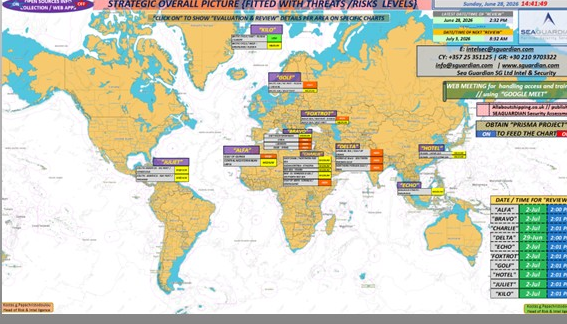
ANNEX “C”: The SEA GUARDIAN Data & Control Reporting system (DACOR)
DACOR system visualizes this report and covers the period between two successive monthly Security Assessments and three weekly reports, with near-real time data and reporting capabilities. The system is ready to be provided as a subscription service hosted in SEA GUARDIAN servers.
| Contact us for a trial or fix an appointment: | or book a “google meet” appointment through the following global calendar: |
| E-mail: intelsec@sguardian.com | https://calendar.app.google/LmPSoo5fDxZMVq357 |
| CY:+35725351125|GR:+302109703322 info@sguardian.com | www.sguardian.com Sea Guardian SG Ltd Intel & Security |
Viewers can also read the previous month’s report here below:
