





B rief Update: No 26/06 Date: March 22, 2026
Executive summary
- This document has been approved for distribution by SEA GUARDIAN S.G. Ltd / Intelligence Department. The provided Intel and Information derives from open sources, the Institute for the Study of War (ISW), the Joint Maritime Information Center (JMIC) and the United Kingdom Maritime Trade Operations (UKMTO) respective Web Pages, as well as products retrofit the company’s Strategic/Operational and Security situational awareness processes, for risks and threat assessment/impact to the Maritime Security. All rights reserved, “no part of this risk assessment may be reproduced in any form (electronic, mechanical, paper, or other means) without written permission by SEA GUARDIAN S.G. Ltd, which maintains the rights for personal data of the document writers”. Under no circumstances can SEA GUARDIAN S.G. Ltd be held responsible for any loss or damage caused by a reader’s reliance on information obtained by this assessment, especially on its firms, company’s management, or individual decision-making.
Objectives
To provide in a 15-day cycle, the maritime industry and Security Stake or Shareholders with:

Major maritime security incident summary and analysis in Geo-strategic frame for Operational Security and Security of shipping for the period March 02-19, 2026.
Threat/risks assessment updates concerning military operations – terrorism – piracy and cargo theft, hijacking and dentations, smuggling, stowaways, ships fired, crew losses, and Cyber-threats, covering a wide spectrum of threats/risks from Maritime security to Navigational safety.
SEA GUARDIAN, pursues innovative approach by analyzing Maritime Security in accordance with international standards and a certain frame of Geo-policy including synergies with a specialized entity for Cyber-defense, adding a new section in the assessment which includes the most important sectors of the policy, the methods and training to confront cyber threats and risks.
Important note:
The Assessment is produced by the R&I team in a global sense covering 23 different regions and giving to readers the capability to study it as a whole, or focusing on areas of interest through the context table, as it extends to more than 30 pages.
Recent Key Developments
March 02,
- “According to information collected by RTBF from several sources, Belgium seized the oil tanker ETHERA during nighthours. The 180‑meter ship, built in 2008 and sailing under the flag of Guinea, was arriving from the English Channel. It was intercepted off the coast of Ostend and first held at sea and then escorted to Zeebrugge, where it was seized…”
- The government of Panama has launched a diplomatic push to expand international support for the Permanent Neutrality Treaty of the Panama Canal by formally inviting 12 countries to adhere to its protocol. Foreign Minister Javier Martínez-Acha Vásquez led the initiative during an official visit to Mexico over the weekend, within the framework of meetings with ambassadors accredited to the country. According to the Foreign Ministry, adherence to the treaty represents a “legal guarantee of global trade”, a political signal of support for international law and an act of confidence in Panama as a “safe, stable and predictable” nation, the local newspaper La Prensa reported.
- March 03,
- A “limited fire” has broken out at the United States Embassy in the Saudi capital of Riyadh after it was hit by two drones, while a fuel tank at Oman’s Duqm commercial port was hit in a drone attack, increasing regional pressure on Gulf Arab states housing US assets, in retaliation for the US-Israeli attacks. The strike on the US Embassy caused “minor material damage” to the compound, the Saudi Ministry of Defence said in a statement. Later reports said that more drones were targeting the site amid Iran’s retaliation across the Gulf to US-Israeli attacks.
- The Army’s 58th Artillery Command recently conducted a training course for its UAV battalion. Senior personnel certified by the Army Drone Training Center led the session, Military News Agency reported. Troops first conducted basic flight operations using visual observation and practiced core control skills, such as throttle management, attitude adjustment, and directional correction.

Qatar’s LNG production halt due to Iranian strikes will not immediately affect Japan’s energy supply, and if there is any impact, Japan could tap the spot market or utilities could buy from each other, Trade Minister Ryosei Akazawa said on Tuesday. Akazawa told a regular press conference that Qatari liquefied natural gas accounts for 4% of Japan’s total LNG imports and reiterated the government has no specific plans to release oil from strategic stockpiles, while some Japan-bound ships are stranded in the Middle East.
March 04,
- Pakistan has sought an alternative crude oil supply route through Saudi Arabia’s Red Sea port of Yanbu amid the closure of the Strait of Hormuz, with Riyadh assuring full support to help Islamabad safeguard its energy security during the evolving crisis. Federal Minister for Petroleum Ali Pervaiz Malik held a crucial meeting with Nawaf bin Said Al-Maliki, Ambassador of the Kingdom of Saudi Arabia to Pakistan, to discuss the fast-changing regional situation and its implications for global energy flows.

- US and Israel’s bombardment of Iran and Lebanon continues, with a strike on a hotel near Beirut and the building of the Assembly of Experts in Qom, as the death toll surpasses 800 in both countries. Tehran continues retaliatory attacks on Israel and US targets in the Middle East for a fourth night, with strikes reported on Washington’s consulate in Dubai and a port in the city of Fujairah in the United Arab Emirates.
- Misrata Free Zone in Libya has announced the launch of an integrated electronic system to manage the counting, sorting and documentation of incoming goods, in a move aimed at modernizing port operations. According to the zone’s administration, the system allows operators to manage voyage schedules and operational data, record container details and conditions, and document any damage with photographic evidence. It also tracks lashing and sealing procedures, monitors unloading stoppages and their causes, and provides real-time statistics and workflow charts.
- Four children were tragically killed in an explosion in southern Djibouti, suspected to be caused by an unmanned aerial drone. According to a local newspaper in Ethiopia, Addis Standard, the Djibouti government suspects that the airstrike was carried out by a drone, as reported by AFP. In a statement released by Djibouti Attorney General Mr. Hassan Mohamed Hassan, it was revealed that the explosion occurred in the Dikhil province in the Afar region. He also stated that a committee has been dispatched to investigate the cause of the explosion.
March 05,
- Donald Trump has expressed public support for a possible Kurdish offensive against Iran as the United States pushes to destabilize the Iranian governing system internally. “I think it’s wonderful that they want to do that, I’d be all for it,” the US president told the Reuters news agency when asked about the prospects of a Kurdish rebellion in Iran.

Somalia’s parliament has backed constitutional changes that couldextend the president’s term in office by a year and push back planned elections. The vote happened on March 4, and on the next day analysts who follow the Horn of Africa country closely, were still debating exactly what the implications are. Somalia has endured conflict and clan battles with no strong central government since the fall of autocratic ruler Mohamed Siad Barre in 1991.
- The United States government has authorized a limited license for the export of Venezuelan gold, following a high-level meeting to expand mining in the country. That day, a notice appeared on the US Department of the Treasury’s website announcing the license. It allows Venezuela’s state-run mining company Minerven and its subsidiaries to export, transport and sell Venezuelan gold to the US, within the parameters set out by US law. Under the license, however, no Venezuelan gold will be permitted to be exchanged with Cuba, North Korea, Iran or Russia. The license also requires payments to sanctioned individuals to flow through Treasury accounts known as Foreign Government Deposit Funds, the same system that has been used to store the proceeds from Venezuelan oil sales.
- The war in the Middle East has pushed Egypt to an economic state of near emergency. That’s was the warning on March 5th from the President Abdel Fattah al-Sisi, over fears of runaway inflation in the import-dependent country. The conflict between the US, Israel and Iran has seen strikes on Egypt’s Gulf allies and paralyzed trade through the Strait of Hormuz. The conflict could also spell trouble for the Suez Canal – a vital waterway for Egypt and key source of foreign currency. The Egyptian pound fell to an 8-month low against the US dollar at close of business on Thursday, March 5th. The currency has lost two-thirds of its value since 2022.
- Turkey’s intelligence agency asked its British counterpart MI6 last month to take a larger role in protecting Syrian President Ahmad al-Sharaa following recent assassination plots, Reuters news agency reported, citing five informed sources. The Islamic State (ISIS) targeted al-Sharaa and two senior cabinet ministers in five foiled assassination attempts, all of which were thwarted, according to the report. The sources, including Syrian and foreign officials who spoke on condition of anonymity due to the sensitivity of the matter, cited rising anxiety over a series of reported ISIS plots to kill the Syrian president.
- Azerbaijan’s State Security Service announced that it had prevented a series of terrorist, sabotage, and intelligence-gathering operations planned by Iran’s Islamic Revolutionary Guard Corps (IRGC). According to state television AzTV, the planned attacks targeted critical infrastructure and prominent individuals in Azerbaijan. Among the intended targets were the Baku-Tbilisi-Ceyhan oil pipeline, the Israeli Embassy in Baku, a leader of the Mountain Jewish community, and an Ashkenazi synagogue.
- It was stated that he returns of piracy incidents off the coast of Somalia, combined with increased geopolitical tension in the Middle East and the possibility of involvement by Houthi rebels, is creating a new environment of heightened risk for international navigation. As noted by the EOS RISK Representative for Greece and Cyprus, the situation in the region’s sea routes is being monitored with particular concern by the maritime community, as instability affects some of the most important corridors of global trade.
March 07
- The Israel-US attacks on Iran have plunged the wider Middle East region into turmoil. From Tehran, tensions have spread, affecting multiple Arab cities, including Abu Dhabi, Doha, Kuwait City, Manama, and Beirut. Amid this wave of military escalation hitting several countries, Yemen has remained – perhaps surprisingly – quiet. The Houthi movement, the Iran-allied de facto authority in northwestern Yemen, has made repeated attacks on US and Israeli targets since the start of Israel’s war on Gaza in October 2023. “Houthi intervention remains a possibility, and it could take the form of a phased escalation,” Luca Nevola, senior analyst for Yemen and the Gulf at the ACLED conflict monitor, told Al Jazeera. “At the current stage, the main Houthi priority remains avoiding direct US and Israeli retaliation.”
- Disruptions to one of the world’s most critical maritime corridors are beginning to ripple across East Africa following the escalating conflict in the Gulf region. In advisories issued to customers, global carriers Maersk, CMA CGM, and Mediterranean Shipping Company said the deteriorating security situation in the Middle East had forced them to suspend sailings and redirect vessels away from traditional routes through the Red Sea and the Suez Canal.
- Saeid al-Jayashi, a senior official at Iraq’s National Security Advisory, revealed that the country is maintaining its crude oil exports through the Strait of Hormuz via organized government channels and “high-level coordination”. In a televised interview, al-Jayashi clarified that while the regional conflict has complicated global shipping, the National Security Advisory is leading discrete efforts to ensure the continued flow of Iraqi oil. He noted that many of these tactical arrangements and diplomatic communications remain confidential to avoid publicizing sensitive logistical maneuvers.
March 08,
- Somalian President Hassan Sheikh Mohamud has slammed Israel’s “interference” in his country, saying its recognition of the breakaway region of Somaliland has further increased instability and weakened international order. In an exclusive interview with Al Jazeera broadcast, Mohamud said Somalia “will never allow” the establishment of an Israeli base in Somaliland and will “confront” any such move. He also warned that the proposed Israeli base could be used as a springboard to attack neighboring countries.
- ndian refiners have begun negotiating for additional crude cargoes from the US, Russia and West Africa to ensure supplies remain adequate in the event of the West Asia conflict drags on for a longer period, industry officials and analysts said. Refineries, which convert crude oil into fuels like petrol and diesel, have deferred planned maintenance shutdowns and are maintaining normal processing rates to create buffers that could meet the country’s requirement in the near term.
- It was published that the effective closure of the Strait of Hormuz has triggered the most severe disruption to Gulf container shipping in decades, with Evergreen, Maersk, CMA, CGM and others suspending services, invoking force majeure and stranding cargo across the region, as Washington unveils a $20bn insurance backstop.
March 09,
- The Iranians relentlessly bombed Israel’s largest port of Haifa, after the Israeli strikes on oil tanks in Tehran. It is noted that Iran announced the 27th phase of Operation “True Promise 4”, targeting Israel and U.S. military facilities in the Middle East. The Revolutionary Guards carried out an attack on the Haifa refinery in Israel, in retaliation for the strike recently suffered by the Tehran refinery. The announcement states that Iranian forces used missiles and unmanned vehicles (drones) in the attacks, enhancing their ability to hit military targets and opponent infrastructure in the region. Energy infrastructure has now also become a target, a fact expected to cause shock to oil supply and destruction of demand.
- “The Swedish Prosecution Authority announced that the Russian captain of a vessel seized in the Baltic Sea on March 6th, has been arrested on suspicion of using false documents, as well as violating Sweden’s Maritime Act and Ship Safety Act. That day the Swedish Coast Guard announced it had boarded a Russian false-flag vessel in Swedish territorial waters as part of “Operation Black Coffee.” The cargo ship “Caffa” was sailing under the Guinean flag when it was boarded off the coast of Trelleborg, a town in southern Sweden. According to Svenska Dagblaget, the captain of the vessel has been in custody since March 7th.

March 10,
- Ukraine has dispatched drone interceptors and military personnel to Jordan as Middle Eastern countries fend off Iranian strikes on infrastructure and US military assets during the US-Israel war on Tehran. President Zelenskyy confirmed that a Ukrainian team departed last week for Jordan, which has US military assets at its Muwaffaq Salti Air Base. The move followed a request from the US, Zelenskyy said, as Washington seeks cheaper technology for intercepting Iranian missiles targeting Israeli and US defence assets as well as other infrastructure across Qatar, Kuwait, Bahrain, Saudi Arabia and the United Arab Emirates.
- Less than four years after a peace agreement ended the civil war in Ethiopia’s Tigray region, conflict is looming once again while civilians aren’t waiting for the fighting to start – they’re already starting to flee. Late night hours in Mekelle, the capital of Ethiopia’s Tigray region, dozens of young men with backpacks and suitcases are searching for a bus to Addis Ababa. While war sets much of the Middle East alight, just across the waters of the Red Sea, another conflict is looming in the Horn of Africa. Federal and Tigrayan forces are once again massing at their shared border in northern Ethiopia.
- March 11,
- A new investigation by the Organized Crime and Corruption Reporting Project (OCCRP) and partner news organizations have found that Russia is placing men with military and intelligence backgrounds aboard oil tankers used to transport sanctioned crude through the Baltic Sea. Reporters analyzed crew lists from 20 tanker voyages and found that ships leaving Russian Baltic ports often carried two additional Russian men listed as “supernumeraries,” meaning they were not part of the standard operating crew. Of the 17 Russian men identified without maritime credentials, at least 13 were linked to security organizations such as the Wagner Group, Russian paratrooper units, or the GRU, Russia’s military intelligence service.
- Russia repeatedly warned its partners in Turkey about the Kiev regime’s plans to sabotage pipelines in the Black Sea, Russian Presidential Spokesman Dmitry Peskov, has said. “We have repeatedly informed our friends in Ankara about the Kiev regime’s plans to sabotage and disrupt the infrastructure of the aforementioned pipelines,” Peskov stated. He recalled that Russian President “recently mentioned evidence obtained by our intelligence services that the Kiev regime is planning sabotage against the aforementioned pipelines [Blue Stream and Turk Stream], which are currently of enormous importance, difficult to estimate in terms of the continent’s energy security.”
- Iran has reportedly begun laying sea mines in the Strait of Hormuz, one of the world’s most critical energy routes. A few dozen mines have been placed so far in the waterway, CNN reported, citing sources. Iran still retains around 80-90 per cent of its small boats and mine-laying vessels, which means it has the capability to deploy hundreds of mines if the situation escalates, the report stated. Iran’s Islamic Revolutionary Guard Corps, along with the country’s navy, could use small craft, explosive-laden boats and shore-based missiles to target ships moving through the area.
- March 12,
- Russia’s Rosatom has said that its offer to help Indonesia tap into nuclear energy still stands as Jakarta awaits the establishment of a watchdog before fully exploring the idea. Coal-reliant Indonesia aims to generate 500 megawatts of nuclear power by 2033. Russia — a country that has been using this clean power source for decades — has repeatedly nudged Jakarta into partnering with its atomic corporation Rosatom. Its leader, Vladimir Putin, even made the nuclear business pitch at least twice to President Prabowo Subianto. At a virtual conference, the Jakarta Globe asked Alexander Tsybulya — the project director at Rosatom — about the latest updates to the negotiations.
- Alert air defense Russian forces intercepted and destroyed 80 Ukrainian unmanned aerial vehicles overnight over regions and the waters of the Azov and Black Sea, the Russian Defense Ministry reported. A fire broke out at an oil depot in the Krasnodar Region due to falling drone debris. TASS has compiled the key information on the aftermath. On-duty air defense systems intercepted and destroyed 80 Ukrainian fixed-wing unmanned aerial vehicles overnight over Russian regions, the Russian Defense Ministry reported.
March 13,
- Israeli shells hit a United Nations peacekeeping base in southern Lebanon on Friday, state media reported, as Israel and Hezbollah fought their latest war. “Israeli shells fell inside the headquarters of UNIFIL forces’ Nepalese battalion, in the town of Mays al-Jabal,” Lebanon’s state-run National News Agency reported, referring to the United Nations Interim Force in Lebanon. UNIFIL and the Israeli military did not immediately comment on the incident.
- US President Donald Trump did not commit to a definitive timeline for the war in Iran during a Friday interview, telling Fox News Radio that the conflict would end when he feels it “in my bones.” Trump added that he did not expect the war “would be long,” but emphasized that only he would know when it would end. The Trump administration has given mixed signals on the length of the war, with senior officials suggesting it could last anywhere from days to months.
- It was reported that three attackers wielding assault rifles stormed the beach at Grand-Bassam in Ivory Coast, popular with foreigners and 40 kms east of Abidjan, before attacking hotels. The 45-minute bloodbath ended when Ivorian security forces shot the attackers dead. The assault was the first jihadist attack in Ivory Coast. The country has largely escaped the jihadist violence that regularly hits neighbors Burkina Faso and Mali. Al-Qaeda’s North African affiliate, Al-Qaeda in the Islamic Maghreb (AQIM), claimed responsibility for the attack, whose victims comprised nine Ivorians, four French citizens, a Lebanese, a German, a North Macedonian, a Malian, a Nigerian and one person who could not be identified.
March 14
- The United States said that it has reopened its embassy in the Venezuelan capital of Caracas after a seven-year hiatus, as President Trump deepens ties with the South American country’s new government. The US embassy said in a social media post that the flag over the embassy has been raised once again, in a ceremonial step that signals the resumption of diplomatic activities in Venezuela. “The morning of March 14, 2019, the American flag was lowered for the final time at the US Embassy Caracas. This morning, on March 14, 2026, at the same time, my team and I raised the American flag—exactly seven years after it was lowered,” Charge d’Affaires Laura Dogu wrote in the post. “A new era for US-Venezuela relations has begun. Onward with Venezuela.”
March 15,
- US President Donald Trump threatened further strikes on Iran’s Kharg Island and urged allies to deploy warships to secure the Strait of Hormuz, a waterway critical for global energy supplies, as Tehran promised to intensify its response. Trump told the NBC News broadcaster that the US strikes “totally demolished” much of the oil export hub and warned of more attacks on the island. “We may hit it a few more times just for fun,” the US leader said. The remarks – if carried out – would mark an escalation for Trump who previously said the US is targeting only military sites on Kharg. Iranian Foreign Minister Abbas Araghchi said Iran would respond to any attack on its energy facilities. He also took exception to the US president’s comments.
- German President Frank-Walter Steinmeier will begin a trip to Panama, Guatemala, and Mexico on Monday, March 16, a visit that will last until March 20, and will focus on strengthening relations with these Latin American nations. “The focus will be on strengthening relations with trading partners in the region, with whom we share values, as well as promoting democracy, the rule of law, and discussion on global challenges,” according to the German head of state’s office. Steinmeier will arrive in Panama City the 16th, where he will be received by Panamanian President José Raúl Mulino. After their meeting, the two heads of state will hold a press conference, which will precede Steinmeier’s visit to the Panama Canal facilities and the Biomuseo. Steinmeier’s visit is the first by a German president to Panama, a nation that is the main market for German exports and investments in Central America.
- March 16,
- During the United States-Israeli war on Iran, Tehran has said the Strait of Hormuz is open to all except the US and its allies. One-fifth of the world’s oil shipments transit through the strait. On March 2, Ebrahim Jabari, a senior adviser to the commander-in-chief of Iran’s Islamic Revolutionary Guard Corps (IRGC) announced that the strait was “closed” and if any vessels tried to cross it, the IRGC and the navy would “set those ships ablaze”. A barrel of Brent crude, the international benchmark, was up 2.5 percent at $105.70 on Monday. That is more than 40 percent higher than before the war began on February 28. Iranian Foreign Minister Abbas Araghchi told the US television network CBS on Sunday that Tehran had been “approached by a number of countries” seeking safe passage for their vessels “and this is up to our military to decide.” He added that a group of vessels from “different countries” had been allowed to pass, without providing details. Countries of which vessels have been passed or is going to pass are Pakistan, India, Turkey, China, France and Italy.
- February – March 2026 will be remembered as the period when the tectonic plates of geopolitics shifted dramatically. In the north, Ukraine enters its fourth year of war, draining Russia’s economic and political resources. In the south, a large-scale military confrontation between Iran, Israel, and the United States erupted at the end of February, plunging the world into a new and uncertain reality. Between these two fires lies the South Caucasus, not merely a geographic label, but the very fulcrum of global survival.

March 17
- President Donald Trump has said that the United States does not “need any help” in reopening the Strait of Hormuz, despite his appeals for an international coalition to support shipping during the war against Iran. Speaking from the Oval Office during a meeting with Irish Taoiseach Michael Martin, Trump told reporters, “We don’t need too much help, and we don’t need any help” on the Strait of Hormuz. He then criticized several parties that have rejected joining such a coalition, including the United Kingdom, France and the NATO alliance.
A subsidiary of Hong Kong conglomerate CK Hutchison said Panamanian officials had not responded to its lawsuit opposing the suspension of its Panama Canal operations because they had failed to hire lawyers. A Panamanian court declared in January that a contract, which had allowed CK Hutchison unit Panama Ports Company (PPC) to manage the Pacific port of Balboa and Cristobal on the Atlantic since 1997, was “unconstitutional”. PPC filed a lawsuit in February under the rules of the International Chamber of Commerce (ICC), and said this month that it was seeking at least US$2 billion in damages. However, Panama did not file any responses to the arbitration by the original deadline of March 13 set by the ICC’s Court of Arbitration, PPC said in a statement issued on Monday in Panama.
March 18
- One of the top counterterrorism officials in the United States, Joe Kent, has resigned over his country’s war against Iran. On March 7th, he published a copy of his resignation letter on the social media platform X, addressing his correspondence to US President Donald Trump. “I cannot in good conscience support the ongoing war in Iran,” Kent wrote. “Iran posed no imminent threat to our nation, and it is clear that we started this war due to pressure from Israel and its powerful American lobby.” Until this week, Kent served as the director of the National Counterterrorism Center, the US agency responsible for coordinating and analyzing terrorism intelligence. The resignation marks the highest-profile rebuke yet of the war effort from within the Trump administration.
- More than half of the Palestinian children detained in Israeli prisons at the end of last year were being held without charge or trial, a Palestinian rights group has said, as concerns mount over reported abuses in Israeli detention facilities. In a statement, Defense for Children International-Palestine (DCIP) said 51 percent of 351 detained Palestinian children were being held in what’s known as “administrative detention” as of December 31, 2025.
- Venezuela’s interim President Delcy Rodriguez has announced that she is replacing the country’s longtime defense minister, General Vladimir Padrino, a central figure from the administration of former President Nicolas Maduro. Rodriguez announced the high-level departure in a post on the social media platform Telegram.
MARITIME SECURITY INCIDENTS: March 03-19, 20261
| INCIDENT No | INCIDENT Type | INCIDENT TIME | INCIDENT DETAILS | |
| UKMTO 009-26 | SUSPICIOUS ACTIVITY | March 03, 2026 | 2300UTC UKMTO has received a report of an incident 137NM east of Muscat, Oman. The Master reported a loud explosion in close proximity of the vessel followed by smoke in the water. The vessel and crew are safe. Vessels are advised to transit with caution and report any suspicious activity to UKMTO. | |
| UKMTO 010-26 | SUSPICIOUS ACTIVITY | March 03, 2026 | 260304-UKMTO_WARNING_010-26 ATTACK Incident date: 03rd March 2026 Incident time: 2240UTC Source: Master Issued: 04th March 2026 0030UTC UKMTO has received a report of an incident 7NM east of Fujairah, United Arab Emirates. The Master reported the vessel being struck by an unknown projectile causing damage to the steel plating. There has been no fire or water intake. All crew reported safe. Vessels are advised to transit with caution and report any suspicious activity to UKMTO. | |
| UKMTO 011-26 | ATTACK | March 04, 2026 | MTO – ATTACK – 011-26. UKMTO has received a report of an incident 10NM east of Fujairah, UAE. The tanker experienced a loud blast and debris from an unknown projectile was found on the deck. The funnel of the tanker sustained minor damage but no major damage has been observed with no environmental implications. All crew are safe and accounted for. Vessels are advised to transit with caution and report any suspicious activity to UKMTO. | |
| UKMTO 012-16 | ATTACK | March 04, 2026 | UKMTO has received a report of an incident 2NM north of Oman transiting eastbound in the Straits of Hormuz. A container ship has reported being hit by an unknown projectile just above the water line causing a fire in the engine room. No environmental impact has been reported at this time. Vessels are advised to transit with caution and report any suspicious activity to UKMTO. | |
| UKMTO 013-26 | SUSPICIOUS ACTIVITY | March 04, 2026 | UKMTO has received a report of an incident 20NM west of Dubai. A container ship has reported witnessing a splash from an unknown projectile in close proximity to the vessel. No damage to the vessel has been reported. Vessels are advised to transit with caution and report any suspicious activity to UKMTO. | |
| UKMTO 014-26 | ATTACK | March 04, 2026 | UKMTO has received a report of an incident 30NM southeast of MUBARAK AL KABEER, KUWAIT. The Master of a tanker at anchor, reports witnessing and hearing a large explosion on the port side then seeing a small craft leave the vicinity. There is oil in the water coming from a cargo tank which could have some environmental impact, the vessel has taken on water, there are no fires reported and the crew are safe and well. Update 001 05 Mar 26 – UKMTO has received an update that the discharge from the tanker is ballast water. The tanker remains 30NM southeast of MUBARAK AL KABEER, KUWAIT, in IRAQI TTW’s. Vessels are advised to transit with caution and report any suspicious activity to UKMTO. | |
| UKMTO 015-26 | ATTACK | March 06, 2026 | UKMTO has received a report of an incident 6NM north of Oman in the Straits of Hormuz. A third-party source has reported a tug being hit by unknown projectiles in the Straits of Hormuz. Vessels are advised to transit with caution and report any suspicious activity to UKMTO. | |
| UKMTO 016-26 | ATTACK | March 07, 2026 | UKMTO has received a third-party report of an incident 10NM north of Jubail, Saudi Arabia in TTW. The report is being investigated. 1450UTC: Third party reports possible UAV attack, majority of crew have been evacuated and reportedly safe. Skeleton crew remains. Vessels are advised to transit with caution and report any suspicious activity to UKMTO. | |
| UKMTO 017-26 | SUSPICIOUS ACTIVITY | March 10, 2026 | UKMTO has received a report of an incident 36NM north of Abu Dhabi, United Arab Emirates. The Master reports witnessing a splash and heard a loud bang in close proximity of a bulk carrier. Authorities are investigating. Vessels are advised to transit with caution and report any suspicious activity to UKMTO. | |
| UKMTO 018-26 | ADVISORY INCIDENT | March 11, 2026 | The Master of a container vessel has reported that the vessel has sustained damage from a suspected but unknown projectile. Extent of the damage is currently unknown but under investigation by the crew. The Master additionally reports that all crew members are safe and accounted for. Update 001: UKMTO has been informed that there is no environmental impact as a result of the incident. Vessels are advised to transit with caution and report any suspicious activity to UKMTO while authorities continue to investigate the incident. | |
| UKMTO 019-26 | ATTACK | March 11, 2026 | Report Time:0435UTC Issue Date: 11 Mar 2026 Source: Company Security Officer UKMTO has received a report of an incident 11NM north of Oman in the Straits of Hormuz. It has been reported that a cargo vessel has been hit by an unknown projectile in the Straits of Hormuz which has resulted in a fire onboard. The vessel has requested assistance and the crew are evacuating the vessel. Update- 001: The CSO has reported that the fire onboard the vessel has been extinguished and there is no environmental impact at this time. Update 002 – 13 Mar 26: The CSO has reported that some of the crew remain unlocated at this time and authorities continue to investigate. Vessels are advised to transit with caution and report any suspicious activity to UKMTO. | |
| UKMTO 020-26 | ATTACK | March 11, 2026 | Report Time: 0205UTC Source: UKMTO has received a report of an incident 50NM NW of Dubai, UAE. The Master of a Bulk Carrier has reported their vessel being hit by an unknown projectile. There is no report of any environmental impact. The crew are reported safe and well. Authorities are investigating. Vessels are advised to transit with caution and report any suspicious activity to UKMTO. | |
| UKMTO 021-26 | WARNING | March 12, 2026 | UKMTO has received a report of an incident 5NM south of Al Basrah, in Iraq TTW. A third party reported that two tankers have been struck by an unknown projectile. The CSO of one affected vessel confirmed the attack had caused a fire onboard. The CSO reported that the crew have been evacuated and safe. Investigations to identify the second vessel affected continue. UPDATE 001- 120140UTCMAR26: The CSO of the second tanker involved has confirmed the vessel was struck and the attack has caused a fire onboard. All members of the crew have been evacuated. No environmental impact has been reported at this time. | |
| UKMTO 022-26 | WARNING | March 12, 2026 | UKMTO has received a report of an incident 35NM north of Jebel Ali, UAE. The Master has reported the container ship was struck by unknown projectile causing a small fire onboard. Full damage assessment impaired by darkness. All crew are reported as safe. No environmental impact has been reported at this time. Authorities are investigating. | |
| UKMTO 023-26 | WARNING | March 17, 2026 | UKMTO has received a report of an incident 23NM east of Fujairah, UAE. A tanker has reported being struck by an unknown projectile whilst at anchor. Minor structural damage reported. No injuries to crew. No environmental impact reported. Update- 001: The CSO has reported that investigations indicate that the vessel was subjected to falling debris from interceptions in the vicinity of the vessel. The vessel received minor structural damage however all crew are confirmed as safe. UKMTO have re-classified this incident as Suspicious Activity. | |
| UKMTO 024-26 | WARNING | March 18, 2026 | UKMTO has received a report of an incident 11NM east of Khawr Fakkan, UAE. It has been reported to UKMTO that a vessel has been hit by an unknown projectile which has resulted in a fire onboard. Vessels are advised to transit with caution and report any suspicious activity to UKMTO While authorities continue to investigate. | |
| UKMTO 025-26 | WARNING | March 19, 2026 | UKMTO has received a report of an incident 4NM east of Ras Laffan, Qatar. It has been reported to UKMTO that a vessel has been hit by an unknown projectile. All crew are reported safe and well. Vessels are advised to transit with caution and report any suspicious activity to UKMTO while authorities continue to investigate. | |
1 In accordance to JMIC and/or UKMTO sources

| VICINITY / AREA / DOMAIN | OVERALL | THREAT’s sections | RISK’s sections | |
| THE GEOPOLITICAL PROFILES & INTERNATIONAL SECURITY (G3is) | X | – | – | |
| Cyber-Defense / assessment and mitigation of Risks by CyberPax | X | – | – | |
| Libya – Central Mediterranean | – | X | – | |
| Syria (Middle East issue in East Mediterranean region) | – | X | – | |
| Lebanon (Middle East issue in East Mediterranean region) | – | X | – | |
| Gaza-Israel (Middle East issue in East Mediterranean region) | – | X | – | |
| Sudan-Eritrea–Ethiopia | – | X | – | |
| Red Sea – Yemen | – | X | – | |
| Northern Persian Gulf / Iran-Israel conflict | – | X | – | |
| Black Sea / NW part (RUSSIA-UKRAINE war | – | X | – | |
| Baltic Sea / NE part (RUSSIA-UKRAINE war) | – | X | – | |
| Terrorism – piracy, cargo theft, smuggling, stowaways, organized crime/drugs trafficking | X | X | ||
| Gulf of Guinea | – | – | X | |
| Central Mediterranean Sea – Libya | – | – | X | |
| East Mediterranean Sea | – | – | X | |
| Suez Canal – Northern Red Sea | – | – | X | |
| Bab-el-Mandeb Straits – Southern Rea Sea | – | – | X | |
| Gulf of Aden – Somalia | – | – | X | |
| Arabian Sea – Gulf of Oman | – | – | X | |
| Hormuz Straits – Persian Gulf | – | – | X | |
| Malacca Straits | – | – | X | |
| Black Sea / East Part | – | – | X | |
| Baltic Sea / West part | – | – | X | |
| Taiwan – Japan & South China Seas | – | – | X | |
| South America – Venezuela / Panama | – | – | X | |
| Piracy – Boarding conditions, kidnapping, firing, electronic harassment | X | – | X | |
| OVERALL Assessment – Consulting | X | – | ||
ANNEXES TO SECURITY ASSESSMENT | X | – | ||
| ANNEX “A”: Overall Threats / Risks Level per SEA GUARDIAN SECURITY ASSESSED AREA | X | – | ||
| ANNEX “B”: Lessons Learned & Useful documents and manuals for GNSS interference | X | – | ||
| ANNEX “C”: Data Control & Report system (DaCoR) / Maritime Security Dashboard | X | – |
Important note: Far than the context table above use the “Cntrl+F” buttons in order to navigate easily not only in the threat/risks assessment section but also in related “key developments” (for example if you type in the box is appeared on the left by “Cntr+F”: «IRAN», you will navigate through all related to IRAN “key developments” and “sectional assessments”).
The Geopolitical Profiles & International Security (G3IS)
- Geo-political / Geo-Strategic profile:
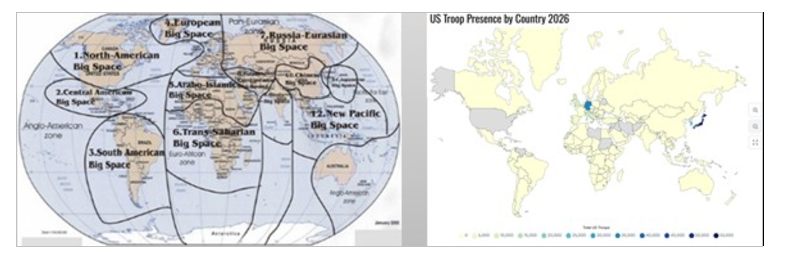
- The international system is becoming more and more defined by a competitive multipolarity in which the major actors compete in a struggle for power using nuclear posturing, alliances, and regional influence without engaging in direct conflict, as highlighted in the announcement by President Emmanuel Macron, that France plans to bolster its nuclear deterrent and deploy nuclear-capable aircraft to European allies. Regional instability is also a factor in the energy security debate, as highlighted in the Indian stance that its reserves and import diversification help to mitigate the importance of the Strait of Hormuz. This is changing the global transport corridors and areas of influence, which SEA GUARDIAN identifies as part of a new future international volatile world which will ensue due to this Geo-political shift pushing maritime criminality to disperse in new areas from the current “hot spots”.
- Geopolitical / Geo-economic Profile:

In this current environment, geo-strategic relations are increasingly influencing geo-economic relations. Recent events provide an example of this. Donald Trump announced that the United States were ready to provide insurance and even naval escort for vessels passing through the Strait of Hormuz, after disturbances caused by conflict with Iran, having significantly impacted maritime trade and global oil prices. At the same time, these events have also increased the demand for energy exports from Russia. Even if there is no permanent shift to the Geo-economic zones and reforming of alliances, there is a significant possibility of the zones being changed in the near future as aftermath of current tensions, conflicts, and wars due to the changes in Geo-strategic influence zones. All this geopolitical/strategic/economic pressure could influence the debts through the factor of energy, reducing the debt of the US and increasing the debt of other states that do not have crude oil production, but are just consumers. This is a major factor that influences the maritime transportation routes (see the above-mentioned charts).

- Global security is also becoming fragmented, with many countries focusing on their own interests rather than global security. This is having a direct impact on global maritime security, while the new forms of cyber and hybrid threats are also technologically and methodologically more advanced. SEA GUARDIAN has previously warned about the increasing influence of these new threats. The biggest issue in the globe is that, far from the tensions due to several states’ internal conflict, the hot spot of international commerce crime, there are two expanded interventions: Russia’s lasting about four years now, and the USA’s in Iran, which would last longer than the estimation at its beginning. Thus, the International Security order that will ensue is very controversial. SEA GUARDIAN advises shipping to receive consulting on processed information (intel) no just adding the information of incidents, inserting in their decision making, and take measures to mitigate international risks by its own market capacities.
Maritime Security profile:

- Maritime security is under threat from hybrid and cyberattacks. Non-state actors are employing advanced technologies, making it difficult to attribute criminal acts, while the presence of extensive war zones facilitates the use of hybrid weapons by undefined groups against shipping for unclear purposes. Shipping companies operating in the European maritime environment are vulnerable to piracy, cybercrime, and supply chain attacks due to the lack of military maritime support, as criminals can ascertain the origin of shipping companies, even if their vessels are registered under other flags. Cooperation in intelligence sharing, cyber defense, and mutual protection is essential. Without this, maritime trade remains a major target for criminal and cyber threats, whilst the maritime security framework is not independent of the global security situation.

The U.S.-Israeli war on Iran has pushed merchant shipping into a hybrid-threat environment where physical danger and cyber disruption can no longer be separated. Reuters reports attacks on civilian vessels, severe restrictions in the Strait of Hormuz, and major disruption to global trade and energy flows, while the IMO continues to stress that cyber risk management must be integrated into normal maritime safety and security processes. In practice, this means that shipowners and operators should no longer view cyber as a back-office IT issue, but as an operational risk that can amplify confusion, delay decisions and worsen the impact of conflict at sea.
- The key lesson is simple: in a conflict environment, trained personnel become the last reliable layer of cyber-defense. Crews and shore teams must be able to recognize suspicious anomalies in navigation, communications, port data, remote access or vendor systems, and know how to escalate early instead of dismissing them as “technical glitches.” Technology remains essential, but without realistic training, clear procedures and repeated drills, even good systems can fail under pressure. In today’s Gulf crisis, the real competitive advantage is not only stronger software, but better-prepared people.
Risk Snapshot
- Cyber-enabled disruption of maritime operations in conflict zones: HIGH
- Human-factor readiness of crews and shore teams: CRITICAL
THREAT ASSESSMENT UPDATE:
Military Operations
Libya – Central Mediterranean
- Libya is becoming more uncertain with the increasing political fragmentation, economic modernization, and maritime security challenges. The death of Saif al-Islam Gaddafi, an influential figure during the Gaddafi regime, is creating more challenges in the country’s political and electoral processes.
- In economic development, the Misrata Free Zone has introduced an integrated electronic system for port operations. The system is expected to help in the management of goods and the monitoring of container operations, documentation of damage, and workflow monitoring. The development is expected to help the country’s economic processes despite economic instability.
- In maritime and energy security, there are concerns in the region due to the sinking of a Russian liquefied natural gas carrier in the Mediterranean Sea within Libya’s search and rescue area, due to explosions and fires. The country is strategically important in monitoring maritime routes and energy logistics in the region.
- Overall threat/risk level: “MEDIUM” // Analyzed in: Military/Paramilitary/Terrorism: “MEDIUM” – ICC/Piracy: “NSR” (NO SIGNIFICANT REPORT) – Hijacking/Fired/Kidnapping: “MEDIUM” – GNSS interference: “LOW”.
- Triggers and risk indicators remain unaltered per area as initially cited in SEA GUARDIAN SECURITY ASSESSMENT 25/15, July 10 and SEA GUARDIAN SECURITY ASSESSMENT 25/17, August 13.
Syria (Middle East issue in East Mediterranean region)
- Syria’s transition remains fragile, marked by weak governance, sectarian tensions, and persistent militia threats.
- Security concerns have intensified following a series of foiled Islamic State (ISIS) assassination attempts targeting President Ahmad al-Sharaa and senior cabinet ministers. In response, foreign intelligence support, including involvement from the UK’s MI6 at Turkey’s request, has been mobilized to enhance presidential protection, highlighting the ongoing challenges of maintaining stability in the country.
- Overall threat/risk level: “MEDIUM” // Analyzed in: Military/Paramilitary/Terrorism: “HIGH” – ICC/Piracy: “NSR” – Hijacking/Fired/Kidnapping: “MEDIUM” – GNSS interference: “LOW”
- Triggers and risk indicators remain unaltered per area as initially cited in SEA GUARDIAN SECURITY ASSESSMENT 25/23, November 13.
Lebanon (Middle East issue in East Mediterranean region)
- Currently, Lebanon is experiencing serious security risks due to the tensions between Hezbollah and Israel. The Israeli government has carried out airstrikes against Hezbollah, but IDF have also attacked civilian sites such as hotels and residential houses in Lebanon. The situation has led to the displacement of many people and the deaths of hundreds. Attacks have been responded to by Hezbollah rocket attacks in northern Israel.
- The United States and Israel have carried on with their military attacks on Iran and its allies. The sites attacked include the Iranian leadership buildings and military sites. As a result of the attacks, Iran has responded by launching attacks on the United States and Israeli sites in the Middle East. The sites attacked include embassies, consulates, ports, and other strategic sites in the Gulf region.
- The current situation in Lebanon has serious implications for the region. Tensions have led to tensions in the Gulf region and the situation has affected the oil market, leading to calls for de-escalation in the region, a situation that may cause instability in the surrounding area.
- Overall threat/risk level: “HIGH” // Analyzed in: Military/Paramilitary/ Terrorism: “HIGH” – ICC/Piracy: “NSR” Hijacking/Fired/Kidnapping: “LOW” – GNSS interference: “MEDIUM”.
- Triggers and risks indicators remain unaltered per area as initially cited in SEA GUARDIAN SECURITY ASSESSMENT 25/23, November 13.
Gaza-Israel (Middle East issue in East Mediterranean region)
- The Gaza and Lebanon conflicts are keeping the region on tenterhooks, with high casualties, failed peace processes, and the sea routes under watchful eyes. The Chief of Staff of the Israel Defense Forces, Eyal Zamir, made an assessment at the Northern Command, accompanied by members of the General Staff Forum, and instructed the continued reinforcement and strengthening of the defenses along the border with Lebanon. While meeting the regional authorities in the north of the country, the Chief of Staff explained the operational situation and the ways the line of control is being deepened along the Lebanese border. Tensions remained high while Israel continued to hold in prison even children under the pretext of “administrative detention”.
- The region was put on high alert after Iran attacked the strategic port city of Haifa using missiles and drones targeting the refinery and other sensitive infrastructure. These strikes, which were carried out by the Islamic Revolutionary Guard Corps as part of Operation True Promise 4, were described as retaliation for Israeli strikes on oil facilities in Tehran and targeted Israeli and U.S. military assets in the region. It has to be reminded that Haifa port will be the end of the India-Middle East Corridor – IMEC project, an alternative trade route of the Red Sea and the Persian Gulf.
- The escalation to the energy sector indicates the rising threats to the region’s oil supplies and the overall economic security.
- Overall threat/risk level: “VERY HIGH” // Analyzed in: Military/Paramilitary/Terrorism: “VERY HIGH” – ICC/Piracy: “NSR” – Hijacking/Fired/Kidnapping: “VERY HIGH” – GNSS interference: “HIGH”.
- Triggers and risk indicators remain unaltered per area as initially cited in SEA GUARDIAN SECURITY ASSESSMENT 25/23, November 13.
- Sudan–Eritrea–Ethiopia
- The country is still volatile with drone attacks and sieges that are worsening the humanitarian crisis and affecting the security of ports, though there are signs of normalization with some commercial flights to Khartoum.
- Tensions in the region are not over, with Ethiopia facing fresh concerns over conflict in the Tigray region due to reports that the government is deploying troops in the north, while the Somali parliament has approved changes to the constitution that could extend president’s term and delay an election. All the above tensions push large populations to relocate again, far from the possible conflict areas.
- Cross-border military operations are escalating instability in the region, with Ugandan-supported airstrikes in South Sudan targeting civilian areas and worsening ethnic tensions and the risk of regional paramilitary operations.
- Overall threat/risk level: “MEDIUM” // Analyzed in: Military/Paramilitary/Terrorism: “HIGH” – ICC/Piracy: “NSR” – Hijacking/Fired/Kidnapping: “LOW” – GNSS interference: “LOW”.
- Triggers and risk indicators remain unaltered as cited in SEA GUARDIAN SECURITY ASSESSMENT 25/15, July 10.
- Red Sea – Yemen
- The Red Sea and the Horn of Africa are still unstable regions characterized by regional conflicts, Houthi threats, and humanitarian issues. The region is supposed to be effectively protected by international operations (Prosperity Guardian, Aspides etc.), but is still characterized as a war risk zone, generating threats to energy security, such as Pakistan need to seek alternative routes for oil supplies through Saudi Arabian Red Sea ports.
- Following the attacks by Israel and the US on Iran, the Arabic Peninsula is experiencing attacks in various Arab cities, including Yemen. The region of Yemen has been quiet, but the Houthi movement has the potential for phased attacks, projecting paramilitary threats in the Red Sea.
- Overall threat/risk level: “MEDIUM” // Analyzed in: Military/Paramilitary/Terrorism: “MEDIUM” – ICC/Piracy: “MEDIUM” – Hijacking/Fired/Kidnapping: “MEDIUM” – GNSS interference: “MEDIUM”.
- Triggers and risks indicators remain unaltered as in SEA GUARDIAN SECURITY ASSESSMENT 25/15, July 10.
- Northern Persian Gulf / Iran in war
- The northern Persian Gulf area has turned into a highly volatile zone due to the rising tensions between Iran, Israel, and the US, which effectively turned the Strait of Hormuz into a conflict zone. Iranian drone strikes were carried out against facilities related to Qatar Energy in the Mesaieed Industrial City and Ras Laffan area, which caused the world’s largest producer of liquefied natural gas to temporarily stop the production.
- Middle East states such as Kuwait, Bahrain, and the UAE are on high alert due to a series of Iranian missile and drone attacks, while air defense systems intercepted projectiles entering their airspace. US President Trump has shown support for a possible Kurdish offensive against Iran as part of a broader attempt to destabilize the country internally.
- Despite the rising tensions, Iraqi authorities claim that the country continues to export crude oil through the Strait of Hormuz with high-level coordination. The regional war escalated after the killing of Iran’s Supreme Leader Ali Khamenei during the U.S.-Israeli attack. The Islamic Revolutionary Guard Corps vowed revenge for the strike and launched large-scale attacks on Israeli and US military installations in the region.
- The Israeli Air Force has also attacked oil installations in Tehran, while casualties are rising in Iran, Lebanon, and Israel. AD Ports Group claims that its operations in the UAE are going on normally through crisis management procedures.
- Overall threat/risk level: “VERY HIGH” // Analyzed in: Military/Paramilitary/Terrorism: “VERY HIGH” – ICC/Piracy: “NSR” – Hijacking/Fired/Kidnapping: “VERY HIGH” – GNSS interference: “HIGH”.
- Triggers that could create escalation are: further Iranian missile and drone attacks against Arab Gulf countries, a prolonged blockage of Hormuz Straights and the will of the new Iranian leadership to declare Jihad. Potential acts of terrorism in the seas and ports cannot be ignored.
Russia – Ukraine War (Black Sea / NW part)
- The Black Sea remains high-risk due to the Ukraine-Russia conflict, hybrid and direct attacks on shipping, and stalled peace efforts.
- Ongoing military strikes and sanctions continue to threaten maritime operations and regional stability while Russia-Ukraine do not show any sign of being on the desk of negotiations for a peace agreement.
- The recent developments in the US-Iran war seem to cover the severity of this conflict, while in practice, Russia-Ukraine continue the latest trend of attacking energy infrastructure as well as harbor installations, which, of course, affect more Russians as the possible enhancement of oil exports is threatened.
- There are signs that Russia will try to use Georgia’s harbor and oil infrastructures to support its oil exports.
- Overall threat/risk level: “HIGH” // Analyzed in: Military/Paramilitary/Terrorism: “HIGH” – ICC/Piracy: “NSR” – Hijacking/Fired/Kidnapping: “HIGH” – GNSS interference: “HIGH”
- Triggers and indicators per area remain as in the SEA GUARDIAN SECURITY ASSESSMENT 25/20, September 30 and SEA GUARDIAN SECURITY ASSESSMENT 25/19, September 16 .
RUSSIA-UKRAINE war (Baltic Sea / NE part)
- The Baltic Sea remains high-risk due to NATO-Russia tensions, shadow fleet activity, and the ongoing Ukraine conflict. Incidents like the Baltic Spirit interception, highlight the threat to maritime security, with little expectation of de-escalation from NATO actions.
- It is expected that there will be an enhancement of grey/shadow fleet activities as the war in the Persian Gulf escalates and the potential rise of Russian oil exports addressed by market needs, is imminent through the Baltic Sea, which is assessed as less war-threatened than the Black Sea.
- Overall threat/risk level: “HIGH” // Analyzed in: Military/Paramilitary/Terrorism: “HIGH” – ICC/Piracy: “NSR” – Hijacking/Fired/Kidnapping: “MEDIUM” – GNSS interference: “HIGH”
- Triggers and indicators per area remain as in the SEA GUARDIAN SECURITY ASSESSMENT 25/20, September 30 and SEA GUARDIAN SECURITY ASSESSMENT 25/19, September 16 .
Terrorism – piracy, cargo theft, smuggling, stowaways, organized crime/drugs trafficking
- Aside from the traditional and ongoing security concerns of piracy, cyber-attacks, and smuggling, recent events have shown a rise in the level of aggressive operations against commercial vessels, especially in strategic areas of the world, as evidenced by the series of incidents in the Gulf and the Strait of Hormuz, where explosive-laden projectiles have attacked several commercial vessels as a result of the ongoing conflict in the region.
- Meanwhile, the ongoing issue of criminal activities, particularly of a prominent Uruguayan cartel, saw the arrest of the key figure of the group in Bolivia, as part of a coordinated effort by law enforcement agencies to deal with the ongoing issue of cocaine trafficking to Europe, which involves several South American countries.
- The above-mentioned, therefore, highlights the fact that the maritime world must deal not only with the ongoing issues of piracy and smuggling but also with the ongoing conflict and criminal activities, with the military/paramilitary actions mixed with International Commerce crime, generating a combination of security and safety threats/risks, which ought to be analyzed separately but simultaneously processed and mitigated.
- Risk Assessment update:
- Gulf of Guinea
- Security in the Gulf of Guinea remains tenuous due to ongoing piracy and criminal activities. Instability in Nigeria, as well as tensions in Equatorial Guinea and Guinea-Bissau, make the region susceptible to spillover effect that might contribute to criminal activities in the region. Connection between internal conflict and international crime induces the need to strengthen maritime security.
- Recent reports have shown that an attack by armed men on the village of Ngoshe in Nigeria’s Borno state has been carried out. According to the Nigerian senator, it is believed that “a massive” number of civilians were killed in the attack, although the exact number is still unknown. This indicates that the region remains vulnerable to attacks by insurgent groups.
- Overall threat/risk level: “HIGH” // Analyzed in: Military/Paramilitary/Terrorism: “HIGH” – ICC/Piracy: “HIGH” – Hijacking/Fired/Kidnapping: “HIGH” – GNSS interference: “VERY LOW”
- Military threat analysis for Gulf of Guinea states:
| Nigeria | Cameroon | Ghana | Congo | Ivory Coast |
| Very High | High | Medium | High | High |
- Indicators which altering the “risks levels” as in SEA GUARDIAN SECURITY ASSESSMENT 25/26, December 29, 2025.
East Mediterranean Sea
- The situation in the East Mediterranean and the Levant region remains unstable due to conflicts in Israel, Lebanon, Syria, and Gaza, rising tensions with groups such as Hezbollah. New alliances, such as the recently announced Israeli “Hexagon,” face opposition from Turkey.
- Conflicts in the region have put additional economic strain on Egypt. President Abdel Fattah al-Sisi has indicated that the country is on the brink of an economic emergency, threatening the political stability of the country and increasing migration flows towards South Europe.
- Overall threat/risk level: “MEDIUM” // Analyzed in: Military/Paramilitary/Terrorism: “MEDIUM” – ICC/Piracy: “NSR” – Hijacking/Fired/Kidnapping: “LOW” – GNSS interference: “LOW”.
- Indicators altering the “risks levels” as in SEA GUARDIAN SECURITY ASSESSMENT 25/22, November 12, 2025.
Suez Canal – Northern Red Sea
- Shipping activity in the Suez Canal is gradually returning to normal, but the confidence of shippers is still low, reflecting concerns about security threats in the region, including the Houthis’ potential threat.
- Major shipping companies like Maersk, CMA, CGM, and Mediterranean Shipping Company have halted operations and rerouted their cargo away from the Red Sea and Suez Canal, reflecting the deteriorating security situation in the Middle East, which is starting to affect trade flows to East Africa.
- Even if the Suez Canal itself seems to stay outside the war in the Arabian Peninsula so far, its proximity to Jordanian coasts could affect the security/safety levels, as the recent import of drone and anti-drone capabilities by Jordan gives an early sign of a possible escalation.
- Overall threat/risk level: “MEDIUM” // Analyzed in: Military/Paramilitary/Terrorism: “NSR” – ICC/Piracy: “NSR” – Hijacking/Fired/Kidnapping: “MEDIUM” – GNSS interference: “LOW”.
- Indicators altering the “risks levels” as initially cited in SEA GUARDIAN SECURITY ASSESSMENT 25/17, August 13.
Bab-el-Mandeb Straits – Southern Rea Sea
- The Bab el-Mandeb Strait and the South Red Sea remain high-risk due to Houthis’ threat and regional instability. International naval presence helps mitigate risks, but shipping should maintain heightened vigilance while Djibouti tries to maintain its superiority in the region against Somaliland.
- It is underlined that the existence of a significant number of fishing boats, especially late afternoon and early morning hours, is due to the yellow tuna fishing, creating conditions to covert piracy actions and para-military attacks with skiffs against shipping.
- Overall threat/risk level: “MEDIUM” // Analyzed in: Military/Paramilitary/Terrorism: “LOW” – ICC/Piracy: “MEDIUM” – Hijacking/Fired/Kidnapping: “MEDIUM” – GNSS interference: “LOW”.
- Indicators altering the “risks levels” as initially cited in SEA GUARDIAN SECURITY ASSESSMENT 25/17, August 13.
Gulf of Aden – Somalia / Somaliland
- The countries of Somalia and Somaliland are in a vulnerable state because of piracy, militancy, and the presence of foreign powers, which could flare up the situation at any moment. The current president of Somalia, Hassan Sheikh Mohamud, has expressed dissatisfaction over the recognition of Somaliland by Israel and the possibility of an Israeli base in the region, which could cause further instability in the region.
- The rise of piracy off the coast of Somalia, coupled with the Middle East tensions and the possibility of the Houthis getting involved, makes the region risky for vessels passing north or southbound. On the other hand, the political progress by the Somali Government in the form of approving constitutional reforms could positively affect maritime security.
- Overall threat/risk level: “MEDIUM” // Analyzed in: Military/Paramilitary/Terrorism: “MEDIUM” – ICC/Piracy: “HIGH” – Hijacking/Fired/Kidnapping: “HIGH” – GNSS interference: “LOW”
- Indicators altering the “risks levels” as initially cited in SEA GUARDIAN SECURITY ASSESSMENT 25/17, August 13.
Arabian Sea – Gulf of Oman
- The maritime security of the Arabian Sea, Gulf of Oman, and western Indian Ocean is at a moderate risk of terrorism and regional tensions. Oman has been playing a significant mediation role in the indirect negotiations between Iran and the US.
- The drone attacks on the US Embassy in Riyadh and the fuel tank in Oman’s port of Duqm are retaliatory actions against the US-Israeli operations.
- Overall threat/risk level: “HIGH” // Analyzed in: Military/Paramilitary/Terrorism: “HIGH” – ICC/Piracy: “LOW” – Hijacking/Fired/Kidnapping: “LOW” – GNSS interference: “HIGH”.
- Indicators altering the “risks levels” as initially cited in SEA GUARDIAN SECURITY ASSESSMENT 25/17, August 13.
Hormuz Straits – Persian Gulf
- Strait of Hormuz: The Strait of Hormuz is no longer navigable due to the conflict between Iran and USA. The conflict is extremely dangerous for ships passing through the Strait, as they are likely to be attacked with shore-based missile strikes and hybrid warfare. The insurance for the passage is suspended, but emergency measures have been put in place to avoid any financial risk, while the announcement of the US Navy to escort merchant vessels through the straits was set back.
- Impact: The closure of the Strait of Hormuz is severely impacting the tankers, LNG carriers and container shipping industry. It is critical to plan rerouting strategies to avoid such situations in the future. Navigation is extremely dangerous for ships passing through the Strait.
- Overall threat/risk level: “VERY HIGH” // Analyzed in: Military/Paramilitary/Terrorism: “VERY HIGH” – ICC/Piracy: “NSR” – Hijacking/Fired/Kidnapping: “VERY HIGH” – GNSS interference: “HIGH”.
- Indicators altering the “risks levels” HAS BEEN LEFT INTENTIONALLY BLANK DUE TO WAR CONDITIONS and unpredictable actions by all involved parties.
- Malacca Straits
- Rosatom has reaffirmed its offer to help Indonesia develop nuclear energy, with the country seeking to diversify its energy mix and reduce its reliance on coal. Indonesia aims to develop 500 MW of nuclear energy, but its development will depend on the creation of a national regulatory watchdog.
- Russian President has encouraged his Indonesian counterpart, to develop a potential partnership with Rosatom. Assessment: Although nuclear energy has the potential to enhance long-term energy security, regulatory and geopolitical challenges are significant obstacles.
- SEA GUARDIAN assesses that in the next mid-term future, the area and the Malacca Strait will be under new pressure in addition to the usual international commercial crime trends, even if Singapore’s strait control authorities have recently intensified measures for navigational safety and security protection.
- Overall threat/risk level: “MEDIUM” // Analyzed in: Military/Paramilitary/Terrorism: “NSR” – ICC/Piracy: “HIGH” – Hijacking/Fired/Kidnapping: “MEDIUM” – GNSS interference: “MEDIUM”
- Indicators altering the “risks levels” as cited in SEA GUARDIAN SECURITY ASSESSMENT 25/20, September 30.
- Black Sea / East Part
- The Black Sea region is still considered a high-risk maritime environment due to the ongoing conflict between Russia and Ukraine, related sanctions and shadow fleet activities. Trade initiatives between Kazakhstan and Pakistan, backed by China intended to ensure trade activities within the region are not disrupted. However, security risks are still high in the region.
- Additionally, authorities in Azerbaijan announced that they had foiled planned terrorist and sabotage activities carried out by the Islamic Revolutionary Guard Corps targeting critical infrastructure such as the Baku-Tbilisi-Ceyhan oil pipeline and the Israeli embassy in Azerbaijan.
- SEA GUARDIAN warns that these developments underscore persistent regional instability and potential risks to energy infrastructure and trade corridors.
- Overall threat/risk level: “MEDIUM” // Analyzed in: Military/Paramilitary/Terrorism: “MEDIUM” – ICC/Piracy: “NSR” – Hijacking/Fired/Kidnapping: “LOW” – GNSS interference: “MEDIUM”.
- Indicators altering the “risks levels” as initially cited in SEA GUARDIAN SECURITY ASSESSMENT 25/18, August 27.
Baltic Sea / West part
- The Baltic Sea remains a high-risk area due to GNSS interference, hybrid threats, and Russian shadow fleet activities. NATO’s Task Force X Baltic is working on surveillance, intelligence, and naval force development to counter these challenges. Amidst these tensions and conflicts between Russia and NATO countries, several incidents involving Russian-linked vessels have been reported.
- The seizure of the oil tanker Ethera by Belgian authorities and the capture of the cargo ship Caffa’s captain by Swedish authorities demonstrate an intense effort from more than one Baltic country to control the grey/shadow fleet. The arrest of Caffa’s captain was carried out during the operation “Operation Black Coffee” off the coast of the town of Trelleborg. The captain is charged with using false documents and violating the Swedish Maritime Act and the Ship Safety Act.
- These actions highlight the efforts of European authorities to secure transportation routes and resources in the strategically important Baltic Sea, while, on the other hand, Russia supports its oil exports using any means independent of the international order.
- Overall threat/risk level: “MEDIUM” // Analyzed in: Military/Paramilitary/Terrorism: “NSR” – ICC/Piracy: “NSR” – Hijacking/Fired/Kidnapping: “LOW” – GNSS interference: “HIGH”.
- Indicators altering the “risks levels” as cited in SEA GUARDIAN SECURITY ASSESSMENT 25/20, September 30.
Taiwan – Japan Sea
- The coalition is consolidating power in Japan and the region, increasing military spending, and strengthening ties with Taiwan. These moves are increasing tensions with China.
- Disruptions in Qatar’s LNG production due to Iranian attacks are not a worry. Qatar contributes a tiny fraction of Japan’s total imports while energy security is not a problem for the country.
- Temporary energy disruptions can be easily covered through the spot market or the inter-utility exchange. There are no plans to release oil reserves, despite delays in shipments to Japan.
- Overall threat/risk level: “LOW” // Analyzed in: Military/Paramilitary/Terrorism: “LOW” – ICC/Piracy: “NSR” – Hijacking/Fired/Kidnapping: “LOW” – GNSS interference: “MEDIUM”.
- Indicators that distort the “risk levels” as in SEA GUARDIAN SECURITY ASSESSMENT 25/21, October 16.
Taiwan – South China Sea
- The South China Sea and Taiwan Strait are still considered high-risk areas due to Chinese military activities and cyber threats against navigation systems. Consequently, vessels in these areas have to reinforce their security and safety defense resilience.
- In the Philippines, the Army’s 58th Artillery Command conducted a UAV training course for its drone battalion. Under the supervision of senior officials who were certified by the Army Drone Training Center, the troops were able to hone their basic flight skills and procedures, including throttle management, attitude adjustment, and directional navigation.
- SEA GUARDIAN assesses that the widening use of hybrid means for military purposes could create an environment of hybrid threats in the mid-term future.
- Overall threat/risk level: “MEDIUM” // Analyzed in: Military / Paramilitary/ Terrorism: “LOW” – ICC/Piracy: “HIGH” – Hijacking/Fired/ Kidnapping: “HIGH” – GNSS interference: “LOW”.
- Indicators that distort the “risk levels” in SEA GUARDIAN SECURITY ASSESSMENT 25/21, October 16.
South America / NE part – VENEZUELA
- Venezuela is still in a state of political instability following the arrest of the previous President, Nicolás Maduro, and the promotion of Delcy Rodríguez. The United States, on the other hand, has re-established diplomatic relations with Venezuela and is focusing on cooperation within the oil and mining industries.
- The United States has given a limited license for Venezuela’s state-owned mining company, Minerven, to export and sell gold, but with certain restrictions, such as no dealings with Cuba, North Korea, Iran, and Russia, and the money has to be routed through Treasury accounts.
- These are all part of a strategy for Venezuela’s economic recovery while keeping a watchful eye and abiding by international sanctions, as it tries to revive its oil and mineral industries, while in a state of political instability, with the interim government proceeding to substitute high officials appointed close to the previous president, Maduro.
- Overall threat/risk level: “MEDIUM” // Analyzed in: Military / Paramilitary/ Terrorism: “MEDIUM” – ICC/Piracy: “VERY LOW” – Hijacking/Fired/ Kidnapping: “LOW” – GNSS interference: “MEDIUM”.
- Indicators that signal the escalation or de-escalation of threats/risks are: the transition of leadership from an interim government to an elected government, the resettlement of diplomatic procedures between the US and Venezuela, the control of natural resources (oil, mines), the adaptation of a peace trend by the Venezuelan people, the diminishing of human trafficking, and the organized crime in ports.
South America / NW part – PANAMA
- The Panama Canal is still at risk from opportunistic maritime crime, including theft and smuggling, and organized crime is still taking advantage of trafficking routes, with migration in the Darien Gap still posing a risk.
- However, Panama is currently seeking further international support for the Permanent Neutrality Treaty for the Canal, with several countries invited to adhere to its protocol. This is in line with the fact that it reinforces global trade guarantees, international law, and Panama’s reputation for stability and security.
- CK Hutchison’s Panama Ports Company is pursuing at least US $2 billion in damages following a Panamanian court’s ruling that its contract is unconstitutional. Panama has missed the arbitration response deadline; it appears that they have raised obstacles in the usual order of passing through the canal. The dispute highlights the legal and operational risks faced by foreign investors in strategic infrastructure.
- Overall threat/risk level: “MEDIUM” // Analyzed in: Military / Paramilitary/ Terrorism: “MEDIUM” – ICC/Piracy: “HIGH” – Hijacking/Fired/ Kidnapping: “NSR” – GNSS interference: “LOW”.
- Indicators that signal the escalation or de-escalation of threats/risks are: the indices of smuggling incidents against shipping, the political stability in Panama, as well as the further internationalism of the passage, the Colombian organized crime actions, the control of human trafficking, and the organized crime on the Panama Pacific approaches.
Piracy – Boarding conditions, kidnapping, firing, electronic harassment
- The maritime environment is facing with an array of complex risk factors that include piracy, armed conflict, and the criminalization of migration routes, such as the Darien Gap.
- The increase migrants’ numbers using multiple routes that shipping frequently uses and the lack of effective management of the sea and land routes, have created an environment where illegal immigration is likely to be linked to crime and piracy.
- This situation generates a compounded environment of navigational and security risk in conflict and post-conflict era that needs to be considered as an integrated threat. Thus, maritime industry must shift to face up these challenges, taking into consideration equally security and navigational safety hazards, in relation to the threats/risks that each region represents for every port-to-port call.
Overall Assessment – Consulting
Diplomatic tensions are rising as the conflict between Iran, Israel, and the USA is escalating with retaliatory strikes and security alerts across the Gulf countries. In Europe, Emmanuel Macron announced that France will strengthen its nuclear deterrence capability and the strategic defense cooperation with European countries and NATO. In a widen context, the politics and instability in Sudan, Ethiopia, South Sudan, constitutional reform in Somalia as well as Somaliland as a new state entity, remain relevant.
Instability is expanding as escalation in the Middle East is affecting global energy markets and maritime trade, especially in the Strait of Hormuz, an important energy corridor for oil and LNG trade and the south Red Sea / Horn of Africa. The rise in demand for Russian energy exports is a consequence of changing supply patterns, whereas in the case of India, the government is relying on strategic reserves in the face of possible disruptions in energy supplies. Maritime risks have been heightened after the sinking of a Russian LNG vessel in the Mediterranean Sea and the latest strikes in the Black Sea.
Trade suffers from the highest pressure due to restrictions on maritime, air, and road shipping routes.
Maritime trade suffers due to more shipping routes being dismantled, especially at key chokepoints such as the Strait of Hormuz. While costs have already increased more due to higher insurance, security measures, and fuel costs, the possibility of trade being interrupted is rising. Safety risks are associated with accidents and incidents, such as sunken vessels, which may come from military attacks, security violations, or navigational hazards. Overall, trade is slower, costlier, and riskier, particularly for energy shipments and strategic routes, while container shipping started to be influenced more. The most important concern isn’t the war itself but the possibility of its expansion.
Overall assessment: International trade and maritime system operate in a high-risk and volatile environment that requires continuous monitoring, diversified supply routes, and strengthened maritime security measures.
Overall consulting: Decision-making should incorporate dynamic voyage risk assessments, scenario planning, and real-time intelligence on security threats, navigational risks, and port conditions. Companies should strengthen route flexibility, emergency response planning, crew safety, and cybersecurity protection of vessels and maritime assets. With the integration of real-time intelligence monitoring, route flexibility, and safety measures, maritime companies can become more resilient for decision-makers in order to minimize their vulnerability to security threats, maritime accidents, and supply chain risks.
ANNEX “A”
to Periodic “Security Assessment”

Sea Guardian S.G. Ltd / Intel Department (www.sguardian.com / (+30) 694 437 3465)
can support your operational planning, assist in determining the risk assessment and aid in decision making by producing tailor-made assessments upon request on ports in the region, on routes, on cargos and specific merchant vessels. You can refer to our previous Threat & Risk assessment analysis briefs for more information and background analysis on the events and situation for each specific region.
ANNEX “B”
to Periodic “Security Assessment”
| LESSONS LEARNED | ||
| INCIDENTS | REACTIONS | TRANSFORMATION NOTICES |
| The attacks on July 2025 in RED SEA | Permanent contact with the shipping company as well the maritime security company that hires security teams. | Developing independent international relations and operational apps for supporting crew recovery after submerging. |
| The defensive actions against the attack on ETERNITY C | The Security management and team’s high standards in decision-making processes in an international environment, respecting the ship’s Captains’ capacity. | Developing of training standards. |
| The attacks on July 2025 in RED SEA | The active contingency plans and business impact analysis in case of discontinuation with the security guarding teams (such as an attack difficult to face with small arms). | Further implementation of maritime/ISO standards. |
| The aftermaths analysis of the ETERNITY C submersion | The possible change in Houthis’ attacking methods not only to destroy but also to seize vessels under their internal coast guard rules for ransoms in the form of penalty fees to liberate them. | Specifying and bordering threats/risks analysis for defining when a military response is demanded. |
| Inbound in an area of high military / paramili- tary threats with all navigational aids and AIS closed | Operate all the navigational aids and AIS/communication systems after having been attacked by ballistic or related missiles, when visual targeting was available due to the lack of international naval forces. | Stabilize the closed navigational aids to prevent targeting towards the necessity of giving information through them to friendly entities. |
| The detailed analysis after a special interview of security crew assessing decision-made | A fundamental decision involves choosing whether to abandon a sinking vessel using a lifeboat for safety, or to escape directly into the sea with only life jackets, while under the threat of attacking skiffs searching for survivors. | Balance the threat while abandoning the ship at sea with the threat of environmental and geographical conditions for survival. |
| The re-emergence of piracy in the Gulf of Aden-Horn of Africa and Somalia | From the latest incidents in the area, it was proven that the existence of Maritime security teams is of paramount importance, as well as the existence of International Maritime operations in the area. | The overall security umbrella is achieved if: – A consistent/ coherent Security assessment has been done in advance – International Maritime operations in the region exist – The use of Security teams onboard for a wider area is available. |
Usefull links for conflict indexes and picture of piracy attacks in:
- ACLED and IMB/ICC for the war threat levels and International commerce crime incidents.
- Companies under sanction by Ukraine (Black Sea):Database Of Legal Entities Under Sanctions
- https://www.youtube.com/watch?v=Pt6GS7QohAI, for an overall general assessment by the SEA GUARDIAN President presented at Naftemboriki TV (Shipping) for the latest period, covering the time-frame before and after the Houthis ballistic, drones and UCAV attacks.
Sea Guardian S.G. Ltd / Intel Department (www.sguardian.com / +30 6944373465) can support your operational planning, assist in determining the risk assessment and aid in decision making by producing tailor-made assessments upon request on ports in the region, on routes, on cargos and specific merchant vessels. You can refer to our previous Threat & Risk assessment analysis briefs for more information and background analysis on the events and situation for each specific region.
Viewers can see here below the previous report and connect same with today’s (above):
Data Control & Report system (DaCoR) / Maritime Security Dashboard
DaCoR system visualize this report and covers the period between two successive 15-day cycle Security Assessment with near-real time data and reporting capabilities

| Contact us for a trial or fix an appointment: | or book a “google meet” appointment through the following global calendar: |
| E-mail: intelsec@sguardian.com CY:+35725351125|GR:+302109703322 info@sguardian.com | www.sguardian.com Sea Guardian SG Ltd Intel & Security | https://calendar.app.google/LmPSoo5fDxZMVq357 |
Future Outlook
Looking Ahead,
SEA GUARDIAN is committed to further enhancing the digital capabilities and expanding service offerings. The focus is on leveraging data analytics to drive personalized customer experiences and exploring new market opportunities. There is confidence that our strategic initiatives will support our partners for sustained growth and successful decision making. DaCoR digitalizes the maritime security environment in harmonization with new equipment, training updates, and synergies with the cyber sector, in order to provide a compound physical and digital security environment with supplementary function to the available networking systems of control, intelligence, and report sea situational awareness.
Partners (shipping companies) willing to experience the DaCoR system for a 10 day trial should communicate with SEA GUARDIAN for getting a free of charge user name and password.
Copyright and Confidentiality
This document has been generated by processed information (intel) which in-house SEA GUARDIAN database and algorithms produces in near-real time with SEA GUARDIAN R&I team mankind staffing-work and it is a service to clients with SEA GUARDIAN maintaining the intellectual property provided as service for specific client and reasons, prohibited to be distributed outside the frame of its company without a written consent of SEA GUARDIAN in accordance with GDPR rules.
Viewers can log here below and see/read hte previous report for connection an dfamiliarisation pirposes:
